Switzerland and the UK are relegated to sidelines of European research framework program
DOI: 10.1063/PT.3.5037

For the UK science community, participating in the research and innovation framework program of the European Union (EU) “may hang on how much fish France gets out of the English Channel,” quips Vladimir Fal’ko, a condensed-matter theorist at the University of Manchester. “In Europe, things become political very quickly.”
Political impasses have landed both the UK and Switzerland on the sidelines of Horizon Europe, the current €95.5 billion ($102 billion) framework program, which runs from 2021 through 2027. Negotiations between the UK and the European Commission (EC), the EU’s executive body, have stalled over the Northern Ireland Protocol, which aims to satisfy the need for an open border for divided Ireland while also enforcing that border as a separation between the EU, to which the Republic of Ireland belongs, and the UK, of which Northern Ireland is a part. (See “Northern Ireland physicists face a unique post-Brexit situation ” by Sarah Wild, Physics Today online, 3 May 2022.)
And in June 2021, the EC refused to negotiate with Switzerland—which has never joined the EU—about its association with Horizon Europe after that country pulled out of talks on bundling a bunch of bilateral agreements into one overarching agreement. The individual agreements span such issues as trade, agriculture, and access to social welfare and residency rights for EU citizens.

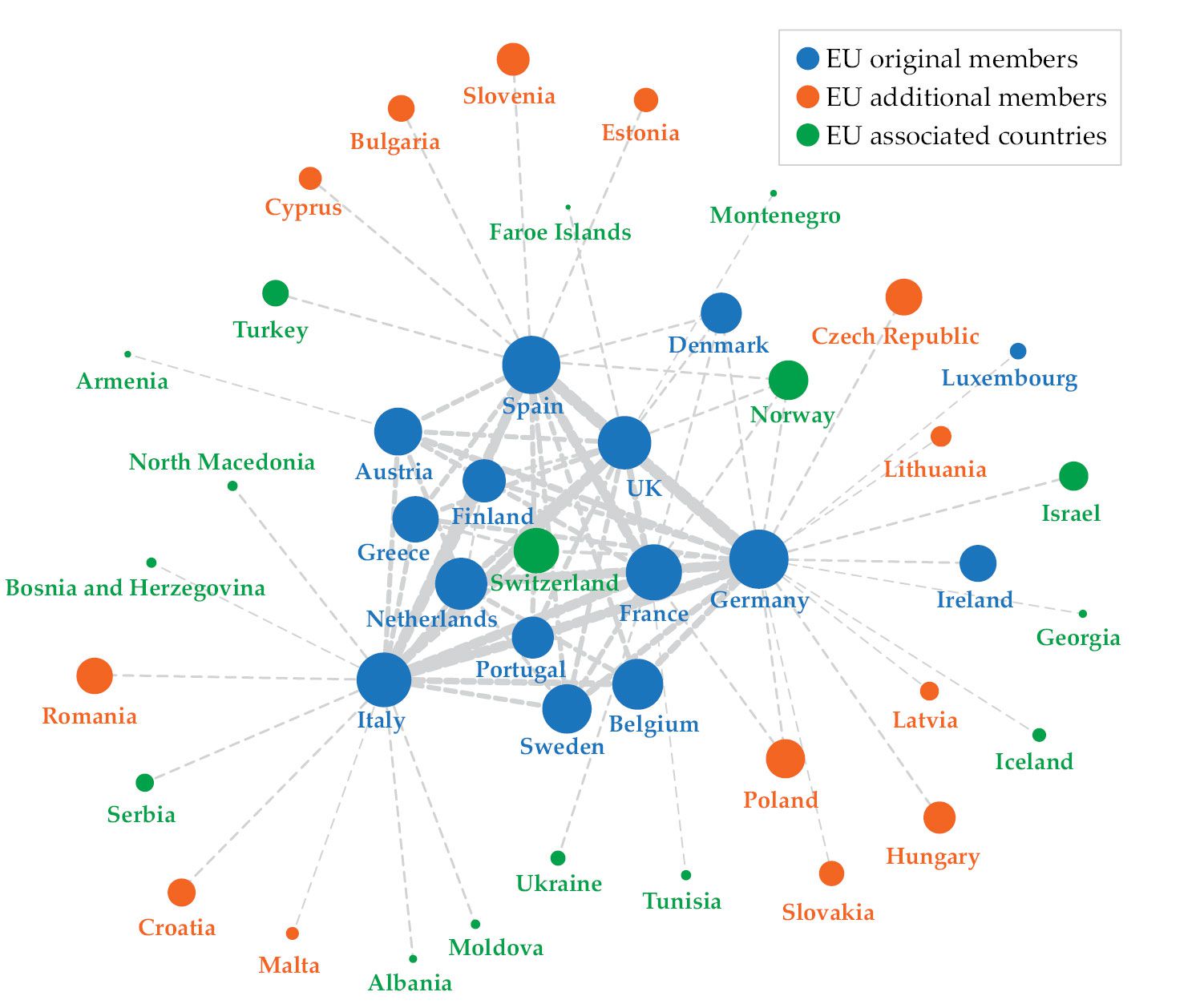
Links among participating countries are fostered by the European research and innovation framework program. Shown here is an overview of the strongest connections in Horizon 2020, the framework from 2014–20, based on 7500 collaborative projects in 2014–17. There were 28 European Union countries until the UK pulled out. Node size is representative of a country’s participation in the framework program and the link thickness represents the number of collaborations. (Courtesy of the European Commission, Directorate-General for Research and Innovation.)
Scientists in the UK and Switzerland are dismayed to find themselves barred from full participation in Horizon Europe. They see the two countries’ situations as intertwined, although the political contexts differ. The EU’s hard line with Switzerland is interpreted by many as a signal to other countries in reaction to Brexit: Those who leave the EU don’t get to pick and choose agreements with Europe à la carte.
The exclusion of Switzerland and the UK from Horizon Europe is bad for member states, too, says Robert-Jan Smits, president of Eindhoven University of Technology in the Netherlands. Previously at the EC, Smits ran the earlier EU framework program, Horizon 2020. “Without association, the possibilities for cooperating in easy and flexible ways are not there anymore. That is a blow for the fabric of cooperation that we have established over the years.”
Cooperation and competition
Member and associated countries pay into the EU science and innovation framework according to their GDP, and grants are awarded competitively by the EC. The framework program includes postdoctoral fellowships, doctoral mobility opportunities, individual career grants, cross-border collaborations between industry and academia, and multinational collaborations.
Horizon Europe has five mission areas with goals set for 2030: adaptation to climate change, including societal transformation; cancer research, prevention, and treatment; healthy oceans, seas, and coastal and inland waters; climate-neutral and smart cities; and soil health and food. Examples of goals in those areas are cleaning marine and fresh waters, supporting the transformation of 100 cities toward climate neutrality, and achieving healthy soils across at least three-quarters of the EU. The current framework will continue the 10-year, €1 billion Quantum Technologies Flagship from Horizon 2020, but it is not launching new efforts in the same form.
All 27 EU member states and a dozen associated countries participate in the framework program. The associated countries include Israel, Norway, Turkey, and, until last year, Switzerland. Funded proposals from Israel, Switzerland, and the UK have often exceeded the monetary value of those countries’ contributions.
New rules for the Horizon Europe framework program limit countries to getting out only as much money as they put in. But money is not the main benefit of participating, scientists say. Rather, the framework stimulates international collaborations, raises the level of competition, addresses global challenges, and strengthens science in Europe. Still, Smits notes the irony of top-performing countries consigned to the wings just when the EC is negotiating to admit far-flung countries into the framework program. Discussions are most advanced with Canada and New Zealand, he says. Australia, Japan, and South Korea are also interested.
No longer leaders
Scientists in nonassociated countries can participate in more than half of Horizon Europe offerings. But individual grants are off limits, so researchers who want to go to Switzerland or the UK have lost access to the exchange programs. A suite of research grants spanning all career levels is also off the table for those countries. Most multinational projects are open, except in areas the EC deems strategic, such as quantum information and new space-propulsion systems.
The number of nonmember participants is often limited, sometimes to just one, notes Joël Mesot, president of ETH Zürich. “If someone else is already in, that’s it.” As nonmember participants in the framework program, researchers in Switzerland and the UK “have no rights to define projects,” he continues. “We can’t be the leader, and partners don’t have to invite us to the table. It’s a real problem.”
Mesot notes that in 2014, Switzerland was excluded from the previous research and innovation framework program. The country was reinstated after more than two years. “We lost 30% of participation in collaborative projects,” he says. Now, he continues, doubts over whether Switzerland will rejoin Horizon Europe mean “we are seen as unreliable partners, which is difficult for research consortia. It’s a time of uncertainty for us and our partners.”

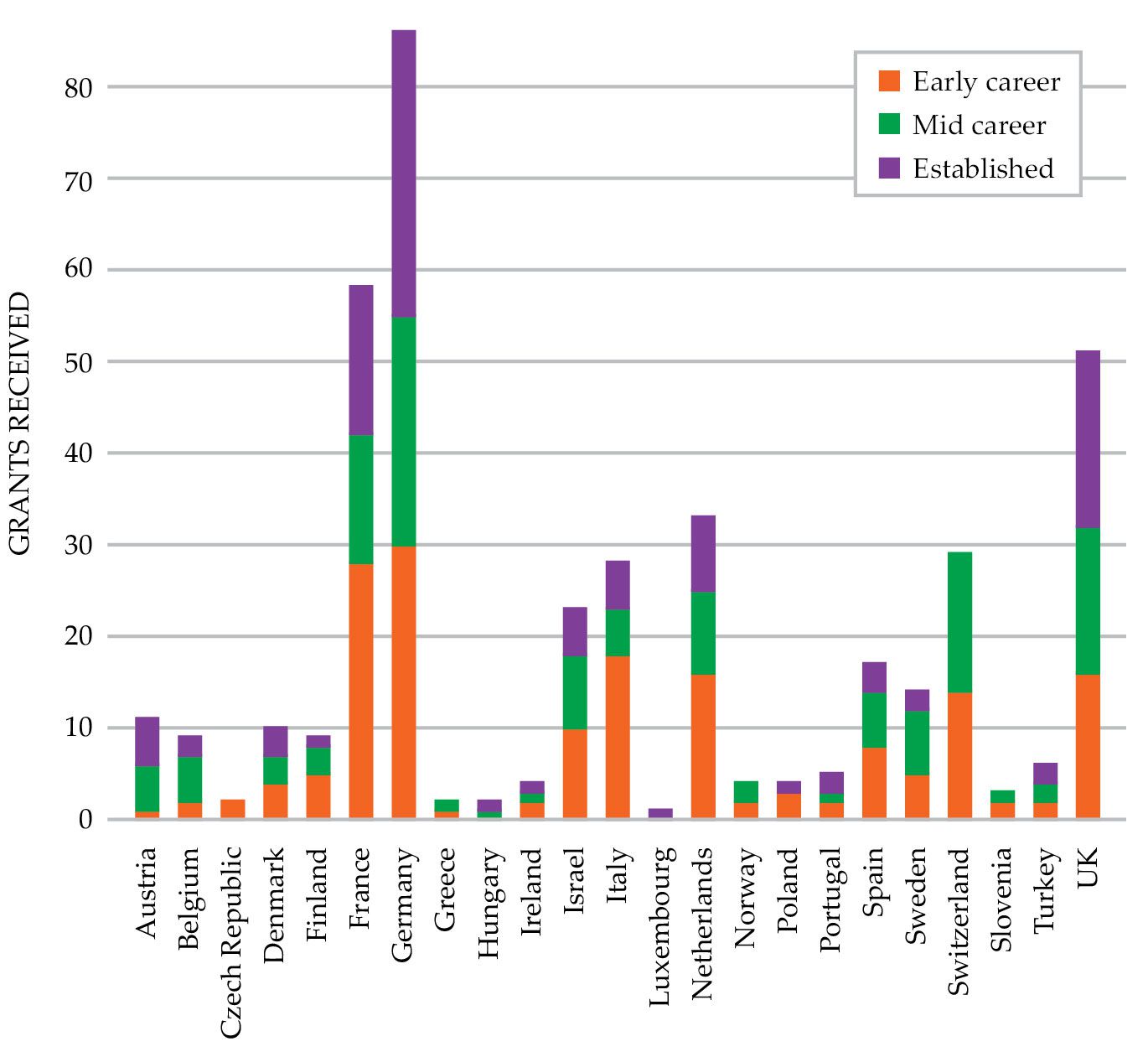
Nearly 20% of awards to individual researchers in the physical sciences and engineering in the 2021 call by the European Research Council went to researchers in the UK and Switzerland; the same was true across the life and social sciences and humanities. The successful applicants in those countries won’t be funded by the ERC, though, because they are not currently associated with the Horizon Europe research and innovation framework program. (Compiled using data from the European Research Council.)

“It’s a disaster for collaborative projects,” says Jean-Philippe Brantut, a tenure-track professor in the Laboratory for Quantum Gases at EPFL, the Swiss Federal Institute of Technology in Lausanne. “I have been contacted about joining international networks and had to say it won’t work.” The landscape in quantum technology moves quickly, he adds. “Because the field is growing, it’s important to be there. Once a network has crystallized, if you are out, you are out.”
Manchester’s Fal’ko, who works on two-dimensional materials and played a significant role in the Graphene Flagship (see Physics Today, August 2021, page 20 ), says that after a while European colleagues “will see no benefit in working with [UK scientists] if we can’t join their networks.” If the UK doesn’t participate in Horizon Europe, the best groups in the country will “automatically be damaged,” he says. “It’s not necessarily possible to find equally world-leading competencies in the UK to compensate for potentially broken links, as the strongest groups already have plans and commitments for the foreseeable future.”
Compensation and confusion
For some researchers, the loss of access to prestigious European Research Council (ERC) grants for individuals represents the biggest hit. Both Switzerland and the UK were anticipated to be associated partners during the first call for proposals in Horizon Europe. By the time grantees were announced earlier this year, however, negotiations with Switzerland were stopped and those with the UK were dragging. Their downgraded status means researchers in those countries can’t claim the awards—which came to nearly 20% of the total (see graph, page 26). Institutions in EU countries wooed many of them.
Both the Swiss and UK governments say they will compensate for the opportunities lost by ineligibility to participate in Horizon Europe. That includes stepping in to fund applicants who were awarded ERC grants in the first call. Switzerland is launching its own quantum initiative—to parallel the Horizon 2020 Quantum Technologies Flagship. And the government is offering to cover any ERC grant recipients from other countries who move to Switzerland and thereby lose their ERC funds. The UK is considering similar measures.
“Funding is easy to fix,” says Brantut, whose ERC application last year was successful. “My colleagues who were not successful will now have the option to apply in Switzerland.” But because the pool of applicants will be smaller, he says, the parallel grant “will not be nearly the career maker as an ERC grant.” The domestic stand-in programs “can’t replace the prestige,” he adds.
“We are putting considerable effort to supporting researchers and to helping them navigate the red tape,” says Jonathan Lamprecht, a scientific adviser for EU framework programs at the State Secretariat for Education, Research, and Innovation in Bern, Switzerland. “Some researchers don’t realize they are able to participate in Horizon Europe.” Lamprecht’s colleague Brita Bamert stresses that “Switzerland’s goal is to reenter Horizon Europe as soon as possible.”
Researchers in the UK and Switzerland fear that exclusion from the European framework programs will degrade their communities. With fewer funding options, the system becomes more insular and less competitive, says Alberto Morpurgo, a University of Geneva experimentalist who works with graphene and other 2D materials. Fal’ko agrees: “I am afraid of the isolation. Access to fewer funding sources will also undermine our attractiveness to outside talent. And people who are mobile can and will move to Europe and continue their careers there.”
“There’s no benefit to the EU to cut ties with two of the communities with the best traditions in science and industry,” says Didier Queloz, codiscoverer of the first exoplanet, who splits his time between the University of Cambridge and ETH Zürich. As an example, he notes that Europe aims to excel in artificial intelligence and quantum computing. “But it can’t push if the best players are not playing leading roles—and the best people in AI and quantum computing are in the UK and Switzerland,” he says. “By cutting ties, they remove horses from the carriage.”
Stick to Science
On 8 February 2022, science leaders in Switzerland and the UK launched Stick to Science, an initiative that calls on politicians to disentangle science and politics—and to let their countries rejoin Horizon Europe independent of solving the broader disputes between them and the EU. More than 5500 individuals and 270 organizations across Europe have endorsed the initiative. “The signatories believe that collaboration in science, research and innovation in Europe is more important than ever as we face some of the world’s greatest challenges,” the Stick to Science website says. “Europe’s position in the world would be stronger with robust research collaborations that contribute to a prosperous European research and innovation landscape.”
It’s important for politicians to hear the Stick to Science message, says Antoine Petit, chairman and CEO of the CNRS, and an early signatory. Cooperation between researchers in the UK and Switzerland with colleagues in EU member states will continue either way, he says. But without affiliation in Horizon Europe, institutions in the UK and Switzerland will likely put their efforts into scientific cooperations outside of Europe.
“You should not change a winning system,” says Otmar Wiestler, president of the Helmholtz Association, Germany’s largest network of research centers. The conflict in Ukraine could be an argument to separate R&D from the overarching negotiations between the EU and the UK and Switzerland, Wiestler says. The war will force Europe to reconsider economic issues, military readiness, energy, and international relations, he explains. “It’s not the time for Europe to splinter more. We need to pull together.”
More about the authors
Toni Feder, tfeder@aip.org