Data reanalysis throws existence of an ocean on Titan into question

Figure 1.

These detailed photos of Saturn’s moon Titan were created from data collected by the Cassini probe, which started observing the moon in the early 2000s.
(Photos by NASA/JPL-Caltech/University of Nantes/University of Arizona.)
Saturn’s largest moon, Titan, boasts mountains carved from ice and meandering rivers filled with liquid ethane and methane. During its visit to the Saturn system between 2004 and 2017, the Cassini spacecraft collected not only that data (see figure 1 ) but also other information that many researchers interpreted as evidence for a buried global ocean. As Titan orbits Saturn, the moon is stretched in a process called tidal flexing, which is the result of the planet’s strong gravitational field and the moon’s changing distance from its host. Researchers analyzed the Doppler shifts in Cassini’s radio signals from when the probe orbited the moon and concluded that the push and pull that Titan experiences is possible only if the moon has a liquid interior, as opposed to an inflexible solid one. That conclusion put Titan in good company with other suspected ocean moons, like Jupiter’s satellite Europa, and supported the idea that oceans on icy moons may be common.
But not all the Titan data fit that picture. The push and pull on Titan from Saturn’s gravitational field can be quantified by the tidal Love number. Some analyses of the data have found that number to have high values, which would support a global ocean; others have found low values. None of the analyses could isolate an imaginary component of the Love number that describes the shear energy dissipation in Titan’s interior. Flavio Petricca and colleagues at NASA’s Jet Propulsion Laboratory and other institutions in the US and Europe set out to conclusively measure Titan’s Love number by reanalyzing Cassini’s data with modern data-processing techniques, including phase-averaging algorithms that had been used to remove noise from Mars’s rotation data collected by NASA’s InSight lander.
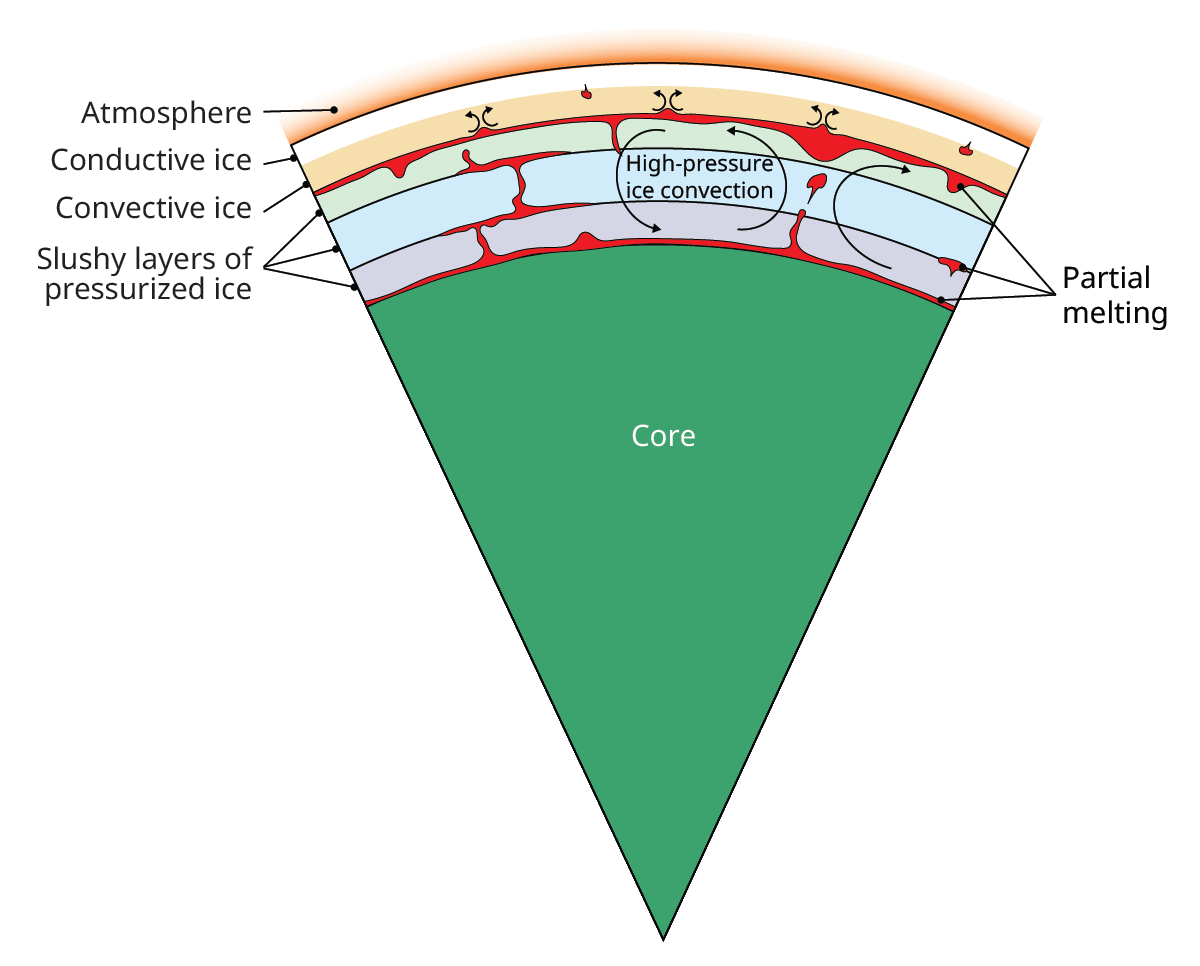
Petricca and colleagues found that the data supported a large Love number. But they also showed a value for the moon’s shear energy dissipation that was much larger than they would expect for a body with a liquid ocean. 1 After refining a model, the researchers inferred that what’s under Titan’s more than 150-km-thick ice shell is not an ocean but rather a churning, slushy mix of hydrated rock, semi-melted ice, and pockets of meltwater, as shown in figure 2 . The convection of heat generated by tidal flexing circulates pockets of meltwater and potentially moves materials like silicates or even organics to the moon’s surface. Although Titan may lack a global ocean, the volume of all the liquid water trapped in the ice could be equivalent in volume to the Atlantic Ocean. The researchers say a slushy environment may be better for the prospect of life than a global ocean.
Figure 2.

According to a new model, Titan’s interior has a rocky core topped with layers of high-pressure ice and slush, which allow the moon to dissipate energy and withstand Saturn’s strong tidal forces.
(Image adapted from ref. 1 .)

The research team doesn’t yet understand how Titan’s hydrosphere could have become slushy. One possibility is that a collision or other perturbing event in the Saturn system in the past 100 million years shifted Titan’s orbit and potentially the moon’s ability to support a subsurface ocean. Understanding Titan’s hydrospheric history could also provide insight into what it takes for oceans to develop or be maintained on icy moons.
Researchers do not have the wealth of gravitational data for other moons that they do for Titan, but that will be changing in the 2030s. The European Space Agency’s Juice and NASA’s Europa Clipper are on their way to study Jupiter’s icy moons. As for Titan, NASA’s Dragonfly, a first-of-its-kind rotorcraft mission, is slated to explore multiple locations on Titan’s surface and, as part of its objective, try to detect icequakes, whose seismic activity would be dampened if an ocean exists.
Reference
1. F. Petricca et al., “Titan’s strong tidal dissipation precludes a subsurface ocean ,” Nature 648, 556 (2025).