Speak easy: The educational benefits of a three-minute research talk


Alexi Musick, a master’s student in physics at the time, presents at the 2024 San José State University Grad Slam.
(Photo by Robert C. Bain, © 2024 SJSU.)
At the family table over the holidays, how many of you were grilled by a relative who wanted to know exactly what you’re doing in graduate school: “What are you working on again? Why is this so important? Pass the yams.” What do you say to quickly explain your research before they get bored and go off to play with your baby cousin? It needs to be concise, short, and impactful.
That scenario, in which you have a very short time to get your idea across to someone who’s not familiar with your field, is termed an elevator pitch. There are constraints you need to recognize: Who is my audience? What is their level of understanding? And how much time do I have for my pitch? At the family dinner table, you might have 90 seconds. If you run into your favorite researcher at a conference, you might have two minutes. If you’re invited to pitch venture capitalists, you might have three minutes.
You want your relatives to remember your story so they can brag about you to their friends. You want that famous scientist at the conference to remember you when you apply for a postdoctoral position in their lab. And you want those venture capitalists to provide seed funding for your startup. What can you say to convince them that your idea is the one to remember?
The ability to explain complex concepts concisely to a nonspecialist audience is a critical skill at all academic levels. It can offer tremendous career benefits, especially in physics, in which cutting-edge topics may require years of study to fully comprehend. It can also help increase scientific awareness among the broader public. The two of us believe that physics educators owe it to the community and the profession to help students develop those skills, which can be honed with practice. In this article, we describe how campus competitions and classroom exercises can do just that: When students can develop proficient elevator pitches about their research, they are able to strengthen their physics communication skills.
The Three Minute Thesis competition
Originally developed in 2008 at the University of Queensland in Australia, the Three Minute Thesis (3MT) competition has taken hold in academic institutions across the globe. Students have a maximum of three minutes to explain their graduate research to a lay audience, and they can use only one background image. Competitions are judged by a panel of professionals recruited from all fields and professions. They typically include one or two preliminary rounds and finals.
The 3MT competition has been replicated at many US institutions, including Stanford University , Cornell University , and the University of South Florida . And various other incarnations (and names) exist, including MIT’s Research Slam , the Institute of Physics’s Three Minute Wonder , and the pitch competitions at the annual Falling Walls Science Summit .

Marc d’Alarcao, one of the organizers of the San José State University Grad Slam, delivers opening remarks at the 2024 event.
(Photo by Robert C. Bain, © 2024 SJSU.)
The competitions are usually face-to-face events, meaning that presenters are live on a stage, but alternatives include online and prerecorded contests. In the California State University (CSU) system, where the 3MT competition is called the Grad Slam , the 23 CSU campuses hold local competitions either live, online, or prerecorded. The top two finalists from each campus then advance to a CSU-wide competition, which is hosted online by one campus. Marc d’Alarcao and Cheryl Cowan at San José State University (SJSU) began the CSU Grad Slam competition there in 2021. D’Alarcao says the primary motivation was professional development for the students: “Students believe that this is an incredibly transformative experience for them, and as educators, we owe our students the opportunity to provide it.”
Competitions in the 3MT style are not only wonderful opportunities for the students but also incredibly valuable for the universities involved. They generate buzz on campus, and they allow other students, faculty, and audience members to quickly learn about various topics. In d’Alarcao’s experience, attendees almost invariably leave a 3MT competition raving about how articulate and impressive the students were.
Pitches in the classroom
It can be hard to find funding and institutional support for a campus-wide competition. One possible stepping stone toward that goal is to add an elevator-pitch-style exercise into an existing course so that students gain a taste for that style of presentation. Importantly, the exercise should be ungraded so that students can focus on speaking colloquially and are unmoored from the burden of trying to get everything perfect. We both employ this technique in our classroom instruction and have found it to be a fun and entertaining way to break students out of their routine and gain a deeper level of conceptual understanding.
In one of our (Anderson’s) advanced physics laboratory courses, for example, students rotate through approximately eight stations over the course of the semester. At each one, they are tasked with completing a classic experiment in physics, such as the single-photon double-slit experiment to demonstrate wave–particle duality or the Cavendish experiment to measure the gravitational constant. At the end of each experiment, they are asked to stand in front of their classmates and deliver a three-minute speech that describes what the experiment is about.

Marie Haverfield, one of the judges at the 2025 San José State University Grad Slam, watches attentively during a presentation.
(Photo by Robert C. Bain, © 2025 SJSU.)
The professor gives them guiding questions on how to approach their talk: What is the name of the experiment? What are you trying to measure? Why is it important? What are the experimental procedures? Each group is given about 10 minutes to prepare for their first three-minute speech. They are generally quite nervous about the task—several students said they felt nauseous—but they muddle through. After the talk, there is a short question and answer session, with the group that presented previously asking the first question.
The exercise is repeated after each experiment. After three or four speeches, the students start becoming more comfortable speaking in front of their peers. They realize that they are simply talking to their friends and classmates, many of whom have the same questions they have. They also realize that they are conveying something useful to the other groups: Because their peers will also be carrying out the same experiment, they are providing them with a mental framework for future assignments.
One interesting aspect of the exercise is how students begin to develop a scientific language. Students have a particular way of speaking to each other, which, of course, does not always resemble the way seasoned scientists speak to one another. It is fascinating to watch students learn how to use the rigorous descriptive language of a professional scientist without alienating their classmates.
Once the students become more comfortable with the three-minute speech, the professor can throw a wrench into the machinery by asking the students to give another speech to a different target audience: perhaps an eighth grader, or an aunt who never went to college, or an uncle who believes that Earth is flat. That added wrinkle forces students to think about their audience and the message they are trying to get across. As one might expect, students initially grumble about having to give another speech. But in our experience, those feelings quickly give way to excitement and a marked increase in energy level. We generally see applause after every speech, great questions, and raucous laughter—which is practically unheard-of in a lab course!
In class surveys, students were extremely positive about the elevator-pitch exercise, with 90% agreeing that it would improve their public-speaking skills. When asked to rate the value of the exercise on a scale from 1 to 5, students gave it an average score of 4.7. Implementing the elevator-pitch exercise isn’t difficult. It’s a low-stakes, ungraded task that does not require an inordinate amount of class time. Moreover, it’s well worth the effort: It leads to a marked improvement in students’ engagement with the course and their public-speaking skills.
Building educational impact
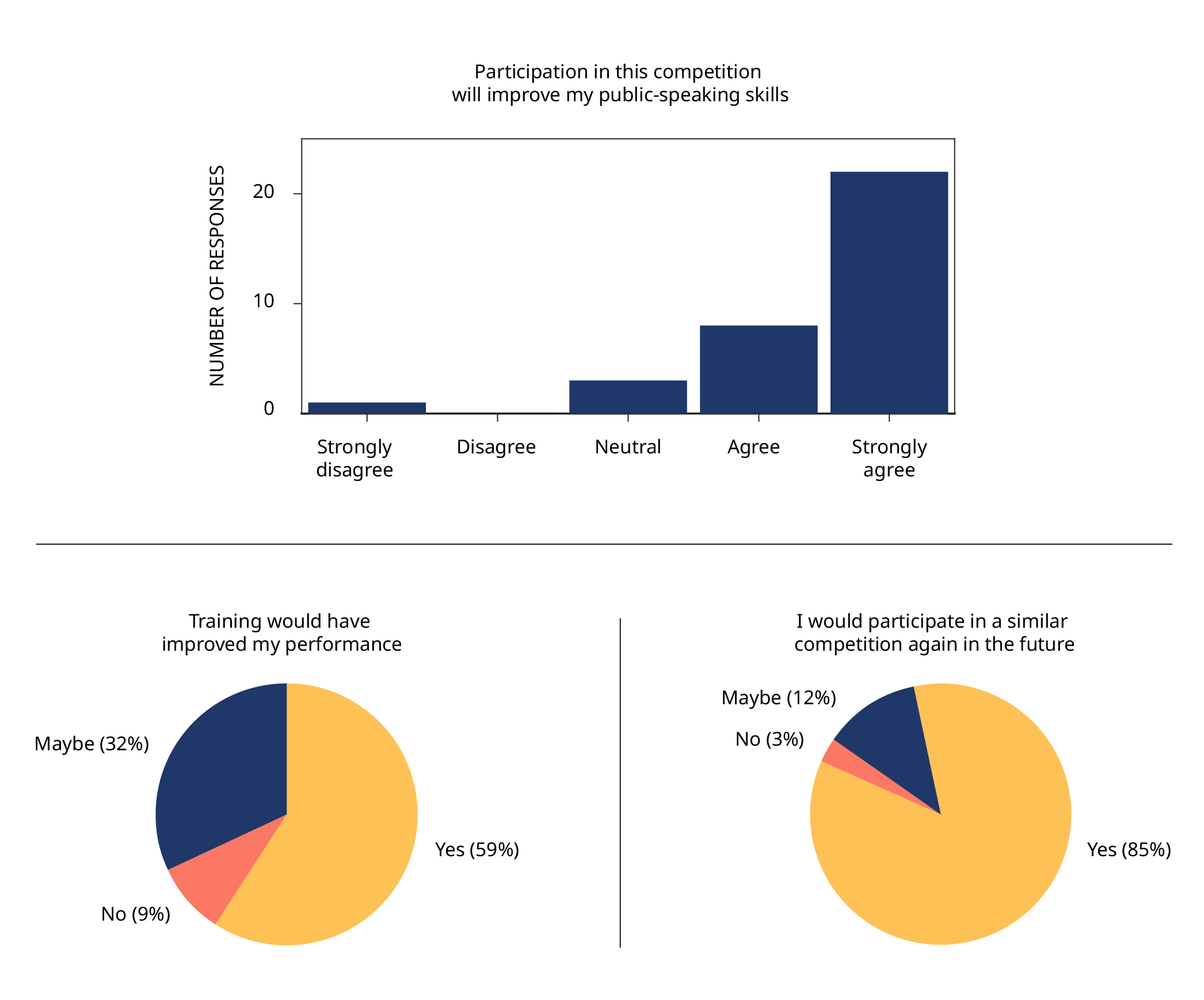
We conducted surveys in 2025 at the San Diego State University (SDSU) Grad Slam and the CSU-wide finals to attempt to quantify the impact of participation in the event. Between the local competition at SDSU and the CSU-wide competition, we received 34 responses from participants and 38 responses from audience members. One takeaway was that students were extremely happy to have taken part in the competition. Of the responders, 88% said they agreed or strongly agreed with the statement, “I feel that participating in this competition will improve my public speaking/presentation skills.” And 85% said they would participate again if given the opportunity.

Results from participant surveys taken in 2025 at San Diego State University’s Grad Slam event and California State University’s system-wide Grad Slam finals. Respondents overwhelmingly agreed that participation in the three-minute thesis competition improved their public-speaking skills and that they would eagerly do it again. Most, however, felt that they would have benefited if they had received more training in public speaking.

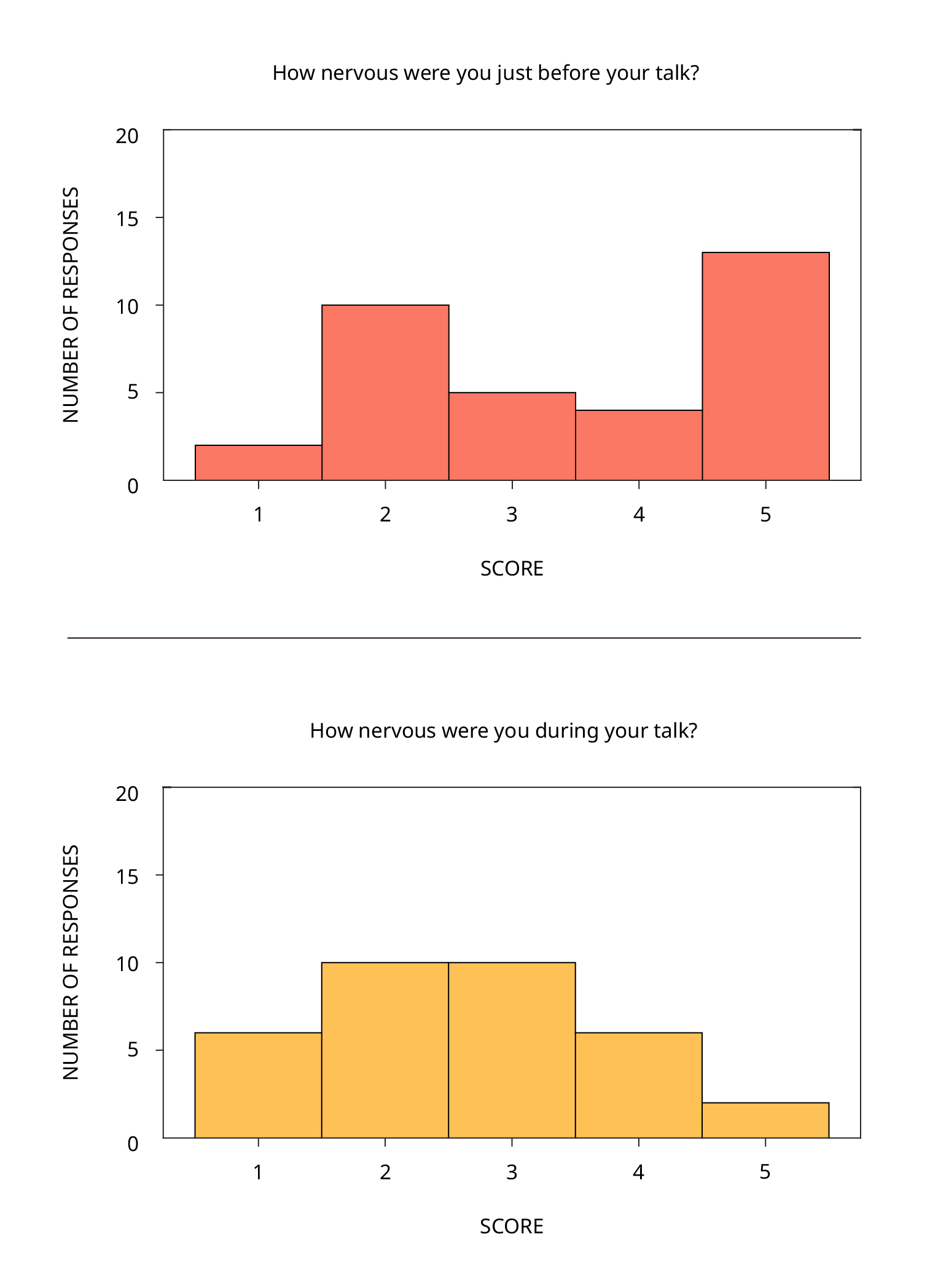
Many students reported that participating in the competition helped with managing the nervousness associated with public speaking. Participants were significantly more nervous just before their talk than they were during it. That experience—a decrease in anxiety over the course of a stimulus—is called habituation and is a central tenet to treating social anxieties. 1 Repeated exposure to public speaking has been shown to greatly improve confidence and reduce the anxiety associated with it.
But one of the challenges that many students face is the lack of resources to help them prepare to compete. Nearly two-thirds of our survey responders said they felt training would have improved their performance and they would have been interested in training if it were available to them. While an increasing number of universities are offering 3MT-style competitions, only a few have structured training programs in scientific communication. That is a missed opportunity because training programs could provide an invaluable way to have a lasting impact on professional development.
Of the universities that participate in the CSU Grad Slam, SJSU stands out because of its highly developed and competitive training program: So many students apply that they cannot all be accommodated. SJSU organizers require that the students who are accepted take it seriously. For three months, they meet weekly with an accomplished speaker from campus who serves as their coach and helps them conceptualize their topic, organize their thoughts, and distill everything down to three minutes. “It’s the preparation for that event that really provides the benefit for the student,” says d’Alarcao. “At least five people … have gone through our program and later told me that this was the single best thing that happened to them at San José State University.”

More results from the surveys taken in 2025 at the SDSU and CSU Grad Slam events. Participants were significantly more nervous before their talk than during it, which illustrates how habituation to presenting in public helps improve public-speaking anxiety.

Several studies have been conducted about how to craft a winning 3MT pitch. 2 3 4 They note that winning talks often follow nearly identical structures and contain similar rhetorical elements. There needs to be a hook that grabs the audience’s attention, a problem statement, an explanation of the solution, a statement about the implications of the work, and a closing statement that connects back to the hook to complete the story. Another important aspect to consider is performance skills. Including some coaching in acting and in how body language relates to public speaking can instill valuable skills that students may not otherwise develop as part of a physics education.
It’s important to note that the 3MT competition is not just for doctoral students: Anyone working in science can benefit from signing up. At Cal State Long Beach, the participants are nearly entirely master’s students. The Grad Slam is critical for students to develop the skills to “effectively communicate, effectively engage, and particularly engage those outside of their discipline,” according to Dina Perrone, the school’s interim dean of graduate studies and organizer of the campus’s competition. Participating in the contests can have a broad and lasting impact on students’ careers, whether they pursue opportunities in academia or industry.
In the academic world, the ability to present your work clearly at conferences and to the broader public has a tangible benefit. But being a good communicator can open additional career opportunities. Perrone notes that attention spans are shorter today. “The elevator pitch is becoming more important and critical in determining a variety of opportunities,” she says. “That three-minute spiel has a greater impact and opens up more doors to you than it probably did in the past.”
Setting up an elevator-pitch competition
Although it’s incredibly rewarding to establish a 3MT-style contest at your university, it can be quite daunting. Here we present some of the key steps to doing so. Interested readers should also consult the extensive resources available on the University of Queensland’s official 3MT webpage that are designed to help individuals start a similar competition at their institution. (If you want to use the 3MT name, you will also need to receive permission from the University of Queensland, which has trademarked the logo and brand.)
The first step is to recognize that one individual usually needs to spearhead the push to start an elevator-pitch competition on campus. That person needs to not only get the administration excited about hosting a competition but, more importantly, secure financial backing. Costs for a pitch contest vary depending on scale, but there are typically five main expenditures to consider: room rentals, catering, prizes for winners, promotional materials and badges, and, if you want to incorporate a training program into the competition, the cost of a speaking coach. That usually runs to around $20 000 in total, according to d’Alarcao. Administrators may be swayed by the argument that a competition is beneficial to students, but they are often more easily persuaded when informed about how its public-facing nature provides the university with exposure to the local community and the alumni base.
The second step is more complicated: working out the logistics of the competition. When and where will it be held? Who will be the judges and moderators? What training, if any, will be provided? How will students sign up? How many students is there space for? Those issues and many others need to be worked out at least six months in advance. Organizing an online competition presents its own challenges. Although they are generally more accessible and allow family and friends to easily watch loved ones present, online events are a “huge lift” on the back end, says Perrone.
A personal experience
I first discovered the Three Minute Thesis competition in 2017 during the first year of my PhD program at the University of Western Australia (UWA) in Crawley. I’ve always had a lot of anxiety about public speaking, so my initial reaction was that the competition was definitely not for me. Fortunately, I had met a few other PhD students who had entered the competition before. They convinced me that it was fun and that I should give it a try. So I pushed my nerves aside and signed up.
At the time, UWA offered a few modest training programs to help students prepare for the competition. I attended a workshop on how to write my talk, and another one, led by someone from the theater department, about how to deliver it. That second workshop was particularly memorable because I had never considered the performative aspect of giving a talk. I spent hours writing my talk and practiced delivering it every chance I could get. I remember reciting it aloud in the shower, while walking around campus, and in the lab when I needed a break from other work.
Finally, the day of the competition came, and I was so nervous. With sweaty palms and shaky knees, I got up and delivered my talk, “No hard feelings: Using tissue stiffness for non-invasive cancer detection .” I was so consumed by nerves that I don’t think I paid much attention to the other talks. At the end of the day, tension was high as they prepared to announce the winner. To my surprise, it was me! I was awarded an oversized check and a trip to Brisbane to represent UWA in the regional Asia–Pacific Three Minute Thesis competition. Because the competition was filmed, I also ended up with a nice video to show my family and explain what I was doing with my PhD.
Even though I was less successful at the regional competition, the experience was transformative. I received a huge confidence boost in public speaking, and I still use the skills that I learned in the workshops in my conference presentations today. Although I still get nervous every time I give a talk, I now know that it’s something I can handle.
Gavrielle R. Untracht
Recruiting students is the next step. That can be accomplished by emailing the graduate student body and securing small cash prizes to use as an incentive. Sharing footage from similar competitions can assist in recruiting participants. Another helpful tip is to mention the competition to faculty members, who are usually eager to have their group’s work publicized and can nudge their students to enter. The application process should require students to state how far along they are in their project, and that information can be used to filter out applicants if too many individuals enroll. We suggest that after students sign up, organizers reach out to each one’s adviser to make sure that they are on board with their student competing and that there are no intellectual property issues with the project topic. Once students are registered, training can begin.
The competition itself typically involves preliminary and final rounds, which each have three judges and a moderator. At SDSU, for example, 24 students are accepted into the competition. In the preliminary round, they are split into four groups of six students. The top two students in each group advance to the finals. Each speaker has three minutes to give their presentation; their background slide is preloaded onto a computer. Remaining time is indicated on a large countdown clock. After each talk, the judges tally the scores while the moderator briefly interviews the speaker about their future research plans and what they hope to do after graduating. Judging takes about two minutes to complete, so each participant should be allotted about five minutes. With a bit of extra time for introductions and conclusions, the preliminary rounds usually take about 45 minutes, and the final typically lasts about an hour.
A critical need
Science communication is fundamental to bridging the gap between researchers and the public, for fostering public trust, and for ensuring that scientific knowledge informs public policy. Especially in the current political climate, which is rife with misinformation and distrust, scientists have a responsibility to ensure that our research can be communicated in a way that the public understands. So much depends on that communication, including convincing legislators to allocate funding to scientific research, ensuring access to the most up-to-date public-health policies, and fighting climate change. Participating in competitions like the 3MT can provide emerging research leaders with the skills that they need to become scientific ambassadors to the public.
In the words of Mark Telling, the director of the Institute of Physics’s UK- and Ireland-wide Three Minute Wonder competition, “At a time when a growing number of platforms demand succinct sound bites, the ability to communicate STEM ideas to lay audiences across different sectors using inventive yet clear and credible ideas has never been so important.”
References
1. R. R. Behnke, C. R. Sawyer, “Public speaking anxiety as a function of sensitization and habituation processes ,” Commun. Educ. 53, 164 (2004).
2. S. Carter-Thomas, E. Rowley-Jolivet, “Three Minute Thesis presentations: Recontextualisation strategies in doctoral research ,” J. Engl. Acad. Purp. 48, 100897 (2020).
3. K. Hyland, H. Zou, “ ‘I believe the findings are fascinating’: Stance in three-minute theses ,” J. Engl. Acad. Purp. 50, 100973 (2021).
4. G. Hu, Y. Liu, “Three minute thesis presentations as an academic genre: A cross-disciplinary study of genre moves ,” J. Engl. Acad. Purp. 35, 16 (2018).
More about the authors
Gavrielle Untracht, who won the 2017 3MT competition at the University of Western Australia, is an assistant professor in the department of health technology at the Technical University of Denmark in Kongens Lyngby. Her research focuses on biophotonics. After being selected as an Optica ambassador in 2024, she developed a training workshop to help students prepare for three-minute pitch competitions.
Matt Anderson is a Senate Distinguished Professor in the physics department at California’s San Diego State University, where he is the director of the Grad Slam competition. His research focuses on ultrafast optics and physics education. He also promotes physics on his popular YouTube channel, Physics with Professor Matt Anderson .