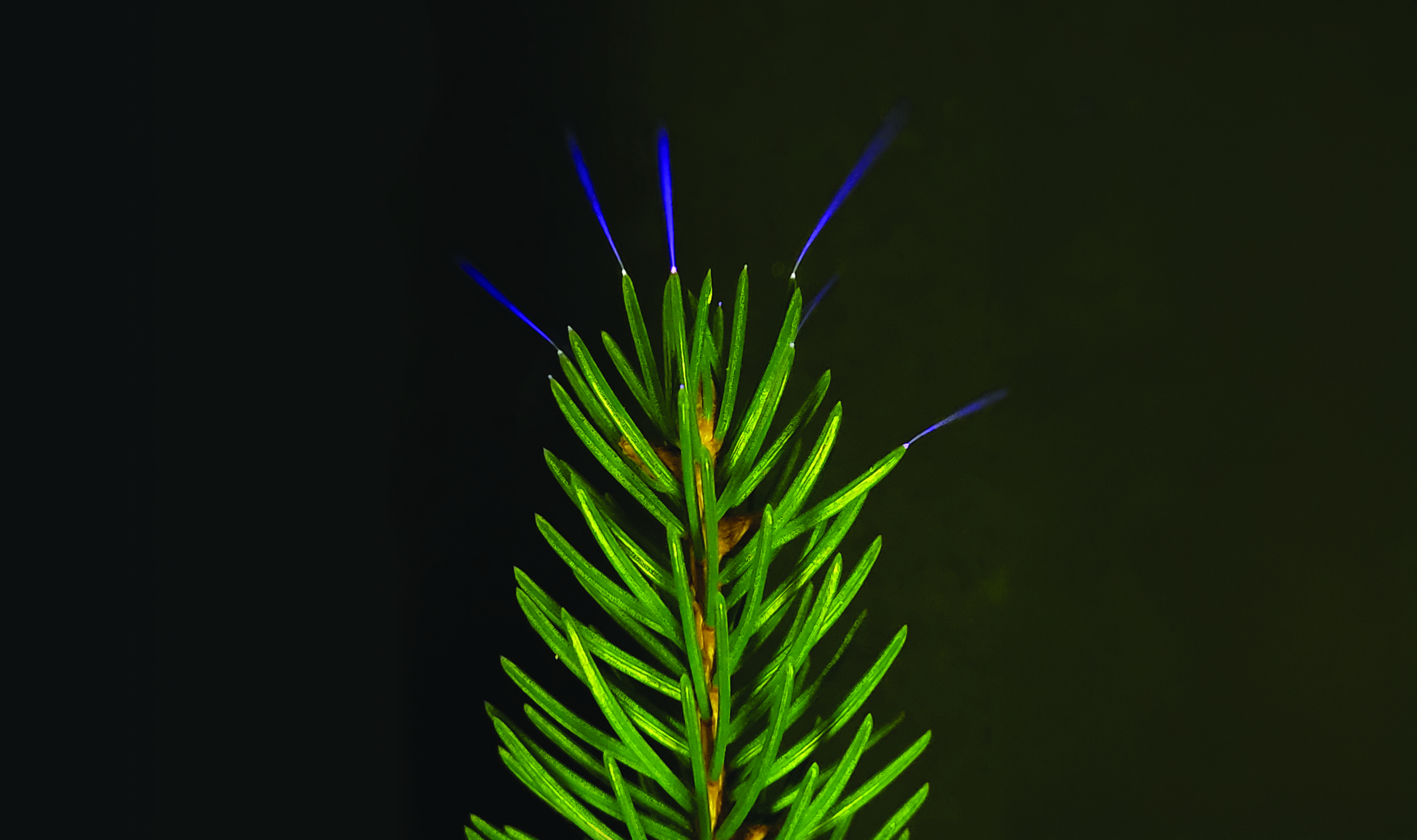
Trees can glow during thunderstorms


(Image courtesy of William Brune.)

The purple light emanating from these spruce needles is emitted by weak electric discharges. Patrick McFarland of the Pennsylvania State University and colleagues placed a branch of a spruce tree below a charged aluminum plate and grounded it with a metal wire. The electric field formed by the two metals’ attraction has a strength that is about of that of fields required for lightning. In response to the field, an electric charge travels up the branch to the tips of the leaves, where it is released into the air.
The glow of the branch’s leaves is a laboratory demonstration of Saint Elmo’s fire, a phenomenon that has long been seen, for example, during thunderstorms by sailors on ship masts and pilots on aircraft. Yet despite decades-old discussions in the scientific literature, researchers did not confirm that electric discharges can form on tree leaves during thunderstorms until 2024. That summer, McFarland his adviser, William Brune, drove a minivan retrofitted with monitoring equipment into the path of a thunderstorm in North Carolina. They observed with a telescope UV radiation emitted from the canopies of two trees and then focused the radiation on a UV-sensitive camera. 1
The discharges measured in North Carolina lasted one to three seconds and corresponded to currents of about 1 μA. The phenomenon, if widespread in forests during thunderstorms, could affect atmospheric chemistry. McFarland and colleagues are interested in studying the discharges’ production of hydroxyl radicals, which oxidize greenhouse gases and thus decrease how long the atmospheric-warming gases reside in the air.
Reference
1. P. J. McFarland et al., “Corona discharges glow on trees under thunderstorms ,” Geophys. Res. Lett. 53, e2025GL119591 (2026).