Cities built on river sediment are sinking

Where rivers meet oceans, flowing water suddenly has space to spread out. The current slows, and sediments suddenly drop out of suspension and pile up to form massive fans of sand and silt. Many of civilization’s earliest cities were built on the fertile farmland of such river deltas. Today, deltas are home to an estimated 350 million to 500 million people globally. Alexandria, Egypt—the largest city on the Mediterranean coast—is built atop the western edge of the Nile River delta. Guangzhou, which sits at the mouth of the Pearl River in China, is 1 of the 10 delta-situated cities that have populations greater than 10 million.
Figure 1.

The city of New Orleans sits atop the Mississippi River delta.
(Image from ESA/CC BY-SA 3.0 IGO .)

Cities and coastlines across the globe face growing flood risk from sea-level rise caused by climate change. But for dozens of major cities that are built on river deltas, rising oceans are not the only threat. The land is sinking beneath cities including New Orleans (see figure 1 ); Buenos Aires, Argentina; and Bangkok, Thailand. “When we talk about climate change, people have an appreciation for sea-level rise and its effects on coastal communities, but land subsidence still appears as an underappreciated hazard,” says Leonard Ohenhen at the University of California, Irvine.
Many factors contribute to land subsidence. Sediments in deltas naturally compact over time, and the process is exacerbated by the physical weight of urbanization and population growth. Pumping water out of aquifers deflates the ground surface, and the demand for water only grows with increasing populations. Physical barriers, such as dams and levees, that are used to prevent routine flooding of population centers can also keep out a supply of new sediments that typically build up the delta over time.
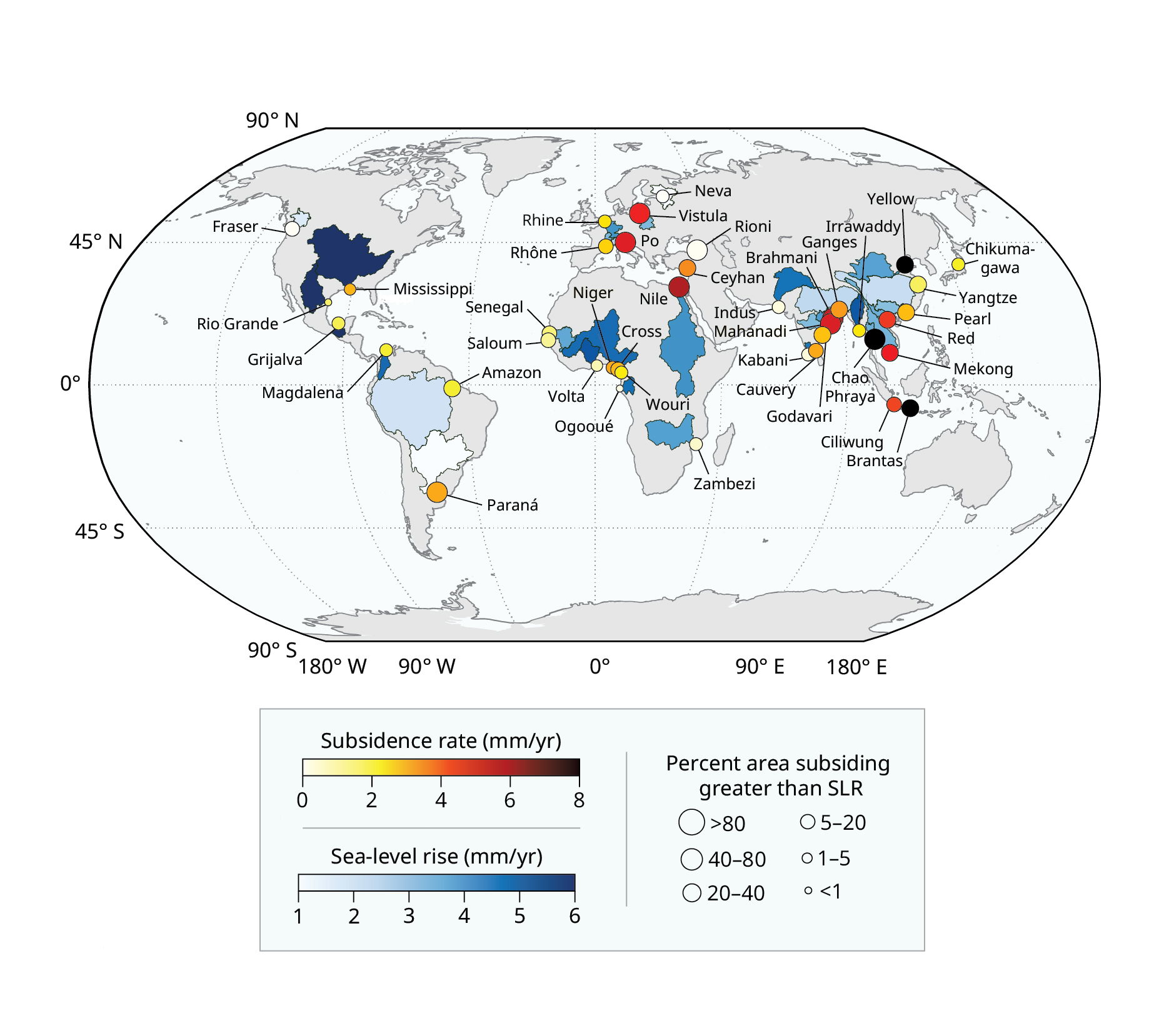
In a new study, Ohenhen and colleagues analyzed vertical land motion in 40 of the world’s major delta systems, 1 shown in figure 2 . The researchers explored not only how fast delta systems are subsiding but also how much specific human activities, such as groundwater pumping and urban expansion, contribute to their sinking. For nearly half the deltas studied, land subsidence rates exceed the rate of sea-level rise. Thus, alongside global work to curb climate change impacts, local land management strategies are crucial for reducing future flood risk.
Figure 2.

Forty delta systems across five continents were examined for the study. For each delta, the size of the circle reflects the percentage of the delta area that is sinking faster than the local rate of sea-level rise (SLR), and the color reflects the average rate of subsidence. The river basin—the area of land that drains into the river—is outlined for each system and shaded blue according to the rate of sea-level rise at each delta.
(Figure adapted from ref. 1 .)

Small movements measured from large distances
To establish the rate of vertical land motion down to the scale of millimeters, Ohenhen and colleagues used interferometric synthetic aperture radar (InSAR) data collected from 2014 to 2023 by the Sentinel-1 satellites. Launched by the European Space Agency as part of the Copernicus Earth observation program, Sentinel-1 continuously captures radar images of Earth; the satellites record each region every 6 or 12 days, depending on the region’s location on the globe. A major benefit of radar imagery is that, unlike photography, it can be collected through cloud cover and is insensitive to light conditions.
The Sentinel-1 satellites send out radio waves in the C-band, which has a wavelength of about 5.6 cm, and measure the return time and phase of the reflected waves. At least two passes over a region are necessary because phase measurements from a single pass look like random noise. By subtracting a second set of measurements from the first, researchers can precisely calculate ground displacement from an orbital distance of nearly 700 km. (For more about the method, see the 2006 PT article “InSAR, a tool for measuring Earth’s surface deformation ,” by Matt Pritchard.) For each delta in the study, 150–200 radar images provided snapshots of the ground motion over the full collection period.
Maps of vertical land motion for each delta system, as shown in figure 3 , delineate the spatial patterns of ground motion. In the Fraser River delta in Canada, for example, hot spots of subsidence are surrounded by regions of slight uplift caused by glacial rebound. That phenomenon—the slow rise of land that had been depressed by the weight of an ice sheet—is found throughout high-latitude regions. In contrast, subsidence is widespread in the entire region of the Chao Phraya River delta around Bangkok, though sinking is most pronounced in certain coastal areas at the city’s southern edge. In heavily vegetated areas or wetlands, reliable InSAR signals can’t be collected, as indicated by spotty coverage in some map regions in figure 3 , most notably in the Niger, Mississippi, and Paraná River deltas.
Figure 3.

Maps of vertical land motion (VLM) from individual river-delta systems show areas of ground uplift (blue) and subsidence (red) for nine river deltas that are home to major cities (labeled in white).
(Figure adapted from ref. 1 .)

For their assessment of the human drivers of sinking, Ohenhen and colleagues gathered multiple global datasets. Published models of sediment flux and sea-level rise were used to quantify those parameters at each delta, and population data were used to quantify urban expansion. To estimate changes in groundwater storage, the researchers used data from NASA’s twin-satellite missions GRACE (Gravity Recovery and Climate Experiment) and its successor GRACE-FO (Follow-On). The satellites measure subtle changes in gravity across Earth’s surface. Because water’s mass contributes to changes in gravitational pull, the data have been used to estimate total water storage. Groundwater storage was then calculated by subtracting contributions from surface water and soil moisture and validated against independent well measurements where they were available.
A sinking feeling
With estimates for each parameter in hand, the researchers applied two machine-learning statistical analysis methods to parse the relative contributions of each human activity to subsidence rates. In an analysis of all deltas together, they found that decreased groundwater storage was the predominant driver of subsidence; sediment flux and population growth contributed to subsidence to a lesser degree and in roughly equal proportions.
Decreased groundwater storage was the dominant factor driving subsidence in most individual locations as well. In the Mississippi River delta and a handful of others, sediment loss had the greatest impact. Though population growth has contributed to subsidence in many deltas, it was not found to be the dominant driver in any of them. Ohenhen emphasizes that the human-driven processes that the researchers analyzed are not the only factors that contribute to delta sinking. Oil and gas extraction and the draining of peatland for development, for example, are also important to consider.
Of the 40 deltas that the researchers studied, 22 are sinking at average rates of 3 mm/yr or more. And for all but the ones at the Neva River in Russia and the Fraser River in Canada, more than half the delta area is sinking. The global average rate of sea-level rise is 4 mm/yr, but that rate varies significantly by region, as shown in figure 2 . For three of the deltas—the ones at the Chao Phraya River in Thailand, Brantas River in Indonesia, and Yellow River in China—the average rate of sinking is at least 8 mm/yr, twice the average rate of sea-level rise. And in 18 of the 40 deltas, the rate of sinking exceeds the rate of local sea-level rise.
What can be done about it? One silver lining is that, whereas a certain amount of sea-level rise from climate change is unavoidable, human intervention can slow some of the sinking. The researchers cite regulation of groundwater pumping, managed aquifer recharge, and sediment management as avenues for reversing the course of subsidence.
For all the benefits of C-band InSAR, the 5.6 cm waves are affected by the presence of vegetation, which can reduce the coherence of land-surface measurements. To help bolster the dataset, NASA and the Indian Space Research Organisation (ISRO) launched in July 2025 an InSAR satellite that uses L-band radar with a wavelength of 24 cm. “The big frontier that we are focusing on is coverage and robustness in deltas, vegetation, wetlands, and seasonally flooded terrain where the C-band struggles,” says Pietro Milillo, an assistant professor at the University of Houston and the collaborations lead for NASA’s surface topography and vegetation incubation study. It will likely take two to five years before similar analyses can be conducted from the NASA–ISRO Synthetic Aperture Radar data.
Milillo says the study by Ohenhen and colleagues is “an important first step” that uses the best available data. “That kind of harmonized cross-delta comparison is something that the community has wanted for a long time.”
Reference
1. L. O. Ohenhen et al., “Global subsidence of river deltas ,” Nature 649, 894 (2026).