A classical analogue for quantum effects


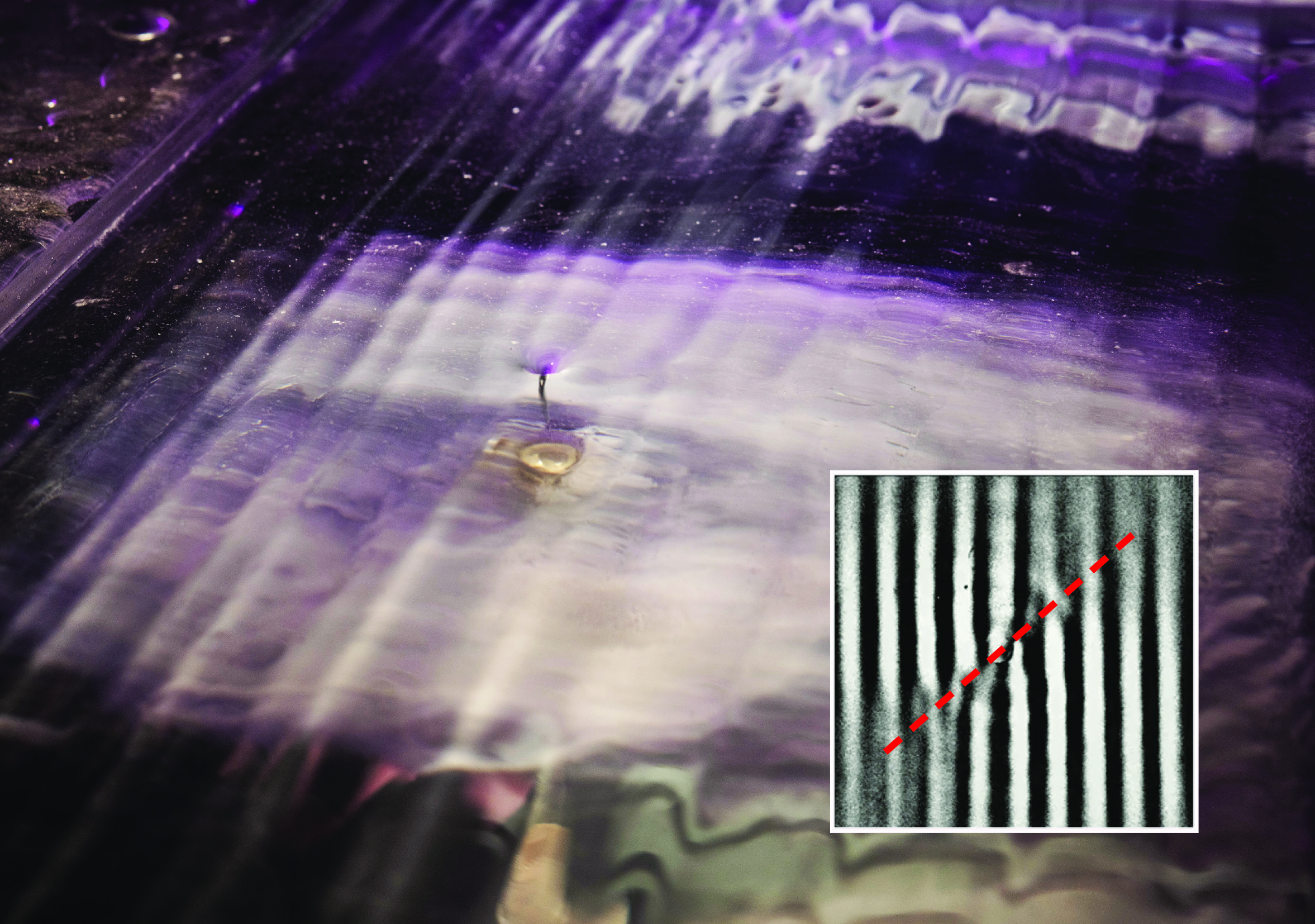
(Photo courtesy of Andrew Scott, Okinawa Institute of Science and Technology; inset adapted from ref. 1 .)

When researchers used a custom wave tank at the Okinawa Institute of Science and Technology to watch how standing surface waves are scattered by a vortex, what they saw was unexpected. The interaction produced the nonlocal topological effect seen here: a flat line (highlighted by the dashed red line in the inset, which has the vortex at its center) that extended across the surface of the water and rotated opposite the direction of the vortex flow. 1 When the vortex flow was sped up, multiple counterrotating lines appeared.
The experiments were inspired by similar ones performed almost five decades ago; they were described by Michael Berry in a 2010 letter to Physics Today, “Aptly named Aharonov–Bohm effect has classical analogue, long history .” Those earlier experiments documented the interaction of a vortex with traveling waves, not standing ones. They managed to replicate in water waves an effect mathematically analogous to the Aharonov–Bohm effect—a quantum mechanical phenomenon in which an electron can be affected by an electromagnetic potential despite remaining in a region that is free of electric and magnetic fields. In the Okinawa experiments, as in the earlier ones, the wave tank’s vortex, standing in for a magnetic field–generating solenoid, caused a phase shift in the water waves that’s analogous to the phase shifts experienced by passing electrons.
The Okinawa experiments demonstrate once again that classical systems can serve as laboratories for visualizing quantum effects that may be much harder to observe in quantum systems.
Reference
1. A. Singh et al., “Topology made visible through standing waves in a spinning fluid ,” Commun. Phys. 9, 123 (2026).