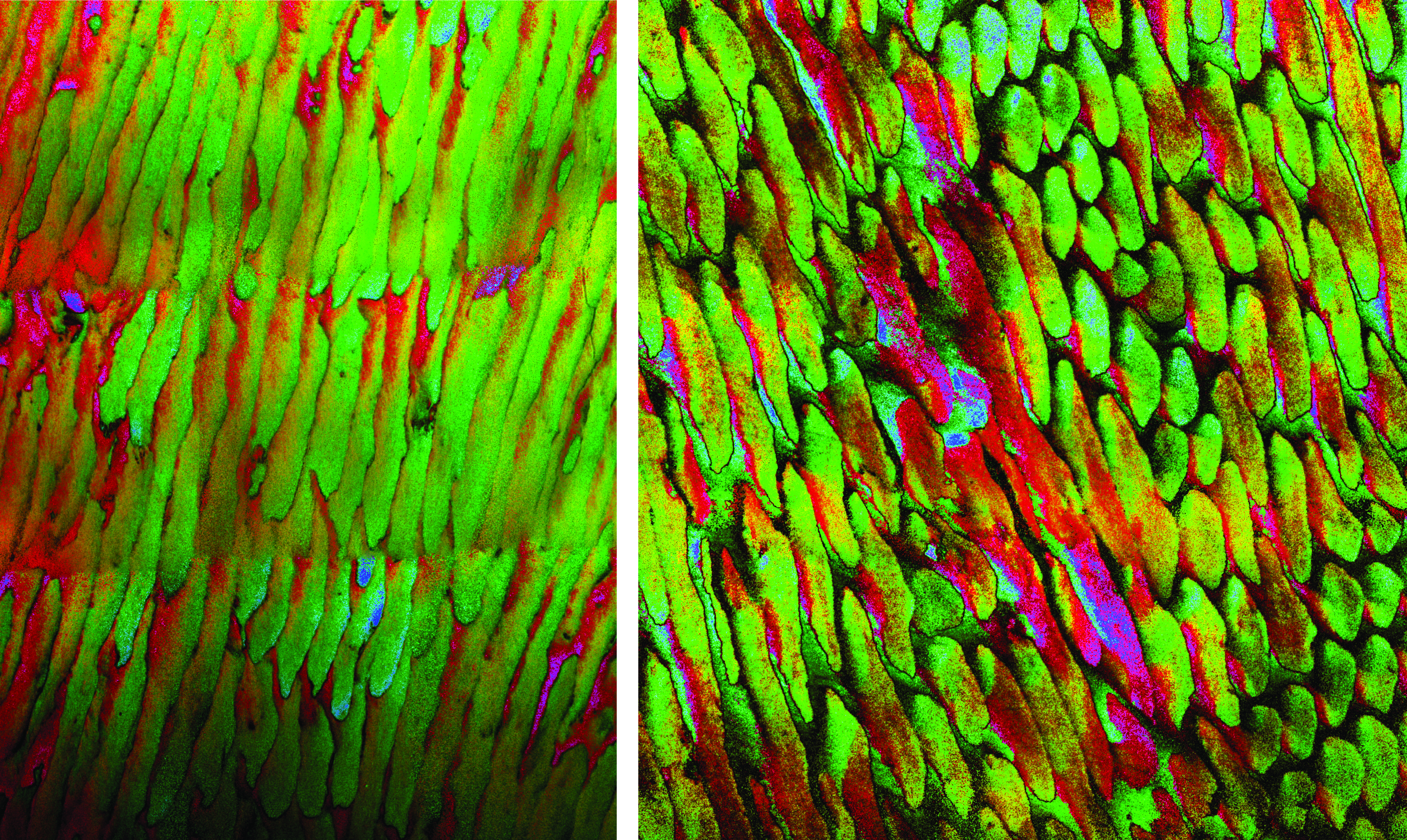
A dental lens on human evolution

(Photos courtesy of Pupa Gilbert.)

Tooth enamel is the hardest tissue in vertebrates, and its lack of organic material prevents it from decomposing quickly. Pupa Gilbert of the University of Wisconsin–Madison and colleagues recently analyzed tooth samples, including from individuals who lived about 40 000 years ago (left) and 700 years ago (right), to see whether the nanostructure of the enamel could provide insights into evolutionary changes associated with humans’ changing diet. The researchers used a polarization imaging method that they developed to measure the orientation of the enamel’s thin, long hydroxyapatite nanocrystals. 1 The elliptical shapes in the images are rods roughly 5 µm wide that contain thousands of the nanocrystals, each of which takes up about a pixel. The colors represent the measured orientation of the crystals; the contrast between adjacent crystals indicates the degree of misorientation between them.
Gilbert and colleagues found a greater degree of nanocrystal misorientation in the more recent sample. They associate the change with humans’ transition to a grain-based diet during the agricultural revolution about 12 000 years ago. Although agricultural foods became easier to chew, the byproducts of processing contribute to higher abrasion. When nanocrystals are more misoriented, enamel is better at deflecting crack propagation and is therefore more durable. Over humans’ evolutionary history, enamel nanocrystals have undergone a trend toward greater misorientation, a change that researchers attribute to more mechanically challenging diets. More studies of the nanostructure of tooth enamel could indicate when humans started cooking their food.
Reference
1. P. U. P. A. Gilbert et al., “Enamel nanocrystal misorientation increased with meat-eating and agriculture ,” Nature 654, 76 (2026).