A peek into the physics of squeaky sneakers


(Image cropped from a photo by Thomas Ronveaux/Pexels.)
The squeaking of sneakers is the unofficial soundtrack of a basketball game. Squeaks also arise in a range of mechanical systems, including hip and knee replacements, where polymer liners slide against metal or ceramic heads, and bicycle brakes in need of a tune-up. Until recently, the processes responsible for producing squeaks were poorly understood: How does slip occur at a frictional interface? What governs the interfaces’ stability? Could there be a way to suppress the sound? As part of a team of applied physicists and engineers, I have been probing some of the fundamental questions about friction at interfaces between soft and rigid materials.
Generally, the sound created when two materials slide over each other is the result of a macroscopic stick–slip: The surfaces momentarily stick together, the system stores elastic energy up to the point where equilibrium is lost, and then the surfaces slip, which releases that energy. If the frictional force drops with increasing slip velocity, that can give rise to self-excited oscillation. A small increase in velocity leads to reduced friction, which causes a further increase in velocity. Many earthquakes are generated via the same stick–slip process.
Such a description, however, fails to capture the rich dynamics of extended frictional interfaces, where instead of slipping all at once, surfaces slip by means of the propagation of crack-like slip fronts and slip pulses. Localized slip distribution is particularly pronounced when the sliding involves a rigid surface and a soft solid—in our study, a squeaking shoe.
The shoe problem
We start our assessment of the origin of squeaking by sliding a basketball shoe on a rigid plate. To gain a direct view of the contact at the frictional interface, we take a transparent acrylic plate and mount LEDs on its sides. The light’s angle of incidence is large enough that the light is totally reflected and remains trapped within the plate. Where the shoe sole makes contact, the light transmits onto the rubber, and the contacting locations on the plate appear bright. We visualize the contact evolution in space and time with a 100 000 frames-per-second camera and measure the sound with a microphone.
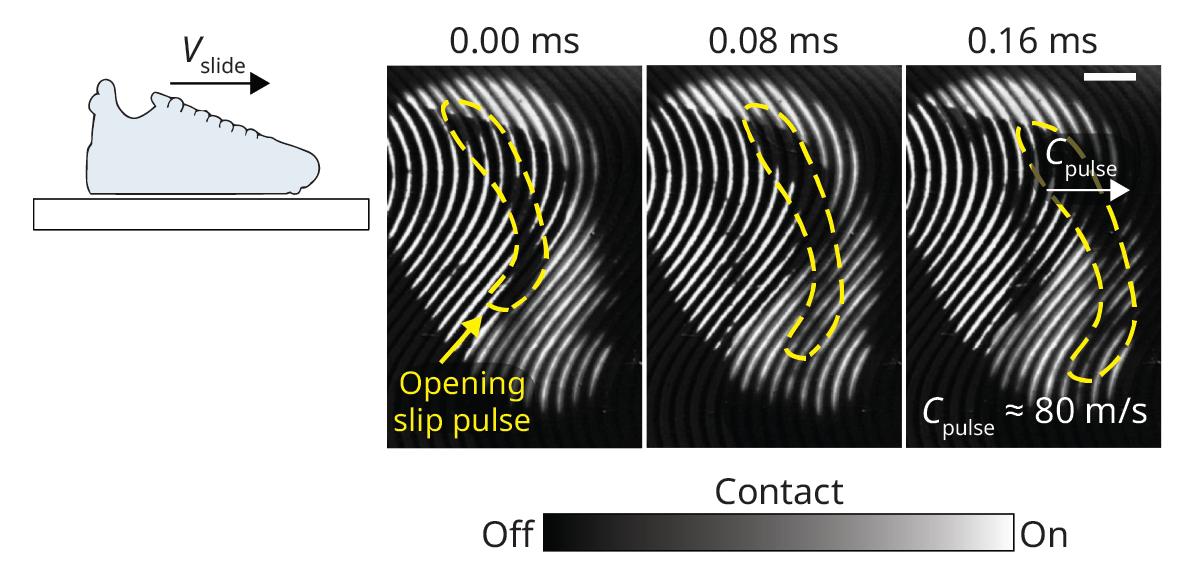
We observe that sliding does not occur along the interface all at once. In some localized regions, contact between the sole and plate is momentarily lost, while the surrounding interface is under high pressure and stuck. The detached regions are called opening slip pulses, one of which is shown in figure 1, and they race along the interface at speeds exceeding the shear-wave speed of the rubber. The pulses are generated at constant time intervals of 0.2 ms, which corresponds to a frequency of about 5 kHz. At the moments when pulses appear, we hear squeaking sounds with the same frequency. The coincidence of both the sound- and pulse-generation frequencies is strong evidence for the causal relationship between opening slip pulses and the squeaking sound.
Figure 1.

Snapshots of the frictional interface between an acrylic plate and a basketball shoe, sliding to the right at velocity Vslide, show an opening slip pulse traveling left to right at a speed Cpulse of 80 m/s—much faster than, and independent of, the sliding speed. The white scale bar in the top right corner is 10 mm.
(Figure adapted from A. Djellouli et al., “Squeaking at soft–rigid frictional interfaces ,” Nature 650, 891, 2026.)

Nucleation and propagation
Theoretical analyses and simulations show that uniform sliding along an interface between solids of different elastic properties is unstable, particularly when, as it is in our shoe scenario, the friction coefficient is high. The instability arises from a combination of factors. First, frictional strength is coupled to contact pressure—local pressure fluctuations cause fluctuations in slip. Additionally, the mismatch between the two materials means that local slip causes pressure changes.
That two-way causal relationship between slip and pressure makes small perturbations grow indefinitely: A semistable initial state of uniform sliding will transition to a state where most of the interface remains stuck, and slip localizes into pulses that travel along the interfaces at the speed of sound. The pressure fluctuations that kick-start pulse nucleation can result from macroscopic vibrations of the system. When pressure across the interface is particularly high, transient pressure bursts may also be triggered by electrostatic discharge at the surface, similar to the discharge produced when rubbing a balloon on your hair.
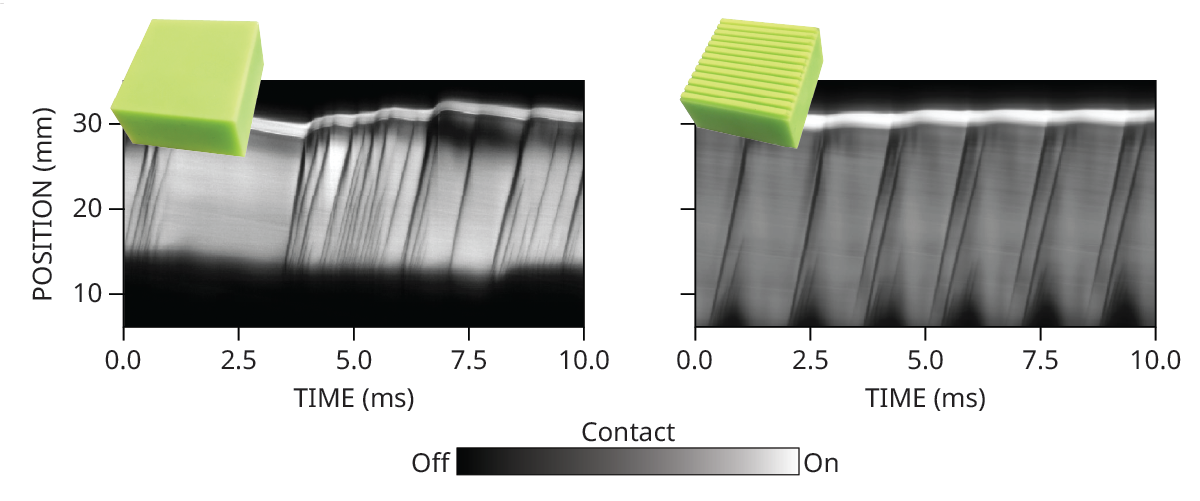
To further understand what governs the dynamics of slip pulses, we cast rubber blocks on 3D-printed molds, shown in figure 2, with either flat frictional surfaces or ridges similar to the ones found on basketball shoes. Opening slip pulses are observed when both flat and ridged surfaces slide. The shape and periodicity of the pulses, however, differ significantly between the two.
Figure 2.

Spatiotemporal contact maps show how opening slip pulses travel along a transect of a rubber block with a smooth surface (left) and one with ridges (right). A smooth block produces unpredictable, irregular slip pulses, whereas a ridged block produces slip pulses at a consistent frequency that results in a predictable, characteristic squeaking sound.
(Figure adapted from A. Djellouli et al., “Squeaking at soft–rigid frictional interfaces ,” Nature 650, 891, 2026.)

On flat surfaces, pulses can travel in multiple directions—and can tilt, merge, and separate—which gives rise to messy dynamics and a scratch-like sound that contains a broad spectrum of frequencies. Conversely, on the sole-like surfaces, pulses are confined within a single ridge. Each ridge acts as a waveguide that suppresses complex interactions between pulses and tames the messy dynamics into an ordered one. Consequently, pulses are generated at a constant frequency, as shown in figure 2, and the resulting sound is a clean squeak.
We were surprised to see that such small changes in surface geometry have profound effects on the propagation dynamics of pulses. We had expected that coupling between individual ridges would cause them to behave as an equivalent continuum 2D surface. To understand why that was not the case, we made samples with a single ridge and gradually increased the ridge’s width. For small ridge widths, we found that pulses become confined, making the interface essentially 1D, and the dynamics are ordered. When a ridge is at least four times as wide as the typical pulse, the interface behaves as a 2D surface, and the dynamics become chaotic.
Setting the tone
For a given rubber-block geometry, the squeak frequency is remarkably robust. Variations in pressure or sliding velocity have negligible effects. The frequency is, however, sensitive to the block height. The two have an inverse relationship: Taller blocks produce lower frequencies. With that knowledge, we designed a series of blocks with carefully controlled heights such that each block produces a well-defined note, and we used them to play a familiar melody—“The Imperial March (Darth Vader’s Theme)” from the Star Wars franchise.
Why are slip pulses initiated at specific frequencies? We observe oscillations at the trailing edge of the block that gradually increase in amplitude. Each oscillation temporarily lifts the contact at the trailing edge, which sets favorable conditions for the nucleation of pulses that are locked into the first shear natural frequency of the system.
Our findings could give rise to new musical instruments or to a new era of squeakless sneakers. The latter could perhaps be achieved either with a design that harnesses the chaotic regime in which pulses are not synchronized and thus generate a “shhh” sound instead of a squeak or with a system in which pulses occur only at such high sliding velocities or pressures that they would never be generated in a given application.
On a more fundamental note, our study sheds light on the interplay between geometry and the way slip pulses propagate, a topic of interest in not only mechanics but also earthquake physics. Most theoretical foundations that describe slip pulses come from the geophysics community, and experimental approaches similar to ours serve as tabletop models for studying earthquakes.
Additional resources
► A. Djellouli et al., “Squeaking at soft–rigid frictional interfaces ,” Nature 650, 891 (2026).
► Y. Poles, S. Shi, J. Fineberg, “Slip-pulses drive frictional motion of dissimilar materials: Universality, dynamics, and evolution ,” Proc. Natl. Acad. Sci. USA 121, e2411959121 (2024).
► N. K. Mohammadi, G. G. Adams, “Self-excited oscillations of a finite-thickness elastic layer sliding against a rigid surface with a constant coefficient of friction ,” J. Appl. Mech. 85, 021005 (2018).
► G. C. McLaskey, B. D. Kilgore, N. M. Beeler, “Slip-pulse rupture behavior on a 2 m granite fault ,” Geophys. Res. Lett. 42, 7039 (2015).
► K. Viswanathan, N. K. Sundaram, S. Chandrasekar, “Stick-slip at soft adhesive interfaces mediated by slow frictional waves ,” Soft Matter 12, 5265 (2016).
More about the authors
Gabriele Albertini is an assistant professor of structural engineering at the University of Nottingham in the UK. His research focuses on nonlinear processes that govern failure of materials and systems.