Giant telescopes take small but significant steps toward realization
DOI: 10.1063/PT.3.5135

“A year ago, I would have been pessimistic about building the Thirty Meter Telescope on Mauna Kea,” says John O’Meara, deputy director and chief scientist for the W. M. Keck Observatory, one of 13 observatories on Mauna Kea, the Northern Hemisphere’s premier site for optical and IR astronomy. Opposition to the Thirty Meter Telescope (TMT) has long been strong, and in 2019, hundreds of Native Hawaiians and others blocked the road to prevent its construction on the mountain. (See “
But changes in the TMT leadership and in its approach to interactions with Native Hawaiians, as well as a new governance structure for Mauna Kea, may open the door to more fruitful dialog. O’Meara, who is not involved in the TMT, says recent developments make him “optimistic about astronomy on Mauna Kea, whether or not TMT is part of it.” And Robert Kirshner, who in May took the job of TMT executive director, says the TMT’s “new community-based model” gives him hope that the TMT can be built “through mutual stewardship of Mauna Kea.”
The perceived potential for rapprochement lines up timewise with steps NSF is taking with the US Extremely Large Telescope (ELT) Program. The agency is evaluating the environmental and cultural impacts of building the TMT on Mauna Kea and will soon review the designs of the TMT and the 25.4-meter-diameter Giant Magellan Telescope (GMT), the other US-led ELT project, which has a site in northern Chile.
The 2020 decadal survey by the US astronomy community named NSF investment in the TMT and GMT as its highest priority for ground-based projects. Known as Astro2020, the survey recommends that NSF get a 25% share in each of those international facilities in order to give access to US-based users who are not affiliated with TMT and GMT member institutions. If only one of the telescopes is built, NSF should go for a 50% share for the broader US community, says Astro2020. (See “Astro2020 proposes new approaches to realizing projects ,” Physics Today online, 18 November 2021.)

Chunks of low-expansion glass are placed in a mold for casting one of seven segments, each 8.4 meters across, that will form the primary mirror of the Giant Magellan Telescope in Chile. This work is being done at the University of Arizona.
DAMIEN JEMISON, GIANT MAGELLAN TELESCOPE—GMTO CORPORATION

Meanwhile, construction on the European Southern Observatory’s 39-meter Extremely Large Telescope is well underway on Cerro Armazones in Chile, some 700 kilometers north of the GMT site. The European telescope is on schedule for completion by the end of the decade, well ahead of the others.
The sky access that would be gained by building the GMT in the Southern Hemisphere and the TMT in the Northern Hemisphere would give the US a scientific edge. If neither US ELT is built, astronomy in the US would suffer; the access policy for the European Southern Observatory ELT for astronomers from nonmember countries has yet to be defined. Even with only one of the two, says O’Meara, it would be hard to remain at the top of the field. “US leadership in astronomy needs big glass.”

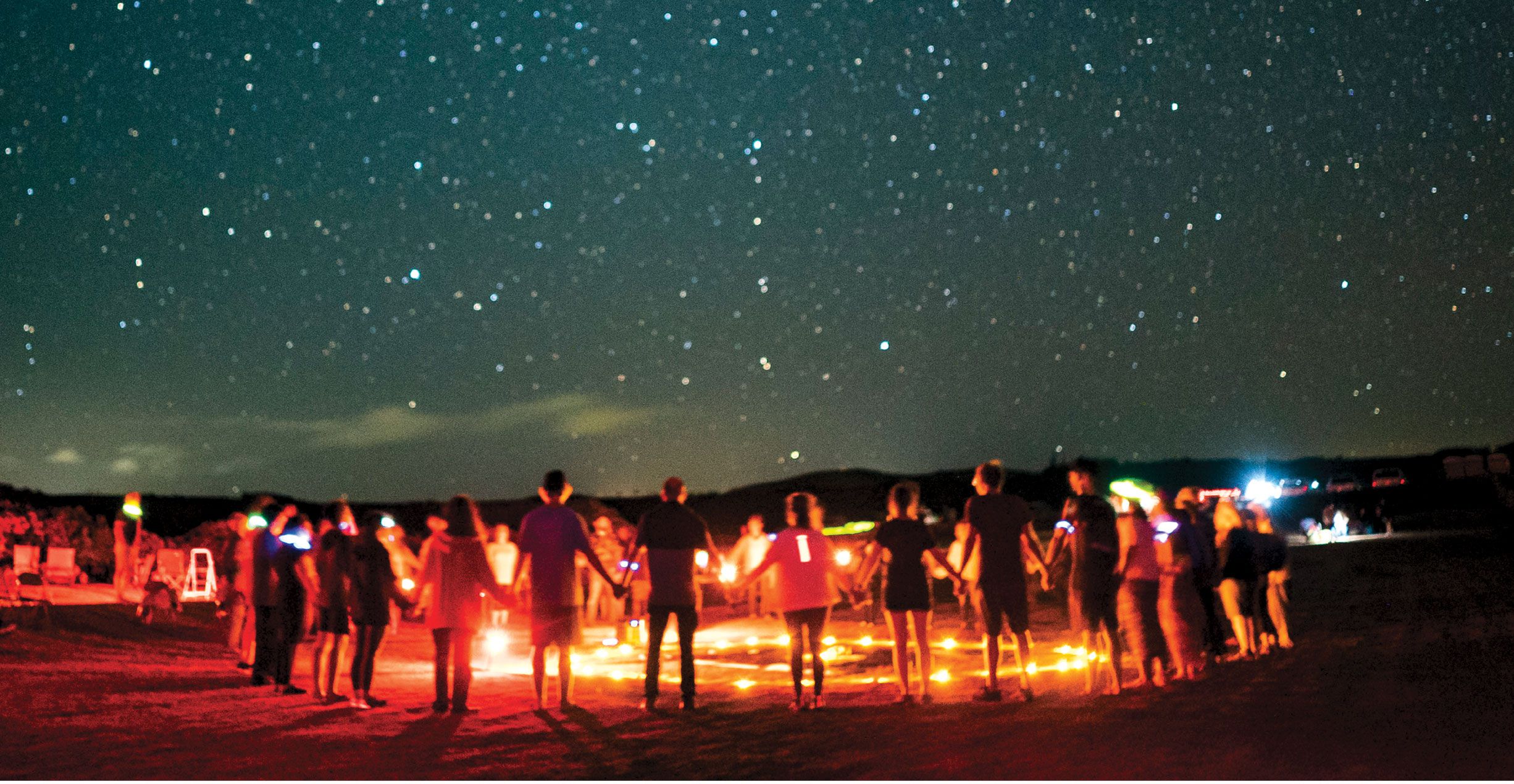
Stargazing events such as this one from 27 August at Moʻokini Heiau, a National Historic Landmark on the island of Hawaii, are among the activities that the Thirty Meter Telescope outreach team is collaborating on with Native Hawaiians in efforts to build positive long-term relationships.
‘OHANA KILO HŌKŪ/KEITH UEHARA
The ELTs will be able to detect more-distant and fainter objects than is possible with existing 8- to 10-meter-class optical–IR telescopes. One area of anticipated discovery is exoplanets. “We’ll be able to see planets by reflected light. They don’t have to be hot. They could have habitable temperatures,” says Kirshner. “Looking at the atmospheres of other planets will be very powerful.” In the long run, he says, “it’s not kooky to talk about learning biology with the ELTs.”
Observations may also provide clues to the nature of dark energy, dark matter, and the origin and expansion of the universe, and they will test general relativity in the strong fields of black holes. The ELTs will be trained on objects spotted by the James Webb Space Telescope and the Vera C. Rubin Observatory. “We’ll also follow up on gravitational-wave observations by LIGO [the Laser Interferometer Gravitational-Wave Observatory],” says Kirshner.
Two telescopes, one priority
In recommending that NSF treat the TMT and GMT as a single priority, Astro2020 reset the tone between the projects; the astronomy rivalry between two of their lead institutions—Carnegie Institution for Science for the GMT and Caltech for the TMT—goes back decades before either telescope was proposed.
Good relations between some of the astronomers on the projects have always existed, of course, and there is crossover among the leadership; Kirshner, for example, was on the GMT board for 12 years before taking the TMT reins. But ties are better now because of their being a joint priority. Wendy Freedman, former GMT board chair and a professor at the University of Chicago, says that relations between the projects are as good as they’ve ever been, but that “when there is concern that only one will be built, everyone gets nervous.”
Worldwide, 16 telescopes in the 8- to 10-meter class exist, Freedman notes. “There is so much exciting science to do. It would be so nice to have all three ELTs. It would be a tragedy to have any fail.”
Both US-led projects have ready designs, US and international partners, and partial financial and in-kind commitments, and both have begun manufacturing mirrors and other parts. Their technologies differ, as will their astronomical instruments, but their science goals and capabilities are similar.
The GMT primary mirror is to be formed from seven 8.4-meter mirrors. Six of those have been cast, and three are fully polished. Site excavation was completed in 2019. The next large items are the telescope mount and the enclosure, says the board chair, Walter Massey. So far, the collaboration has amassed commitments totaling about $800 million. Project partners include more than a dozen institutions in the US, Australia, Brazil, and South Korea. The newest partner, the Weizmann Institute of Science in Israel, came on board in fall 2021.
The TMT mirror will be made from 492 1.4-meter segments, using the same technology as both the Keck telescopes and the European ELT. Some 50 of them are in the roundel stage, waiting to be formed into the hexagons needed for tiling. Cash commitments to date total roughly $400 million—with half coming from the Gordon and Betty Moore Foundation. Partners have also made in-kind commitments of comparable value for the enclosure, mount, and mirror supports. The TMT partners are Caltech and the University of California in the US, and government departments and institutions in Canada, China, India, and Japan.
The Astro2020 cost estimates for construction are $2 billion for the GMT and $2.4 billion for the TMT; those tabs will likely rise due to time delays, inflation, and supply issues. For comparison—rough, given differences in costing methods—the European ELT price tag is on budget at €1.4 billion (about $1.4 billion).
The NSF plans to decide about funding the US ELT by late 2024. That’s the ideal timeline to enter full construction-phase funding, says Richard Green, interim director of the US ELT Program at NOIRLab, NSF’s National Optical–Infrared Astronomy Research Laboratory, which would manage time allocation, data, and other user interfaces for the projects. “But a lot has to happen for that to happen.” A green light could mean first light in 2035 for the TMT and at the end of this decade for the GMT. The US ELT would be NSF’s largest research-facility investment ever.

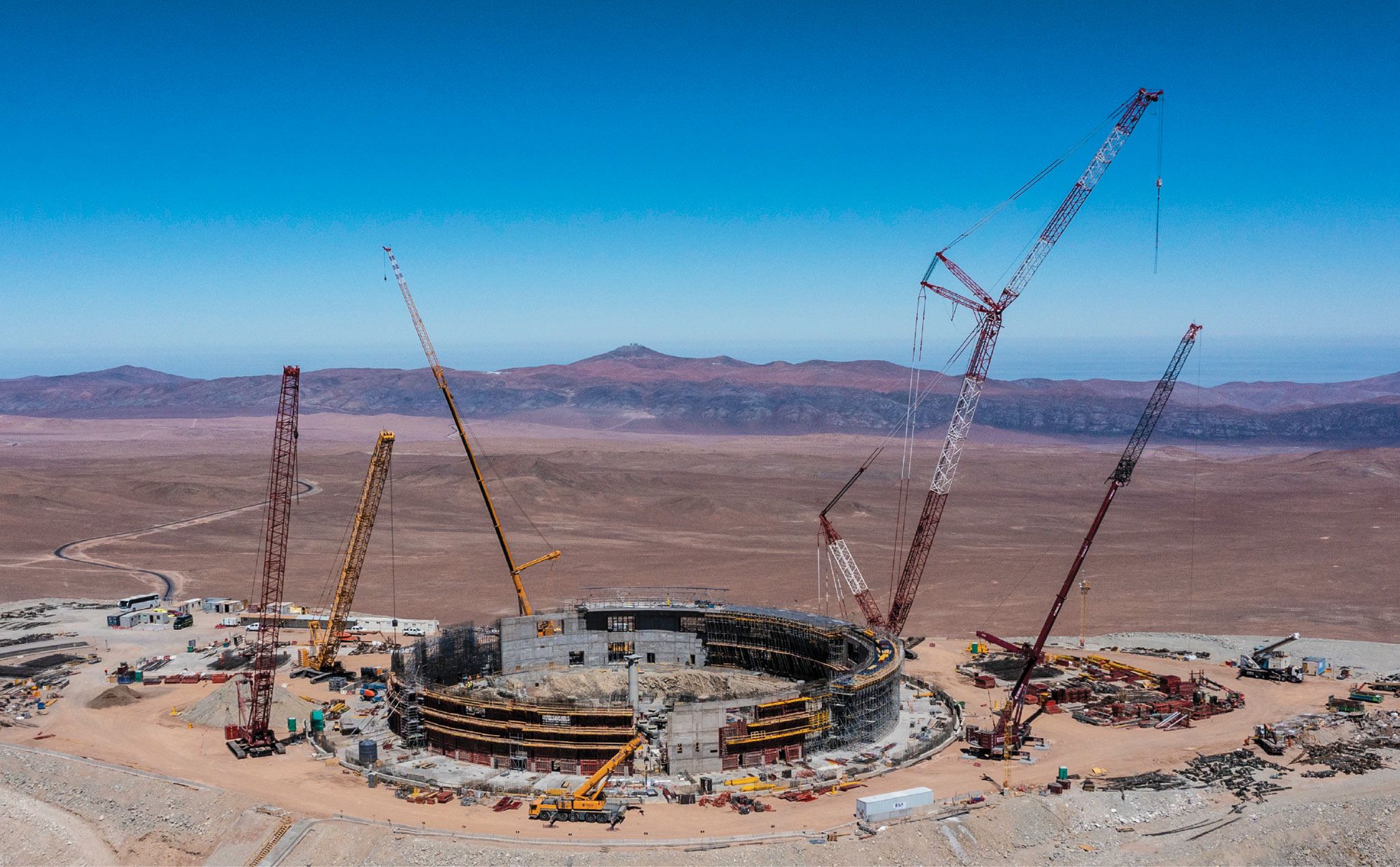
Construction of the Extremely Large Telescope by the European Southern Observatory is in full swing about 3000 meters above sea level on Cerro Armazones in Chile (see the interactive webcam at https://elt.eso.org/about/webcams/ ). The 39-meter telescope is the largest of the proposed next-generation optical–IR telescopes and the only one that is fully funded. It is on track to see first light by the end of this decade.
SIMON LOWERY, ESO STAFF
Funding and other challenges
For the GMT, the big challenge is funding, says Massey. “I’m convinced that we have demonstrated that we know how to build the telescope.”
The TMT, too, is technologically ready, but it faces a web of challenges involving money, international politics, and access—both legally in terms of locating on Mauna Kea and socially as far as addressing Native Hawaiian opposition. The TMT’s backup site, on the Spanish Canary Island of La Palma, comes with other political hurdles. And for either location, the deterioration in US–China relations could cloud China’s continued participation.
Earlier this year, the state of Hawaii established a new governance body for Mauna Kea lands. The 11-member Mauna Kea Stewardship and Oversight Authority will have representatives from the Native Hawaiian community, for which the mountain holds sacred and cultural significance. It will also include stakeholders with expertise in land resource management, public education, and business, as well as representatives from the University of Hawaii and the state’s Board of Land and Natural Resources. Nominees by the state’s governor—including one representing the observatories, Rich Matsuda—still must be confirmed by the state senate. The new body will take over management of—and have extended jurisdiction over—the lands currently managed by the University of Hawaii under the supervision of the Board of Land and Natural Resources.
For astronomy, the most important decisions facing the authority concern access to the land. The current 65-year lease held by the University of Hawaii for 11 000 acres centered on the summit of Mauna Kea—where all of the observatories are located—expires in 2033, as do subleases for each observatory on the mountain. Absent new land authorization, the observatories will need to be decommissioned and the land restored, which could take years. And to go ahead with new projects requires confidence in long-term access. “NSF is unlikely to authorize expenditures for the TMT without a land commitment,” notes Douglas Simons, director of the Institute for Astronomy at the University of Hawaii at Manoa, and a longtime Hawaii-based astronomer. With the new authority having “unprecedented power” and being more representative, he adds, the hope is that “there will be more harmony going forward.”
The new authority’s decisions for land use are needed by 2028—when the transition from the University of Hawaii to the authority is completed. “That’s as late as you can push it,” says Simons. “I have a healthy dose of concern about how much has to be done in the short time available.”
Listening to Native Hawaiians
Meanwhile, in parallel with legal and other planning activities, the TMT team is working to improve relations with the Native Hawaiian community. Fengchuan Liu is the new TMT project manager. Liu is a physicist who had been the TMT deputy project manager and before that had worked on several space missions at NASA’s Jet Propulsion Laboratory. In June 2021, he moved from California to Hawaii and went out to talk to Native Hawaiians, including TMT opponents.
In the past, says Liu, the TMT was successful in connecting with Native Hawaiian families whose kids had access to college education and were interested in science, but not with those who lacked such opportunities or who preferred career paths that would allow them to stay near their land. Like everyone else, Liu says, Native Hawaiian families want their children to have opportunities. “We are learning from the communities and working with the communities.”
The TMT outreach and education team tutors in schools and hosts evenings of storytelling and stargazing. It is collaborating with a community college to provide scholarships, training, and placement in internships and jobs in local businesses, including observatories, with the aim of improving job prospects across many fields. The team is also planning a program through which Native Hawaiian high school students can visit their Indigenous counterparts in TMT partner countries. “All of these programs came through listening and community requests,” says Leinani Lozi, a Native Hawaiian and TMT community outreach specialist.
Rather than asking what it would take to convince the Native Hawaiian community to support TMT construction, Liu says, “we are asking, ‘What can we do for the community? What are the right things to do to build long-term relationships?’” That approach goes beyond the TMT, he says. “It is about the future of astronomy and about how science communities relate to Indigenous people, culture, and lands.”
Kealoha Pisciotta is a Native Hawaiian cultural practitioner who for years worked as a telescope technician on Mauna Kea (see the interview with Pisciotta, Physics Today online, 23 October 2019 ). “I have no qualms about them wanting to help the community,” she says, “but it can’t be transactional.” She is skeptical that such activities will lead to acceptance of the TMT and worries that, unless it works by consensus, the new stewardship authority will steamroll Native Hawaiian voices. “People are fed up with the continual ‘We are going to do better.’ It’s kind of obnoxious,” she says.
Astronomy in Hawaii contributed $221 million to the economy in 2019 and was responsible for more than 1300 jobs, according to a January 2022 report by the University of Hawaii Economic Research Organization. The local economy would take a hit if astronomy were to leave Mauna Kea, Pisciotta admits, “but I think people are more interested in protecting the land.” Native Hawaiians are not against astronomy, she emphasizes, but, noting that the community has “had to sue to get the telescopes to follow the law,” she says that astronomers and other users of Mauna Kea “have acted in bad faith for too long.”
The Office of Hawaiian Affairs (OHA), a quasi-autonomous state body that advocates for Native Hawaiians, wrote NSF on 17 September in response to public hearings held this past summer. The office recommends that the agency delay its environmental review of Mauna Kea. “OHA does not advise gambling on overly optimistic and presumptuous lease expectations,” the letter says. Given the change in authority over the mountain, it says, delaying the review would be the rational approach and would also be “respectful of the new authority’s position and prerogative.”
Still, with NSF’s involvement making the federal government a player, more opportunities for negotiating are possible, says Simons. He points to the 2011 deal for the solar telescope on Maui, which included $20 million over a decade to train Native Hawaiians in science, technology, engineering, and math fields at the University of Hawaii Maui College. A similar arrangement may be possible for the TMT, he says, “but with more money, plus other creative solutions, and involvement of community voices in important decisions.”
Other areas for negotiation include capping the number of telescopes on the mountain, hiring more Native Hawaiians at the observatories, taking measures to help endangered species, and paying more rent—under the current lease, the observatories pay $1 per year to the state and grant the state’s astronomy program at the University of Hawaii 10–15% of telescope time. “Sometime, many decades in the future,” says O’Meara, “there should be no more telescopes on the mountain. That’s part of the commitment we should make.”
If Mauna Kea doesn’t pan out for the TMT, plan B is to build it on La Palma. That site would allow most of the science, but it comes with different twists. Many astronomers worry that NSF won’t invest in the TMT if it’s not on US soil; it’s different for the GMT because the US has no territory in the Southern Hemisphere and has a long history of astronomy investments in Chile.
More about the authors
Toni Feder, tfeder@aip.org