Undergraduate students grapple with an uncertain future


It is an understatement to categorize the past year as a period of significant upheaval for STEM students. Recent changes in science policy have introduced grant retractions, funding cuts, 1 and a marked reduction in graduate program admissions. (See, for example, PT ’s 2025 news stories “Physics, astronomy graduate admissions in the US expected to shrink amid funding uncertainty ” and “Funding uncertainties muddle graduate admissions .”) Compounded by the rapid integration of AI and automation, both the physical sciences labor market and the standard physicists’ and astronomers’ toolkit are shifting. Those developments are fundamentally altering how students and early-career scientists perceive their professional viability.
To evaluate the concerns of the next generation of scientists, the Society of Physics Students (SPS) and Sigma Pi Sigma, organizations of the American Institute of Physics (AIP, publisher of Physics Today), conducted a survey last year at the Physics and Astronomy Congress, the largest conference for undergraduate physics and astronomy students. Echoing the surveys that had been conducted at the 2016, 2019, and 2022 congresses, the 2025 survey asked undergraduates to identify the two most important issues currently facing students.
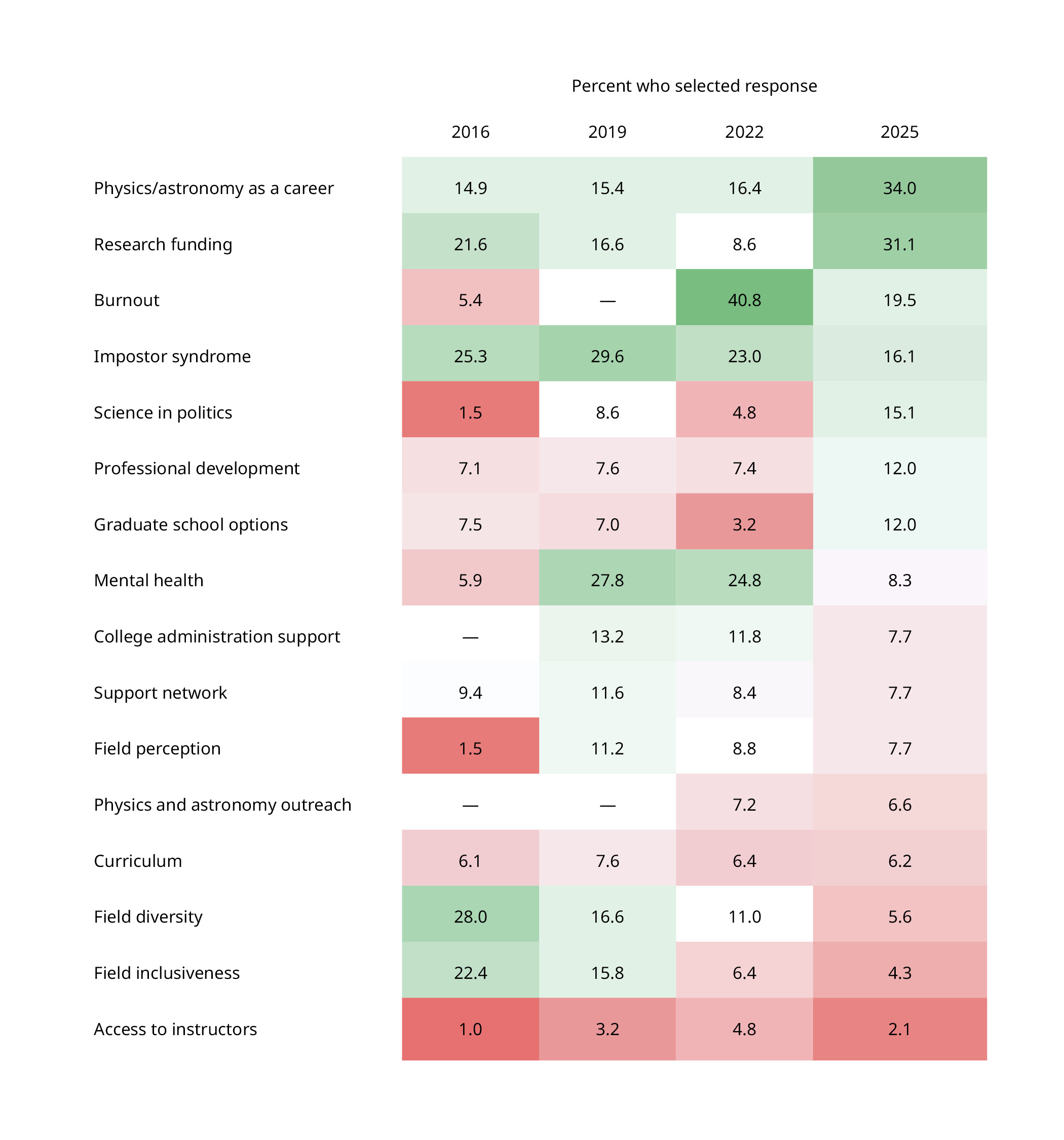
The series of surveys provides a unique pulse check on the concerns of undergraduates in the physical sciences. The last decade of data, shown in the table below, reveal a shifting landscape of student anxiety. In 2016, respondents expressed the most concern over field diversity and impostor syndrome (also known as impostor phenomenon, self-doubt despite evidence of success), whereas in 2019, respondents’ concern about mental health had grown sharply. By 2022, students identified burnout as a critical systemic hurdle. (For Conrad and Wright’s summary of the 2022 survey findings, see their 2023 PT article “Helping the pandemic generation .”)

Percentage of surveyed students who chose each issue as one of the top two that are facing physics and astronomy students. Surveys were conducted at Sigma Pi Sigma’s triennial Physics and Astronomy Congress between 2016 and 2025. Results are shaded according to their rank on the list, with the most chosen answers for a given year in green and the least chosen answers in red. Dashes indicate that a response option was not available that year.

The most recent data show that the focus has shifted again. Today’s students are increasingly stressed by the overarching uncertainty of science’s future. One student noted, for example, “the feeling that there aren’t enough jobs and that most will be unemployed or forced to work outside the field.” The convergence of fiscal instability, uneasiness about physics and astronomy as a viable career path, and technological disruptions risks a significant brain drain as students may pivot away from research toward more stable or lucrative majors and roles.
An uncertain outlook
The latest survey was administered after students at the conference had discussed their individual concerns in small groups. The survey was completed by 483 students. The first question asked students to identify the two most important issues facing them, their physics and astronomy clubs, and their colleagues. Students couldn’t select more than two. As shown in the table, the top five concerns were physics or astronomy as a career, research funding, burnout, impostor syndrome, and science in politics.
Valuable insights were also gained from students’ open-ended responses expanding on what they felt was the most important issue facing them and their peers. Across nearly all responses, students described a shared feeling of uncertainty about the future despite strong motivation and love for physics and astronomy. Survey data reveal five pervasive concerns:
Doubt driven by funding instability. Students overwhelmingly identified unstable funding as a root cause of concern about internships, graduate admissions, and long-term careers, with 31% of respondents selecting research funding among their top two concerns. Many students said that they perceive physics as an elite, shrinking field where opportunity depends more on timing or funding than on merit. For example, one student said, “Students are expected to do internships, REUs [Research Experiences for Undergraduates programs], research, conferences, presentations, et cetera, et cetera, to even have a shot at graduate school or a career, but with so much uncertainty in funding, this makes these opportunities inaccessible for most, if not all, students.” Widespread reductions in funding for graduate students and basic science have led to shrinking research opportunities, department closings, and a decreasing number of graduate seats. Many students reported that anti-intellectualism is directly threatening the future of science.
Severe career uncertainty. Many students reported insufficient preparation for pursuing career paths outside of academia. Though most recipients of physical sciences bachelor’s degrees end up in the private sector, students said that they feel unprepared to translate their skills to industry, that they lack career pathway exposure, and that they see graduate school as both the only option and increasingly unattainable. One student wrote, “I think that as of today many physics students are worried about finding viable careers. It seems that every job that a physics major applies to requires a PhD or postdoc, leaving many of us who desire to enter industry feeling like backup options to engineering or data science majors.” The percentage of surveyed students who chose “physics/astronomy as a career” as the most important issue they are facing more than doubled—from around 15% in 2016 to 34% in 2025—a reflection of how anxious undergrads are about what comes after graduation.
Burnout, mental health strain, and impostor syndrome. High expectations and competition in research, internships, coursework, and leadership amid shrinking opportunities are producing widespread burnout, anxiety, and loss of confidence, students reported. Students did not frame those struggles as personal weakness but as a consequence of unrealistic norms, inadequate support, and constant pressure to compete in an increasingly constrained system. Many students questioned whether they belong or whether their efforts will ever be enough. Those issues have been present in the four cohorts studied. (For an analysis of the mental health issues faced by physics and astronomy PhD students, see the April 2026 PT article “Building graduate programs that support mental well-being ,” by Patrick Banner, Kellen O’Brien, and Chandra Turpen.)
Inequitable access, lack of advising, and declining inclusivity. Students from small institutions, rural areas, community colleges, low-income backgrounds, other countries, and marginalized groups reported fewer opportunities, inferior advising, and less support than students with more resources or from overrepresented groups. Many said they feel isolated, unheard, or unsupported. Many students reported a feeling that inequality is increasing and that there is strong retrograde motion against recent gains in inclusivity. (To read about alternative course structures aimed at reducing barriers for physics students, see PT ’s October 2025 article “Reframing the narrative on physics readiness ,” by Suzanne White Brahmia and Geraldine L. Cochran.)
Erosion of trust in the educational model. Students expressed concern that AI is undermining learning, academic integrity, and critical thinking and that curricula feel disconnected from jobs and societal needs. Many questioned whether their education prioritizes grades and abstraction over understanding, applicability, community, and joy, and that prioritization led students to doubt whether getting a degree is worth it. It was not clear to students whether AI will be beneficial in their future careers.
Though students articulated many concerns, they also demonstrated commitment to problem-solving and a love of discovery. After completing the initial survey individually, students at the conference broke into groups based on their geographic regions and discussed their strengths, concerns, and ideas for solutions. Students from around the country felt they had persistence, perseverance, grit, and resilience. They demonstrated hopefulness, resolve, and a sense of community. Students were deeply interested in helping their colleagues and expressed a need for tangible actions to address the challenges they face.

Students at the 2025 Physics and Astronomy Congress in Denver, Colorado.
(Photo courtesy of AIP.)

Students at the 2025 Physics and Astronomy Congress in Denver, Colorado.
(Photo courtesy of AIP.)

Students at the 2025 Physics and Astronomy Congress in Denver, Colorado.
(Photo courtesy of AIP.)

Students at the 2025 Physics and Astronomy Congress in Denver, Colorado.
(Photo courtesy of AIP.)

Students at the 2025 Physics and Astronomy Congress in Denver, Colorado.
(Photo courtesy of AIP.)

Students at the 2025 Physics and Astronomy Congress in Denver, Colorado.
(Photo courtesy of AIP.)
When prompted with the question, “If you could ask the greatest minds in the world to solve one problem that you’ve talked about today, what would it be?,” students synthesized their concerns into actionable focus areas. Brainstorming sessions revealed a sophisticated understanding of the scientific ecosystem. Rather than requesting passive aid, students proposed solutions rooted in advocacy and communication.
Many proposals focused on restoring public trust in science through grassroots outreach, improving science lobbying, and making complex research more accessible to the layperson. By framing science communication as a solution to fiscal instability, students demonstrated a clear resolve to bridge the gap between the laboratory and the public sphere. The exercise generated significant, actionable ideas for academic departments. The ideas included engaging with alumni, promoting the full variety of career paths for physics and astronomy students, strengthening connections between courses and industry skills, and highlighting options other than graduate school, since about half of undergraduates go straight into the workforce.
Path forward: Using community resources
The survey confirmed that physics and astronomy undergraduates remain exceptionally bright and eager but are profoundly troubled by the current state of science and a perceived scarcity of career pathways. Though our field excels at solving technical problems, those social and systemic challenges are directly affecting student retention and mental health.
Fortunately, our community has already developed robust, research-validated resources to address those challenges. We urge departments to integrate the following resources into their undergraduate programming:
Effective Practices for Physics Programs (EP3). 2 The EP3 guide provides a framework of effective practices for physics departments. It was developed and reviewed by experts in the physics community under the auspices of the American Physical Society and American Association of Physics Teachers. Beyond curricula, the guide provides evidence-based techniques for student retention and departmental health. It is an essential toolkit for all departments. (For more about the EP3 guide, see the 2025 PT article “Helping physics departments thrive ,” by David Craig, Michael Jackson, and Theodore Hodapp.)
TEAM-UP report. 3 The TEAM-UP findings on belonging, physics identity, academic support, personal support, and leadership provide a blueprint for supporting all students who are marginalized or uncertain about their place in the field.
SPS Careers Toolbox. 4 This comprehensive, step-by-step guide is designed to help students transition from the classroom to professional roles. It demystifies the job search process for those not pursuing the traditional academic route.
Proactive steps that departments can take to support students include the following:
More career education. Physics and astronomy graduates remain in high demand in fields including quantum science, medical physics, robotics, additive manufacturing, biomanufacturing, semiconductors, cybersecurity, and data science. By highlighting high-growth areas, departments can help students more easily connect their skill sets to a wide variety of career paths. Faculty can host speakers who have common career paths, such as those who work in industry and advanced manufacturing.
Strengthening industry ties. Academic and industry leaders must collaborate to teach career-relevant knowledge, skills, and abilities for future-looking occupations. The academic community benefits from building internships, research experiences, and co-ops, and the community at large should work together to make those opportunities available. Participating in industry-led organizations focused on technology adoption and workforce training can help faculty accelerate course development and student placement in technology sectors.
Advocacy and agency. Encourage science advocacy. Writing letters to policymakers, engaging in science communication, and participating in outreach are some of the many ways that students can improve their self-efficacy and have a sense of control.
The physics and astronomy community is not powerless to address the concerns of students. Scientific research is undeniably affected by a dynamic funding landscape. But professors, department staff, industry leaders, government lab personnel, and the national science societies can take action to help students feel confident in their choice to study physics and astronomy. Though students are currently feeling the weight of macroeconomic uncertainty, we must reassure them that they have indisputable skills that are applicable across broad sectors. By providing the right tools, mentorship, and perspective, we can ensure the next generation of scientists moves from a state of apprehension to one of empowered discovery.
References
1. J. Mervis, “Exclusive: NSF director to resign amid grant terminations, job cuts, and controversy ,” Science, 24 April 2025.
2. S. B. McKagan et al., eds., “A Guide to Effective Practices for Physics Programs ,” American Physical Society (2021).
3. AIP National Task Force to Elevate African American Representation in Undergraduate Physics & Astronomy, The Time Is Now: Systemic Changes to Increase African Americans with Bachelor’s Degrees in Physics and Astronomy , AIP (2020).
4. American Institute of Physics Career Pathways Project, Careers Toolbox for Undergraduate Physics Students & Their Mentors , 4th ed., AIP, SPS (2017).
More about the authors
Shannon Clardy is dean of the Caver College of Aviation, Science, and Nursing at Henderson State University in Arkadelphia, Arkansas, and a co-chair of the Executive Program Committee planning the 2028 Physics and Astronomy Congress.
Brad Conrad is a member of the Executive Program Committee for the 2028 Physics and Astronomy Congress and was also on the committee for the 2025 congress.
Matthew Wright is chair of the physics department at Adelphi University in Garden City, New York. He was a member of the 2025 Physics and Astronomy Congress’s Executive Program Committee.