Willful ignorance of the global impact of nuclear war


Nuclear weapons were created during the 1940s and first used by the US in 1945. In the following years, more countries built weapons, existing arsenals grew in size, and city-destroying fission weapons gave way to fusion weapons, which are even more destructive. As the US, followed by the Soviet Union, began developing military strategies and plans for how to use the weapons in substantial numbers, global concern grew about the large-scale, long-term effects of nuclear war. In a 1958 memo to President Dwight D. Eisenhower that described a nuclear war exercise, Robert Cutler, his special assistant for national security affairs, observed, “The effect of any such exchange is quite incalculable.” Cutler noted that no one knew what such a war would do to “the weather, to crop cycles, to human reproduction, to the population of all areas of the world (whether or not directly exposed to the detonation). It is possible that life on the planet might be extinguished.” 1
Conducted between the mid 1940s and mid 1970s, early studies of the global consequences of nuclear war focused primarily on the long-term health impacts of radioactive fallout and the environmental effects caused by dust and nitrogen oxides produced during the explosions. In particular, studies found that dust lifted into the stratosphere by near-surface nuclear explosions force the cooling of Earth’s surface and that nitrogen oxides produced in atmospheric nuclear explosions cause destruction of the ozone layer and expose Earth’s surface to dangerous levels of UV radiation. 2 But it took until the early 1980s for Soviet and US scientists to learn that smoke from fires resulting from a nuclear blast could block out enough sunlight to plunge surface temperatures below freezing and produce what is called a nuclear winter. 3 Those catastrophic outcomes helped motivate Soviet General Secretary Mikhail Gorbachev and US President Ronald Reagan to end the Cold War nuclear arms race, begin drastic cuts in arsenals, and declare in Geneva in 1985 that “a nuclear war cannot be won and must never be fought .”
But the world has changed since that declaration 40 years ago. Today, nine nuclear-armed states, several of which have recently been or are currently at war, control a growing arsenal of roughly 12 000 nuclear weapons and have strategies for how to use them. 4 At the same time, policies intended to regulate the weapons are weakening. In February 2026, New START, the last international strategic nuclear arms control treaty designed to cap the largest nuclear arsenals, expired with no prospect for a follow-on. And in May, the five-yearly Nuclear Non-Proliferation Treaty Review Conference, which evaluates the state of the 65-year-old agreement, failed for the third consecutive time since 2010 to reach a consensus about the treaty’s implementation and progress, reinforcing a sense of a worsening crisis in the nuclear order.
Two reports from 2024 and 2025 published by the US National Academies of Sciences, Engineering, and Medicine (NASEM) demonstrate that even in the context of increased nuclear threats and reduced regulations, the global and catastrophic impacts of nuclear war are being ignored. The 2024 report describes nuclear war consequence models developed by the Defense Threat Reduction Agency (DTRA) for the Department of Defense: “DTRA provides estimates of the impact of nuclear weapons. The consequence assessment is focused on prompt effects and military objectives. This results in a partial accounting of the consequences leading to a limited understanding of the breadth of the outcomes.” The report notes that “current modeling by DoD’s DTRA of the consequences of nuclear explosions resulting from strategic deterrence failure are limited to prompt military effects, especially detonation (blast) and some fallout effects, and does not extend to broader and longer-term effects.” 5
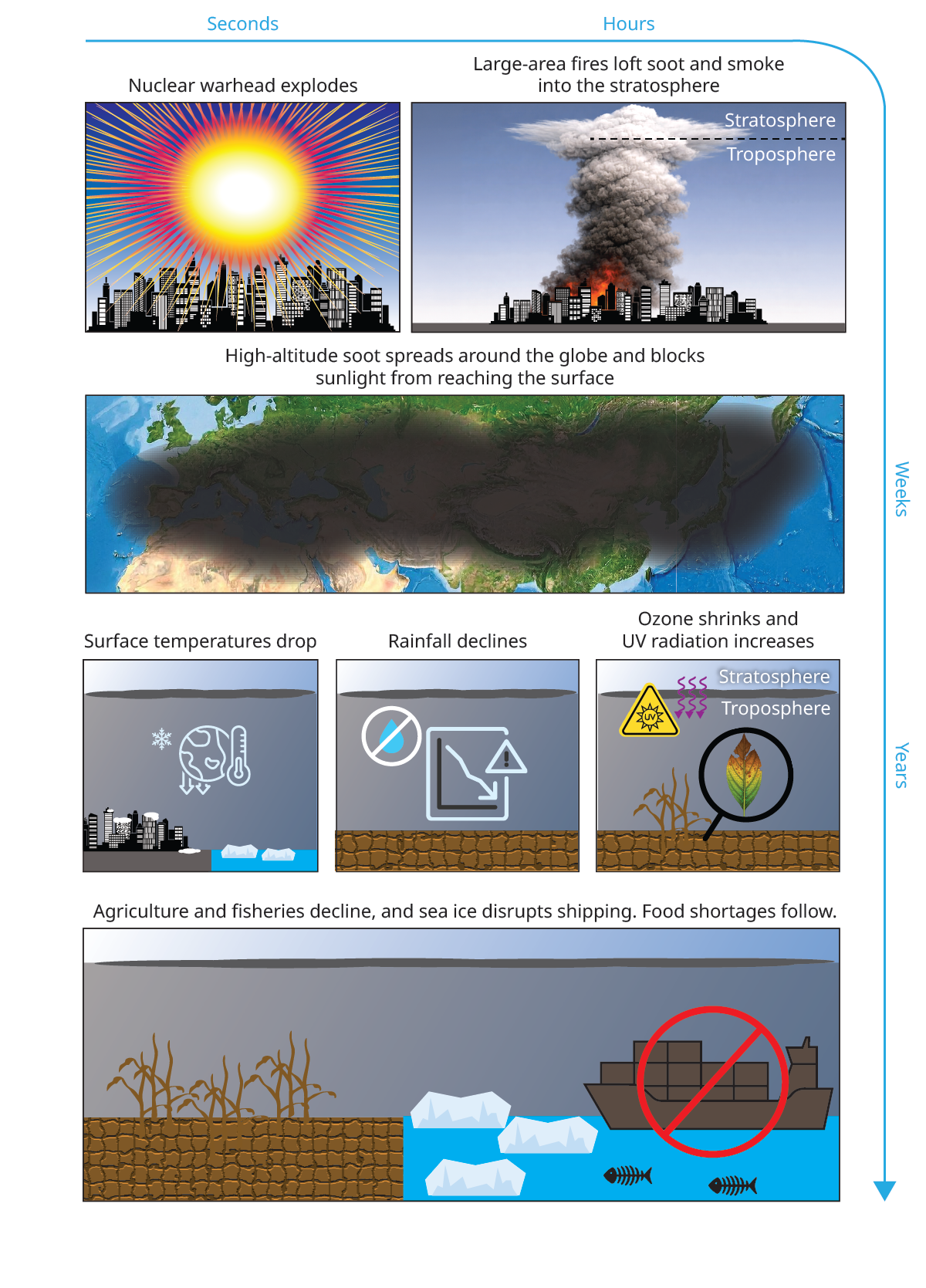
Figure 1.

Smoke from fires ignited by nuclear weapons could block sunlight for years, which would make Earth’s surface dark, dry, and cold. The disruption to agriculture and fisheries would lead to global famine.
(Image adapted from ref. 7 .)

To address that gap in understanding, the 2024 report also highlights that “there is a need to better understand other physical effects of nuclear weapons (e.g., fires, damage in modern urban environments, electromagnetic pulse effects, and climatic effects, such as nuclear winter), as well as the assessment and estimation of psychological, societal, and political consequences of nuclear weapons use.” 5 The 2025 NASEM report provides some insight into those questions by echoing the understanding from the 1980s that smoke injected into the stratosphere from a nuclear war would trigger a nuclear winter, with the potential to “alter life on Earth to a degree never seen before in human history,” including through disruptions to the “food chain and production ecosystem” (reference 6 , page xiii). Given what is already known, it is clear that nuclear war threatens the security and well-being not only of nuclear-armed states but of the whole world.
Although there is still much to be understood about many consequences of nuclear weapons use, climate models that can render the global impacts of nuclear war have seen big advances since the 1980s. Modern computers allow for detailed climate models that simulate global environmental processes, including the climate response to nuclear war and its effects on land, oceans, sea ice, and food security. In this article, we review what is known about nuclear winter and discuss the urgent need to incorporate current knowledge into national and international policy debates and decisions about nuclear weapons.
Global climate and food impacts
Nuclear winter is not just a drop in temperature after a war; it’s a broader Earth system response across the atmosphere, the ocean, sea ice, and ecosystems. If nuclear weapons are used on cities and industrial areas, many large fires could start at the same time, producing large amounts of black smoke that could affect climate around the world 7 (see figure 1 ). Simulations of a regional nuclear war between India and Pakistan show that even a smaller-scale use of nuclear weapons that injects 5 teragrams (Tg)—equivalent to 5 million metric tons—of black smoke into the stratosphere could produce climate change effects unprecedented in recorded human history. 8 (For more about those simulations, see the 2008 PT feature article “Environmental consequences of nuclear war ,” by Brian Toon, Alan Robock, and Rich Turco.) Several other climate modeling groups have simulated the impact of smoke injections of comparable sizes and seen similar results. 9 Larger scenarios, linked to wars between the US and Russia or the US and China, could produce smoke injections of 150 Tg. Smoke would reduce sunlight, drop global average temperature and precipitation, and shorten growing seasons for several years. The amplitude of the impacts would scale with the total amount injected. After a large-scale nuclear war, the ocean would respond more slowly than the atmosphere but remain changed for a longer time because of its massive thermal inertia.
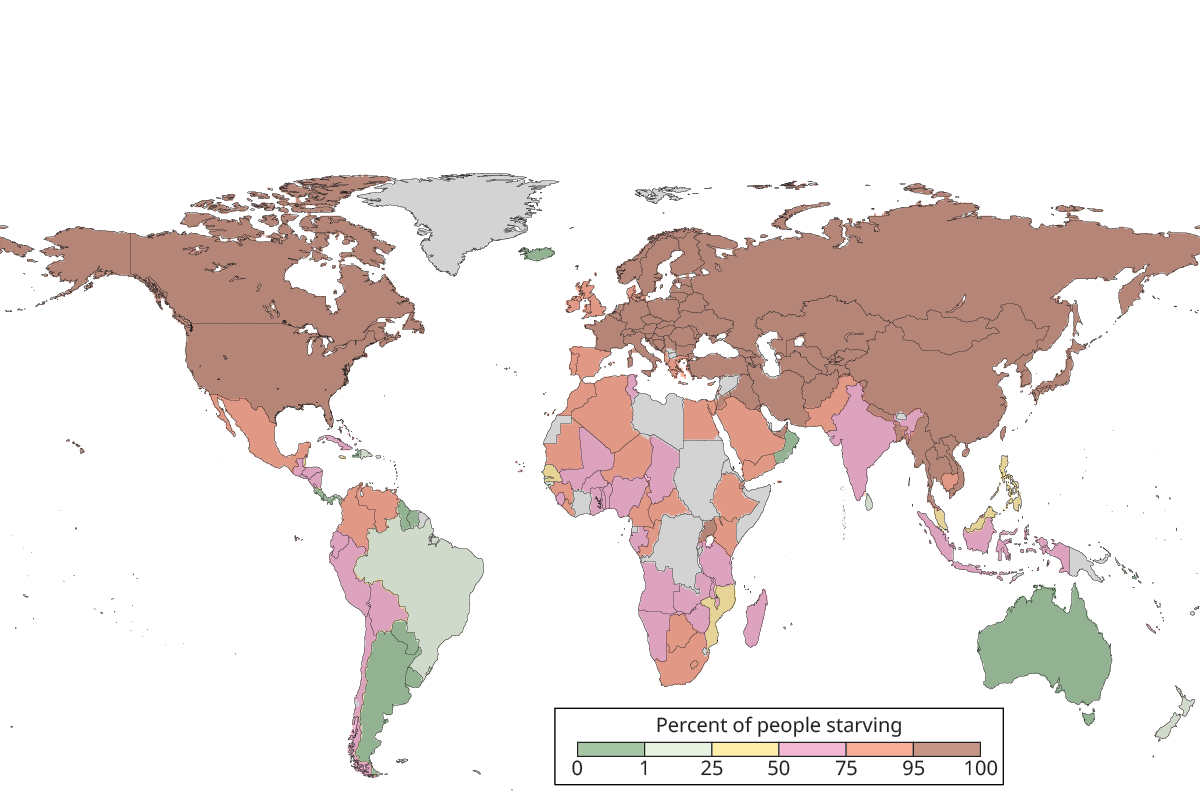
Figure 2.

A nuclear war could result in widespread famine. The plotted calculations estimate the percentage of each country’s population that would starve in the second year after a US–Russia nuclear war that injected 150 million metric tons of black smoke into the stratosphere. The estimates assume that international trade stops, food waste is eliminated, stored food is consumed in the first several months after the war, half of the livestock are consumed in the first year, and the remaining half of livestock crop feed is redirected for human consumption. Each country’s available calories are assumed to be distributed to only part of the population, at the minimum intake needed to maintain normal physical activity; the remaining population fraction is counted as starving. Under those assumptions, about 6 billion people would die from famine.
(Image adapted from A. Robock et al., “Opinion: How fear of nuclear winter has helped save the world, so far ,” Atmos. Chem. Phys. 23, 6691, 2023.)

For human society, the biggest effect would likely come from the food supply pipeline. Lower temperatures, less sunlight, and reduced rainfall would hurt crop production on land, while colder and darker ocean conditions would reduce marine food production. Using several crop models, Jonas Jägermeyr and colleagues found that a 5 Tg black-smoke injection would reduce global production of maize, wheat, rice, and soybeans by about 12% in the first year. 10 That loss is much larger than the effects of the worst recorded natural variations in those crops. To evaluate black-smoke injections of 5–150 Tg, two of us (Xia and Robock) and colleagues combined climate simulations with crop, fishery, and livestock models and found that the food impacts would be global and severe. 11 Simulations also show that the ocean would cool quickly at the surface after injected smoke reached the stratosphere; the resulting expanded sea ice would influence marine fisheries by disrupting the ocean food web. 12 In larger smoke-injection scenarios, sea ice would expand to block some ports that are now ice-free and thus could exacerbate food shortages.
In smaller nuclear war scenarios, famine could threaten 1 billion to 2 billion people. In the largest case, linked to a US–Russia war, the climate effects on food production could threaten most of Earth’s population. (To see where famine would occur, see figure 2 .) The damage would not stop at production; international food trade itself could be strongly disrupted, especially if major exporting countries are also hit by large crop losses. 13 The estimated impacts still have many uncertainties and do not yet include losses of infrastructure, transportation, fertilizer, seeds, labor, or social stability. The estimates also do not include the impacts of radiological fallout or the effects of increased UV radiation, the latter of which would be caused by nuclear war–induced ozone loss. 14 For those reasons, current models likely underestimate the full human and ecological consequences.
What we still do not know
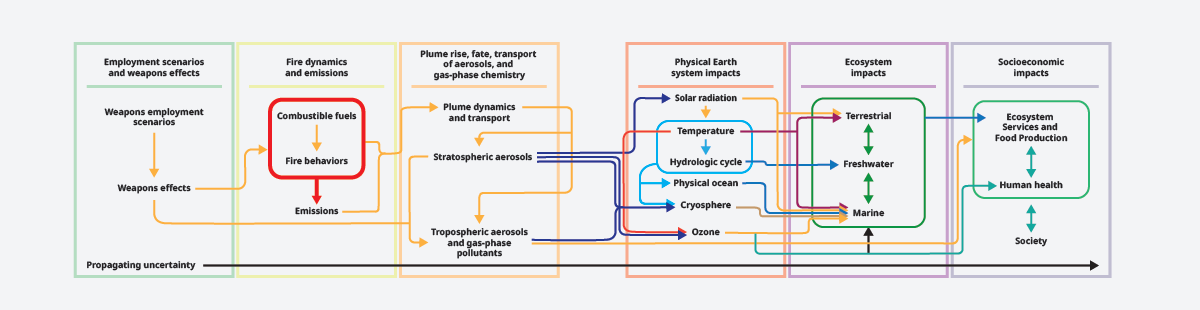
Although modern models have greatly improved the understanding of what happens after black smoke from nuclear weapons–induced urban fires reaches the stratosphere, key uncertainties remain. The 2025 NASEM report highlights those uncertainties, beginning with the war itself. For example, where is the war fought, what kinds and how many weapons are used, and what targets are hit? Other uncertainties are related to the spread of resulting fires and the subsequent smoke. For example, how much fuel is available to burn in cities and industrial areas, how do fires spread through damaged urban areas, and how much black smoke is produced? Questions also remain about how environmental conditions, such as weather, humidity, and topography, could change the results. (See figure 3 for a flow chart that illustrates many of the uncertainties.) The 2025 report emphasizes that better urban fuel data, fire models, and emissions estimates for built environments are needed.
Figure 3.

The issues that need to be better understood to quantify the impacts of nuclear war on humanity are often interconnected. A key unknown is the one inside the red box: How will combustible fuels respond and the resulting fires behave after nuclear attacks on cities and industrial areas?
(Figure adapted from ref. 6 , fig. S-1; reproduced with permission from the National Academy of Sciences, courtesy of the National Academies Press.)

Another major uncertainty is the quantity and chemistry of black smoke that is injected into the stratosphere. Dynamic factors such as rain can impact the quantity of smoke that stays in the lower atmosphere, and smoke that reaches the upper troposphere or stratosphere can last much longer and spread much wider. To better understand those dynamics, the report calls for better smoke-resolving fire models and more use of observations from wildfire pyrocumulonimbus events—the fire-induced formation of cumulonimbus clouds—to test them.
In their 2025 report, the NASEM authors recommend more funding to examine the details of the different spatial and temporal scales of nuclear war effects and of the complex interconnections between smoke’s aerosol properties, clouds, the ocean, ozone chemistry, food production and trade, human health, and social disruption. 6 The question, then, is no longer whether nuclear war could produce severe environmental effects but how to better model its full catastrophic trajectory, from nuclear arsenals, war plans, and fires to the resultant impacts on climate, society, and human survival.
Policy and research implications
Physicists invented nuclear weapons 80 years ago. Today, scientists remain key to developing, maintaining, and modernizing nuclear arsenals. But they also have a special obligation to understand and explain the full spectrum of existing and potential harms of nuclear weapons. In support of that view, the science academies of the G7 countries (Canada, France, Germany, Italy, Japan, the UK, and the US) in a 2024 joint statement declared that the scientific community has an important role in developing and communicating an “evidence base that shows the catastrophic effects of nuclear warfare on human populations and on the other species with which we share our planet.” Scientists need to engage policymakers, armed forces, and the public to consider what actions can be taken, given the fundamental threat that nuclear weapons and nuclear war pose to the populations of warring nations as well as to humanity and nature as a whole.
One practical need is coordinated national and international studies, conducted by researchers from universities, national and UN agencies, nuclear weapons laboratories, and militaries, on the effects of nuclear war. 15 Among the recommendations in the 2025 NASEM report is to conduct studies on the physical effects of nuclear wars and the attendant ecological, societal, political, economic, and psychological effects over subsequent decades. 6
In the US, however, no funding for studying the issues is available from key federal government agencies, even those that have previously supported work on the many impacts of climate change. Nuclear strategists have argued that focusing too much on the humanitarian impacts of using nuclear weapons could undermine national nuclear deterrence efforts by signaling that the US might not use its weapons out of concern for the climate. 16
To advance studies on the effects of nuclear war, we recommend that Congress take up the recommendations of the Physicists Coalition for Nuclear Threat Reduction , a group that supports the reduction of nuclear threats through mobilizing advocacy across international communities of physical scientists. Congress should also require DTRA to model all nuclear weapons effects that are missing from their analyses and to include those findings in planning and decision-making at all levels.
There is room for international action as well. Work done by the Princeton University Program on Science and Global Security and the Scientific Advisory Group of the Treaty on the Prohibition of Nuclear Weapons (TPNW) 17 influenced the United Nations General Assembly to vote overwhelmingly in December 2024 to establish an expert panel to study the effects of nuclear war. The new study, the first of its kind in 35 years, is examining the physical effects and societal consequences of nuclear war on local, regional, and planetary scales. The effort includes looking at the climatic, environmental, and radiological effects and the impacts on public health, global socioeconomic systems, agriculture, and ecosystems. 18 The results of the study are to be published in 2027 and will add to global awareness of the problem and the urgency to address it. The TPNW, which prohibits nations from developing, testing, stockpiling, using, or threatening to use nuclear weapons, has already been joined by 100 countries—a global majority—and provides a mechanism to take action on nuclear disarmament.
References
1. Z. Mian, “Nuclear war effects and scientific research: Time for a 21st century UN study ,” First Committee Monitor, Reaching Critical Will, 4 October 2024, p. 15.
2. J. Schell, The Fate of the Earth, Knopf (1982).
3. R. P. Turco et al., “Nuclear winter: Global consequences of multiple nuclear explosions ,” Science 222, 1283 (1983); V. V. Aleksandrov, G. L. Stenchikov, On the Modelling of the Climatic Consequences of the Nuclear War , Computing Center, USSR Academy of Sciences (1983).
4. H. Kristensen et al., “Status of World Nuclear Forces ,” Federation of American Scientists (26 March 2025).
5. National Academies of Sciences, Engineering, and Medicine, Risk Analysis Methods for Nuclear War and Nuclear Terrorism: Phase II , National Academies Press (2024), pp. 19, 20.
6. National Academies of Sciences, Engineering, and Medicine, Potential Environmental Effects of Nuclear War , National Academies Press (2025).
7. C. Harrison et al., “Accessible climate and impact model output for studying the human and environmental impacts of nuclear conflict ,” Geosci. Data J. 13, e70076 (2026).
8. A. Robock et al., “Climatic consequences of regional nuclear conflicts ,” Atmos. Chem. Phys. 7, 2003 (2007); A. Robock, L. Oman, G. L. Stenchikov, “Nuclear winter revisited with a modern climate model and current nuclear arsenals: Still catastrophic consequences ,” J. Geophys. Res. 112, D13107 (2007).
9. A. Stenke et al., “Climate and chemistry effects of a regional scale nuclear conflict ,” Atmos. Chem. Phys. 13, 9713 (2013); M. J. Mills et al., “Multidecadal global cooling and unprecedented ozone loss following a regional nuclear conflict ,” Earth’s Future 2, 161 (2014); B. M. Wagman et al., “Examining the climate effects of a regional nuclear weapons exchange using a multiscale atmospheric modeling approach ,” J. Geophys. Res. Atmos. 125, e2020JD033056 (2020); A. Ranjithkumar et al., “Nuclear conflict in Eastern Europe: Climate disruption and radiological fallout ,” npj Clean Air 2, 28 (2026).
10. J. Jägermeyr et al., “A regional nuclear conflict would compromise global food security ,” Proc. Natl. Acad. Sci. USA 117, 7071 (2020).
11. L. Xia et al., “Global food insecurity and famine from reduced crop, marine fishery and livestock production due to climate disruption from nuclear war soot injection ,” Nat. Food 3, 586 (2022).
12. K. J. N. Scherrer et al., “Marine wild-capture fisheries after nuclear war ,” Proc. Natl. Acad. Sci. USA 117, 29748 (2020); J. Coupe et al., “Nuclear winter responses to nuclear war between the United States and Russia in the Whole Atmosphere Community Climate Model version 4 and the Goddard Institute for Space Studies ModelE ,” J. Geophys. Res. Atmos. 124, 8522 (2019); C. S. Harrison et al., “A new ocean state after nuclear war ,” AGU Adv. 3, e2021AV000610 (2022).
13. F. U. Jehn et al., “Food trade disruption after global catastrophes ,” Earth Syst. Dyn. 16, 1585 (2025).
14. S. Yook et al., “Arctic ozone hole and enhanced mid-latitude ozone losses due to heterogeneous halogen chemistry following a regional nuclear conflict ,” Earth’s Future 13, e2025EF006866 (2025).
15. Information on nuclear war effects can be found at the Princeton University Program on Science and Global Security, “Global Environmental Effects of Nuclear War: Introductory Resource Guide ”; A. Robock, “Climatic Consequences of Nuclear Conflict: Nuclear Winter is Still a Danger ”; O. B. Toon, A. Robock, Earth in Flames: How an Asteroid Killed the Dinosaurs and How We Can Avoid a Similar Fate from Nuclear Winter , Oxford U. Press (2025).
16. National Academies, “Environmental effects on nuclear war: Meeting #2 ,” Vimeo (24 May 2023).
17. Z. Mian, “We need a U.N. study of the effects of nuclear war ,” Scientific American, 28 October 2024.
18. United Nations Office for Disarmament Affairs, “Panel on the Effects of Nuclear War ”.
More about the authors
Alan Robock is a distinguished professor in the department of environmental sciences at Rutgers University–New Brunswick in New Jersey in New Brunswick, New Jersey.
Lili Xia is an assistant research professor in the department of environmental sciences at Rutgers University–New Brunswick in New Jersey in New Brunswick, New Jersey.
Zia Mian is codirector of the Program on Science and Global Security at Princeton University in New Jersey.