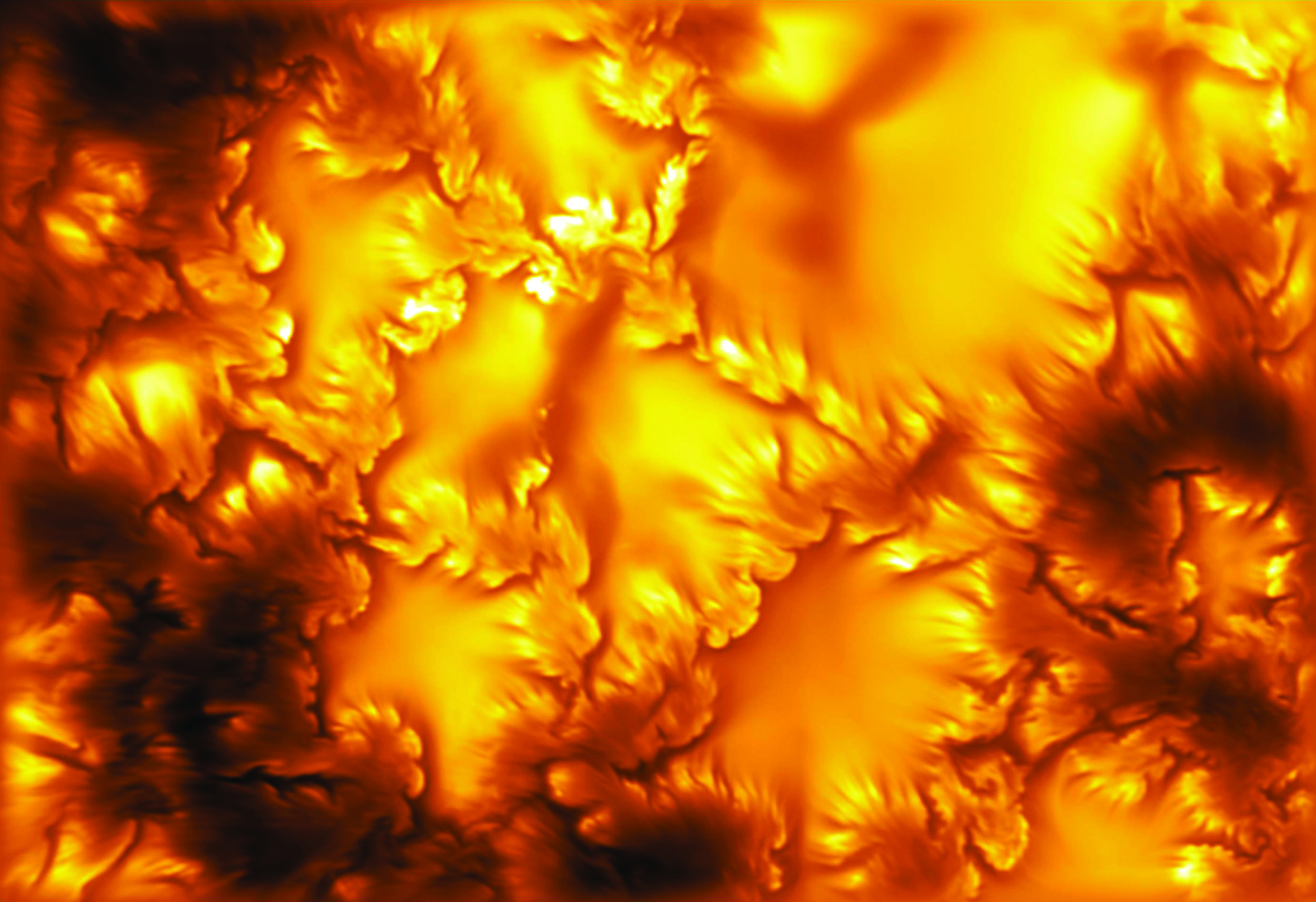
A close-up of the Sun


(Image by NSF/NSO/AURA/MPS/CC BY-NC-ND .)

Using the world’s largest solar telescope, researchers have for the first time observed vortices called Kelvin–Helmholtz instabilities (KHIs) on the Sun’s photosphere, the layer of the star commonly referred to as its surface. 1 The structures, which are visible where the surface appears to billow, were captured by the NSF Daniel K. Inouye Solar Telescope in the highest-resolution image to date of the Sun’s photosphere. The KHIs stem from the convective plasma layers’ flow past each other and around points of magnetic flux concentration at different velocities. The interactions at the interface of those fluids create shear forces, which produce the swirling features.
Although theorists had predicted the existence of KHIs in the Sun’s photosphere, previous observations lacked the spatial resolution necessary to discern the structures. The 4 m aperture of the Inouye Solar Telescope, located in Hawaii, allowed researchers to resolve much smaller features—as small as 19 km—than they could with other solar telescopes, which typically have apertures under 2 m. Identifying the vortices as KHIs, which are well-understood processes for fluids flowing at different velocities in contexts including ocean waves and Jupiter’s magnetosphere, may shed light on solar behavior. The researchers propose that the constant churning of the instabilities in the photosphere may act as an engine to drive the twisting of magnetic field lines, which may power coronal heating and space-weather events, such as solar flares and coronal mass ejections.
Reference
1. D. Kuridze et al., “Ubiquitous Kelvin–Helmholtz instabilities driving plasma mixing on the Sun ,” Nature 656, 595 (2026).