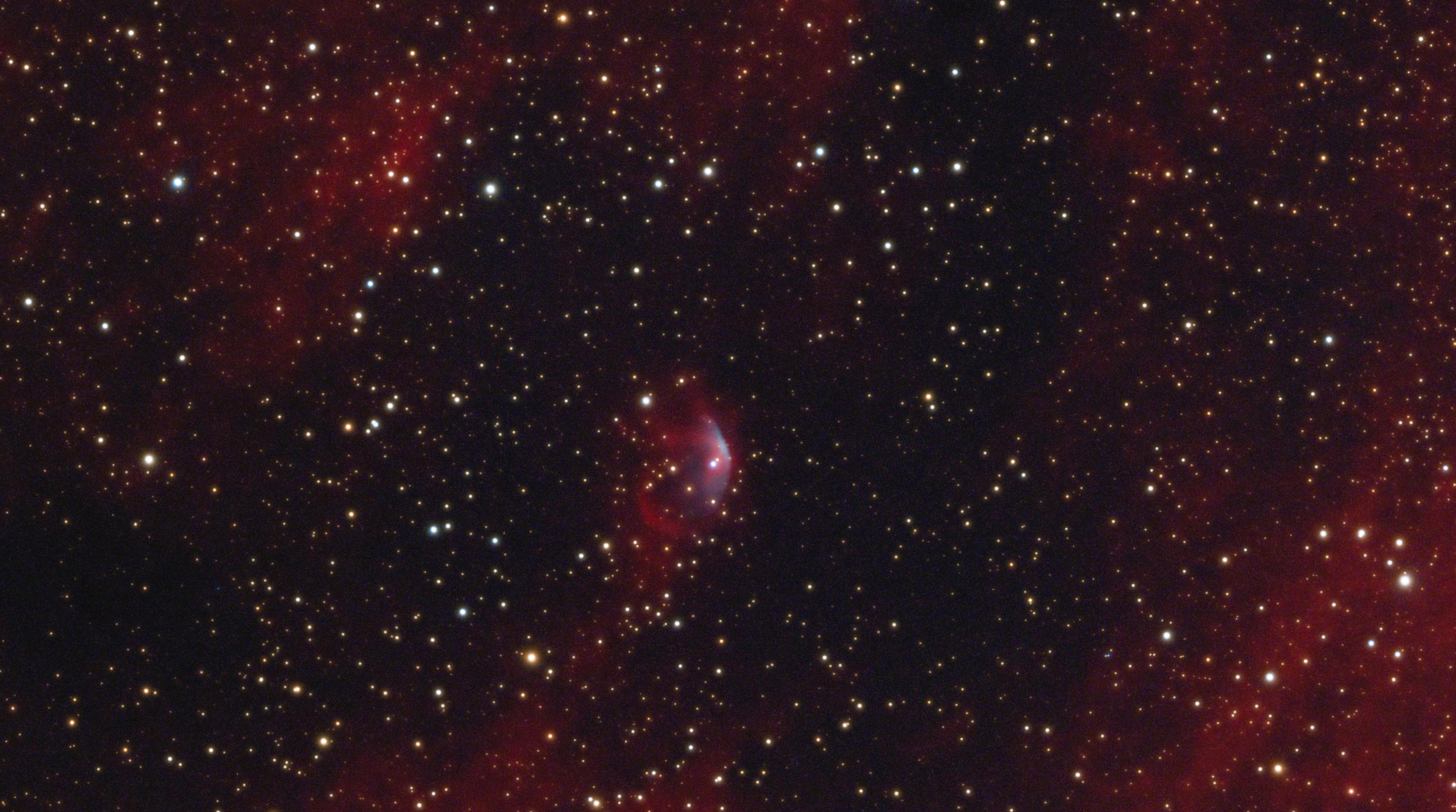
A shock wave in the Cygnus constellation


(Image courtesy of Howard Bond.)

Using small telescopes with modern low-noise detectors capable of accumulating long total exposure times, amateur astronomers can obtain extremely deep imagery of nebulae in the night sky. This image shows a faint nebula surrounding a star in the northern constellation Cygnus. Created by amateur Peter Goodhew, it is based on 144 hours of exposures obtained in August and September 2024 by him and others with five telescopes equipped with mirror or lens diameters of 15–50 cm.
The parabolic blue arc to the right of the center white star is a textbook example of a bow shock, formed when a stellar wind collides with a relatively stationary interstellar medium. The star is part of a cataclysmic binary, a system in which an ordinary star transfers mass to a nearby white dwarf companion. The material forms an accretion disk, from which some of the gas is ejected into space at high speed. As the supersonic stellar wind collides with interstellar gas, it excites ionized oxygen along the shock front, creating the blue arc. The pink color marks ionized hydrogen in the surrounding interstellar medium.
References
H. E. Bond et al., “Two more bow shocks and off-center Hα nebulae associated with nova-like cataclysmic variables ,” Astron. J. 170, 78 (2025).