The legacy of a great observatory
DOI: 10.1063/PT.3.4681
The Spitzer Space Telescope is one of four large astronomical observatories launched by NASA in the 1990s and early 2000s; the others are the Hubble Space Telescope, the Chandra X-Ray Observatory, and the Compton Gamma Ray Observatory. An extremely sensitive telescope, Spitzer observed the mid- and far-IR bands of the electromagnetic spectrum. It was the last of the so-called Great Observatories to be launched, in 2003, and it was decommissioned at the end of January 2020. More Things in the Heavens: How Infrared Astronomy Is Expanding Our View of the Universe captures Spitzer’s scientific legacy.

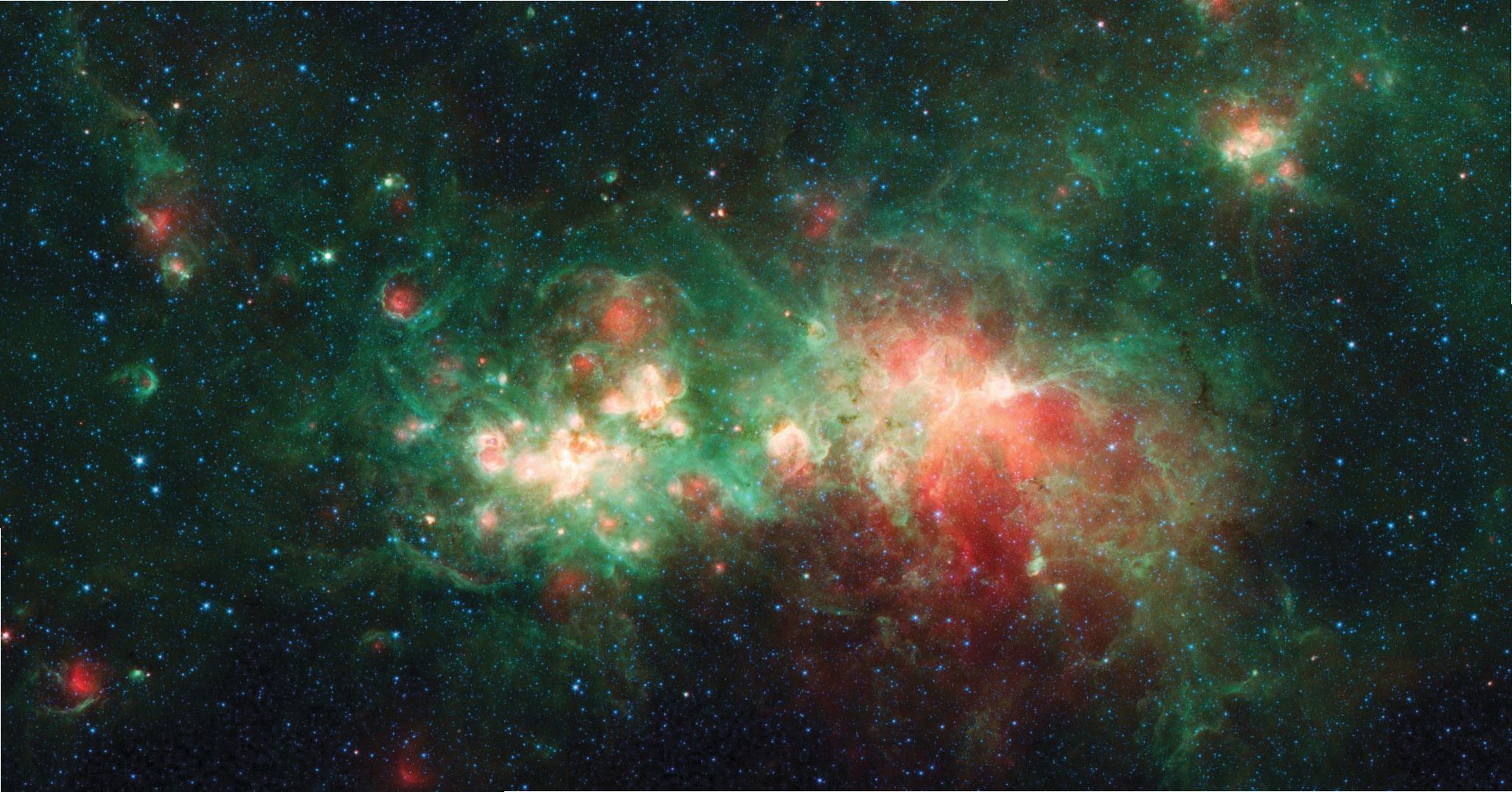
An IR image of the nebula W51, one of the most active star-forming regions in the Milky Way, captured by the Spitzer Space Telescope.
NASA/JPL-CALTECH/GLIMPSE & MIPSGAL TEAMS

The book’s authors, Michael Werner and Peter Eisenhardt, worked on Spitzer for decades (as did this reviewer). Because they wrote More Things in the Heavens for a general audience, they did not use equations, but they still lean heavily on technical figures. Along with quantitative graphs, such as spectral energy distributions and color–color diagrams, the authors include many “indicative color” images of astronomical objects in which the IR wavelengths observed by Spitzer are mapped to the red, green, and blue that our eyes can see. Those aspects could make the book difficult for nontechnical readers, but most readers of Physics Today should have no problems understanding the science.

Most of the book is devoted to the major discoveries made by physicists and astronomers who used Spitzer. Perhaps the most important are the observations of star and planetary-system formation in the Milky Way and distant galaxies. The ideal targets for Spitzer were stars and planetary systems that formed in nebulae where interstellar dust blocks essentially all visible light yet allows IR radiation to escape. The blocked light also heats the dust, which then produces more IR radiation. Astronomers used Spitzer to analyze accumulations of circumstellar dust—commonly known as debris disks—that seemingly are left over after planet formation.
Images from the telescope also yielded star-formation maps of nearby galaxies. Likewise, data gathered by Spitzer of IR brightness from distant galaxies were used to derive their total star-formation rates.
Exoplanets were discovered well after Spitzer was designed, but the telescope’s extremely stable orbit meant that astronomers could use it to precisely study the small dips in stellar brightness that occur when exoplanets transit across stars. Such unexpected applications highlight the value of general-purpose space facilities like Spitzer; they can be used to study new phenomena never dreamed of during the mission’s planning.
Spitzer was also effective at finding accreting supermassive black holes in the centers of galaxies. They power so-called active galactic nuclei, regions at a galaxy’s center that have a high luminosity and include the most luminous known quasars. The radiation from those nuclei has nearly power-law spectral energy distributions, which means they emit more in the long-wavelength IR bands observed by Spitzer than stars, whose emission spectra are quasi-blackbody.
Spitzer also observed some of the most distant known galaxies. The Hubble Space Telescope first found the galaxies, but it could observe them in only a small segment of the near-IR bands. Spitzer provided vital confirmation of the galaxies’ ages and distances by showing that the ratio of 3.6 µm light to a shorter wavelength captured by Hubble was consistent with the stellar radiation from a young galaxy formed early in the history of the universe.
More Things in the Heavens is a well-written account of the accomplishments of a great observatory over its more than 16-year lifetime. It shows how much patience is needed when working on a space mission. I first heard about the mission that became Spitzer at a meeting in 1974, and I made observations with it throughout its life. Fortunately, Spitzer’s scientific return was worth the decades of effort by many dedicated scientists and engineers.
More about the authors
Edward L. Wright is a professor emeritus of physics and astronomy at UCLA. He worked on the Spitzer Space Telescope from about 1976 until it was decommissioned last year.
Edward L. Wright, University of California, Los Angeles.