NASA’s next space telescope reaches assembly milestone


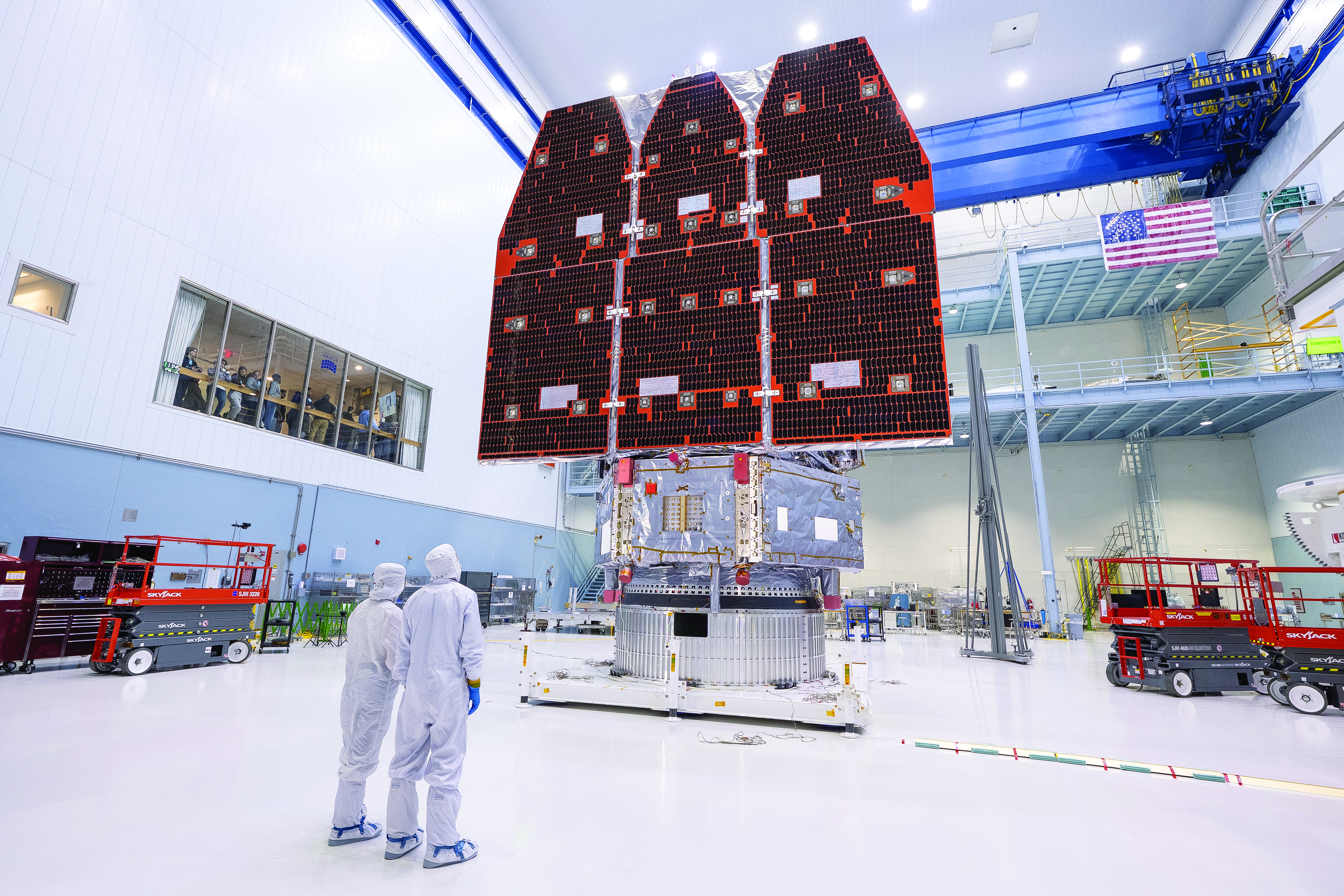
Technicians take in the completed Nancy Grace Roman Space Telescope in a clean room at NASA’s Goddard Space Flight Center in November 2025.
(Photo by NASA/Jolearra Tshiteya.)

When the Nancy Grace Roman Space Telescope’s inner and outer portions were bolted together at NASA’s Goddard Space Flight Center in Greenbelt, Maryland, last November, one might imagine a collective sigh of relief from everyone involved. In the five years since receiving a green light from NASA, the mission has navigated a pandemic, a US government shutdown, and threats of budget cuts. Now the telescope will undergo final tests before being shipped to NASA’s Kennedy Space Center in Florida for launch as early as the fall.
The concept that led to Roman was recommended in the 2010 decadal survey of astronomy and astrophysics. A decade earlier, scientists had discovered dark energy, which putatively pervades all space and is the leading explanation for the accelerating expansion of the universe (see Saul Perlmutter’s 2003 PT article on dark energy ). The astronomical community was eager to develop a telescope that could further study the universe’s expansion and probe the nature of dark energy. It was also keen to continue the exoplanet hunt of the Kepler space telescope, which was retired in 2018.
Over the next 15 years, teams at NASA created a space telescope that could tackle those two tasks. Roman was designed with a much larger field of view in the near-IR than any of the agency’s previous large missions. And it was engineered to survey exoplanets that Kepler and other space-based technology could not detect.
Roman’s distinctness comes from its massive surveying capacity. Whereas the Hubble Space Telescope and the James Webb Space Telescope excel at imaging an individual galaxy or single cosmic feature, Roman will image thousands of them at once. Using that wide lens, astronomers can study the brightness, distance, and distribution of supernovae, galaxy clusters, and other objects. The observations will be relevant for answering many cosmological and astrophysical questions.
For instance, astronomers will use the survey data to further understand the nonuniformity of today’s universe. Precision measurements of the cosmic microwave background suggest that the universe was almost perfectly uniform some 378 000 years after the Big Bang. Fast-forward more than 13 billion years: The universe has volumes of empty space interspersed with dense sheets and clumps of galaxies. Mapping how the large-scale structure evolved over time could provide insight into changes to dark energy.
Roman will fill a void in space-based exoplanet surveys as well. Other NASA missions, such as Kepler and the Transiting Exoplanet Survey Satellite, have identified exoplanets located one Earth’s distance or less to their host star by detecting the signature of a planet transiting in front of its star. While powerful, the transit method has its limitations: If a telescope using the transit method peered at our solar system from far away, it would miss all the planets. In addition to spotting transits, Roman will use the microlensing method (see the 2009 PT article by Jonathan Lunine, Bruce Macintosh, and Stanton Peale about exoplanet detection techniques ). That way, Roman will identify exoplanets that have orbital radii larger than Earth’s distance to our Sun. Such planets are likely much more analogous with our solar system’s planets.
Although most of Roman’s observing time will be dedicated to large surveys, the mission also will test a novel way to identify fainter exoplanets than even the most advanced telescopes today can detect. In addition to employing indirect exoplanet surveying methods such as transits and microlensing, Roman will attempt to take direct images of exoplanets. Direct images are much harder to capture because the light from the host star masks the faint presence of a planet. Ground and space telescopes have been able to directly image only about a dozen exoplanets, most of which are large, young, hot planets that glow brightly.
The coronagraph instrument that Roman will use to take direct images will be the first of its kind in space to use deformable mirrors and active wavefront control. Although it won’t be sensitive enough to spot an Earth analogue, it could see the equivalent of our solar system’s Jupiter in size, temperature, and orbiting distance to its host star.
A bumpy ride
The Roman Space Telescope has weathered numerous headwinds over its development. Shortly after the official go-ahead came from NASA in February 2020, the pandemic slowed its progress. Delays in hardware delivery, testing, and assembly caused the mission’s budget to increase by nearly 10%, from about $4 billion to $4.3 billion, and pushed the launch date back by at least six months. The team later made up that time and is on track to meet its prepandemic launch goal. Half the mission’s work was paused during last fall’s government shutdown, but time-critical testing was allowed to continue. As a result, the launch date did not slip further.
So far, the mission has retained funding necessary to stay on schedule despite NASA’s budget uncertainty last year. The annual appropriations bill to fund NASA this fiscal year has not been passed as of publication, but drafts of the House and Senate bills suggest Roman may avoid the deep cuts that were in the president’s FY 2026 budget request and maintain what NASA has projected the mission will need . The funding level in a draft conference report released in early January should enable Roman to meet its projected launch date.