The arXiv server to require English version with submissions

Effective 11 February, the arXiv preprint server is requiring authors to submit papers in English or with a full English translation. Within several weeks of publication, the November arXiv blog post announcing the change received more than 45 comments opposing the new rule. The administrators of the server say that is record pushback from the science community. “It was not a 100% comfortable decision,” says Ralph Wijers, an astrophysicist at the University of Amsterdam and chair of the arXiv Editorial Advisory Council. Two issues, he says, held sway: Moderators can’t judge the appropriateness of submissions in languages they can’t read, and papers in English can reach a broader audience.
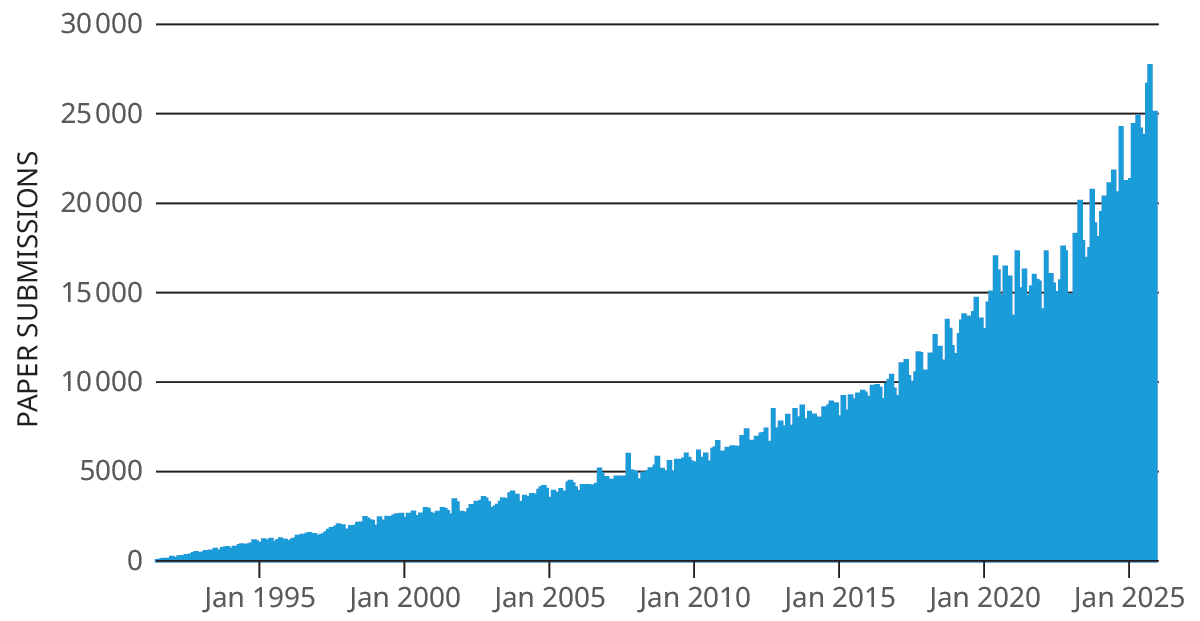
Researchers in physics, astronomy, quantitative biology, economics, and other fields use arXiv. The server hosts nearly 3 million preprints and receives, on average, roughly 24 000 submissions and tens of millions of downloads per month. (To read about the origins of the server, see the 2021 PT story “Joanne Cohn and the email list that led to arXiv .”) The number of submissions per month is growing, in part because of AI-written papers. Non-English papers make up about 1% of the submissions, according to arXiv administrators. A 2005 French-language algebraic geometry paper with, according to Google Scholar, 1212 citations is an example of an influential one.

The numbers of preprints submitted monthly to arXiv has steadily grown in the past three decades.
(Graph data from arXiv.org monthly submissions page .)

Until now, authors had to include an English abstract, but their papers could be in any language. Under the new policy, authors can still submit in other languages, but they have to include an English translation of the full paper.
The arXiv editorial board had been talking for several years about requiring that papers be submitted in English, Wijers says. The triggers were the growth in submissions and the availability of free, adequate translation software, he says. “We want to be fair to moderators and give the papers the widest reach.”
Although preprints published on arXiv are not peer reviewed, moderators look them over to make sure they are suitable. Some 300 experts around the world volunteer to make sure submissions are “not AI slop, not all false, and are in fact scientific papers,” says Licia Verde, a Catalan Institution for Research and Advanced Studies professor of theoretical physics at the University of Barcelona and the chair of the arXiv Science Advisory Council. “It needs to be something that an editor of a journal would send to a referee.”
Having authors submit translations reduces the burden on the moderators, notes Wijers. When he previously moderated submissions in high-energy astrophysics, he says, he spent about 30 seconds on each paper. “I couldn’t afford to spend more than half an hour per day.”
Much of the online opposition to the new policy comes from French mathematicians. Among the objections they and others raise (not all of which were posted in English) are that “putting English first as this policy does treats the hundreds of non-English human languages as second-class participants in the global conversation” and the policy “raises further barriers to participation in science and mathematics.” Another poster wrote that “important articles will be read in any language.” Several people posted that they might or would stop using arXiv because of the policy, and others offered their services as moderators in various languages.
Jean-Pierre Bourguignon is a former president of the European Research Council who is now an honorary professor at the IHES (Institut des Hautes Études Scientifiques) outside of Paris. He notes that arXiv plays a “key role” for mathematicians, physicists, and computer scientists worldwide. The move, he says, caught him by surprise and “is certainly not going to be a solution” that contributes to making arXiv more international.
Several posters noted that the moderators could translate submissions as needed. But, says Verde, it’s better for authors to retain control over their own work and how it is presented. Wijers notes that leading scientists worldwide must have decent passive knowledge of English.
Steinn Sigurðsson, an astrophysicist at the Pennsylvania State University and arXiv’s scientific director, says that “the intent is to encourage more foreign-language papers,” rather than to squeeze out submissions in other languages. The server will be able to accept a lot more foreign-language papers under the new policy, he says, because the moderators “will be able to curate the content from the translated version.”
Wijers says that arXiv will revisit the issue in a couple of years. “I don’t expect this to be permanent,” he says. In five or so years, he says, translation software may be good enough that arXiv could include an option on its website to translate on the spot.