Romantic cosmology
DOI: 10.1063/PT.3.4964
In Roman mythology, Janus is the two-faced god of transition and change. One of his faces looks toward the past; the other looks toward the future. In The Janus Point: A New Theory of Time, Julian Barbour offers not a new theory of time, as the subtitle suggests, but a new perspective on the arrow of time, one that builds on the theory he expounded in The End of Time: The Next Revolution in Physics (1999).

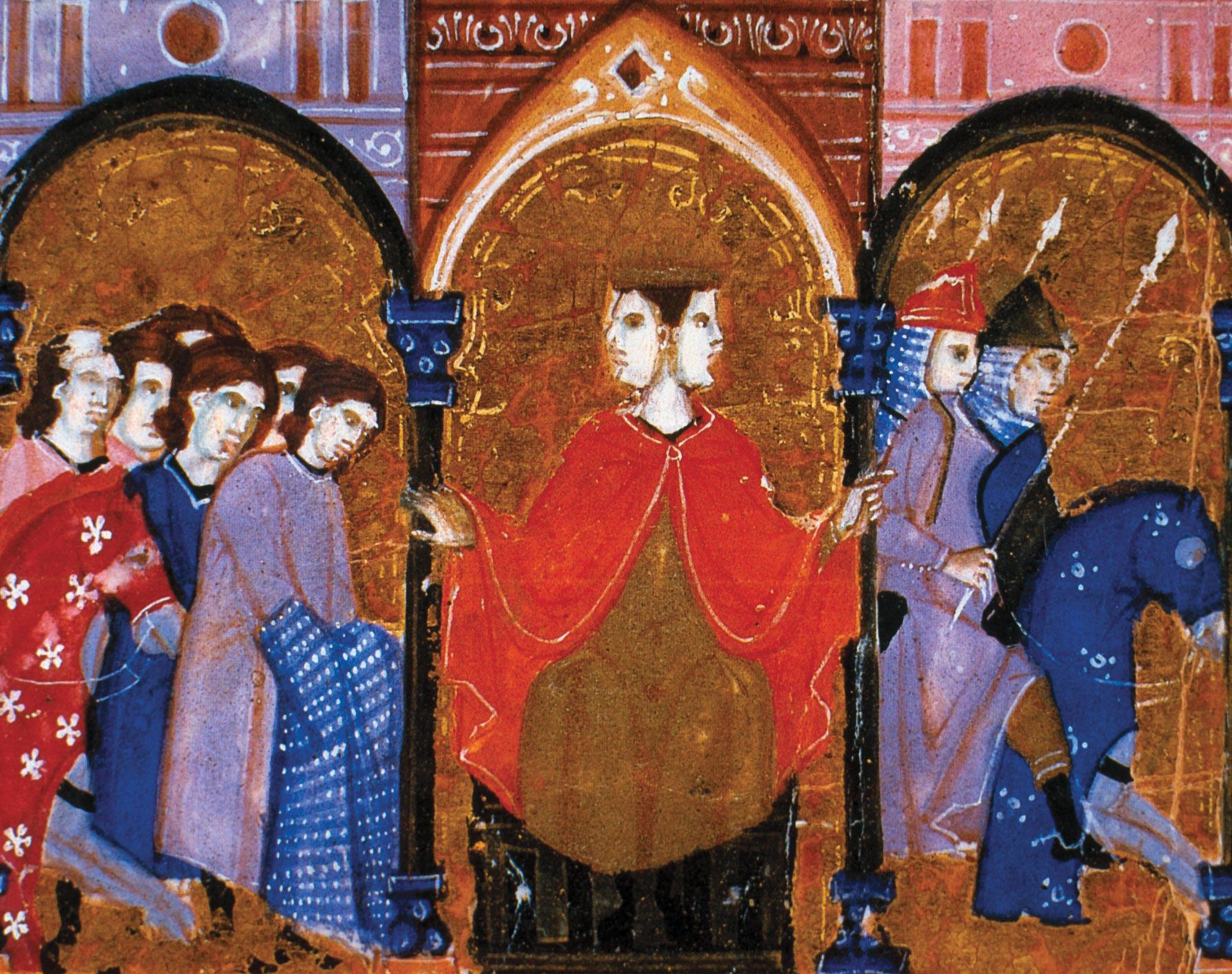
The two-faced Roman god Janus, as depicted in a miniature from a 15th-century illuminated manuscript.
ALBUM/ALAMY STOCK PHOTO

Barbour challenges the conventional wisdom that the one-way nature of physical processes—such as ripples emanating from a stone thrown into a pond—is best accounted for by postulating that the universe began in a special initial condition. According to that standard worldview, the ever-increasing entropy predicted by the second law of thermodynamics eventually leads to a featureless, cold universe with no meaningful structure.
In The Janus Point, Barbour aims to present an alternative to that picture, one in which the universe’s starting point is not so atypical and the unidirectionality of physical processes is a consequence of either the universe’s expansion or its increasing complexity. He associates that increasing complexity with what one might call the finer things: life, humanity, art, and science. That vision of inexorable progress echoes Gottfried Leibniz’s view that we live in the best of all possible worlds. Barbour contrasts that vision with what he sees as the bleak pessimism of the traditional explanation.

After a long introductory critique of the history of thermodynamics, Barbour turns to N-body theory. Drawing on the results of Joseph Louis de Lagrange and Carl Jacobi, he shows that isolated systems of gravitating point masses with a nonnegative total energy have a finite minimum size at some point in time. He calls that minimum the Janus point because at that point one can face toward the past or toward the future and “see” an expanding universe.
Because Barbour wants to defeat what he sees as the pessimism of the second law, and because he needs a quantity more plausibly associated with time asymmetry than just the expansion of the universe, he introduces the term “shape complexity,” which he defines as
Away from the Janus point,
Barbour presents the example of three bodies that nearly collide. As a result of their interaction, two of the particles wind up orbiting each other and the other heads off to infinity, thus increasing the shape complexity. It is nontrivial to show that the complexity increases monotonically as the system moves away from the Janus point, but Barbour and collaborators have managed to put bounds on the amount it deviates from monotonic increase. Those bounds get narrower as the number of particles increases. That is certainly an interesting result.
The next part of the book involves a technical demonstration of another intriguingly suggestive result: If one assumes that both the energy and the total angular momentum of the universe are equal to zero, one can show that the Janus point is a point of total collision or total explosion akin to our Big Bang singularity. It thus follows that particle configurations become highly symmetric as the Janus point approaches, which suggests that the “special” initial conditions that seem to dominate in the early universe might actually be generic features of the early stages of a gravity-dominated universe.
To show that increasing complexity is a good proxy for time’s arrow, Barbour must demonstrate that it not only strongly tends to increase monotonically but also that the increase manifests in the myriad temporally asymmetric processes that provide the observational basis for our arrow of time. At times he fully embraces that idea and argues that the growth of complexity, not the growth of disorder, “puts the direction into time—and us into the universe to witness its forward march.” Elsewhere he is content to concede that purely dissipative processes in which complexity decreases are also part of the arrow of time.
Be that as it may, making a precise connection between complexity or cosmological expansion and the observed arrow of time is of secondary interest to Barbour. More important for him is to overcome what he and others, including Bertrand Russell and Steven Weinberg, regard as the bleak prospect of heat death. Although he acknowledges that energy is continually dissipated in an expanding universe in accordance with the second law, Barbour wants to explain why structure, complexity, life, and art nevertheless continue to emerge. As he says on the penultimate page, The Janus Point is “in part, a song of thanks to the cosmos and the fact that I, like you, am a participant in whatever it does.”
One could hardly find a more romantic view of the cosmos.
More about the authors
Steven Weinstein is an associate professor of philosophy at the University of Waterloo in Ontario, Canada, and an affiliate of the Perimeter Institute for Theoretical Physics. His research focuses on the foundations of quantum mechanics and the nature of time.
Steven Weinstein, University of Waterloo, Waterloo, Ontario, Canada.