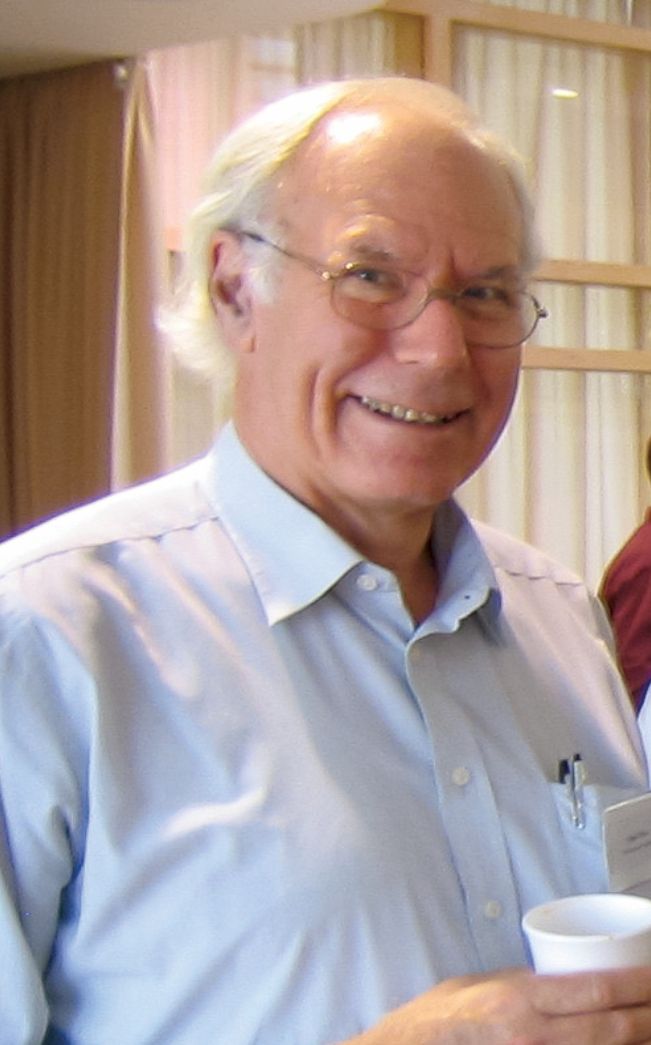
Nigel Oscar Weiss
DOI: 10.1063/PT.3.4662
Astrophysicist and applied mathematician Nigel Oscar Weiss, who made many fundamental contributions to our understanding of magnetohydrodynamics (MHD) and the Sun’s magnetic field, died on 24 June 2020 in Cambridge, UK.

Nigel Oscar Weiss
JOHN H. THOMAS

Nigel was born on 16 December 1936 in Johannesburg, South Africa. He was educated at Hilton College in Natal (which he hated) and then Rugby School in the UK (which he loved). He studied natural sciences at Clare College, Cambridge University. His graduate work at Cambridge was supervised by geophysicist Edward Bullard. Nigel began with fieldwork in seismology but soon switched to theoretical work in MHD. His dissertation examined variable hydromagnetic motions.
After receiving his PhD, Nigel joined the newly opened Culham Laboratory in Oxfordshire. There he wrote his classic paper showing that the combined effects of advection and diffusion in an array of cellular eddies expel magnetic flux from the eddies’ cores and produce a concentrated magnetic field along their boundaries. That groundbreaking work involved the development of stable numerical discretization schemes, which he used extensively in his later research.
In 1965 Nigel returned to Cambridge as a lecturer in the department of applied mathematics and theoretical physics (DAMTP). One of us (Thomas) was a postdoctoral fellow in DAMTP in 1966–67 and benefited from Nigel’s sage advice on numerical methods for solving the MHD equations. Nigel remained at DAMTP for the rest of his career, becoming a reader in 1979, professor of mathematical astrophysics in 1987, and emeritus professor in his retirement.
A problem of continued interest to Nigel throughout his career was magnetoconvection—that is, thermal convection in an electrically conducting fluid in the presence of a magnetic field. He and his students and collaborators advanced our knowledge of magnetoconvection with new theoretical ideas, some derived from the then active subject of chaos theory, and numerical simulations of increasing sophistication. They added nonlinear effects and fluid compressibility, which led to applications of magnetoconvection to the Sun’s near-surface magnetic field. That work culminated in Nigel’s 2014 monograph Magnetoconvection, with one of us (Proctor) as coauthor. Nigel’s work led to great progress in understanding the complex dynamical interaction between strong intermittent magnetic fields organized into “flux tubes” and the surrounding convection.
Nigel was particularly interested in sunspots, which are perhaps the best “laboratory” for observing magnetohydrodynamic behavior under astrophysical conditions. His work in the 1970s with Friedrich Meyer, Hermann Schmidt, and Peter Wilson examined the influence of convection on the formation and decay of a sunspot. For one of us (Thomas), sunspots were the subject of several collaborations with Nigel: We organized a NATO workshop on them, wrote review articles, and published a monograph, Sunspots and Starspots (2008). With Nicholas Brummell and Steven Tobias, we showed that magnetic flux pumping by the solar granulation can explain many features of sunspot structure and evolution. Although a theoretician at heart, Nigel kept in close touch with solar observations, often through visits to Sacramento Peak Observatory and interactions with Alan Title and his group at Lockheed, who were conducting observations from space.
Nigel also contributed significantly to dynamo theory, the study of the way in which motions of a conducting fluid can produce and sustain a magnetic field. Using low-order mathematical models, he was one of the first to explore the chaotic behavior of dynamos, and he related the behavior to that of the solar dynamo and the 22-year solar magnetic cycle, especially concerning the occurrence of the Maunder minimum (from 1645 to 1715) and other periods of reduced solar magnetic activity. With Jürg Beer and Tobias, he investigated the historical record of cycle modulations—with radioisotope variations in tree rings and ice cores as data—and showed that those irregularly modulated cycles could be interpreted theoretically through chaotic behavior of the models. Nigel and his wife, Judy, a scholar in English and fellow of Robinson College, wrote a paper on a poem by Andrew Marvell that contains one of the earliest references to the disappearance of sunspots in the late 17th century.
Nigel was an active participant in the academic and social life of his Cambridge college, Clare, and he served the university as chair of its School of Physical Sciences from 1993 to 1998. He was president of the Royal Astronomical Society in 2002 and was awarded its Gold Medal in 2007 for his research contributions to solar astrophysics.
A man of exceptionally broad interests, Nigel read and traveled widely, loved music, collected modern art, and served on a scientific advisory board for the UK’s National Gallery. He and Judy established an educational trust in Cape Town, South Africa, to support students from underprivileged backgrounds. He was a kind mentor to many students and colleagues, exuded a quiet authority, and was modest about his own achievements.
More about the authors
Michael Proctor, Cambridge University, Cambridge, UK.
John H. Thomas, University of Rochester, Rochester, New York.