Physics departments face widespread closures


(Artwork adapted from iStock.com/Five Stars.)
Financial challenges, changes in federal science policy, and enrollment declines are changing the landscape of higher education in the US. Given those headwinds, physics students are increasingly concerned with funding instability and limited career opportunities. (Shannon Clardy, Brad Conrad, and Matthew Wright highlighted those issues earlier this year in their PT article “Undergraduate students grapple with an uncertain future .”) They also face an additional and perhaps lesser-known hurdle: Many physics departments across the country are closing their doors.
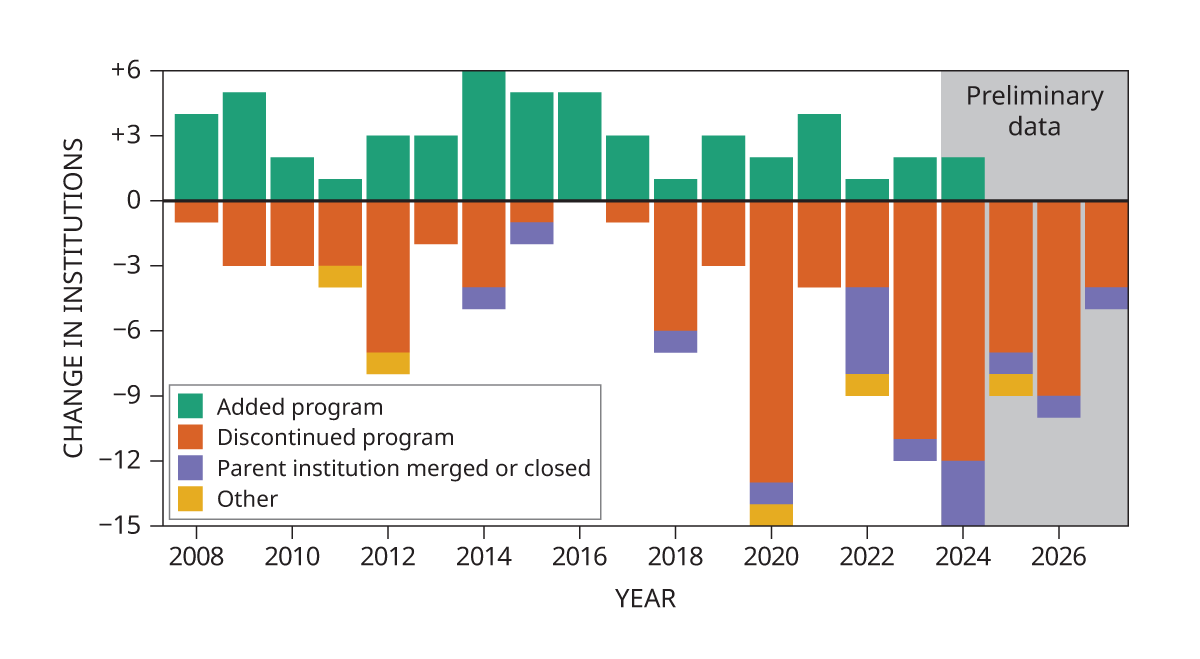
Recent articles in APS News 1 and The SPS Observer 2 highlight five institutions that discontinued their undergraduate physics programs after educating students for decades. Our research reveals that those examples are just the tip of the iceberg: We’ve identified 118 institutions across the US that have eliminated physics programs since 2008. (For a year-by-year analysis of closures, see the bar graph in figure 1 .) More than half of those discontinuations occurred after 2020, which suggests that the COVID-19 pandemic played a role.
Our tally is higher than previous reports, because those reports list all programs that have students, even those in the process of shutting down. Moreover, 52 institutions have added a physics major since 2008, so the net change in undergraduate programs somewhat conceals the extent of the program eliminations.
Figure 1

Additions and eliminations of US physics bachelor’s programs since 2008. In all, 52 institutions added a physics bachelor’s program, while 118 institutions eliminated one. Of the eliminated programs, 98 were discontinued, 15 were terminated because their parent institution closed or merged with another institution, 3 were switched to a combined math and physics major, and 2 were placed under indefinite suspension. (The last two categories make up the Other category.) The year indicates when a program started, stopped, or will stop accepting new students.

Quantifying program eliminations
Two annual surveys track physics graduates in the US. The Department of Education collects data about all academic disciplines through a mandatory set of surveys called the Integrated Postsecondary Education Data System (IPEDS), 3 and the American Institute of Physics (AIP) statistical research team collects detailed information about physics programs through its Survey of Enrollments and Degrees, which is filled out by around 90% of physics departments nationwide. 4 (AIP is the publisher of Physics Today.)
But neither survey includes a comprehensive list of active programs that are currently accepting new physics students and have no plans to stop. To create that list, we manually investigated programs that stopped or started reporting physics graduates to IPEDS or AIP or reported low numbers of graduates.
For the purposes of our study, we considered undergraduate physics programs that report graduation data to IPEDS for any bachelor’s degree program in the general major category of physics. We also included the major of engineering physics/applied physics in our count, but we did not add other physics-related categories, such as biophysics, astronomy/astrophysics, or physics teacher education. Aside from newly founded programs, we excluded institutions that reported fewer than five graduates to IPEDS since 1984 or no graduates since 2008.
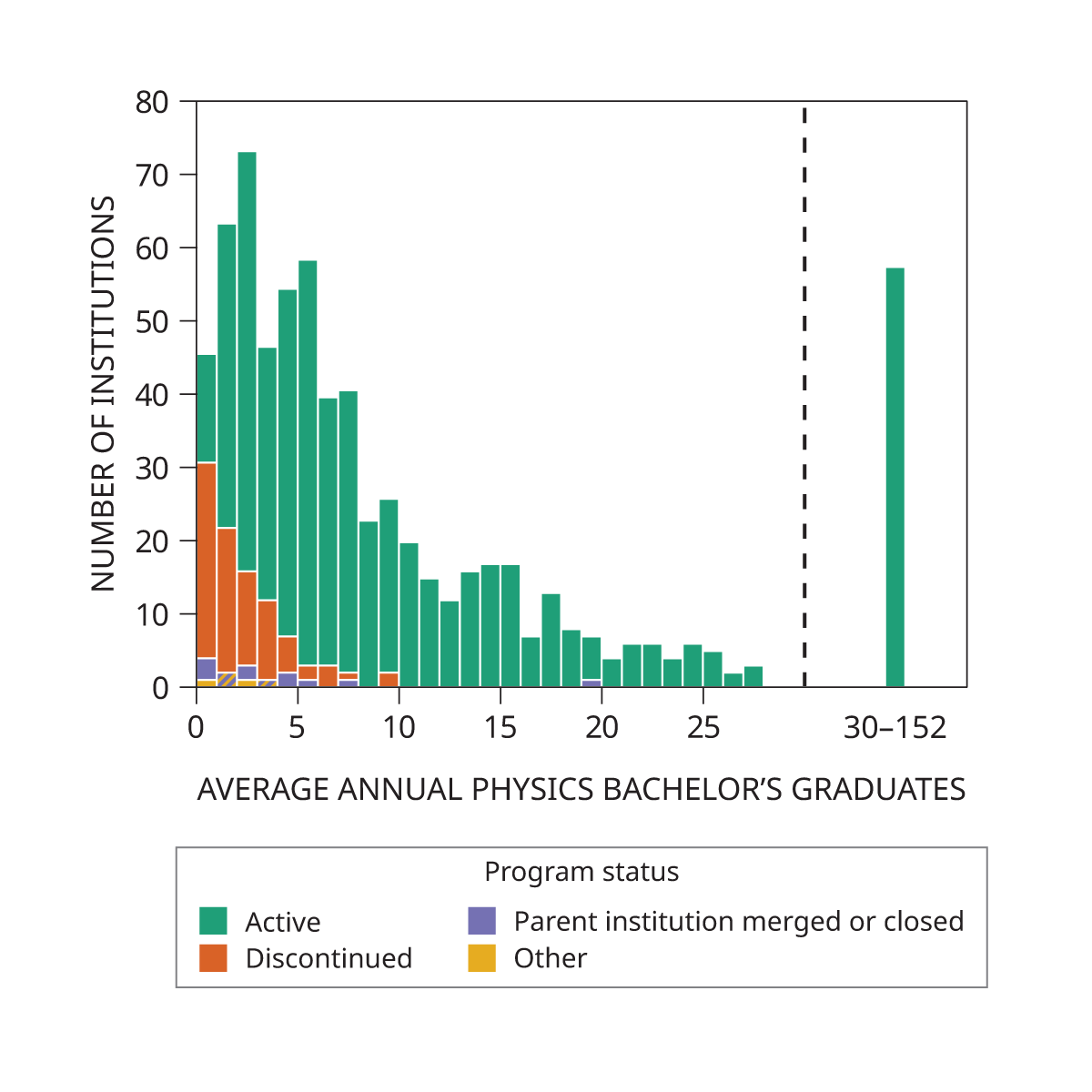
Figure 2

Average annual physics bachelor’s graduates at active and eliminated programs. Every discontinued program averaged fewer than 10 graduates per year in the three years prior to elimination (or the three years leading up to 2025, the last year for which we have data). The median number of graduates at discontinued programs is 1.7, while the median for active programs is 6.0. Around two-thirds of active programs average fewer than 10 graduates a year. The bar at right accounts for the 58 institutions that average at least 30 physics bachelor’s degrees per year; the largest department averages 152 per year.
(Data from IPEDS.)

Because current and prospective majors in programs that are being discontinued can finish their degree through what is termed a teach-out agreement, graduates frequently appear for several years as a program is phased out. We referred to course catalogs and other official information to identify the year each program stopped or started accepting new students. To find eliminations in progress, we identified programs with low enrollment and searched for official statements announcing closings. The recent program eliminations (or additions) are almost certainly a lower bound for the actual number because the most recent graduation data is from the 2024–25 academic year, and many program closures that are in progress have not been widely publicized.
Of the 819 physics programs active at any point from 2008 to the present, 118 are no longer active, meaning that 14.4% were eliminated. In 2008, there were 767 active physics programs, and there are now 701—a net decline of 8.6%. Figure 2 shows a histogram of average enrollment for active and eliminated programs. Discontinued programs had an average enrollment of fewer than 10 students in the three years leading up to their elimination, but in many cases, those enrollment numbers were not declining but were consistent with their historical averages.
Who’s dropping physics?
We based our research on the Carnegie Foundation for the Advancement of Teaching’s 2021 Basic Classification of US higher education institutions, which divides schools into six classifications based on multiple characteristics. We considered institutions in three of the classifications: baccalaureate colleges, which primarily award bachelor’s degrees and are divided into two categories based on focus; master’s colleges and universities, which primarily award bachelor’s and master’s degrees and are divided into three categories based on size; and doctoral universities, which confer significant numbers of graduate degrees and are divided into three categories based on level of research activity.
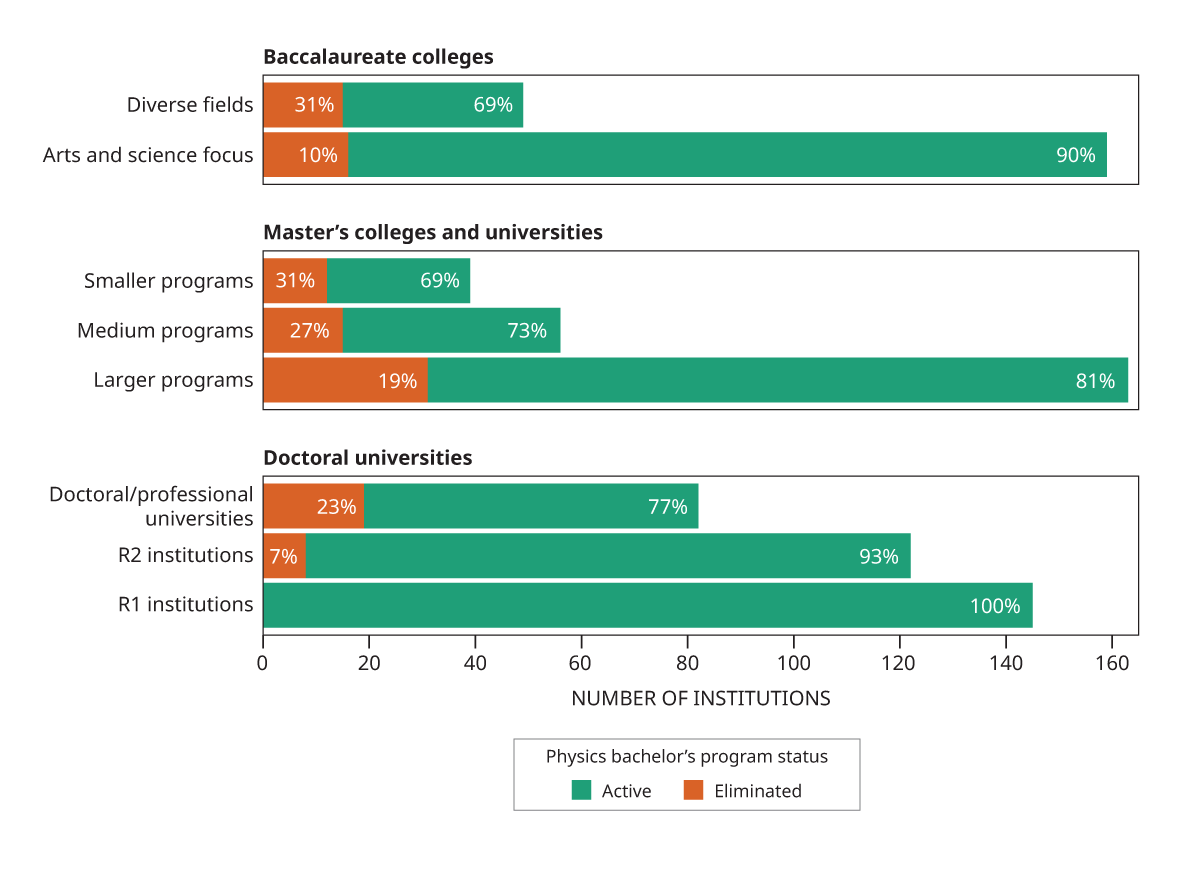
As figure 3 shows, most of the program eliminations occurred at institutions in the baccalaureate or master’s classifications. Of those institutions, most of which are primarily undergraduate focused, baccalaureate colleges with an arts and science focus had the lowest rate of physics program elimination, at 10%.
Doctoral universities that confer 20 research doctorate degrees and report at least $5 million in research expenditures annually are further divided into two categories based on research activity: R1 (very high research activity) and R2 (high research activity). No physics programs were eliminated at R1 institutions, but 7% of physics programs at R2 institutions were terminated.
Figure 3

Status of physics bachelor’s programs at different types of institutions, as categorized according to the 2021 Carnegie Basic Classification. Physics programs were more frequently eliminated at baccalaureate colleges, which primarily teach undergraduates; fewer programs were eliminated at programs with physics graduate degrees. Note that the Carnegie classification relates to the institution as a whole, and many universities in the master’s colleges and universities and doctoral universities classifications do not offer physics graduate degrees.

Institutions often discontinue physics programs quietly, meaning the major simply disappears from the course catalog at the start of an academic year. If they do announce the program’s elimination, budgetary deficits and low enrollment in associated majors are commonly cited. We found that discontinuations are more common for institutions with lower endowments and fewer undergraduate students, but various factors are at play. We plan to perform a detailed statistical analysis in the future.
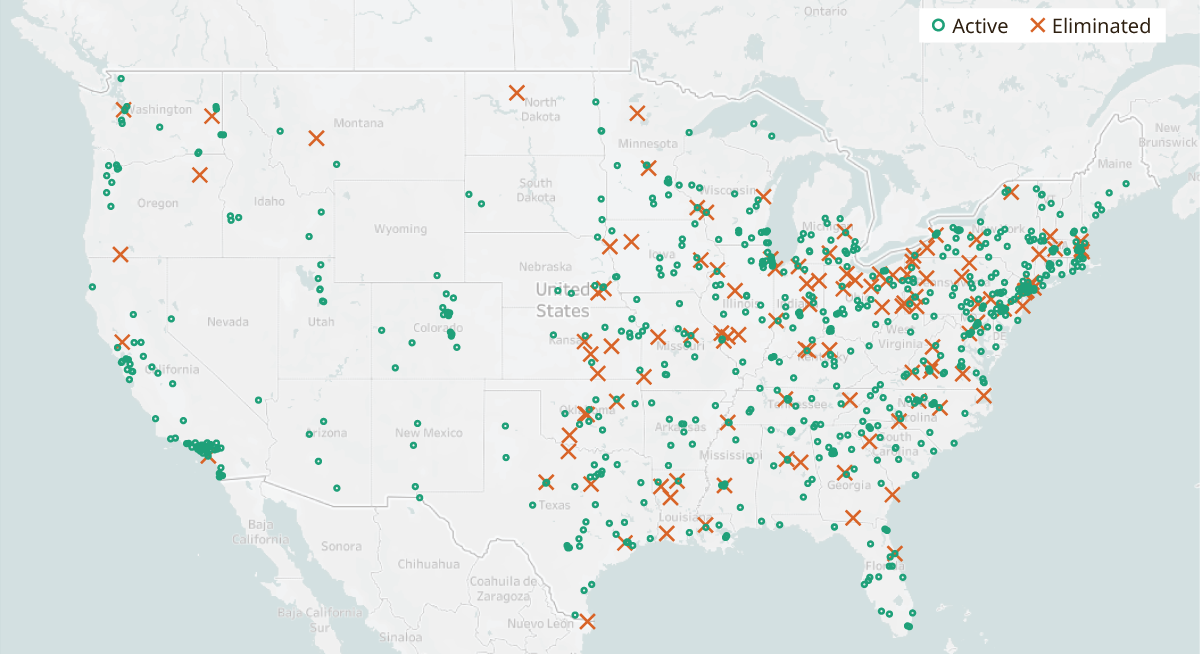
Although physics programs are disappearing across the US, the closure rate is particularly high in Appalachia and the Midwest. Some of those closures are likely associated with declines in the regional college-age population and whether other institutions in the area have physics programs (see figure 4 ). About one-quarter of eliminations are in smaller towns or rural areas that are not near an urban center, which means some students now live farther from an institution with a physics program. Because most college students attend an institution near their home, that raises the barrier to obtaining a physics education. 5
Although students are often still able to begin their physics education at a local community college or four-year institution without a physics major, they may be less likely to transfer to a four-year institution with a physics major unless one is nearby. Program closures also have a pernicious trickle-down effect on high school physics education in local communities: As Jill Marshall, then the American Association of Physics Teachers (AAPT) president, noted in a 2012 editorial, “high-school teachers tend to stay in the communities where they went to school.”
Figure 4

Location of active and eliminated physics programs in the continental US. Active programs are denoted by a green circle, while eliminated physics programs are denoted with a orange X. Not pictured in the map are the seven institutions outside the continental US with physics programs, which all remain active.
(Map data from Mapbox and OpenStreetMap.)

New state laws and regulations have mandated minimum enrollment thresholds for a program to stay active, and they have been the direct cause of program discontinuations at public institutions. Texas, for example, in 2011 began requiring that undergraduate programs have a minimum of five program graduates per year over five years. 6 About half the physics programs at public universities in Texas soon faced elimination or probation.
Ohio and Indiana enacted laws in 2025 requiring programs to have 5 and 15 graduates per year, respectively, over every three-year period. Those laws have already led to four physics program eliminations and at least two cases where a physics bachelor of arts degree has been eliminated (but the bachelor of science degree in physics remains an option). We have not counted the two cases as eliminations, but they are important to note. In Indiana, three additional physics programs are under the 15-graduate-per-year average and are part of an improvement plan or, for newer programs, a ramp-up period. 7
If all physics programs in the US were required to have an average of five graduates per year to remain active, 41% of all programs across the country would be discontinued: Two-thirds of physics departments average fewer than 10 graduates per year and 79% average under 15. Other states that have enacted enrollment-based laws include Florida, Louisiana, Oklahoma, Missouri, and Tennessee.
Headwinds in higher education
Challenges for all physics departments are expected to increase in the coming years. The high degree of research funding at R1 and R2 institutions has likely shielded some lower-enrollment undergraduate physics programs thus far, but that may change with the recent reductions in federal funding for the physical sciences. (For more on those funding cuts, see the recent PT article “The shrinking NSF support for the physical sciences .”) Birth rates in the US dropped in the years following the 2008 financial crisis, and that cohort is just beginning to enter college. The long-anticipated “demographic cliff” predicts that the number of 18-year-olds in the US will drop by about 15% by 2039. 8
International students are an important constituent in US physics departments: Non-US citizens represented around 13% of physics bachelor’s degree recipients in 2024–25. 9 Changes in student visa requirements may further reduce the number of physics students. Those anticipated drops in enrollment will likely accelerate program eliminations in the coming years. Although the number of physics programs has grown in recent years, eight of the institutions that added a physics program since 2008 have since eliminated it.
Historically, undergraduate physics enrollment in the US has ebbed and flowed, with notable drops in graduates in the 1950s, 1970s, and 1990s. 4 (For a look at how PT covered those declines at the time, see the articles in January 1962 by Clarence B. Lindquist, June 1971 by H. William Koch, and September 2003 by Bob Hilborn and Ruth Howes, among many others.) In 1999, fewer than 4000 bachelor’s degrees in physics were awarded nationwide, a sign that was seen by the community as a wake-up call.
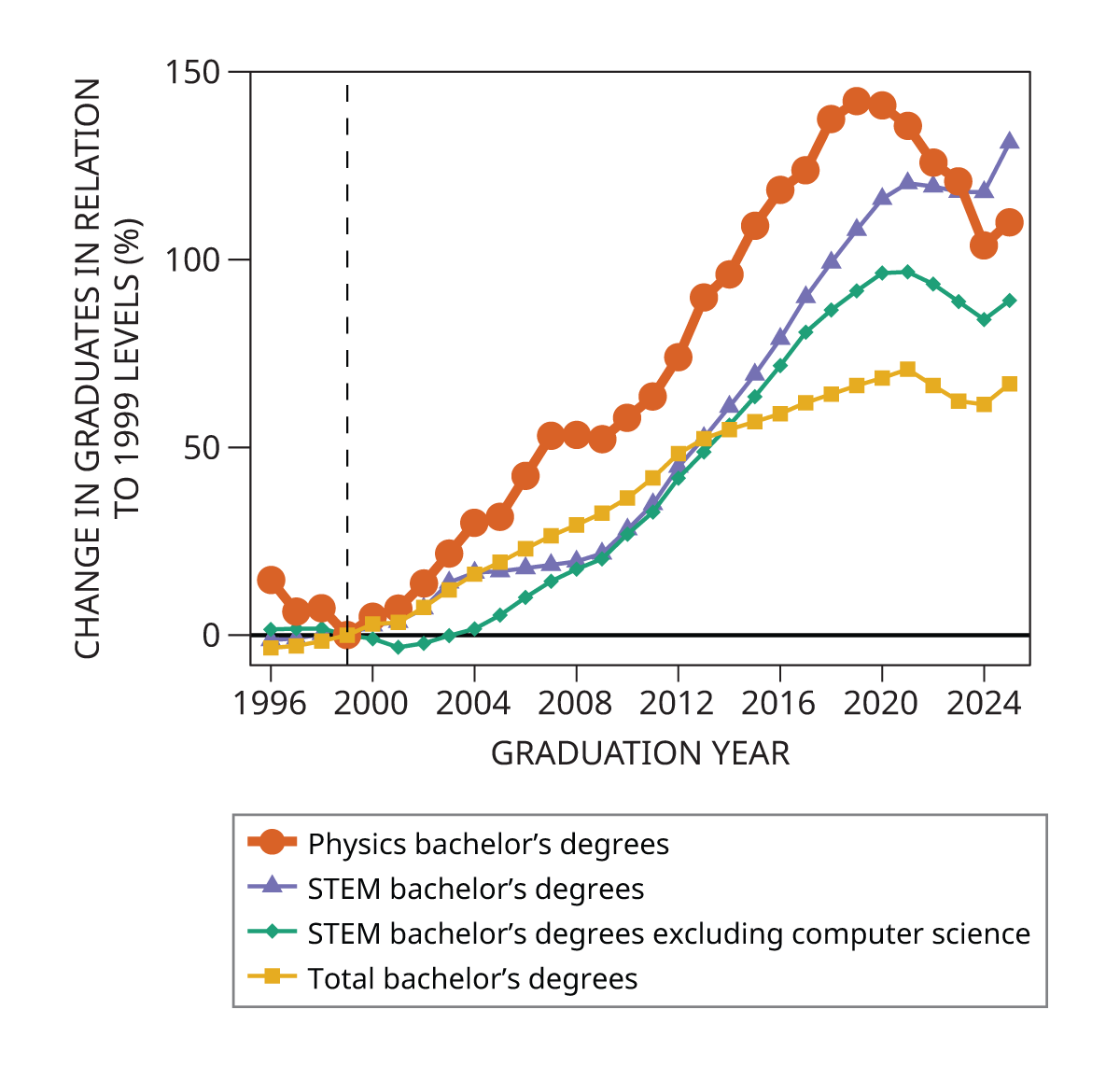
In response, a task force created under the auspices of AIP, AAPT, and the American Physical Society (APS) developed the Strategic Programs for Innovations in Undergraduate Physics report, which identified best practices from departments that were thriving. Over the next two decades, undergraduate physics programs experienced tremendous growth, and the number of physics bachelor’s degrees awarded in the US increased by nearly 150% by 2019, as shown in figure 5 . The growth in physics outpaced other STEM fields and total US enrollment for all majors. (We use the definition of STEM from the National Center for Education Statistics. 10 )
Figure 5

Percentage change in bachelor’s degrees awarded annually in the US in physics, STEM fields, STEM fields excluding computer science and related majors, and all fields, from 1996 to 2025. After an initial decline, the annual number of physics bachelor’s degrees awarded increased significantly—more quickly, in fact, than STEM and overall graduation rates—from 1999 to 2019. After a decline during the pandemic years, graduation rates have begun to rebound. To avoid double-counting students who majored in physics and another STEM field, we have included only students whose first declared major is physics.
(Data from IPEDS.)

After the 2020–21 academic year, the number of bachelor’s degrees awarded in all fields in the US began to decline after more than four decades of growth. 3 The annual number of bachelor’s degrees in physics has dropped more quickly than the overall number of degrees awarded but remains approximately twice the level it was in 1999. The number of physics graduates is relatively small compared with the number of graduates in other fields: It represents fewer than 2% of STEM graduates in recent years, a percentage that is dwarfed by the number of graduates in engineering fields, which account for around 25% of STEM degrees. Other STEM fields experienced less drastic declines in the number of graduates, even when computer science and related majors—which represented about 30% of STEM graduates in 2024–25—are excluded. Recent graduation data showed a moderate rebound in graduation rates from 2024 to 2025.
As institutions grapple with declining enrollment, undergraduate physics programs—small, faculty-demanding departments—often become a tempting place to downsize. Even stable or growing physics programs often have fewer graduates than other STEM disciplines. Upper-level physics courses with significant prerequisites often have a low student-to-faculty ratio, which makes them expensive in the eyes of administrators at teaching-focused institutions whose operating budget is reliant on tuition. Although we did not explore the phenomenon empirically, we are also aware of reductions in tenure-track faculty lines and other faculty or staff positions in physics programs across the country. Those programs have been downsized rather than eliminated, a trend that is more difficult to detect.
Other STEM fields, including chemistry, are also experiencing program eliminations. 11 We observed that physics departments are often one of several programs eliminated at the same time, but no one has compiled a comprehensive record of program terminations in other fields. Enrollment and financial challenges are not unique to the US: In an August 2025 survey of UK physics departments by the Institute of Physics, 8 of the 31 responding departments expected to close within two years. 12
Reimagining physics programs
Physics is a versatile major that complements other disciplines: If the number of physicists declines, it may prove detrimental to emerging fields such as quantum computing, nuclear fusion energy, and AI. Scientific and technological innovations are made possible by the academic expertise that is first learned in undergraduate programs.
Some physics programs have begun sharing resources to educate upper-level students and adapting to a more interdisciplinary focus. After appeals to retain programs were denied, a group of physics programs at several Texas universities banded together to form the Texas Electronic Coalition for Physics (now known as the Texas Physics Consortium), which offers upper-level physics courses taught virtually by faculty among the institutions. (For more on the Texas consortium, see the December 2011 PT article “Texas cuts ‘low-producing’ physics programs .”)
Prospective physics students interested in attending a small college can also look for an institution with a dual-degree program. In those programs, students start at the small school but go on to complete their studies at a larger partner institution that has additional course offerings and majors. Those students can earn a degree in applied physics from their home institution, for example, and an engineering degree from the partner institution.
Other departments are shifting from a traditional physics major to a major in both mathematics and physics, computational physics, or engineering physics. Physics faculty can collaborate with professors from different disciplines to start majors in quickly developing fields, including data science, quantum computing, and materials science. It is especially important for faculty in interdisciplinary physics-focused majors to report their data to AIP since AIP categorizes graduates differently than IPEDS.
Physics students are increasingly concerned about employment, but that, too, has historical parallels. A decline in US federal funding for physical sciences in the early 1970s led to a major crisis in the field. Writing in PT in June 1971 in response to that predicament, then-director of AIP H. William Koch made four recommendations, which are worth restating, as to how the community could avoid similar crises in the future: first, to collect data on employment of physicists; second, to use that data to train new physicists; third, to work with federal funding agencies and policymakers; and fourth, to assist physicists in finding jobs in new and existing employment areas. (For more on the 1970s jobs crisis in physics, see the recent PT article by Julia Menzel.)
In today’s increasingly data-driven world, it is especially important for departments to report their data to AIP and to implement evidence-based adjustments to their programs so that they can better prepare their students for current and future challenges. Faculty can help their students join the broader physics community by connecting current students with alumni and facilitating travel to regional and national conferences. APS also offers external mentorship opportunities through the APS Mentoring Community .
The physics community also has developed resources to help threatened departments face those daunting challenges, including the Effective Practices for Physics Programs guide and its toolkit for departments under threat. 13 (For more on the EP3 guide, see the February 2025 PT article “Helping physics departments thrive ,” by David Craig, Theodore Hodapp, and Michael Jackson.) Students, professors, politicians, scientists in government and industry, professional societies, and funding agencies must work together to reinvigorate physics education and advocate for its value in an ever-changing world.
This project was supported by the Sophomore Research Program at the College of Wooster. We would like to thank Patrick Mulvey from AIP Statistical Research for helpful discussions and for providing access to historical reports and a list of recent program changes.
References
1. L. Boatman, “Despite strong interest in physics, some universities are shuttering departments ,” APS News, 14 August 2024.
2. J. Hewins, “My university joined the list of deactivated physics and astronomy programs. Why it matters ,” SPS Observer, 13 March 2025.
3. Data and information related to the individual IPEDS survey components are available at https://nces.ed.gov/ipeds/ .
4. Data for AIP’s annual Survey of Enrollments and Degrees going back to the 1958–59 academic year can be found at https://repository.aip.org/node/129846 .
5. D. Segovia, D. Cooper, Distance Matters: Exploring Geographic Barriers to Transfer for California Community College Students , RP Group (November 2024).
6. J. A. Marshall, “The physics major in jeopardy ,” Am. J. Phys. 80, 849 (2012).
7. A. Appleton, “Indiana colleges and universities eliminate or merge hundreds of degrees ,” Chalkbeat Indiana, 1 April 2026.
8. J. Marcus, “A looming ‘demographic cliff’: Fewer college students and ultimately fewer graduates ,” NPR, 8 January 2025.
9. P. Mulvey, S. Nicholson, J. Pold, Physics Bachelor’s Degree Recipients: Recent Trends, Educational Characteristics, and Influences , American Institute of Physics (2026).
10. H. A. Bhatti, “One million more: Assessing a decade of progress in undergraduate STEM education ,” J. Microbiol. Biol. Ed. 26, e00155-25 (2025).
11. K. Vasquez, “St. John’s University moves to close chemistry programs amid falling enrollment ,” Chemical and Engineering News, 18 June 2026.
12. M. Banks, “Quarter of UK physics departments face closure, finds IOP report ,” Physics World, 24 September 2025.
13. C. Lannert, J. Borgardt, “Toolkit for departments under threat ,” in “A Guide to Effective Practices for Physics Programs,” S. B. McKagan et al., eds., American Physical Society (2021).
More about the authors
Joseph Smith is an assistant professor of statistical and data sciences at the College of Wooster in Ohio. His research interests include STEM education and intense laser–matter interactions.
Brad Pypa is an undergraduate student studying statistical and data sciences and economics at the College of Wooster in Ohio.
Hannah Venzon is an undergraduate student majoring in statistical and data sciences and sociology and minoring in mathematics at the College of Wooster in Ohio.