The US is losing appeal for international students

Federal research funding in the US is on the rocks. Visas to study and work in the country have become more restrictive and harder to get. Universities have doubled down in cautiousness about how many graduate students they admit. Given the instability and uncertainty, it’s no surprise that international students—who, for nearly two decades, have made up about 44% of the physics PhD student population in the US—are thinking twice before opting to pursue their PhDs in the country. (For more on funding, visas, and university admissions, see the 2025 PT story “Rapid-fire changes in federal funding stoke uncertainty in US universities .”)
The University of Illinois Urbana-Champaign saw a decrease this year of more than 17% in international applications for PhD spots in physics, says Lance Cooper, the department’s graduate coordinator. For students from China and India, he says, the drops were 26% and 27%, respectively. (Bangladesh was among the few countries for which the number of applicants rose.) For comparison, domestic applications increased by nearly 10%. At the University of Maryland in College Park, applications for the physics PhD program went from 1000 last year to 850 this year, a drop “attributable entirely to fewer international students applying,” says physics chair Steven Rolston.
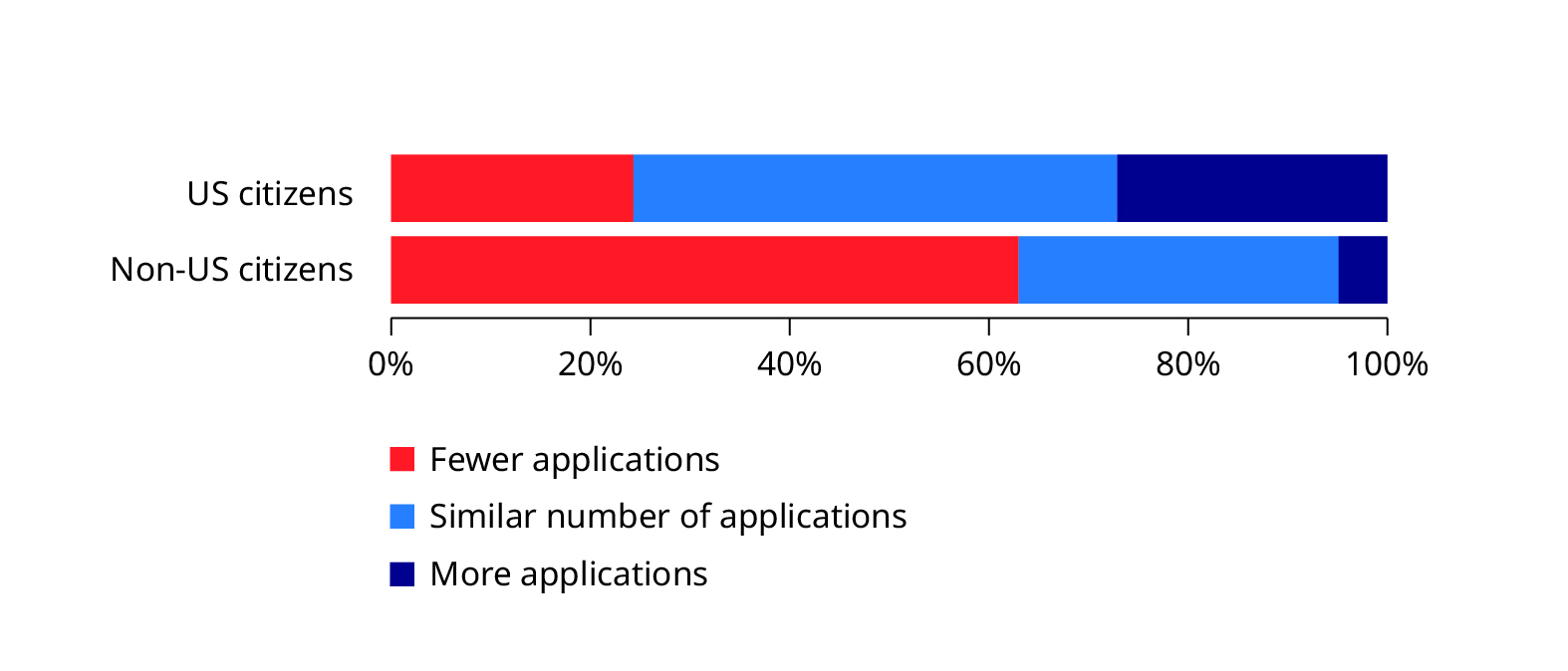
Such snapshots dovetail with the results of a survey conducted this past spring by the statistical research team at the American Institute of Physics (AIP, which publishes Physics Today). According to the group’s 4 June report , more than 60% of US PhD-granting physics and astronomy programs received fewer applications from international students for this fall than for a year earlier; for US student applications, about half of departments saw little change and the rest were split roughly evenly between increases and decreases (see the chart).

More than 60% of the 81 US PhD-granting physics and astronomy departments that responded to a survey by the American Institute of Physics reported that they had received fewer applications from international students in fall 2026 than they had in 2025. The bars show the percentages of departments that reported a decrease, no significant change, and an increase in the numbers of applicants.
(Bar chart adapted from P. Mulvey, T. Owens, and S. Nicholson, Federal Funding and Visa Uncertainty Shape Fall 2026 Graduate Admissions in Physics and Astronomy , American Institute of Physics, 2026.)

Depending on their nationality, students who come—or try to come—from abroad may find themselves in unexpectedly precarious positions. The experience has become infused with anxiety and uncertainty. To ensure their futures, PhD candidates are accelerating their PhDs, skipping visits home, picking up master’s degrees in case they are forced to exit the country before completing their doctoral degrees, or pursuing their studies in other countries.
Frustrations
Abdullah Alhag arrived in the US from Libya in 2014. He double majored in physics and computer science at the Ohio State University and then worked for three years before starting his physics PhD at OSU. After President Trump returned to office, Alhag tried to finish faster because “the States has started to feel like a prison for people from countries under a complete travel ban.” (The ban relevant to him was implemented in June 2025.) He plans to finish his experiments investigating atomic qubit interactions with 2D materials at OSU and then write and defend his thesis remotely from outside the US.
Alhag notes that his professional connections are in the US and that entering a new job market will be a challenge in the current economic climate; he says he may pursue a postdoctoral position in Europe or elsewhere. For now, he says, although he feels safe, he worries about getting on a plane to go to a conference, even domestically: “Once they see my passport . . .”

Abdullah Alhag, a PhD candidate from Libya, in the lab at the Ohio State University. His PhD research has focused on the interactions of atomic qubits with 2D materials for quantum information science. He says that he no longer feels welcome in the US and plans to pursue his career abroad.
(Photo courtesy of Abdullah Alhag.)
A dual Russian–European citizen worked in the US finance sector before starting their physics PhD at a major US university in 2020. (Many international students who were interviewed for this article requested anonymity out of fear of retaliation, including the endangerment of possible future applications for a US visa.) The student had entered the US without incident multiple times. But in 2022, instead of the usual two weeks to renew their visa, they were stranded in Europe for a year and a half. The process is “like an administrative black hole,” they say. “I suspect the hassles are because I have Russian citizenship.” Finally, they were allowed back into the US. But when they returned to Europe for a family matter in 2024, they were pulled back into the vagaries of the visa process. After more than a year in limbo, they filed a writ of mandamus to require the government to give them a decision on the visa. Within two weeks, they say, they got their visa. They returned to the US in late 2025.
A theoretician, the Russian–European student was able to continue their PhD work from afar. To get by financially—including paying rent in the US—they did whatever their department came up with: “I worked with the communications department, I graded,” they say. “It would have been impossible without the support of my university.” In the current environment, they say, they are less inclined than before to pursue a career in the US.
After applying for a US visa multiple times, a student finally gained entry late last year to pursue a physics PhD at a university that had accepted them for fall 2024. Shortly after they arrived, new rules came into play for people from a host of countries, including the student’s home country of Nigeria. It would no longer be possible to reenter if they left the US. Not knowing when they’d see their spouse and child, who are in the UK, caused “mental stress,” they say. “I couldn’t concentrate.” Still, the student plans to stay to complete their PhD in computational nanoscience.
A German national wanted to study AI with a specific mentor in the US but was denied a visa. The student is now working on their PhD at a UK university. A student from Iran had their sights set on a PhD in theoretical physics at a US university. The school deferred admission twice, in 2024 and 2025, while the student tried to get a US visa. As the student’s hopes faded that the visa would be granted, they decided to study in Canada. The delays and denials from the US “caused mental and emotional pressure,” the student says. The US suspension in January 2026 of visa issuance to Iranian nationals has created an additional professional barrier, the student says: “I cannot travel to any scientific event in the US just because of my nationality.”
Mitigations
Many other international graduate students and aspiring graduate students face related challenges. US universities and faculty members help where they can. They commonly defer admissions. They provide points of contact. They advise against leaving the country for conferences or visits home. They come up with responsibilities that students can carry out remotely to continue collecting a paycheck if they do get stuck outside the country.
When students who are advanced in their PhD studies have been stranded outside the US, as sometimes happens for those who go home to China, for example, universities have arranged for them to complete their dissertations and defend remotely. “If someone is in their fourth or fifth year, we would come up with ways for them to finish their PhD,” says Cooper. “But if they get stuck back in their home country in their first year, I don’t know if we could do anything.” Cooper says that he has contacted state representatives for help obtaining visas and contributed personal funds to help a prospective student with a writ of mandamus. The student was denied entry.
“A flood of international students has been applying for master’s degrees,” says Cooper. The degrees are insurance to avoid being left empty-handed if students can’t stay to finish their PhDs. A federal rule, set to take effect in mid-September, that will cap stays for international students is likely to exacerbate that trend—and discourage PhD students from coming to the US, he adds. Betty Wilkins, graduate program coordinator at Virginia Tech, says that physics PhD candidates who came in with physics master’s degrees are picking up master’s degrees in computer science and other fields.
Wilkins says she has seen an uptick in applications from international students who did their undergraduate studies in the US. Students who are already in the US have a visa, notes Cooper. “I have discussions with them about when they should go home to renew. These discussions never happened 5 or 10 years ago.” Students are “trying to read the tea leaves,” he says.
At the other end of the physics degree pipeline, graduates are increasingly leaving the US to put their skills to use. According to a 3 August report from the AIP statistics team, the percentage of international PhDs who were outside the country in the year after receiving their degree jumped from 16% in 2024 to 29% in 2025; that is the largest one-year increase in people leaving the US since 2006, which is as far back as the AIP researchers have checked. For US citizens, the percentage who were not in the country a year after receiving their degrees rose from 10% in 2024 to 12% in 2025.
The June AIP report on graduate admissions concludes that “departments generally are not anticipating restoring previous levels of international recruitment in the 2027 cycle, and a notable share remain uncertain about future admissions plans altogether.” The findings suggest, the report says, that “current funding and immigration-related uncertainties are likely reshaping graduate admissions strategies and the future talent pipeline for physics and astronomy, and likely all physical science disciplines, in the U.S.”