Science organizations mobilize against politicizing purse strings

Once the world’s envy, American science faces what looks to many like a dystopian future. Political appointees, not peer reviewers, could have the last word on awarding research grants. Once-independent investigators could need explicit government approval to use federal money to collaborate with colleagues abroad, attend conferences, or publish papers.
That scenario may become reality in the US if the Regulation for Federal Financial Assistance, proposed by the Office of Management and Budget (OMB), goes into force. The proposal goes far beyond science; it would affect all entities that receive federal money—children’s programs like Head Start, towns and municipalities, Medicaid, food stamps, hospitals, and more. Scientists and scientific societies have been vocal in opposing the proposed rule.
Originally set to go into effect on 1 October, the rule is on hold. The stopgap federal budget bill passed in early September by Congress has delayed its implementation through at least 11 December.
The delay is a “big win,” says Colette Delawalla, founder and CEO of the nonprofit Stand Up for Science. Science advocates need to throw sand into the gears, she says. “We need to make clear to Congress that scientists are upset, and we need to connect this to the midterm elections.”
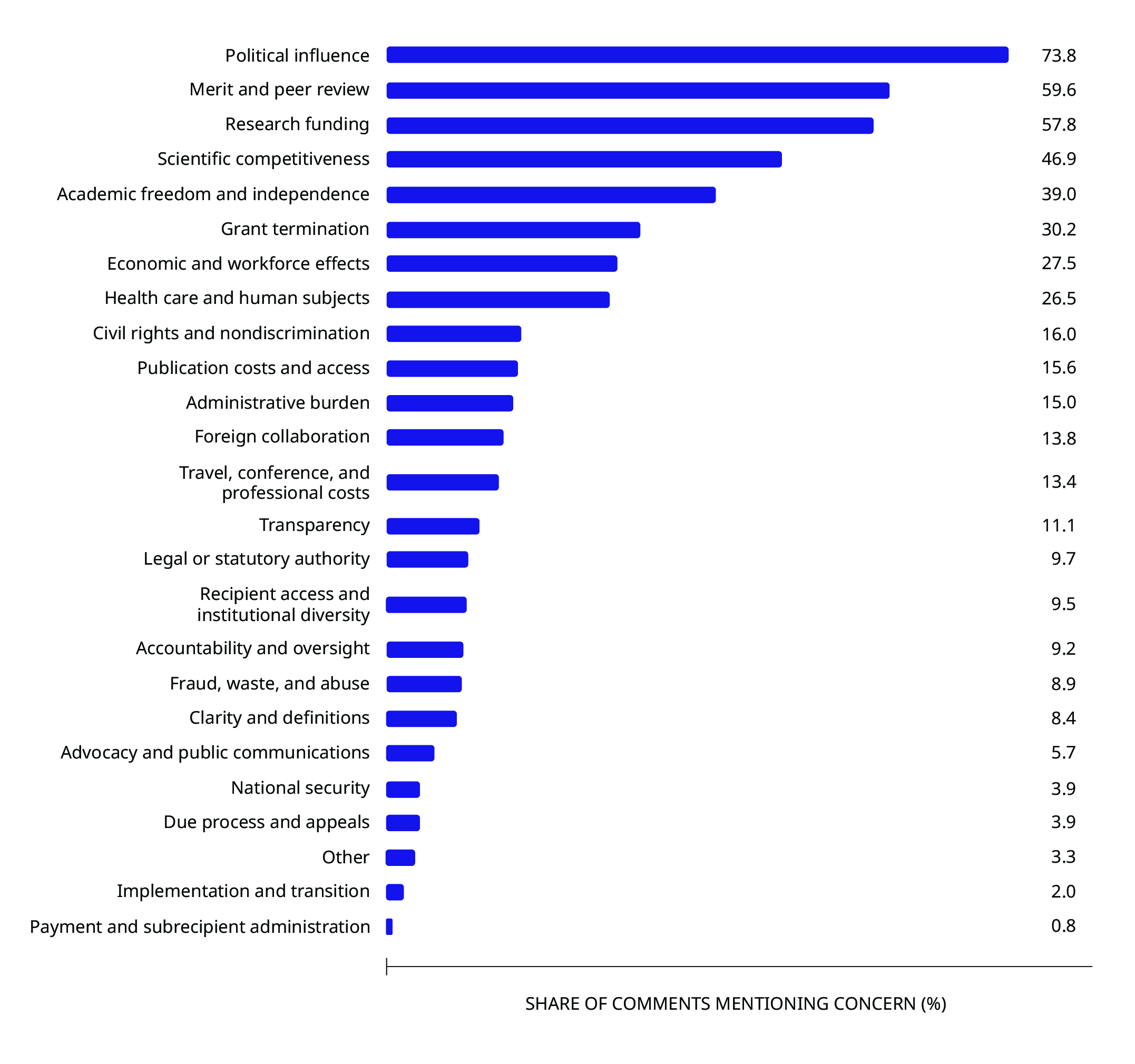
Following the announcement of the proposed rule in late May, many scientific societies, institutions of higher learning, and other organizations began mobilizing scientists to submit comments online explaining how the rule would affect them. The comments that poured in during the 45-day period that ended on 13 July were overwhelmingly in protest of the rule: An American Physical Society (APS) analysis of nearly 41 000 unique comments that expressed a clear stance shows that 98.9% opposed the rule (see the chart for the top concerns expressed). That’s out of more than 52 000 comments downloadable from OMB on 14 July; as of late September, the office had posted nearly 165 000 of the comments, from a reported total of more than 496 000. Now, hoping Congress will quash the rule, scientific organizations are focusing on impressing upon elected officials on both sides of the aisle how damaging it would be.

Volumes of comments poured in this summer during the public commenting period for the Office of Management and Budget’s proposed rule for Federal Financial Assistance. Using AI to analyze the data, a team at the American Physical Society found that 78% of a subset of more than 52 000 comments were unique and laid out a clear position on the rule, and of those, nearly 99% opposed it. Commenters raised concerns about many subjects, as shown in the chart.
(Chart adapted from one provided by Jakrey Myers and Phillip McNallen, American Physical Society.)

The OMB rule is not good for the research enterprise, says Mark Elsesser, who oversees government affairs for APS. For starters, he says, having individual grants funded or terminated for political convenience is a real concern. “The instability in funding would, for example, disrupt the careers of graduate students and postdocs. It creates barriers to developing a STEM workforce.”
The moment “you mess with people’s paychecks, you make it harder to sustain the system and to produce the next generation of scientific leaders,” says Marcel Agüeros, a professor at Columbia University and president of the American Astronomical Society.
Some federal agencies are preemptively complying with the OMB rule. “Anticipatory compliance is a big issue,” says Agüeros. He says that a university administrator for a grant he was awarded by NASA told him to include a list of meetings he wants to attend in 2027 and 2028. “I can’t say at this point what a meeting will cost in 2028 because its location has not yet been decided,” Agüeros says. And NSF is proposing changes to its grant rules to align with the proposed OMB policies. “They are getting ahead of the game,” says Elsesser.
Politics has always played a role in science, acknowledges Lexi Shultz, the American Geophysical Union’s vice president of science policy and government relations, mostly by setting high-level priorities. “But when we put politics above scientific review, as the OMB proposal does, it affects people,” she says. “The science to support physical health, safety, environmental health won’t be as good.” Scientists may feel pressured to tailor their research proposals to survive a political review, worries Shultz. When everything goes through a political lens, “it’s a black box,” she says. “It’s not good for democracy or for ensuring that taxpayer dollars are spent wisely.”
By law, OMB is required to respond to all substantive public comments. The office could adjust the rule or implement it without changing anything. Congress could further delay implementation. Or, hinging on the amount of pushback from the majority party—opposition is already evident from Senate Committee on Appropriations chair Susan Collins (R-ME)—and perhaps on the November midterm elections, says Elsesser, “the proposal could quietly go away.”
If the rule goes into effect, it will be harder to reverse than the executive orders with which it overlaps. In that case, Elsesser and others say, there will be lawsuits.