Stellarators are among the leading fusion energy candidates

Long an underdog in an underdog field, stellarators are now in the running to produce fusion energy. Both the stellarator concept—confining plasma with external magnets in a complex geometry—and, more broadly, fusion energy development have benefited over the past decade from scientific and technological advances, a push for green energy, and burgeoning investor interest. Stellarators gained attention in January when one startup, Thea Energy, was the first of eight companies pursuing five fusion concepts to complete an early design review as part of the Department of Energy’s Milestone-Based Fusion Development Program.
DOE launched the program in 2023 to promote public–private partnerships in fusion. Modeled partly on NASA’s Commercial Orbital Transportation Services program, which helped SpaceX succeed, the DOE program awarded $46 million total to the eight companies (see PT’s 2023 story “What’s old is new in DOE’s choice of fusion hopefuls ”). Along with providing some federal funding, the DOE program validates company achievements and helps them raise private money, says Scott Hsu, who as lead fusion coordinator at DOE was the milestone program’s chief architect; he is now at the climate-tech venture capital company Lowercarbon Capital.
Harder to build, easier to run
The entire fusion energy community got a shot in the arm with the 2022 demonstration of net gain at the National Ignition Facility. (See PT’s 13 December 2022 story about the achievement at NIF .) Two of the DOE milestone awards are to companies that similarly use inertial confinement fusion, which focuses high-powered lasers on a small fusion fuel capsule containing isotopes of hydrogen (see PT’s 2023 story “NIF success gives laser fusion energy a shot in the arm ,” about companies pursuing inertial confinement fusion).

High-temperature superconducting planar coils are being used by Thea Energy to simplify its stellarator design. The company has tested the coils; the next step is to build a prototype stellarator, which is scheduled to be operational by 2030.
(Photo courtesy of Thea Energy Inc.)

Among the milestone awardees, two companies each are going the magnetic confinement routes of tokamaks and of stellarators; the other stellarator participant is Type One Energy. Stellarators were invented in 1951 in the US. Germany and Japan each have one, and research has continued in the US, but the concept fell behind tokamaks, which are the most studied of all the fusion energy approaches. Tokamaks “have the most people, the most experiments, and seem a safe path,” says Felix Parra Diaz, who heads the theory department at the Princeton Plasma Physics Laboratory and served on DOE review committee panels for the milestone program.
But the tokamak has an Achilles’ heel: It requires an electric current in the plasma as part of its confinement mechanism, and instabilities in the current can lead to disruptions. If that happens, says Parra Diaz, “the plasma cools, current goes to the wall, and the magnetic field creates forces that can damage the walls. You have to stop the machine and repair it.” For tokamaks to reliably provide energy, he continues, “the game is either to be clever or to sacrifice performance to keep the plasma stable.”
Stellarators, in contrast, have complicated geometries, but the plasma is sustained entirely by the externally applied magnetic field and is stable. They are harder to build but easier to run than tokamaks. The stellarator is still more than an order of magnitude behind the tokamak in terms of pure plasma performance, says Hsu. But, he adds, “all things being equal, the net electrical power to the grid will be higher for a stellarator.”
Computational leaps
A steady beat of scientific advances has sparked new optimism about achieving fusion energy pilot plants within a decade and fusion energy on the electric grid by the mid 2040s. Among them, two stand out: the application of high-temperature superconductors and leaps in computing.
High-temperature superconductors allow for plasma confinement at higher magnetic fields and lower volumes. “That’s a big deal,” says Derek Sutherland, vice president of R&D at Realta Fusion, which is in the DOE milestone program and focuses on the magnetic-mirror confinement fusion concept. “With higher plasma density, the fusion rate increases,” he explains. “If you double the magnetic field strength, you can generate 16 times the fusion output in a given volume.” That, in turn, brings down cost.

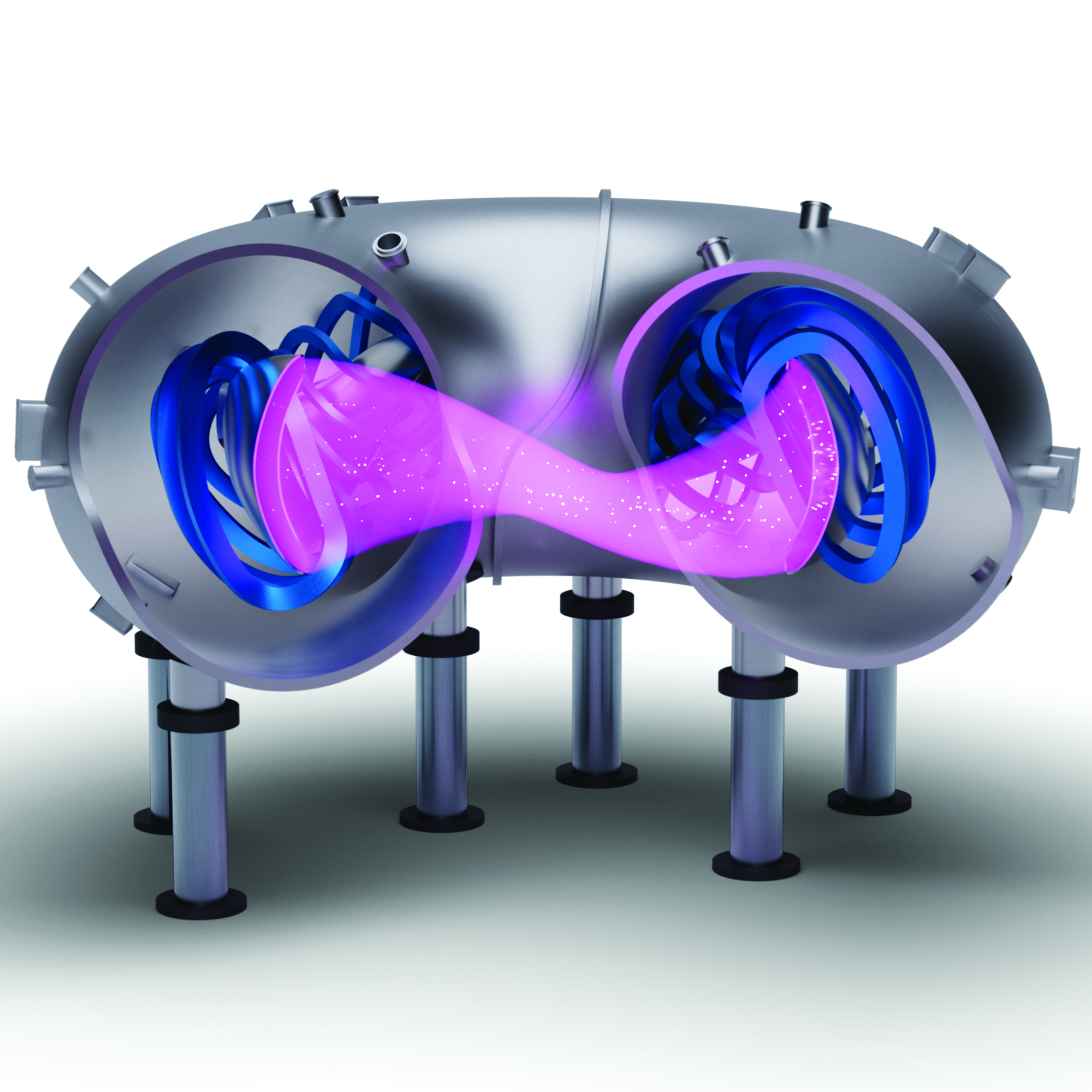
A stellarator with geometrically complex magnets (blue) to confine plasma (pink) is to be built by Type One Energy, a participant in the Department of Energy’s fusion development milestone program. Construction is slated to start in Clinton, Tennessee, late this year, with operations planned to begin in 2029. Roughly 12 meters across, the machine would serve as a test bed for a future stellarator that would produce electricity.
(Rendering courtesy of Type One Energy.)

And computational advances, including with AI, help with fusion machine design. That’s particularly useful for the complex geometries of stellarators. Thea Energy’s innovation is to use roughly 350 planar coils instead of a few complicated magnets, says Charles Swanson, the company’s director of fusion systems. “You still need a twisted, elongated, donut-shaped magnetic field,” he says, but the company’s design is simpler to build than a traditional stellarator. “Without modern computational power, you couldn’t come up with optimized stellarator designs,” says Hsu.
More challenges
Scheduling breakthroughs for scientific challenges is impossible, says Hsu. But the remaining challenges are increasingly in engineering, he says, and they overlap for the various fusion concepts. Those challenges include mitigating materials damage from neutrons and breeding tritium for deuterium–tritium fusion reactions. Engineering challenges are “a different flavor” from scientific ones, he says, “and investment is a better predictor of progress to come. That is the transition that fusion is trying to enact now.”
Another challenge for achieving commercial fusion energy is education, says Elizabeth Paul, an assistant professor of applied physics at Columbia University who focuses on stellarator theory and computation. “With more private companies involved,” she says, “there is more emphasis on developing the workforce that will feed into companies and run fusion reactors.”
The different fusion approaches each have pros and cons, says Paul, “and it’s not obvious who will be the winner. It makes sense to explore different approaches in parallel.”
“It’s healthy to have a competition of ideas,” says Uri Shumlak, chief science officer and cofounder of Zap Energy, the milestone company that uses Z pinch to create fusion. “If any one of us is successful, having a carbon-free energy source will benefit society at large.”