The Princeton period

An aerial view of the Institute for Advanced Study in Princeton, New Jersey, in an undated photo.
(Photo from Princeton University, courtesy of the AIP Emilio Segrè Visual Archives.)

From the archives: October 1967
Editorʼs note: This article, on J. Robert Oppenheimerʼs tenure as director of the Institute for Advanced Study, appeared in a special issue on Oppenheimer that was published shortly after his death.
In September 1946 the American Physical Society met in midtown Manhattan. In the minutes of this meeting we read that it “was confined to papers on three topics: cosmic-ray phenomena, theories of elementary particles and the design and operation of accelerators of nuclear particles and electrons. Disparate as these three subjects may appear to be, the trend of physics is rapidly uniting them. 1
Of that meeting, I have two vivid memories. The first one, being introduced to Robert Oppenheimer by Hendrik A. Kramers and discussing with him the problem of radiation reaction on the scattering of an electron in an external field, a subject in which Oppenheimer and Bethe were actively interested at the time; 2 the second one, meeting Isidor I. Rabi for the first time, who at once fired the question: “Do you think the polarization of the vacuum can be measured?” I remember my amazement at a country where experimentalists would know, let alone bother, about vacuum polarization. For this was my first week in the United States. Thus I write as one of those who, because of age, geography or other reasons, did not meet Oppenheimer until after the war. That first week was a preview of things to come.
In January 1947 Oppenheimer gave the Richtmyer lecture at the New York American Physical Society meeting, entitled “Creation and Destruction of Mesons.” 3 In this lecture he reported on the first results obtained with the 184-inch Berkeley cyclotron. He then went on to discuss the soft component of the cosmic rays that originates within a few radiation lengths from the top of the atmosphere and suggested that this component derives from the decay of neutral mesons. This pioneering remark on the role of π0 mesons he made again in a subsequent paper 4 on multiple-meson production.
After the talk he invited me for a drink in a Broadway bar where he told me that he had been offered the directorship of the Institute for Advanced Study in Princeton. He accepted this post in April and thus became the institute’s third director and the first to hold this position concurrently with a professorship there.
That spring, I saw Oppenheimer for the first time in full action. Early in 1947 it was suggested from various sides that a number of small panel conferences be held in the various branches of science. Their purpose should be to review recent developments and discuss possible avenues of progress. Under the auspices of the National Academy of Sciences, and with the support of the Rockefeller Foundation, the first such conference in physics took place on 2–4 June 1947, on Shelter Island, New York. For this meeting Oppenheimer wrote the outline of topics for discussion entitled “The Foundations of Quantum Mechanics.” As was to happen so often in the following years, Oppenheimer showed himself to be the threefold master: by stressing the important problems, by directing the discussion and by summarizing the findings.
Mesons and cosmic rays
In his outline he discussed the copiousness of meson production in cosmic radiation in terms of meson theories then current and concluded that “no reasonable formulation along this line will satisfactorily account for 5 the smallness of the subsequent interaction of mesons with nuclear matter.” In the discussion of this point, Robert E. Marshak got up to propose that there should be two kinds of mesons. 6 It was, one may recall, in September of that year that Cecil F. Powell reported the discovery of π–μ decay at a Copenhagen conference.
The Shelter Island conferences witnessed the opening of a new chapter in quantum electrodynamics. Two of the men who played a leading role in this development were associated with Oppenheimer in the Berkeley days.
One of them, Willis Lamb (Berkeley PhD, 1938, with Oppenheimer) gave an account of the early results of the Lamb–Retherford experiment 7 that indicated an upward shift of about 1000 MHz for the 22S½ state of hydrogen as compared with the prediction for a single particle in a Coulomb field. Rabi reported 8 on a deviation in the hyperfine structure of hydrogen and deuterium that was soon to be attributed quantitatively by Julian Schwinger (research associate at Berkeley from 1940 to 1941) to an anomaly of the magnetic moment of the electron.
Immediately Oppenheimer emphasized that here one might have to work with self-energy effects. Small wonder. As Serber wrote, already in 1930 he had been concerned 9 with atomic level displacements due to radiative effects. In 1934, Dirac 10 and independently Wendell H. Furry and Oppenheimer 11 had noted “that the charge of the electron defined in the usual way is not the true charge” (charge renormalization) and that there should be deviations from Coulomb’s law, a point taken up further by Edwin A. Uehling and by Serber. Here was also the answer to Rabi’s question of a few months ago: Whatever one was measuring, it was not exclusively the “Uehling terms” because these by themselves give an effect that is much too small and of the wrong sign. As is known, the electromagnetic nature of the Lamb shift became evident soon after the conference took place. 12
At the institute
In the late summer of 1947 Oppenheimer and his family moved to Princeton, and a new era began at the Institute for Advanced Study.
Physics had been represented at the institute since its inception—the first two professors appointed in 1933 were Oswald Veblen and Albert Einstein. Bohr and Dirac had been frequent visitors, and Pauli spent the war years there. In addition, a score of other physicists had worked at the institute at one time or another. But upon Oppenheimer’s arrival a function and quality of the institute developed which, for reasons to be profoundly respected, had not been there before. It became a center for physics.

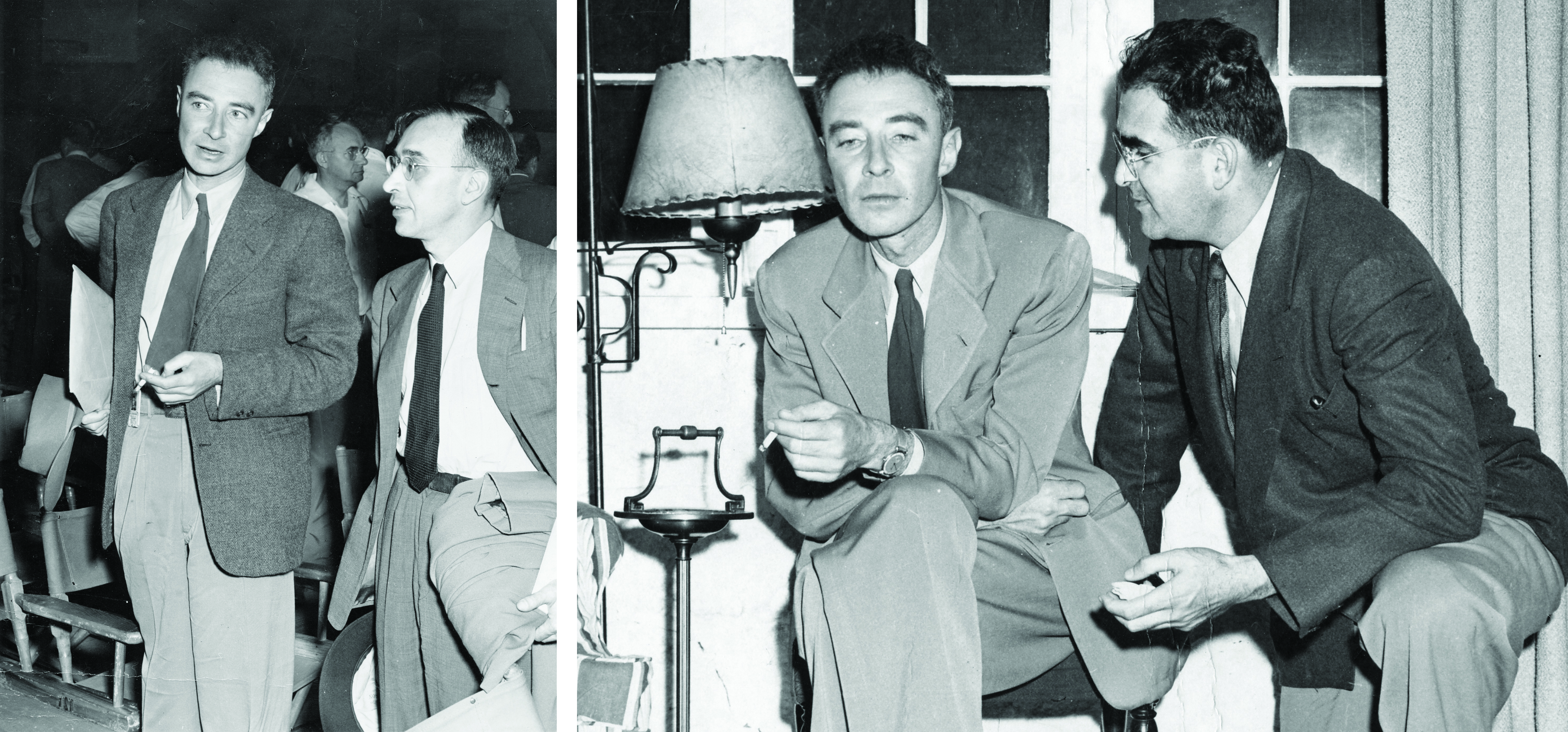
Postwar conversations in 1946 with (left) Gregory Breit of Yale University and (right) Victor Weisskopf of MIT.
(Photos from the AIP Emilio Segrè Visual Archives, Physics Today Collection.)

Once again Oppenheimer’s outstanding talent for assembling the right people and stimulating them to great effort was the decisive factor. Regular periods of residence for eminent physicists have continued to play an important role in the life of the institute. But from the very start Oppenheimer brought to physics at the institute a new emphasis on youth. In fact, on his arrival in Princeton, five research associates from Berkeley came with him as the first temporary physics members in the new style. The first physics paper to come out of the institute after he took over is an application of mass renormalization by one of these associates. 13 It deals with the same aformentioned problem that Oppenheimer had worked on himself in collaboration with Bethe. This is characteristic for the continuity as well as for the transition in Oppenheimer’s activities. For from then on, his principal activity was not so much his own research. Rather it was to be, in the original meaning, a director of physics.
A director, rather than a teacher in the conventional sense, for there is no such teaching at the institute. To be sure, we had our seminars. They were lively—sometimes very lively. And Oppenheimer’s sharp insights played a major part in making them so. Yet Oppenheimer’s main contribution to the work and the style of the institute was not merely the conducting of a seminar. His influence was far more important, more subtle perhaps but no less enspiriting. He could convey to young men a sense of extraordinary relevance of the physics of their day and give them a sense of their participation in a great adventure, as for example in the Richtmyer lecture: “There are rich days ahead for physics; we may hope, I think, to be living in one of the heroic ages of physical science, whereas, in the past, a vast new field of experience has taught us its new lessons and its new order.” 14 He could define and thereby enhance their dedication, by words such as these: “People who practice science, who try to learn, believe that knowledge is good. They have a sense of guilt when they do not try to acquire it. This keeps them busy. . . . It seems hard to live any other way than thinking that it was better to know something than not to know it; and that the more you know the better, provided you know it honestly.” 15
To an unusual degree, Oppenheimer possessed the ability to instill such attitudes in the young physicists around him, to urge them not to let up. He could be critical, sharply critical at times, of their efforts. But there was no greater satisfaction for him than to see such efforts bear fruit and then to tell others of the good work that someone had done.
Quantum electrodynamics
Oppenheimer again gave much drive to the two sequels to the Shelter Island conference. There was the Pocono Manor Inn conference (30 March to 1 April 1948) at which Schwinger gave an 8-hour marathon talk, and Richard P. Feynman’s contribution was not yet fully appreciated. At the very time of this conference Sin-itiro Tomonaga sat down in Tokyo and wrote to Oppenheimer (letter dated 2 April). In this important letter, Tomonaga gave an account of the independent progress that had been made by him and other Japanese physicists toward a “self consistent subtraction method,” or as we now say, the renormalization method. The Old Stone on the Hudson meeting (11–14 April 1949) also had experimental and theoretical refinements of electrodynamics as a main theme, and at that time Feynman’s diagrams were understood. This was the third and last of the precursors of the Rochester conferences.
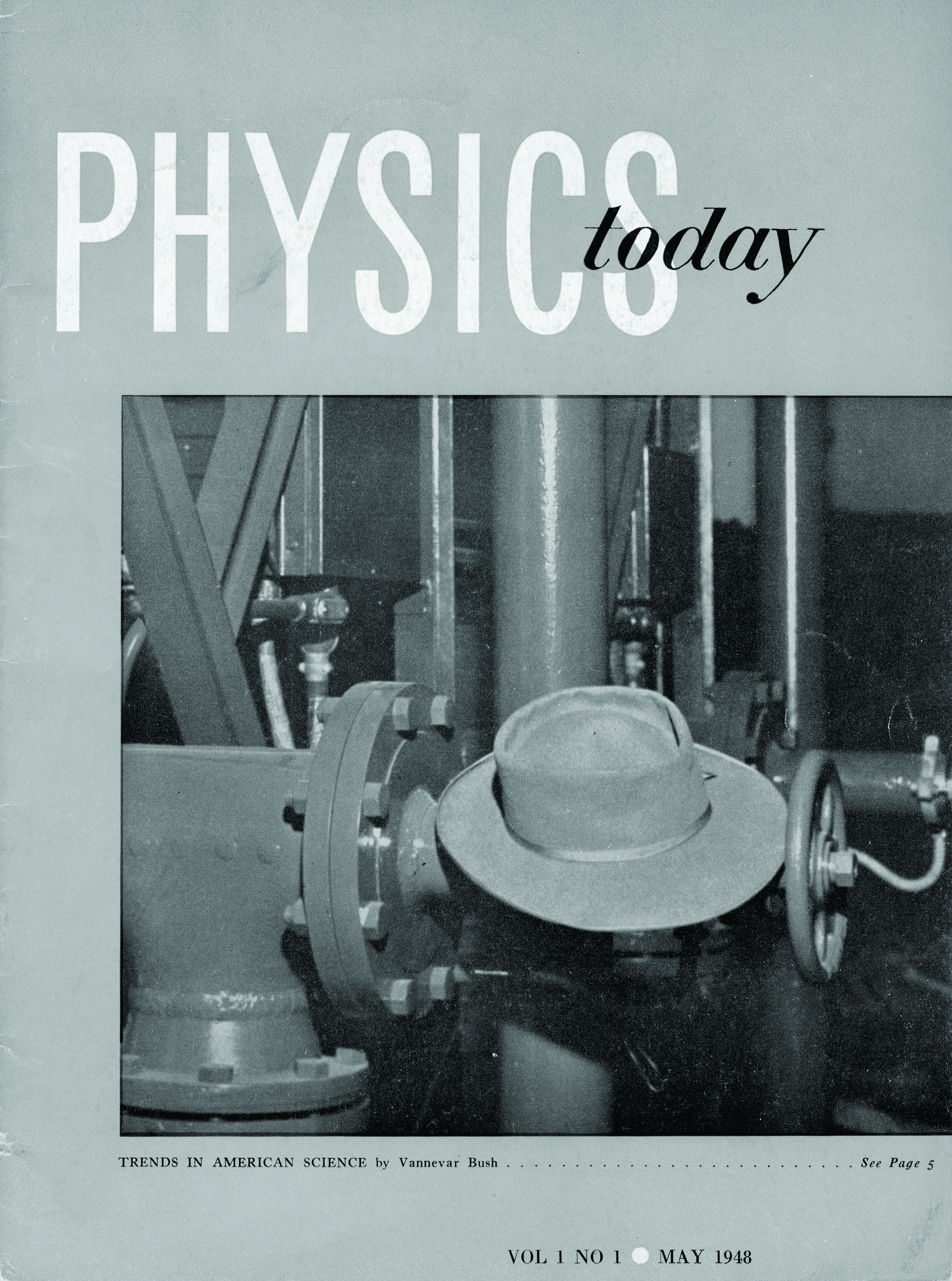
Meanwhile, in the years of which I now speak, the late forties and early fifties, Oppenheimer had become known widely as a principal representative figure of the natural sciences. Thus when in 1948 the American Institute of Physics inaugurated a new journal, Physics Today, the dialogue between theory and experiment was symbolized on the cover of its first issue by a picture of a porkpie sombrero tossed on a cyclotron. When in 1950 the Scientific American devoted an issue 16 to summarize that incredibly full half-century in science, 1900–50, it was fitting that Oppenheimer should write its general introduction.
Poet and physicist
In this introduction, Oppenheimer for once talks about himself, something he did only rarely. All those whose lives have been enriched for having known his warmth and his friendship, as has mine, had to know Robert’s uncommonly strong protective sense of privacy that was sometimes mistaken for an inner aloofness. In any event, in the introduction just mentioned, he tells how, twenty years earlier, Dirac had taken him “to task with characteristic gentleness. I understand [Dirac had said] that you are writing poetry as well as working at physics. I do not see how you can do both. In science we say something that no one knew before in a way that everybody can understand. Whereas in poetry . . .”

Ubiquitous symbol. The cover of Physics Today (volume 1, number 1) shows the 184-inch Berkeley cyclotron with Oppie’s familiar porkpie tossed on it.
(Photo from Lawrence Berkeley National Laboratory, courtesy of the AIP Emilio Segrè Visual Archives, Physics Today Collection.)

Oppenheimer’s physics papers were the real stuff; no poetry there. Yet, as is familiar to all who knew him and as can also clearly be seen in his more reflective writings, it is an integral part of the Oppenheimer style that he had more than a touch of the poet. He was a master of the language.
For many of us it was a joy to hear him discuss or paraphrase a subject, especially if the subject was somewhat familiar, for Oppenheimer’s discourse was not for beginners. But to some his style was alien. It is too simple to say that Oppenheimer polarized his surroundings, but it is true that the reactions that he evoked were never bland.
I must now briefly but sharply interrupt the main line of this account to mention events that have affected all of us, though certainly not all of us equally.
Security
On Sunday, 11 April 1954, a major newspaper ran an article whose title read in part: “Next target: the leading physicists.” It was the first intimation to the world at large of a coming ordeal that had long been expected and that would be in the public domain the very next day. I shall now relate something of the impact of these tense months on life at the institute.
The institute as such has never been asked to accept nor has it ever sought a classified contract. 17 Clearly, therefore, the tumult of those days did not affect the nature of the work done there. It will be equally clear that these happenings dampened the spirit at the institute even more than it did at many other centers. On 14 April chairman Herbert Maass of the board of Trustees announced that Oppenheimer would continue as director. Yet there was reason for uncertainty about this, because the directorship of the institute is an appointment that needs a formal vote of renewal each year. Fortunately this concern turned out to be unfounded.
Before the final decision, the council of the American Physical Society issued a statement on 13 June through its president Hans A. Bethe, in which they stressed that the turn of events might “prevent the development of the best thought.” [Editorʼs note: See more on APSʼs preparation of a statement.] After the final ruling had been made, a formal statement was issued by all twenty-six permanent members and professors emeriti at the institute, of which I quote the following part:
“Dr Oppenheimer has performed for this country services of another kind, more indirect and less conspicuous but nevertheless, we believe, of great significance. For seven years now he has with inspired devotion directed the work at the Institute for Advanced Study, for which he has proved himself singularly well suited by the unique combination of his personality, his broad scientific interests and his acute scholarship. We are proud to give public expression at this time to our loyal appreciation of the many benefits that we all derive from our association with him in this capacity.” *
While I speak as one of the many who think at this moment of a man treated with gross injustice, as one of the many who deeply respect the stand of Harry Smyth, even so this is not the evening to relive our own anguish. Let us rather remember that in spite of other serious responsibilities that had to be part of his destiny, Oppenheimer’s foremost devotion was always to physics. As he put it himself sometime later: “we have, all of us to preserve our competence in our own professions, to preserve what we know intimately, to preserve our mastery. This is, in fact, our only anchor in honesty.”18 Thus it was a comfort to him that physics flourished at the institute in these years. Of this I shall now continue to tell.
In some old notes from the Pocono Conference I found these comments. By Oppenheimer: “Now it doesn’t matter that things are infinite.” By Rabi: “What the hell should I measure now?” They reflect the sense of optimism of the late forties, especially the expectation that with the new theoretical tools other than electromagnetic interactions would soon give sensible results.
Subnuclear research
The mood and the scene changed drastically in the fifties. It was soon clear that hydrodynamics would not yield as readily to the degree that electrodynamics had. At the same time a whole new world of particles and interactions began to unfold. I do not recall any mention, at Pocono or Old Stone, of the original cosmic-ray findings of George D. Rochester and Clifford C. Butler. But it was not long before vast efforts began to penetrate the subnuclear world, by experimentalists with newly available accelerators and by theorists who attempted to find new rules if not laws to cope with the extended vista of strong, electromagnetic and weak interactions.
And so we witness in the fifties two main theoretical approach marches. First, the development of a much needed new phenomenology. Secondly, a reconsideration of the foundations of field theory and a search for new methods to cope with situations in which, if not field theory, then at least-power series expansions appear to fail.

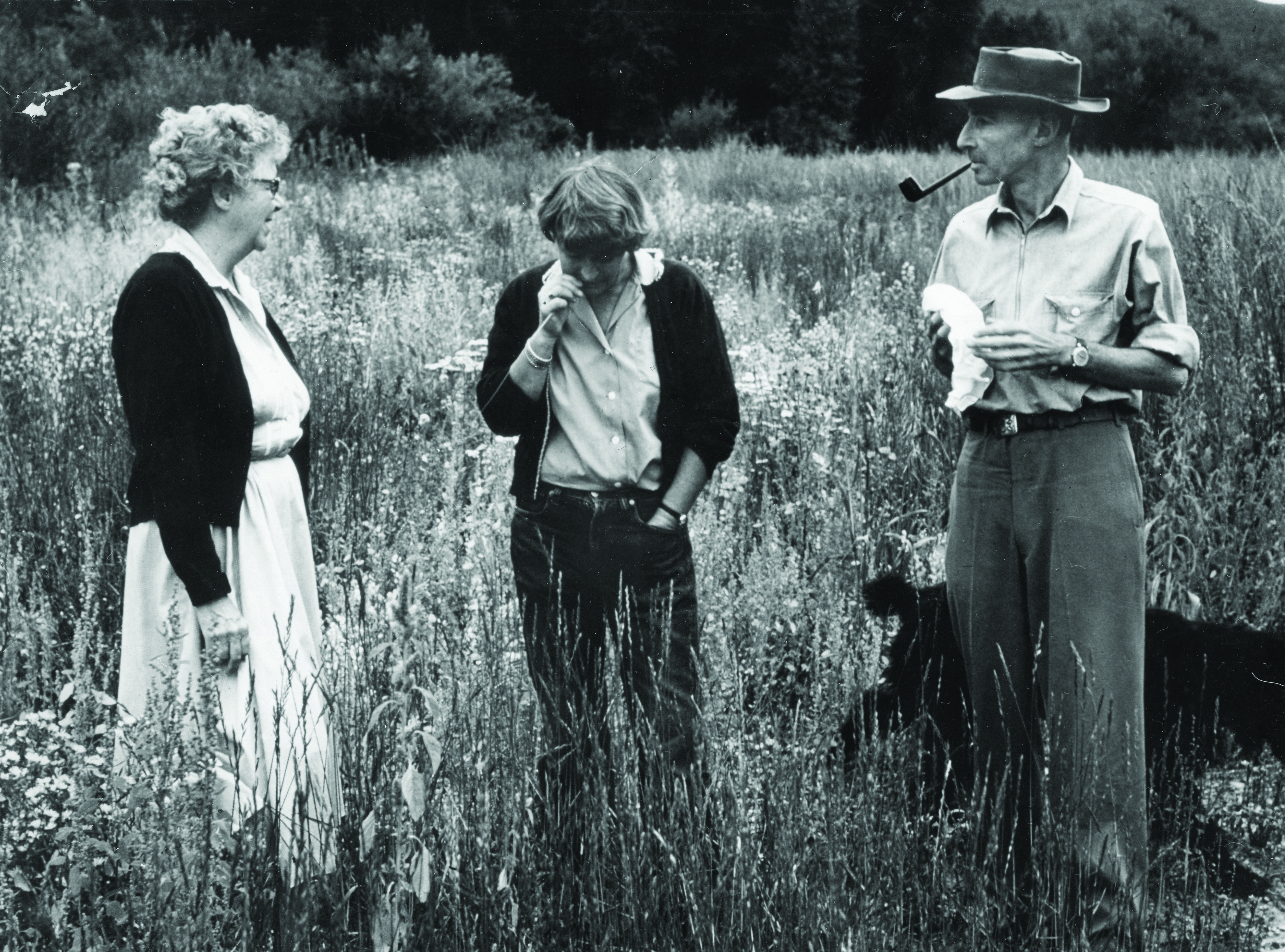
Day of rest. Oppie relaxes with his sister-in-law, Mrs Frank Oppenheimer, and Dorothy McKibbin, one of Project Y’s first employees.
(Photo from the AIP Emilio Segrè Visual Archives, Physics Today Collection.)

It is in this period that theoretical particle physics became largely separate from theoretical nuclear physics. The pioneering developments in this new field are most closely associated with work done at the institute in the Oppenheimer era. Other subjects such as astrophysics and statistical mechanics were also successfully pursued. In those years the institute became a leading center at which aspiring theorists sought to spend time. Its list of alumni is most impressive. One can find them now all over this country as well as abroad. All of us who were part of these active and generally harmonious years will forever be deeply grateful to Robert Oppenheimer.
In the early sixties, there was a large scattering of the physics staff at the institute. Once again Oppenheimer directed the formation of a new team and, by and by, the continuity of the operation will be evident. It was also in this period that the institute’s beautiful new library was opened. When you visit it, you should remember that this is Robert’s building. It took some doing to get it done.
In the postwar period Oppenheimer’s own writings focused more and more on the fact that the relations between the modern sciences and the general culture of our time are not as intimate and fruitful today as they could be. What precisely was his concern in this matter? Was it the problem of “mass culture”? Of course he recognized the importance of popularization, yet “That is not now my problem,” he said. 18 What really preoccupied him was that the span of things the intelligent man can cope with is dangerously narrowing; that the relationships between common sense and specialized knowledge are in greater difficulty now than ever, because the rate of increase of that which is known is now greater than ever. Even to the scientist it is often difficult to appreciate the essentials of a neighboring discipline, not completely foreign but not quite his own, “even in physics we do not entirely succeed in spite of a passion for unity which is quite strong.”
Was it then his intent to explain isotopic spin to philosophers? No harm in trying, he thought, but “as for particle physics, what we are sure of today may not yet be ready to make its contribution to the common culture.” 19
To the intellectual community
Briefly, then, what Oppenheimer had in mind was this. First, he addressed himself to what is loosely called the intellectual community. He wished to foster a common understanding primarily within this community. Second, as an example of what in his opinion could profitably be shared, he mentions the lesson of quantum theory which we call complementarity. He wished and in fact tried to explain this lesson to the biologist, the statesman and the artist because he believed that what to the physicist is a technique represents at the same time a general way of thinking that could be liberating to all. Third, he saw a twofold duty for our educational system. In the face of increasing demands on education we should continue to stress that the cultural life of science lies almost entirely in the intimate view of the professional. At the same time, “no man should escape our universities without . . . some sense of the fact that not through his fault, but in the nature of things, he is going to be an ignorant man, and so is everyone else.” 20
Of the great effort needed to achieve these aims he said the following: “I think that, with the growing wealth of the world, and the possibility that it will not all be used to make new committees, there may indeed be genuine leisure, and that a high commitment on this leisure is that we reknit the discourse and the understanding between the members of our community.
“As a start, we must learn again, without contempt and with great patience, to talk to one another; and we must hear.” 18
Oppenheimer himself talked and wrote with authority on these subjects, an authority which derived from the only primary source acceptable to us: the personal participation of the professional in his craft, whatever the craft may be. Thus it was in keeping with Oppenheimer’s style that, as he devoted himself to these general themes, it was never at the expense of his own hardboiled interests in the progress of physics. He kept fully abreast of all new developments in his field which he loved so deeply.
In early 1966 it became clear that Oppenheimer was most seriously ill. Even then he did not lose his inexhaustible curiosity for physics but kept talking shop, in pain but lucidly, till the end.
Freeman J. Dyson has told me of Oppenheimer’s last visit to the institute. He came to participate in a discussion on the selection of the young physicists who will be members of the institute in the coming academic year. He knew he would not be there to greet them.
Robert Oppenheimer died on 18 February 1967.
Any single one of the following contributions would have marked Oppenheimer out as a preeminent scientist: his own research work in physics; his influence as a teacher; his leadership at Los Alamos; the growth of the Institute for Advanced Study to a leading center of theoretical physics under his directorship; and his efforts to promote a more common understanding of science. When all is combined, we honor Oppenheimer as a great leader of science in our time. When all is interwoven with the dramatic events that centered around him, we remember Oppenheimer as one of the most remarkable personalities of this century. In the years to come the physicist will speak of him. So will the historian and the psychologist, the playwright and the poet. But it would take the singular combination of talents of this extraordinary man himself to characterize his life in brief. Perhaps Robert has done just that. I shall conclude by reading a few lines which he wrote fourteen years ago.
“The wealth and variety of physics itself, the greater wealth of the natural sciences taken as a whole, the more familiar, yet still strange and far wider wealth of the life of the human spirit, enriched by complementary, not at once compatible ways, irreducible one to the other, have a greater harmony. They are the elements of man’s sorrow and his splendour, his frailty and his power, his death and his passing, and his undying deeds.” 21
* This statement was signed by: James W. Alexander, Julian H. Bigelow, Harold F. Cherniss, Freeman J. Dyson, Albert Einstein, Kurt Gödel, Hetty Goldman, Herman H. Goldstine, Ernst Kantorowicz, E. A. Lowe, Benjamin D. Meritt, Deane Montgomery, Marston Morse, Abraham Pais, Erwin Panofsky, George Placzek, Atle Selberg, Walter W. Stewart, Homer A. Thompson, Oswald Veblen, John von Neumann, Kurt Weitzmann, Hermann Weyl, Hassler Whitney, E. L. Woodward, Chen Ning Yang.
References
2. H. A. Bethe, J. R. Oppenheimer, Phys. Rev. 70, 451 (1946) ; J. R. Oppenheimer, H. A. Bethe, 70, 796 (1946) .
3. J. R. Oppenheimer, Phys. Rev. 71, 462 (1947) .
4. H. W. Lewis, J. R. Oppenheimer, S. A. Wouthuysen, Phys. Rev. 73, 127 (1948) .
5. M. Conversi, E. Pancini, O. Piccioni, Phys. Rev. 71, 209 (1947) ; erratum 71, 557 (1947) .
6. The statement that “the particle with mass determined from the range of nuclear forces is the Yukawa particle and not the meson found in cosmic rays” appears first, I believe, in S. Sakata and T. Inoue, Prog. Theor. Phys. 1, 143 (1946) . The Shelter Island discussions led to the paper by R. E. Marshak and H. A. Bethe, Phys. Rev. 72, 506 (1947) . The Japanese paper did not reach the US until early 1948; see R. E. Marshak in Proc. Kyoto Conf., 1965, p. 180.
7. W. E. Lamb, R. C. Retherford, Phys. Rev. 72, 241 (1947) .
8. J. E. Nafe, E. B. Nelson, I. I. Rabi, Phys. Rev. 71, 914 (1947) . See also G. Breit, Phys. Rev. 72, 984 (1947) ; H. M. Foley, P. Kusch, Phys. Rev. 72, 1256 (1947) ; 73, 412 (1948) ; G. Breit, Phys. Rev. 74, 656 (1948) .
9. J. R. Oppenheimer, Phys. Rev. 35, 461 (1930) .
10. P. A. M. Dirac, Proceedings of the Seventh Solvay Conference (1934).
11. W. H. Furry, J. R. Oppenheimer, Phys. Rev. 45, 245 (1934) .
12. See H. A. Bethe, Phys. Rev. 72, 339 (1947) .
13. H. W. Lewis, Phys. Rev. 73, 173 (1946) .
14. From the unpublished manuscript of the Richtmyer lecture, see ref. 3, p. 460.
15. J. R. Oppenheimer, “Knowledge and the Structure of Culture,” Helen Kenyon Lecture, Vassar College, 29 October 1958.
16. J. R. Oppenheimer, “The age of science: 1900–1950 ,” Scientific American, September 1950.
17. See also the comments by J. R. Oppenheimer, in In the Matter of J. Robert Oppenheimer: Transcript of hearing before Personnel Security Board, US Atomic Energy Commission (1954), p. 26.
18. J. R. Oppenheimer, “On science and culture,” Encounter, October 1962, p. 3.
19. R. Oppenheimer, in Perspectives in Modern Physics: Essays in Honor of Hans A. Bethe, R. E. Marshak, ed., Interscience (1966), p. 9.
20. J. R. Oppenheimer, “Science, values and the human community,” Fulbright Conference on Higher Education, Sarah Lawrence College (1957).
21. J. R. Oppenheimer, Science and the Common Understanding, B. B. C. Reith Lectures 1953, Oxford U. Press (1954).
More about the authors
Abraham Pais (1918–2000) joined the Institute for Advanced Study in Princeton in 1946 and was professor there from 1950 to 1963. This article is an edited version of a speech given at the Oppenheimer memorial session of the APS meeting held in Washington, DC, on 24 April 1967.