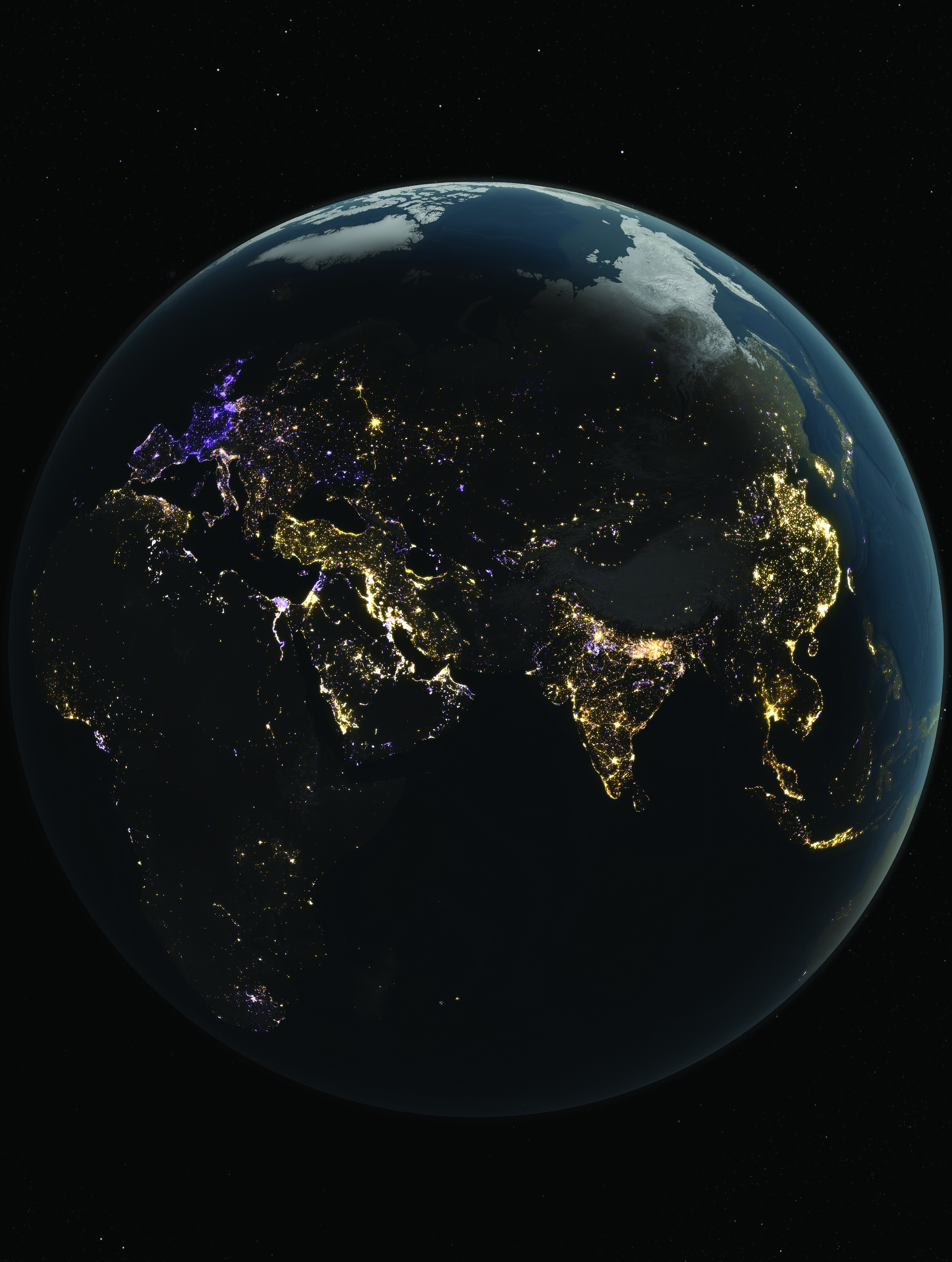
Brightness of the night sky is volatile


In this image of Earth, yellow indicates areas that have experienced short-term events that primarily increased the brightness of nighttime artificial light from 2014 to 2022. Purple denotes areas where such events led to a sustained brightness decrease, and white means that some events in the area brightened the night sky across the time period and others dimmed it.
(Image courtesy of Michala Garrison/NASA Earth Observatory.)

Satellite-based measurements have shown that the night sky above much of Earth’s population has brightened over time. Measurements of changes in radiance of nighttime artificial light have been based on observations with annual or multiyear temporal resolution. But human-related activities that take place on shorter time scales—including construction events, power outages from natural disasters and disruptions from war, and changes in public policy—affect local artificial lighting and thus whether the night sky brightens or dims.
In new work, Zhe Zhu of the University of Connecticut and colleagues have identified frequent fluctuations in the brightness of nighttime artificial light across the globe. 1 Using data from NASA’s Black Marble project, which employs a radiometer aboard the Suomi National Polar-Orbiting Partnership satellite, the researchers obtained nightly signals of brightening and dimming from 2014 to 2022 and corrected for atmospheric effects, lunar illumination, and viewing geometry. Then, they used a detection algorithm to track when the radiance of artificial light in a location increased or decreased, how intense the light was, and whether the change was abrupt or gradual.

This country-level map shows trends in brightening and dimming of artificial light at night (ALAN) and whether the trends are significant over the 2014–22 study period.
(Image courtesy of Tian Li and Zhe Zhu/University of Connecticut.)

Some key results are shown in the map above. The researchers found that variations in radiance were frequent, sometimes abrupt, and often subsequently reversed in the same region. Globally, brightening events contributed to a 34% increase in radiance of artificial light relative to the 2014 baseline, but that was offset by a radiance decrease of 18% from dimming events, so the result was a net brightening of 16%. The new analysis, with its high spatial and temporal resolution, could help provide a consistent framework for understanding the drivers of change in artificial light at night across the globe. Researchers may, with nightly observations, be positioned to study various effects, such as how policy changes curb light pollution or how economic volatility affects human activity.
Reference
1. T. Li et al., “Satellite imagery reveals increasing volatility in human night-time activity ,” Nature 652, 379 (2026).