Slow-forming core could have fueled Ganymede’s dynamo


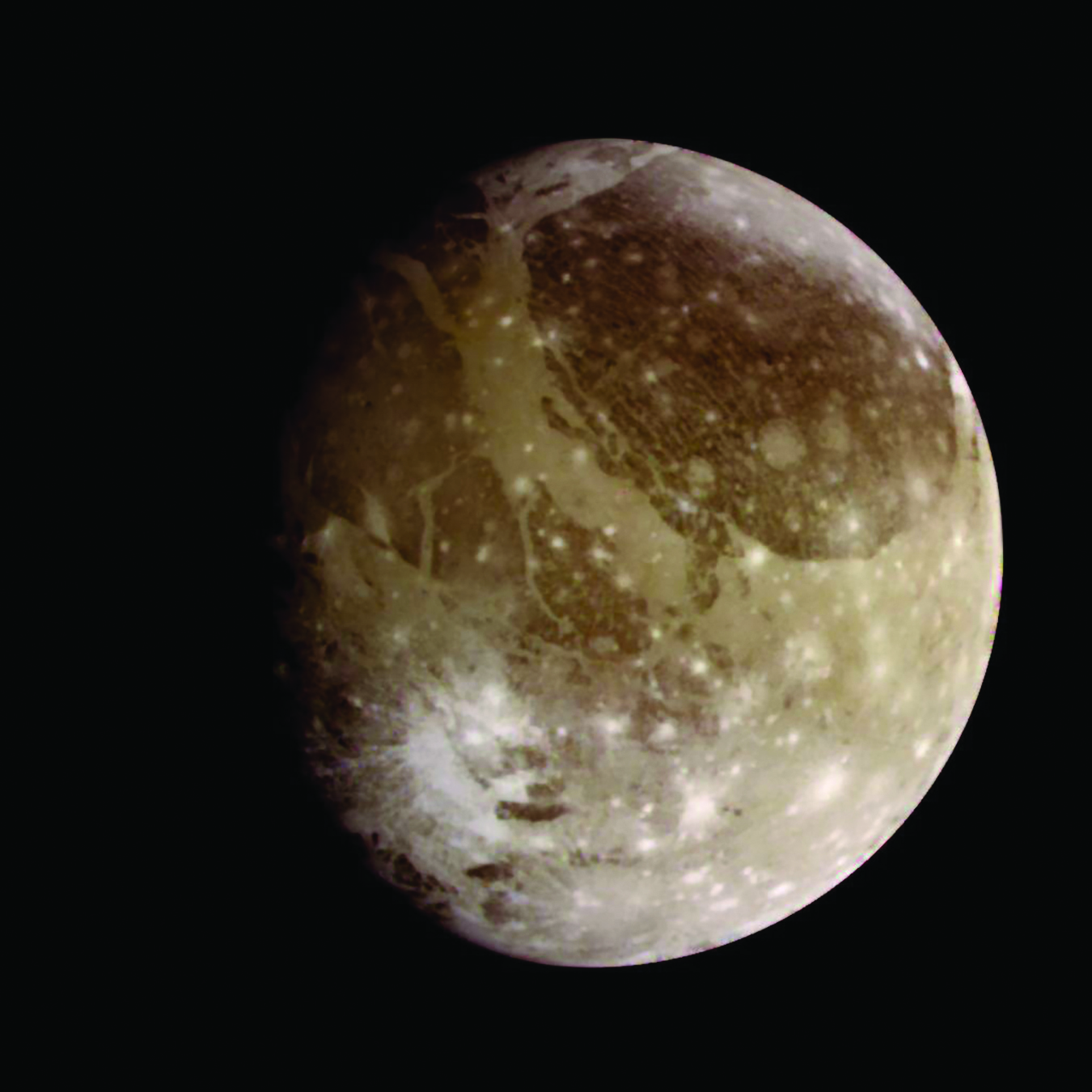
Ganymede, the largest moon in the solar system, was imaged by NASA’s Galileo spacecraft in the 1990s. Galileo’s magnetic field measurements revealed that the moon has an active dynamo.
(Image by NASA/JPL.)

Of the hundreds of moons in the solar system, Jupiter’s satellite Ganymede is the only one that’s known to have an active dynamo. As liquid metal flows in the moon’s core, circulating electric currents form and sustain a magnetic field. With just a handful of observations, modelers of Ganymede have conflicting assumptions about how the Jovian moon’s core and dynamo formed. Now Kevin Trinh of Caltech and colleagues have reported simulations suggesting that Ganymede’s dynamo began developing at a lower temperature than previously thought and, as a result, that the moon’s core may be still slowly forming today. 1
Magnetic field evidence of Ganymede’s dynamo was first detected in the 1990s by NASA’s Galileo spacecraft. The detection led many modelers to assume that similarly to how Earth’s dynamo was generated, Ganymede’s must have been generated after a hot core had fully formed. But Ganymede and other icy moons are much smaller than Earth, so they produce less gravitational heating. The icy moons form more slowly and thus have limited amounts of aluminum-26 and other short-lived, heat-producing radioactive isotopes that are necessary to sustain thermal convection and power a dynamo.
To address the contradiction, Trinh and colleagues adapted a cold-start model that Trinh and another group had developed for the neighboring moon Europa. 2 The new Ganymede model starts with a mixed composition of rock, ice, and iron at 250 K. In that state, the mixture would have melted at temperatures lower than the melting point of pure iron. That would allow for Ganymede’s core to form slowly. As the core differentiated from the rest of the mixture, the moon’s interior temperature would have risen to 1250 K, and iron would then start to melt. The model shows that ongoing melting and core formation could sustain a dynamo whose properties are consistent with the Galileo magnetic field observations.
If Ganymede could start at a low temperature and sustain a dynamo, then why don’t the neighboring Jovian moons of Callisto and Europa have dynamos? Trinh and others are still working on the answer to that question, and it may have to do with, among other factors, the moons’ composition and tidal heating—the frictional heat that’s dissipated when the moons expand and contract as they elliptically orbit Jupiter. Callisto, for example, has rock that’s richer in water than Ganymede’s and likely experienced less tidal heating, and those factors would have inhibited ongoing core formation. Answers may be forthcoming, as the European Space Agency’s Juice (Jupiter Icy Moons Explorer) spacecraft, which is scheduled to enter orbit around Ganymede in 2034, will collect more observations of Jupiter and its moons.
References
1. K. T. Trinh et al., “Powering Ganymede’s dynamo with protracted core formation ,” Sci. Adv. 12, eaed8021 (2026).
2. K. T. Trinh, C. J. Bierson, J. G. O’Rourke, “Slow evolution of Europa’s interior: Metamorphic ocean origin, delayed metallic core formation, and limited seafloor volcanism ,” Sci. Adv. 9, eadf3955 (2023).