Physics, astronomy graduate admissions in the US expected to shrink amid funding uncertainty
DOI: 10.1063/pt.kqzl.oatz

Because of recent federal cuts to science, about 600 fewer first-year physics and astronomy graduate students are expected to enroll in the US this fall compared with the fall 2024 semester. The estimate, from a new report from the American Institute of Physics (AIP; publisher of Physics Today), is based on survey responses from the chairs of 115 physics and astronomy departments in the US in April 2025. The report is among the first to quantify declines in graduate school admissions caused by federal funding reductions.
Many universities withheld offer letters to first-year graduate students this year because they anticipated less money from federal grants, says report coauthor Susan White, AIP’s statistical research director. Federal grants typically support graduate student stipends.
More than one-third of responding departments expect first-year admissions to decrease. In analyzing the estimates that the respondents provided, AIP projects a 13% drop in first-year enrollment in fall 2025 compared with fall 2024. That would be a sharper decrease than in any other year in the past decade, including during the COVID-19 pandemic, which saw a 7% year-to-year drop.
One in six of the responding chairs reported that at least one faculty member in the department has had their federal grant funding reduced or canceled, and one in four anticipate funding disruptions in the next six months. “The expectations of coming cuts [are] very concerning and [are] causing everyone to be more cautious,” wrote one chair.
The admissions reductions and funding impacts are more severe at private universities than at public ones. More than half of private school departments forecast a smaller incoming class, compared with one-quarter of public school departments. And nearly two-thirds of the department chairs at private universities reported having faculty that have experienced or anticipate facing funding disruptions in the next six months compared with roughly one-third of the public university department chairs.

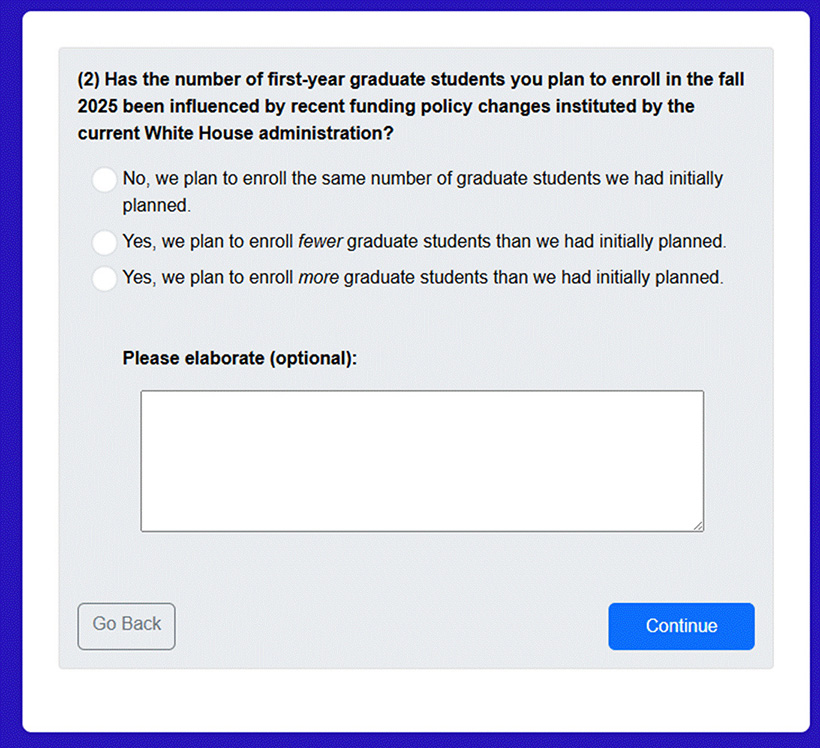
More than 100 chairs of physics and astronomy departments at US universities answered questions such as this one in a recent survey. (Image courtesy of Susan White, AIP.)

White says the report’s findings are relevant to other STEM departments: “I personally suspect enrollment reductions are going to be similar throughout all STEM disciplines because they face the same funding cuts.”
In the survey’s write-in box, department chairs lamented hiring freezes, cancellations of undergraduate internships, and a demoralizing environment. “One cannot work like this—all energy goes in[to] thinking how to survive,” one chair wrote.
Several respondents noted the strains on international students, who face threats of visa revocations and deportations by the Trump administration. One department chair wrote that they could foresee a future decrease in international enrollment “simply because it seems it’ll be harder to secure a visa.” International graduate students have been a main driver of the growth in science, engineering, and health graduate program enrollment in recent years, according to a report from NSF’s National Center for Science and Engineering Statistics.
The AIP survey was largely conducted before the reports of new federal funding changes, including NSF’s pause on the awarding of new grants and its termination of existing grants that are related to combating misinformation and that support diversity, equity, and inclusion initiatives.
The department chairs surveyed said that sharper admissions cuts may come in 2026. Wrote one respondent, “It is almost certain we will have to shrink the size of our graduate program in future years due to the anticipated reduction in federal funding.”
This article was originally published online on 25 April 2025.
More about the authors
Jenessa Duncombe, jduncombe@aip.org