Office tape is an effective tool for making ultrathin diamond
DOI: 10.1063/pt.umsg.yprq

Graphene’s discovery in 2004 was made possible by an exceedingly simple technique: Andre Geim and Konstantin Novoselov used sticky tape to peel away atomically thin layers of carbon atoms from a graphite crystal. For that achievement and their subsequent study of the new 2D material, the two researchers were awarded the 2010 Nobel Prize in Physics (see Physics Today, December 2010, page 14 ).
Even though diamond lacks the layered structure of graphite, a team of Chinese researchers found that tape can also separate an ultrathin diamond membrane from its growth substrate. The approach—developed by Peking University’s Qi Wang, Southern University of Science and Technology’s Kwai Hei Li, and the University of Hong Kong’s Yuan Lin and Zhiqin Chu—could be helpful in the mass production of ultrathin diamond membranes. Unlike its bulky counterpart, ultrathin diamond has unique electrical and optical properties that make the material useful in fiber-optic cables, radar instruments, satellites, and other electronic and photonic devices (see Physics Today, March 2022, page 22 ).
There are a few ways to produce synthetic diamonds with submicron thicknesses. Bulk diamonds can be cut with a laser to produce monocrystalline membranes. Alternatively, thin films with a polycrystalline structure can be grown in a vacuum via chemical vapor deposition (CVD), in which methane and hydrogen react in the presence of an electric current and deposit carbon atoms on a growth substrate, often silicon. But those methods have issues: Laser constraints limit the size of the cut membrane, and until now, CVD diamonds have required time-consuming, multistep etching to separate them from the substrate.
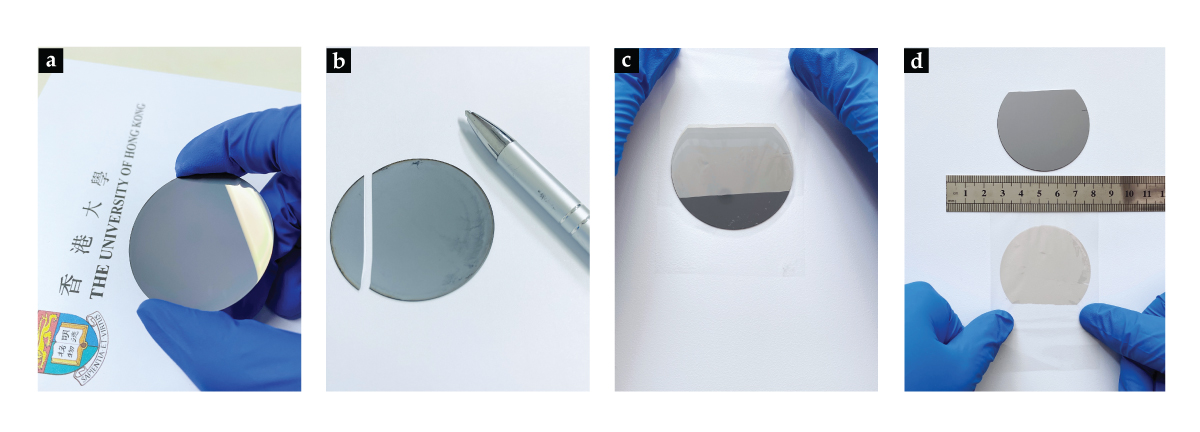
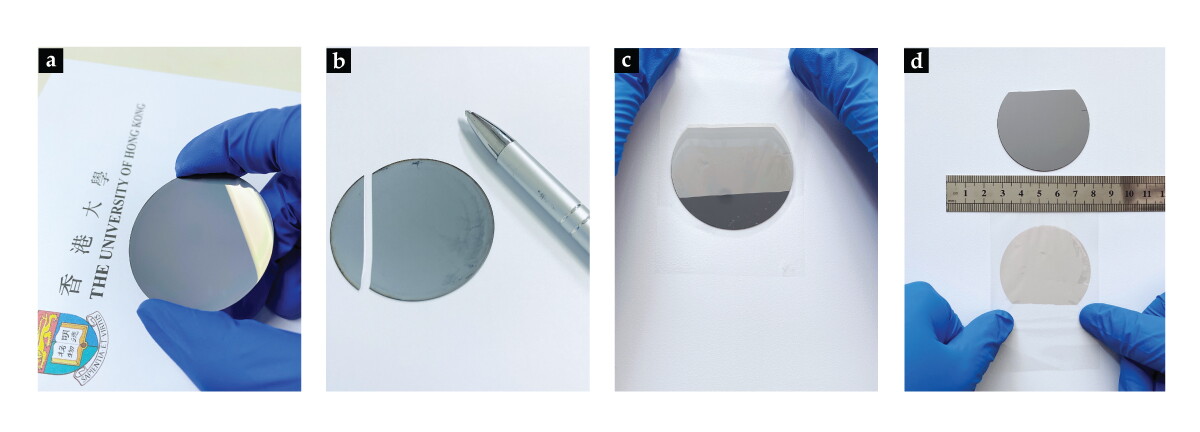
With tape, Chu and colleagues isolated CVD-grown diamond membranes more quickly. The samples were grown on the silicon-wafer substrate shown in the figure below. By cutting across the wafer with a scribing pen, the researchers exposed the crucial diamond–silicon interface. With that access, they could then use the tape to peel the entire diamond membrane from the silicon substrate with limited cracks and deformations.

An ultrathin diamond membrane was grown on (a) a silicon-wafer substrate with chemical vapor deposition. (b) Researchers cut the substrate with a scribing pen, (c, d) and then they used sticky tape to peel the 1-µm-thick and 5-cm-wide membrane from the wafer substrate more quickly and effectively than other separation techniques. (Photos courtesy of Jixiang Jing.)
Polycrystalline diamond membranes tend to have fewer technological applications than their monocrystalline cousins. But the high-quality membranes grown by Chu and colleagues may have improved performance. The researchers’ initial characterizations show that their diamond membranes have electrical, optical, and thermal properties similar to those of monocrystalline diamond thin films. (J. Jing et al., Nature 636, 627, 2024 .)
This article was originally published online on 23 December 2024.
More about the authors
Alex Lopatka, alopatka@aip.org