Helium users brace as shortages begin


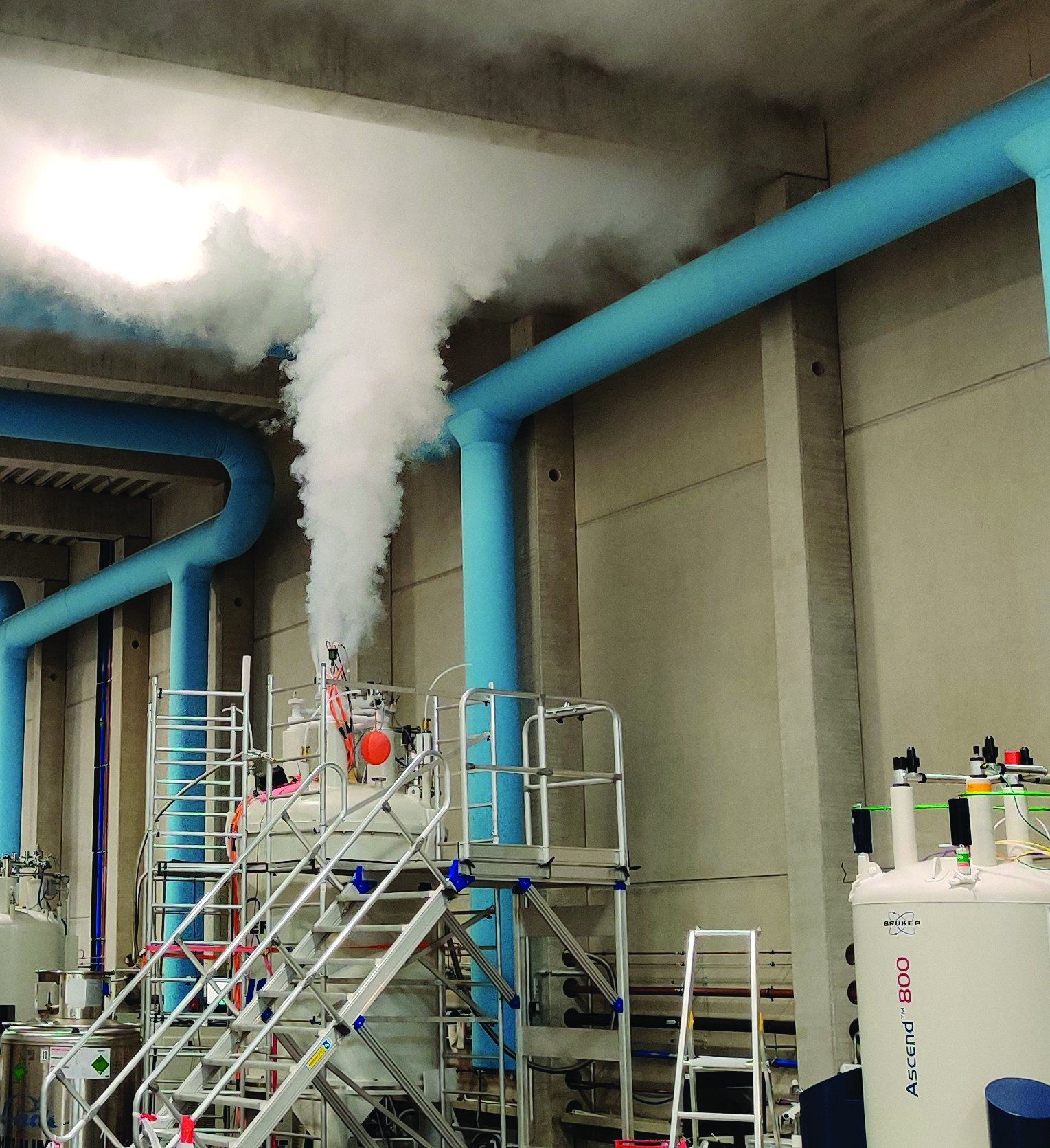
A 22.3-tesla NMR magnet at the Technical University of Munich vents its helium in February 2024 after part of the superconducting coil became resistive. Often, the rate and volume of gas escape in such quenches are too large for recovery systems to handle; in the case shown, the gas could have filled a small blimp.
(Photo courtesy of Matthias Brandl.)

“We hope we are cushioned this time,” says Jeffrey Filippini, who, as associate head for facilities, oversees the helium liquefier for the physics department at the University of Illinois Urbana-Champaign. His department was lucky to accept a delivery of helium in February, just before the US and Israel attacked Iran. Now, with liquefied natural gas plants shut down in Qatar and the Strait of Hormuz nearly unpassable, it may be a while before helium is again predictably available.
Qatar supplies about 30% of the global helium market. The other main sources are Algeria, Russia, Ukraine, and the US. Helium is obtained primarily as a byproduct from natural gas processing. “A significant amount of the world’s helium comes from places that are not geopolitically stable, which makes it susceptible to ‘black swan events,’ ” says helium market consultant Phil Kornbluth. “The war in the Middle East is a classic example.” (For a report on a recent helium crisis, see PT’s 2023 story “Helium prices surge to record levels as shortage continues .”)
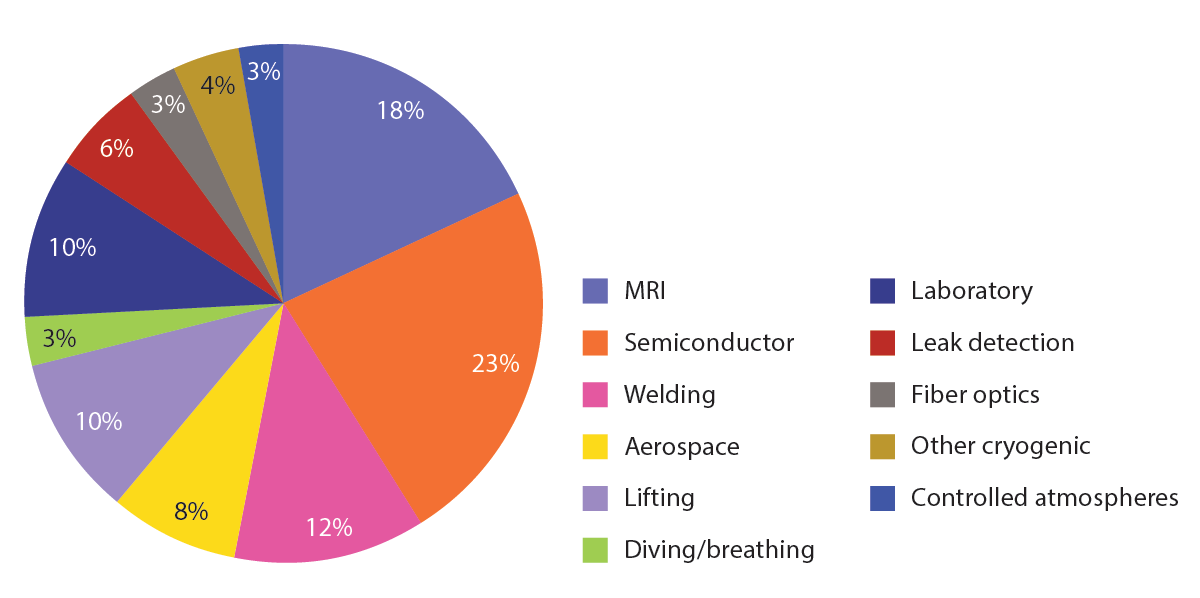
Semiconductor manufacturers and medical imaging facilities are the largest users of helium (see chart below), and they are at the top of the pecking order for allocations, Kornbluth says. Researchers are lower down in priority, along with party balloon sellers. Applications for helium include cooling superconducting magnets for NMR materials studies and, in Filippini’s case, cooling balloon-borne detectors for studying the early universe.
The helium deficit will be most severe during the next few months, before other sources can be integrated into the global supply, says Kornbluth. Even when the conflict subsides and the Strait of Hormuz reopens, he says, it will take months to get liquid natural gas and helium production back up to capacity.

Worldwide helium consumption by usage area for 2025. Semiconductor manufacturing has surpassed medical MRI as the largest consumer of helium. Low-temperature physics, chemistry, biomedical, and other research represented about 10% of the total use.
(Chart adapted from Kornbluth Helium Consulting.)

After previous helium crises, many institutions invested in equipment to recycle helium. Where they could, researchers also switched to mechanically cooled systems that don’t consume liquid helium. “Driven by prices and the choking off of supplies, there have been changes in technology,” says Stuart Brown, chair of physics and astronomy at UCLA. “We are buying a small fraction of helium compared with what we would have bought 5 or 10 years ago.”
But recycling systems and alternatives to liquid helium are not compatible with all experiments: Such helium-saving systems are too heavy for balloon studies, and their vibrations interfere with measurements using scanning tunneling microscopes and high-field NMR spectroscopy. They can also be pricey and power hungry. As a result, many researchers still need helium for their work.
Reduce, recycle, stockpile
Many researchers and facilities managers tell Physics Today that they are not “yet” having difficulty obtaining helium. They point to protection through recycling, stockpiling, and existing long-term contracts with suppliers. “The time scale for response in the market as we see it as users is quite long,” says William Halperin, physics professor and cryogenics facility director at Northwestern University.
Early in the war, Messer, an industrial gas company that supplies Halperin’s facilities, raised prices by about 14% to more than $31.70 per liter. Halperin says he is concerned that Messer will declare force majeure, a suspension of contract that often results in buyers having to pay more to secure helium from other suppliers.
“I am hearing of allotments being cut in half, and prices are all over the map,” says Sophia Hayes, vice dean of graduate education and a chemistry professor at Washington University in St Louis. “The uncertainty is highly distressing for researchers.”

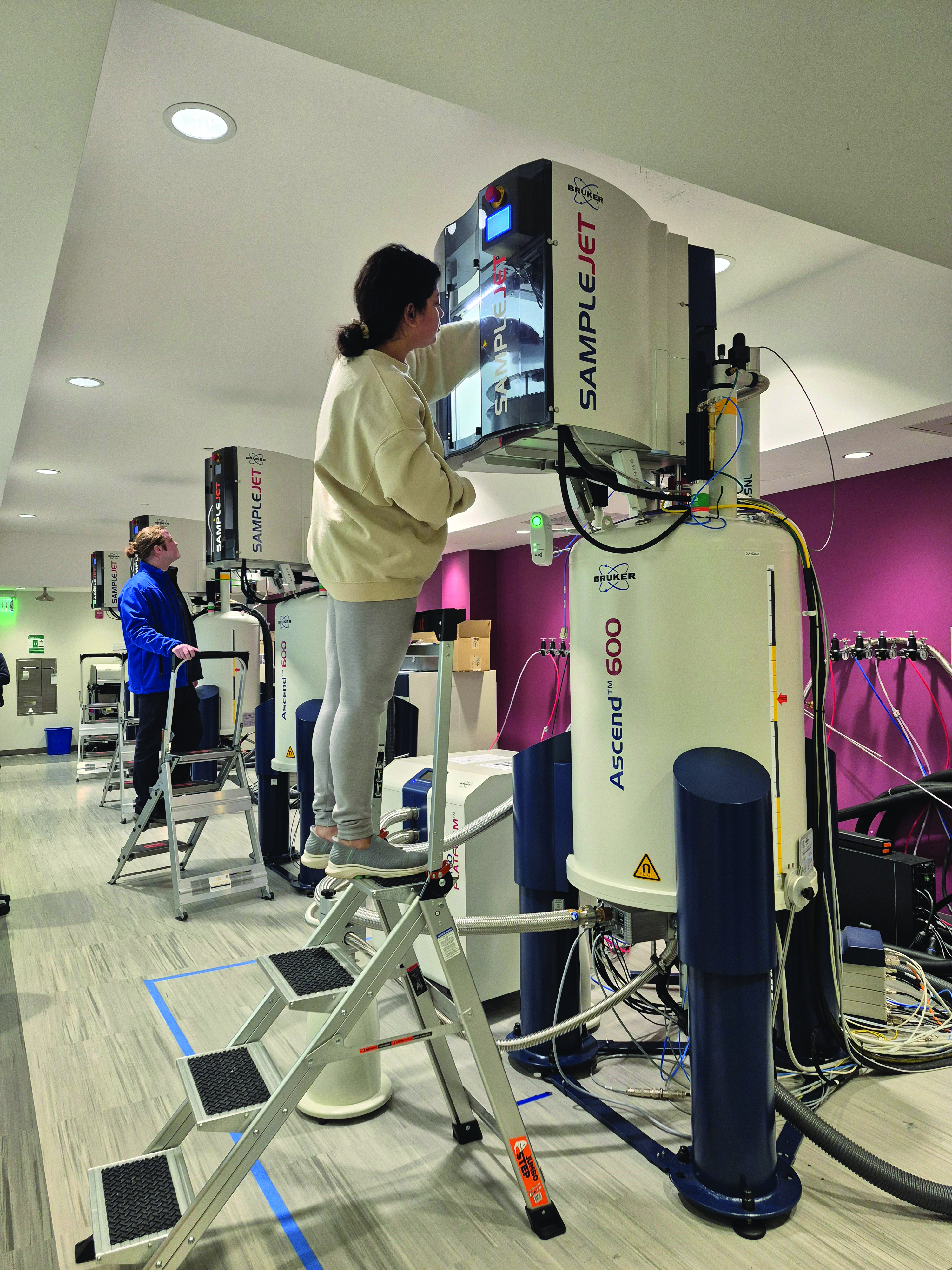
Apala Chaudhuri places clinical samples into Olaris’s NMR spectrometer. Any interruption in helium would translate to an interruption in patient care, CEO Liz O’Day says.
(Photo courtesy of Liz O’Day.)

Other helium users in the US and abroad report similar uncertainty. At the Athinoula A. Martinos Center for Biomedical Imaging at Massachusetts General Hospital in Boston, a magnet used for preclinical imaging of rodents will have to be shut down if the center can’t get helium, says Jerome Ackerman, a scientist there who also looks after helium. The center’s helium supplier, Linde, declared force majeure and said that for now, it cannot provide any liquid helium to the center, Ackerman says.
In February, the UConn Health NMR facility acquired a secondhand NMR machine from the Leibniz Research Institute for Molecular Pharmacology in Berlin. “We need about 2000 liters to cool this thing down,” says facility director Jeffrey Hoch. The university’s supplier sources helium from Qatar and declared force majeure. Hoch says that he and his colleagues found an alternative source but will pay twice the price.
Yohei Miyanoiri, of the Institute for Protein Research at the University of Osaka, says that facilities in Japan that lack reliquefying systems “have increasingly been forced to shut down their experimental instruments.” Consequently, he says, research has become concentrated at user centers such as his. “Ensuring the stable operation of these shared facilities and strengthening their infrastructure and support systems have become urgent priorities.” He notes that Japan will likely become more dependent on the US for helium imports.
Liz O’Day hasn’t felt the effects of a helium shortage yet. But if it comes to that, patients will suffer, she says. Her company, Olaris, uses NMR for discovery and clinical diagnostics, including measuring metabolites in the urine of donor-kidney recipients to noninvasively evaluate the health of their grafts. Helium is essential, O’Day says. “Any disruption would cause a pause in our work.” She has not installed helium recovery equipment because of the up-front cost and the required space. But the current shortage has her thinking about “scalability and sustainability.”
In past helium shortages, researchers have been known to leave a dewar of helium outside on a loading dock, and the dewar “would be ‘magically’ removed and taken to someone across town to save a magnet that was about to run out of helium,” says Hayes. “There are also stories of buying helium gas from a welder and taking it to a liquefaction system to save someone’s magnet,” she says. “The research community looks out for each other.”