Evidence of exotic trimers sought and found in ultracold gas of cesium atoms
DOI: 10.1063/1.2207026
In 1970 Vitaly Efimov derived a bizarre result. If, his analysis showed, one could weaken the interaction between two particles, then just at the point when the two-body bound state vanishes, an infinite series of three-body bound states would emerge out of the quantum blue. 1
The counterintuitive result provoked skepticism among Efimov’s fellow theorists. Vindication by experimenters did not appear because the states, though quite generic, require unusual circumstances: The range of the interatomic potential must be much smaller than the scattering length, a quantum mechanical parameter that loosely corresponds to the radius of the scattering cross section at low energies.
At first, Efimov and others hoped to see a clear example of the three-body states in the weakly bound outskirts of nuclei. Excited helium-4 trimers also seemed a likely venue. Unfortunately, the search in those two systems has so far proved fruitless. Nature, unlike a theorist, can’t guarantee a system’s scattering length will exceed the range of the potential by the right amount.
But there are systems in which one can arbitrarily extend the scattering length: trapped clouds of ultracold atoms. Since the late 1990s, physicists have used magnetic Feshbach resonances to tune the scattering length and achieve a string of stunning coups—Fermi condensates, molecular condensates, and the triggered, supernova-style collapse of Bose–Einstein condensates.
Now, Rudolf Grimm, Cheng Chin, Hanns-Christoph Nägerl of the University of Innsbruck in Austria, and their collaborators have used the Feshbach technique to reveal the presence of Efimov states in an ultracold gas of cesium atoms. 2 Grimm and company didn’t make a gas of Efimov trimers. Rather, they saw atoms flee their trap at a value of the magnetic field where theorists predicted Efimov trimers would form.
Avoiding such spikes in the loss rate is a practical benefit of understanding Efimov states. But there’s a fundamental benefit, too. Making longer-lasting Efimov trimers in the lab would provide a way of using the technology of ultracold atoms to study the elusive and fascinating physics of few-body systems.
Scattering length
In a cloud of ultracold atoms, scattering is s-wave in nature and completely described by a single parameter, the scattering length a. When a dimer state lies just below the scattering continuum, a is large and positive. When a dimer state is just above the scattering continuum a is large and negative.
The dependence of scattering length on the location of energy levels provides a means of adjusting it. The trick is to prepare each of the colliding atoms in a single, magnetically tunable Zeeman state. Then, by tuning an external magnetic field, one can bring the colliding atoms into resonance with a metastable dimer state. As the atoms collide, they briefly occupy the metastable state, which boosts the scattering length. At resonance, the magnitude of the scattering length becomes infinite.
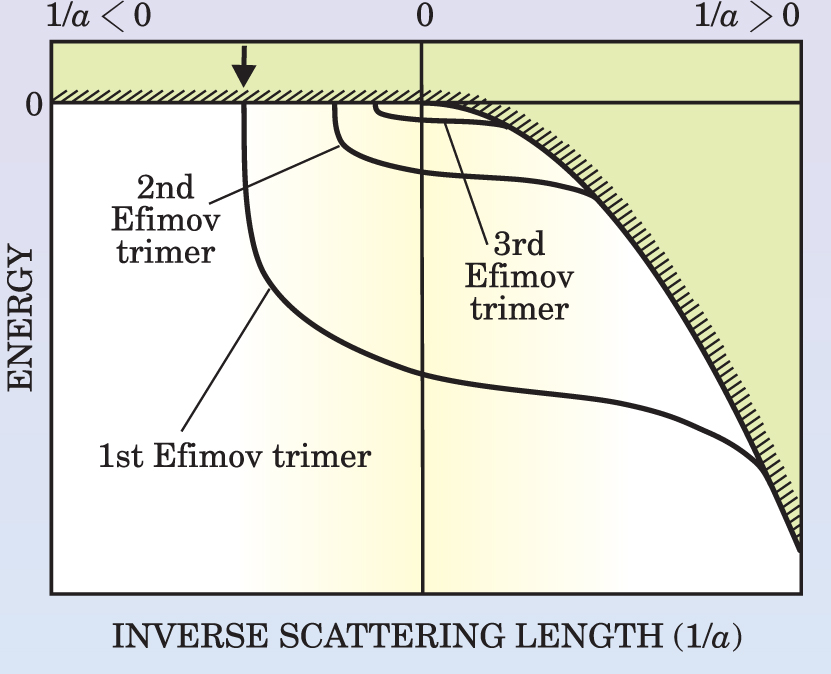
In a sense, Efimov states are three-body generalizations of two-body Feshbach resonances. Figure 1 shows how the Efimov binding energy depends on scattering length. When a > 0, two atoms of mass m can form a dimer with a binding energy of –ħ 2/ma 2. When a < 0, two atoms can’t bind at all.

Figure 1. Efimov states form below the three-body threshold (hatch marks) in an infinite series of ever-weakening binding energy. Only the first three states are shown here. The loss rate of cesium atoms from the Innsbruck trap increased sharply when the scattering length a matched the binding threshold of the first Efimov trimer (indicated by the arrow).
(Adapted from ref. 2.)

Energetically speaking, creating a trimer is like adding a zero-energy particle to a dimer. In his analysis, Efimov found a whole family of resonant, weakly bound trimer states that, as the figure shows, appear at certain distinct values of a. As a → ∞ (1/a → 0 in the figure), the trimer’s binding energies form a series spaced by multiples of exp(−2πn/s 0), where n is a positive integer and s 0 = 1.00624.
Three-body interactions
Three-body interactions, Efimov or not, worry physicists who work on ultracold atoms. When three atoms collide, two of them can form a dimer, releasing enough energy to kick all three atoms out of the trap. Because the three-body loss rate, away from resonance, is proportional to a 4, three-body interactions frustrate attempts to manipulate ultracold condensates by tuning the scattering length.
The a 4 dependence emerges from general theoretical considerations. But what happens at resonances? In 1999, Ebsen Nielsen of Aarhus University in Denmark and Joseph Macek of the University of Tennessee 3 tackled the problem, as did Brett Esry, Chris Greene, and James Burke of the University of Colorado in Boulder. 4 Using different approaches, the two teams derived the three-body loss rate at three-body Efimov resonances and two-body Feshbach resonances. In 2002, inspired by those predictions, Grimm’s Innsbruck team began looking for Efimov signatures in trapped cesium atoms.
Cesium’s particular distribution of energy levels makes the atoms impossible to cool and condense using the standard magnetic traps of cold-atom physics. But in 2002—seven years after teams led by Eric Cornell and Carl Wieman and by Wolfgang Ketterle had made their Nobel-winning condensates—Grimm’s group succeeded in condensing ultracold cesium atoms using an all-optical trap. The optical trap proved essential for finding Efimov states.
With an all-optical trap, cesium atoms can be prepared and trapped in the lowest Zeeman sublevel. At the nanokelvin temperatures of the trap, the energy of the next-highest Zeeman state is more than kT away. As a result, all two-body collisions are elastic and only three-body collisions lead to inelastic losses.
In 2002 Grimm and his colleagues measured the three-body loss rate of trapped cesium atoms at different values of an applied magnetic field. 5 They found the expected a 4 dependence along with resonant enhancements, including one that could be an Efimov resonance. But the evidence was inconclusive. The Efimov resonance showed up in a regime where the trap is leaky.
Cesium atoms interact with each other through the van der Waals potential, which peters out within about 100a 0, where a 0 is the Bohr radius (0.53 Å). Forming Efimov states requires the scattering length to greatly exceed that value. The requirement, in itself, isn’t hard to meet. By tuning an external magnetic field, Grimm could set the scattering length to any value between −2500a 0 and 1600a 0.
But as |a| becomes large, the extent to which scattering length adequately characterizes collisions falls with rising temperature. If the temperature in the trap isn’t low enough, collisions that lie outside the scattering-length description appear and mask the Efimov resonance. In their 2002 experiment, the Innsbruck team had cooled cesium atoms to 200 nK. To see clear evidence of Efimov states, the team reduced the temperature to 10 nK.
Efimov states can form in a thermal gas but not in a BEC. Still, to create a 10-nK thermal gas, Grimm and his collaborators first made a BEC. By adjusting the external magnetic field, they caused the BEC to collapse and more than 90% of the atoms to leave the trap. The remaining 20 000 atoms thermalized at about 10 nK.
Measuring the loss rate required close control of the temperature and number density of the gas. For each value of magnetic field, the Innsbruck team cycled their experiment—from BEC to collapse to measurement—once a minute for thousands of cycles.
The three-body loss rate is proportional to the number density cubed times the loss coefficient. Because the loss coefficient is proportional to a 4 off resonance, it’s convenient to write the coefficient as a 4 C(a) and convenient to plot the fourth root of the loss coefficient against the scattering length, rather than the coefficient itself.
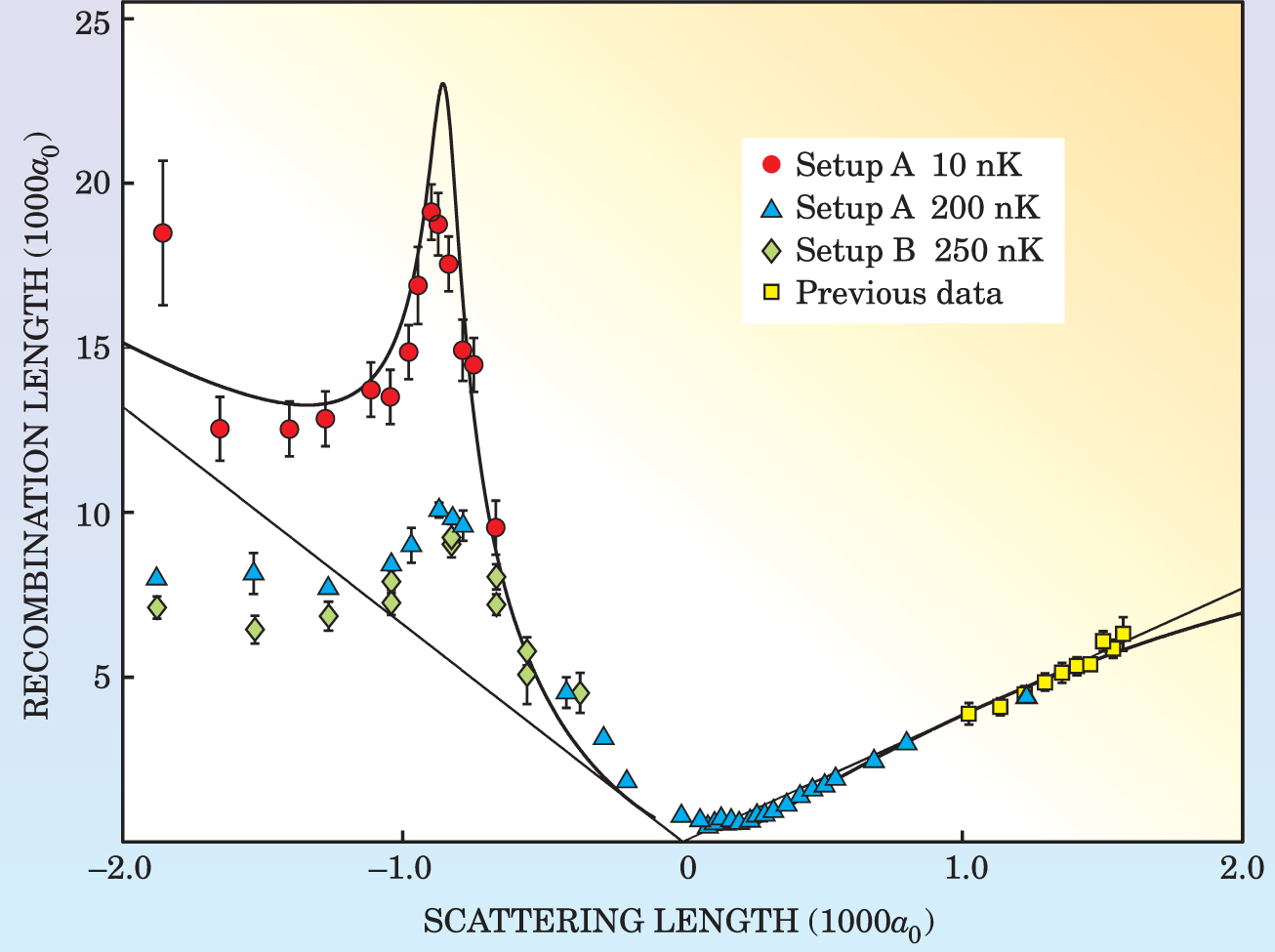
And that’s what appears in figure 2. The four different data sets come from two different types of optical trap and three different temperatures. Some of the old data from 2002 are also included. The straight lines represent the loss coefficient’s off-resonance a 4 dependence, while the curves represent an analytic expression derived in 2004 by Eric Braaten of Ohio State University and Hans-Werner Hammer, who’s now at the University of Bonn in Germany. 6

Figure 2. The three-body loss rate spikes when Efimov trimers form and decay at specific values of scattering length a. Here, the so-called recombination length, rather than the loss rate itself, is plotted against a. With that choice of ordinate, the off-resonance a 4 dependence of loss rate shows up as straight lines. The curved line represents an analytic expression derived in ref.
(Adapted from ref. 2.)

The most prominent feature is the sharp enhancement at −850a 0. Less prominent is a reduction in the loss rate at +210a 0. In the regime of positive scattering length, dimers can form with the help of a third atom. When a = 210a 0, the presence of an Efimov state modulates and reduces that three-body loss.
In a loss-rate experiment, the most direct evidence of Efimov states would come from seeing two or more spikes spaced as Efimov predicted. Grimm and his coworkers couldn’t reach the next potentially observable spike at −19 000a 0. Even so, the appearance of the minimum at the right spot strongly supports both Efimov’s original theory and its subsequent extension to the three-body loss rate.
The next step is to make Efimov trimers and study them. According to Martin Stoll, who now works for an oil company, and Thorsten Köhler of Oxford University, it should be possible to create the trimers by trapping three atoms in each site of an optical lattice. 7
References
1. V. Efimov, Phys. Lett. B 33, 563 (1970) https://doi.org/10.1016/0370-2693(70)90349-7 .
2. T. Kraemer et al., Nature 440, 315 (2006) https://doi.org/10.1038/nature04626 .
3. E. Nielsen, J. Macek, Phys. Rev. Lett. 83, 1566 (1999) https://doi.org/10.1103/PhysRevLett.83.1566 .
4. B. D. Esry, C. H. Greene, J. P. Burke, Phys. Rev. Lett. 83, 1751 (1999) https://doi.org/10.1103/PhysRevLett.83.1751 .
5. T. Weber et al., Phys. Rev. Lett. 91, 123201 (2003) https://doi.org/10.1103/PhysRevLett.91.123201 .
6. E. Braaten, H.-W. Hammer, Phys. Rev. A 70, 042706 (2004) https://doi.org/10.1103/PhysRevA.70.042706 .
7. M. Stoll, T. Köhler, Phys. Rev. A 72, 022714 (2005) https://doi.org/10.1103/PhysRevA.72.022714 .