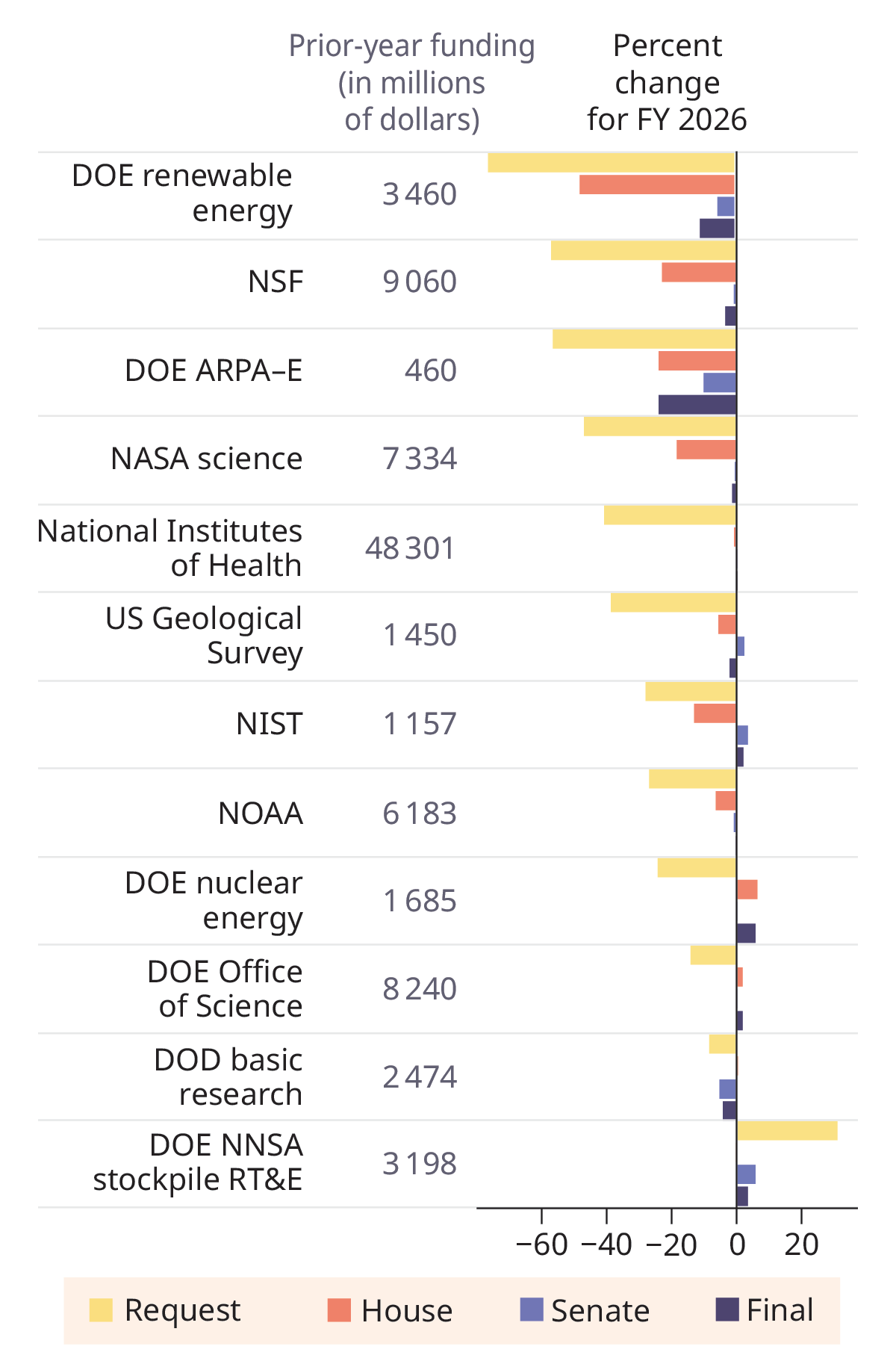
Multiple science agencies escape Trump’s proposed cuts

For more from FYI, the science policy news service at AIP, visit https://aip.org/fyi .
In January, President Trump signed into law a package that funds many federal science agencies through September. Overall, Congress rejected the deep cuts that the White House proposed in its fiscal year 2026 budget request. NASA, NSF, and the US Geological Survey received cuts compared with FY 2025, but the Department of Energy’s Office of Science and NIST received slight increases. NOAA’s funding stayed roughly flat.
In addition to allocating agency funding, the law has numerous provisions that affect science policy. The report accompanying the law requests a briefing on whether the White House Office of Science and Technology Policy is in the process of repealing a Biden-era policy that mandates immediate open access to federally funded research by this year. The law also prevents the Commerce Department, NSF, NASA, and DOE from changing reimbursement rates for indirect costs, which include research-related expenses such as equipment and facilities maintenance. DOE and NSF were among the agencies that attempted to cap indirect cost rates last year. Thus far, courts have rejected the agencies’ attempts at implementing the caps.


Funding for the National Institutes of Health and the Department of Defense passed in early February after being held up by a dispute over funding for the Department of Homeland Security. NIH received nearly level funding, whereas basic research funding at DOD was cut by about 4%.
Here are selected agency highlights:
NSF’s budget was cut by 3.4% to about $8.75 billion. The research account was flat-funded, and NSF is prohibited from cutting any directorate by more than 5% of what its budget was in FY 2024. Funding for NSF’s STEM education programs was reduced to $938 million, a 20% cut from FY 2024 but far less than the 75% cut proposed by the White House.
Funding for NSF’s major construction projects rose to $251 million, up 7.3% from FY 2024. The funds provide for Antarctic infrastructure upgrades, a research supercomputer facility in Texas, and mid-scale infrastructure projects. The White House canceled the major construction funding for FY 2025, saying it was “improperly designated by the Congress as emergency.”
The report also directs NSF to submit a report on its management plan for the R&D centers and major scientific facilities it funds, including the National Center for Atmospheric Research, which the White House has said it plans on “breaking up.”
- DOE’s Office of Science received a 1.9% increase to $8.4 billion. The program with the largest percentage increase, 7.7%, was Advanced Scientific Computing Research. Language in the report limits DOE from carrying out grant terminations on the grounds that the funding “no longer effectuates program goals or agency priorities.” DOE cited that reasoning in the cancellations of hundreds of clean-energy grants last year.
- NOAA received essentially flat funding at $6.17 billion. The law adopts the president’s proposal to move most weather research programs in the Office of Oceanic and Atmospheric Research to the National Weather Service. But lawmakers rejected the administration’s request to zero out the office’s remaining climate and ocean research programs.
- NASA’s budget was cut by 1.6% and its Science Mission Directorate by 1.1%. The breakdown by discipline reveals reshuffling of funds across the directorate compared with FY 2024. The appropriation maintains level funding for the STEM engagement office, which the White House proposed eliminating. The law withdraws support for the Mars Sample Return mission but sustains $110 million for some of its components.
- NIST’s budget increased by 2.3% to $1.18 billion, excluding the $663 million in earmarks that fund external projects. The research facilities construction budget received a 45% increase, and the report directs NIST to deliver quarterly updates on efforts to address its “maintenance backlog.” Reports in 2023 and 2024 detailed decaying infrastructure across NIST’s campuses in Maryland and Colorado (see PT’s 2023 article “Urgent measures are needed to shore up NIST’s crumbling facilities ”). NIST research funding received a 1.5% cut.
For detailed numbers, see FYI’s Federal Science Budget Tracker .