Bubble lasers can be sturdy and sensitive
DOI: 10.1063/pt.xafv.lnix
Soap-bubble physics is nearly as broad as physics itself. Bubbles are an inexpensive, versatile platform for studying effects in fields such as fluid dynamics, optics, and even granular flow. (See, for example, Physics Today, July 2019, pages 16 and 68 .) Now Zala Korenjak and her PhD adviser Matjaž Humar, of the Jožef Stefan Institute in Ljubljana, Slovenia, report a surprising new addition to that already impressive resumé: An ordinary soap bubble makes a pretty good laser. 1
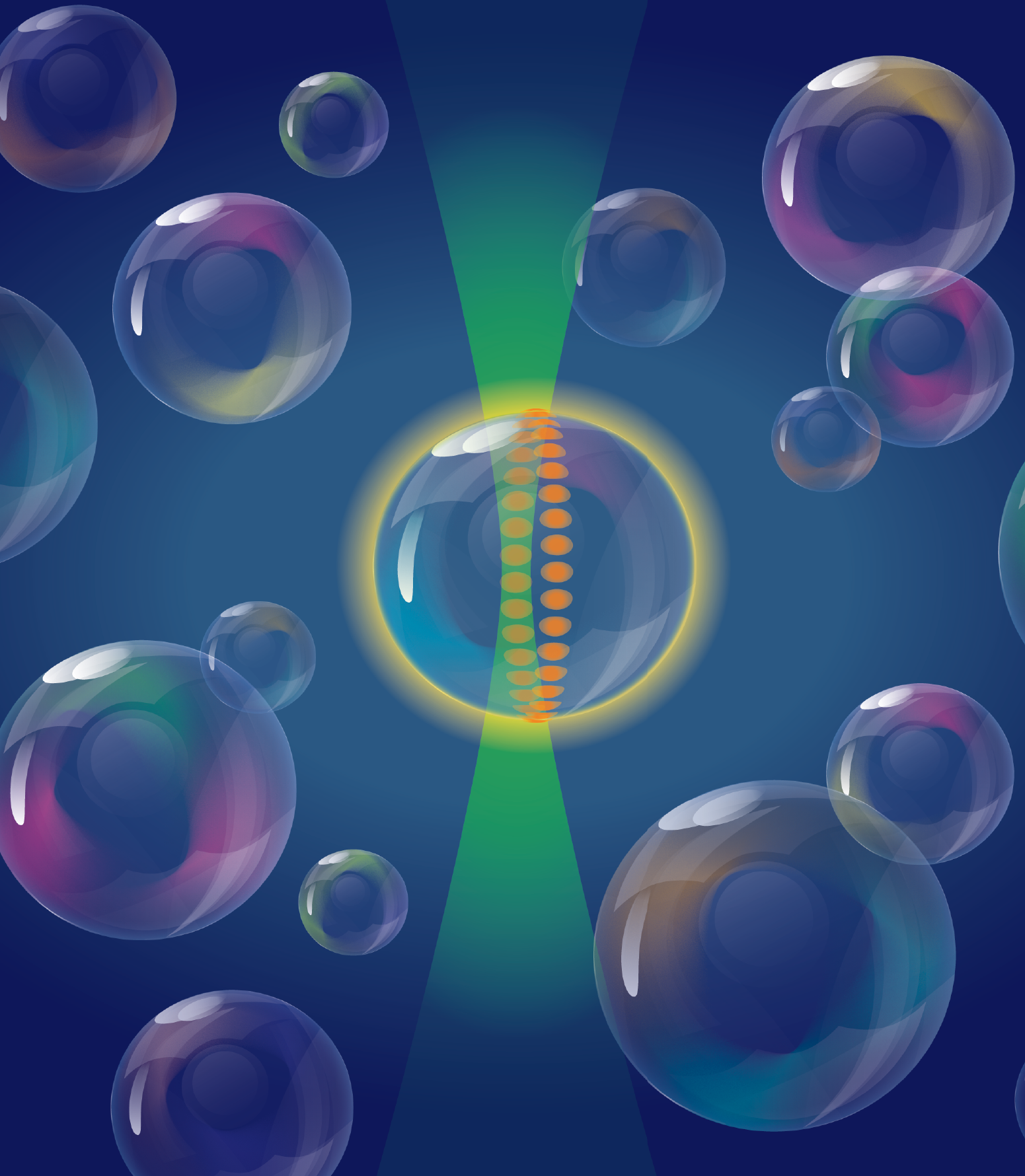
Lasers amplify light by passing it repeatedly through a gain medium, usually by bouncing it between a pair of mirrors. In a soap-bubble laser, the bubble itself serves as an optical resonator. Light waves bounce around and around the bubble’s surface at resonant frequencies called whispering-gallery modes (WGMs; one is illustrated by the orange dots in figure
Figure 1.

Whispering-gallery modes (WGMs), such as the one illustrated in orange, are central to a bubble’s optical properties. When a bubble is doped with laser dye and pumped with an external laser (green), the bubble lases at the WGM frequencies. (Courtesy of Zala Korenjak and Matjaž Humar.)

WGM lasers that use ring-, tube-, or sphere-shaped glass resonators are nothing new, and Humar and his group were already working with them in other contexts. But the soap-bubble version is striking in its low-tech simplicity. And because the bubble is soft and filled with air, it’s sensitive to its environment in ways that more conventional lasers aren’t.
Korenjak and Humar found their most promising results when they switched from soap to another type of bubble, made of so-called smectic liquid crystal. Smectic bubbles are not nearly as prone to bursting as soap bubbles are, and their stability and uniform thickness are a boon to their optical properties.
Soap shells
“These experiments could have been done 30 years ago, easily,” says Humar. “We were quite surprised that nobody had tried this before.” All it took was the right inspiration, which for Humar came from a 2020 paper by Mordechai Segev, Miguel Bandres, and colleagues on laser beams in soap films. 2
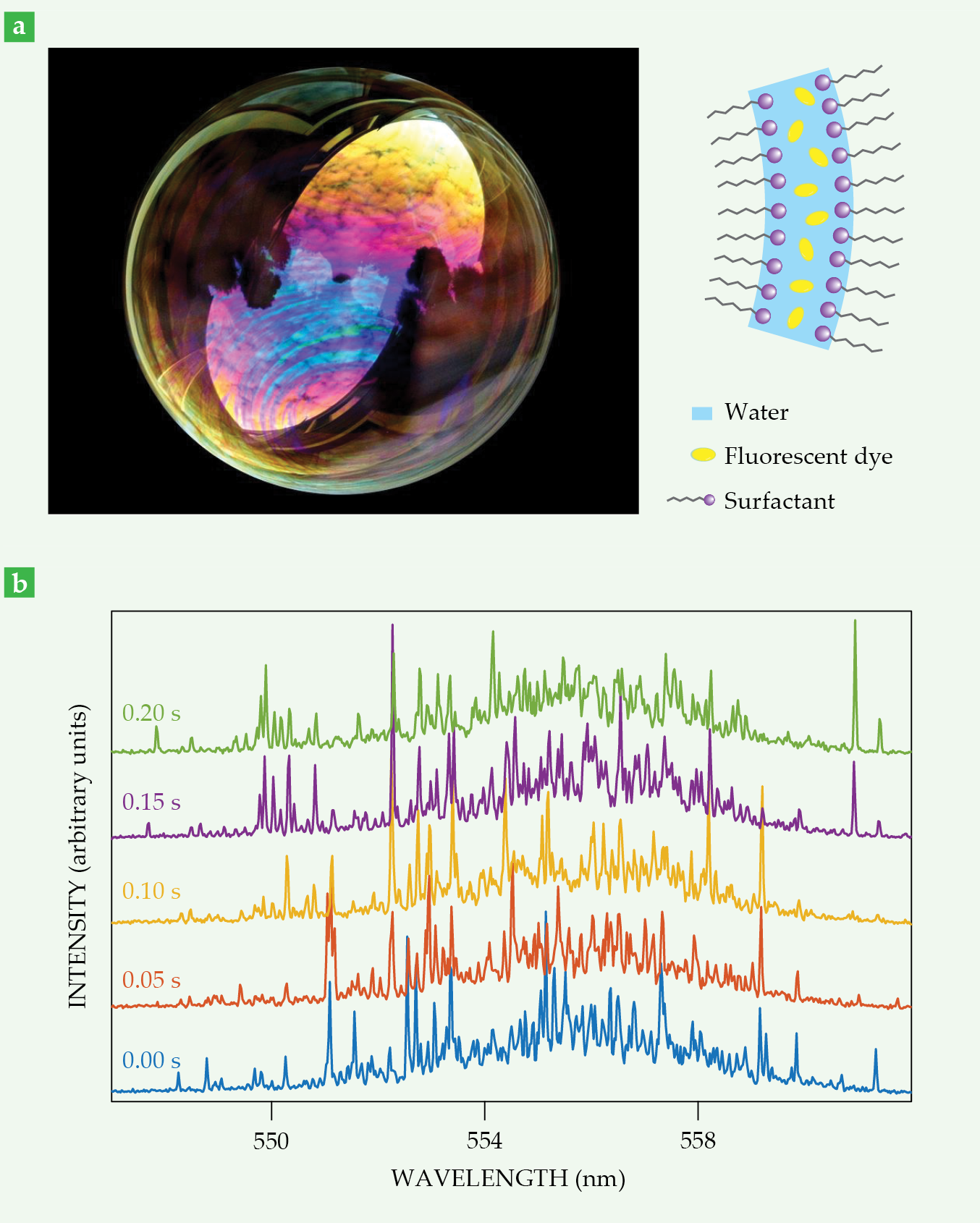
Plenty of analysis has been done on how light bounces off soap bubbles: Thin-film interference, combined with variations in the film thickness, creates the colorful swirling iridescence seen in figure
Figure 2.

A soap bubble consists of two layers of surfactant molecules enclosing a layer of free-flowing water. (a) Because the water layer’s thickness is close to optical wavelengths and varies over the surface of the bubble, thin-film interference gives rise to the characteristic iridescent appearance. (b) A soap-bubble laser’s whispering-gallery-mode spectrum, which is sensitive to the bubble’s thickness, changes erratically from moment to moment. (Bubble photo courtesy of Brocken Inaglory/Wikimedia Commons/CC BY-SA 3.0 DEED ; schematic and spectrum adapted from ref.

“I wondered if the bubble itself could be the laser,” says Humar, and he tasked Korenjak with finding out. “I thought it would be a fun student project. But it turned out that we got some really good results.”
All it took was dissolving a few specks of laser dye in the soap solution and shining a pump laser on the resulting bubbles. Pumped dye lasers are a common setup in laboratory experiments that require wavelength-tunable output. The fixed-wavelength pump laser excites the dye molecules, which then emit light at a longer wavelength. When a molecule by chance emits a photon into a resonant laser-cavity mode—for the bubble, a WGM—it stimulates other molecules to emit more and more matching photons. The result: laser light.
Dye molecules can emit light across a range of wavelengths. To tune the output to a desired wavelength, a conventional dye laser uses a diffraction grating to scatter all other wavelengths out of the laser cavity. There’s no place to put a diffraction grating in a soap-bubble laser, so the bubbles lase simultaneously at all the WGMs across the dye’s emission spectrum. But just because the bubbles’ output isn’t monochromatic doesn’t mean they’re not lasers.
The soap-bubble WGM spectrum, however, is erratic and hard to interpret. Roughly speaking, a spherical resonator’s WGMs are those wavelengths for which a whole number of light waves fit around the sphere’s circumference. But when the resonator is a thin spherical shell—a bubble—the picture becomes more complicated. The light interferes with itself as it bounces between the bubble’s inner and outer surfaces. The interference can be described as a thickness-dependent effective refractive index, which affects how many wavelengths fit around the circumference.
And a soap bubble’s thickness is always changing. As shown in the schematic in figure
“It was a nice surprise that the laser works with just soap,” says Humar. But in search of a more stable lasing spectrum, he and Korenjak turned from soap bubbles to smectic bubbles.
Liquid-crystal layers
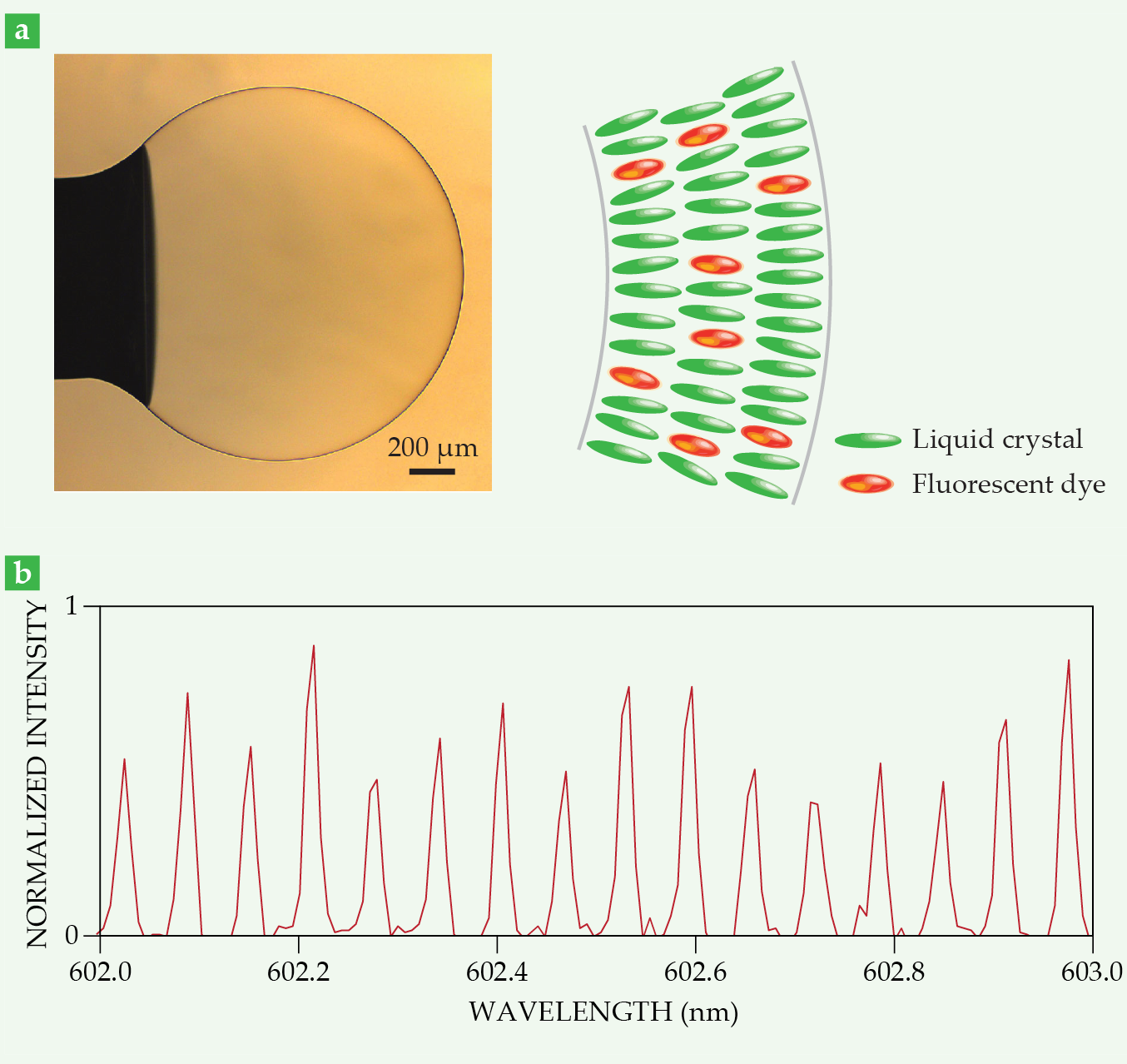
A smectic film, as shown in figure
Figure 3.

A smectic bubble is thinner and more uniform than a soap bubble. (a) The bubble is made of organic liquid-crystal molecules that arrange themselves into ordered layers. (b) As a result, a smectic-bubble laser lases with a stable spectrum of evenly spaced modes. (Adapted from ref.
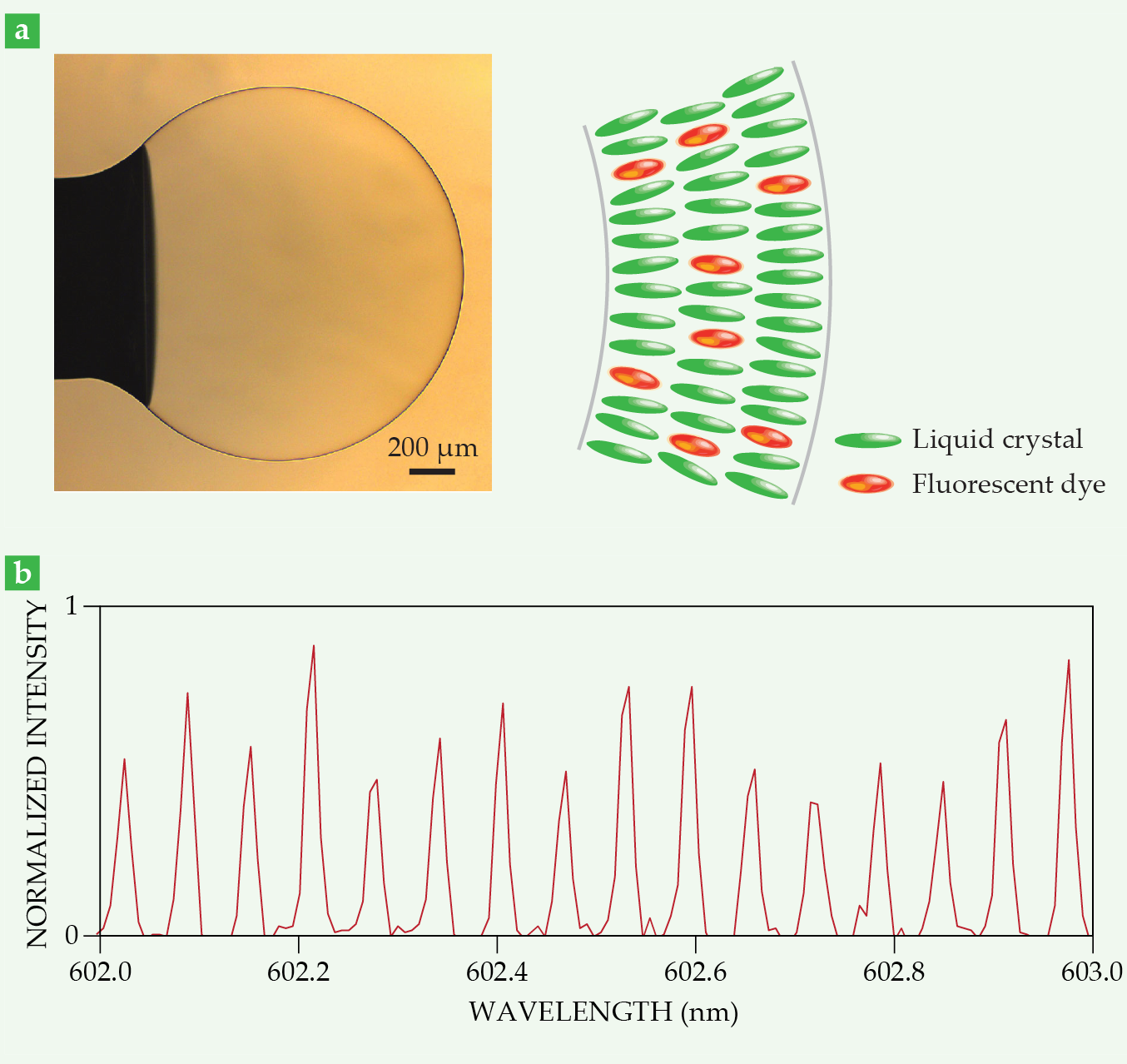
Smectic liquid-crystal molecules arrange themselves into orderly layers, and the number of layers in a smectic bubble is the same everywhere. The result is a bubble that’s eerily transparent, with no iridescence to be seen. But, as shown in figure
Because the WGM spacing is directly related to the bubble circumference, the lasing spectrum offers a quick and precise way to track the bubble size and, in turn, the ambient pressure. Plenty of pressure-sensing technologies exist already, but most are optimized for detecting either small pressure changes or large ones. Korenjak and Humar estimate that their smectic bubbles should be capable of both: A freestanding bubble could measure pressures up to 10 000 kPa—that’s 100 times atmospheric pressure—while being sensitive to pressure changes as small as 1.5 Pa.
But most of the researchers’ experiments weren’t performed on freestanding bubbles. Annoyingly, because smectic films are so thin—just tens of nanometers, compared with hundreds of nanometers for soap bubbles—smectic bubbles steadily leak air over time. To keep a bubble from collapsing entirely, Korenjak and Humar leave it attached to a capillary (one is shown in figure
The capillary makes a big difference to the pressure sensitivity. The air in the bubble and in the capillary get compressed at the same time, so it takes a smaller change in external pressure to measurably alter the bubble’s size. The exact response depends on the volume of the capillary and the bubble, but the net effect is to shift the whole dynamic range downward: The bubble is sensitive to even smaller changes in pressure, but it can no longer withstand such large ones.
Korenjak and Humar were focused on basic research rather than developing a practical technology. “But I imagine that this could be used in a specialized application where you really need a huge dynamic range,” says Humar. “You probably wouldn’t want to use it in consumer products, like your phone. But for something like aerospace, maybe.”
Since sound waves are just pressure oscillations, the researchers are now exploring whether smectic-bubble lasers can work as microphones. They haven’t yet tried recording complicated waveforms, such as people’s voices. But they can distinguish low-volume tones of different frequencies.
References
1. Z. Korenjak, M. Humar, Phys. Rev. X 14, 011002 (2024). https://doi.org/10.1103/PhysRevX.14.011002
2. A. Patsyk et al., Nature 583, 60 (2020). https://doi.org/10.1038/s41586-020-2376-8
More about the authors
Johanna L. Miller, jmiller@aip.org