Analysis of B-meson decay hints at new physics

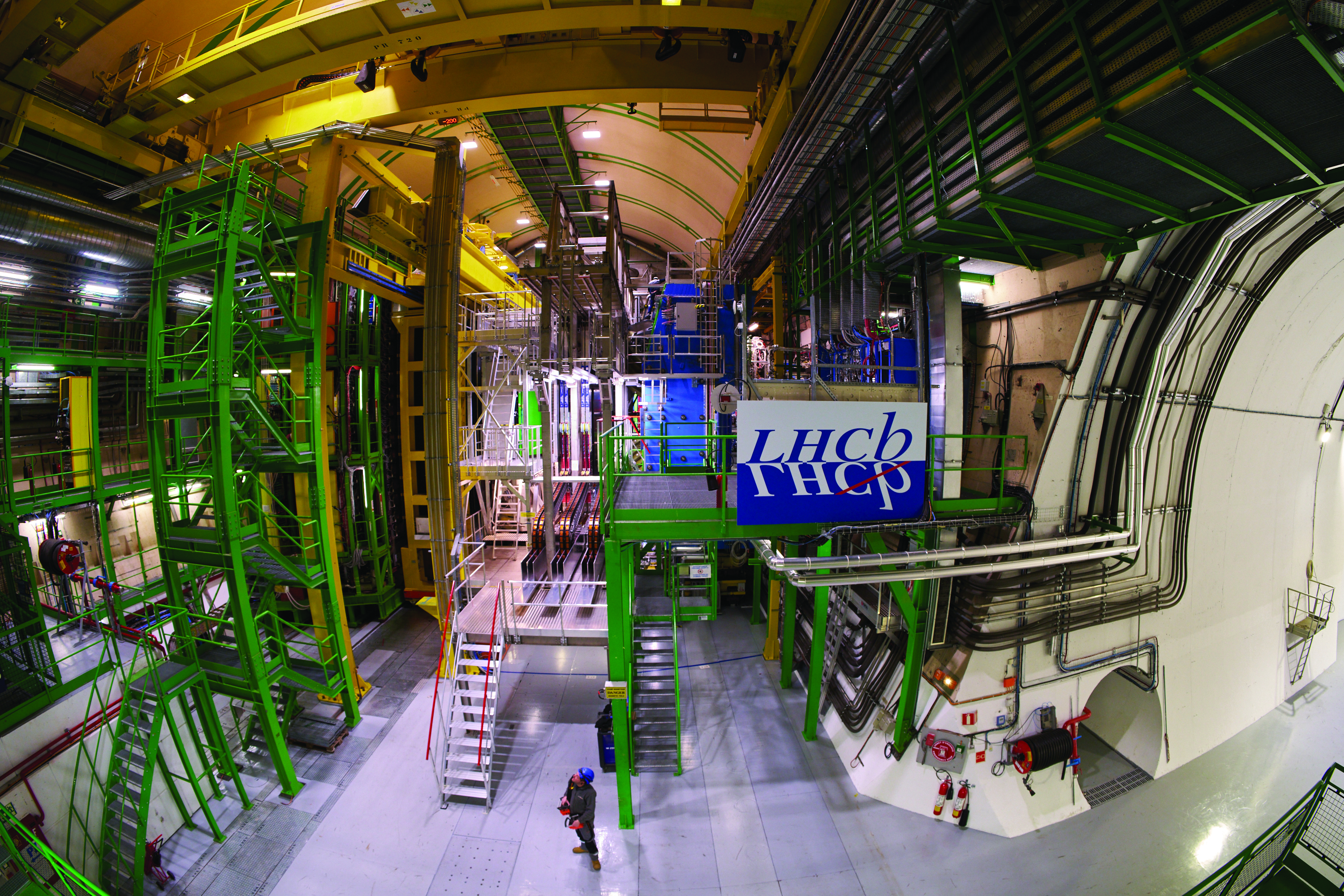
Figure 1.

The Large Hadron Collider beauty (LHCb) is one of several detectors installed at the LHC. Researchers at the LHCb study bottom quarks, as well as related particles like B mesons, that are produced in proton collisions.
(Photo © CERN.)

For more than 50 years, the standard model (SM) of particle physics has been the prevailing description of the fundamental forces and elementary particles in the universe. But notable omissions from the theory, such as explanations for gravity and dark matter, have motivated experiments, like those at CERN’s Large Hadron Collider (LHC), to search for yet-undiscovered physics. Now an analysis of collision data from the LHCb (Large Hadron Collider beauty) experiment, shown in figure 1 , has yielded fresh evidence that the properties of some decays of B mesons, which are composed of a bottom antiquark and a lighter quark, deviate from those predicted by the SM. 1 Though the discrepancy is still under the five-standard-deviation threshold that, by convention, is needed to claim a discovery, it adds to growing support for the idea that new physics may play a role in the behavior of B mesons.
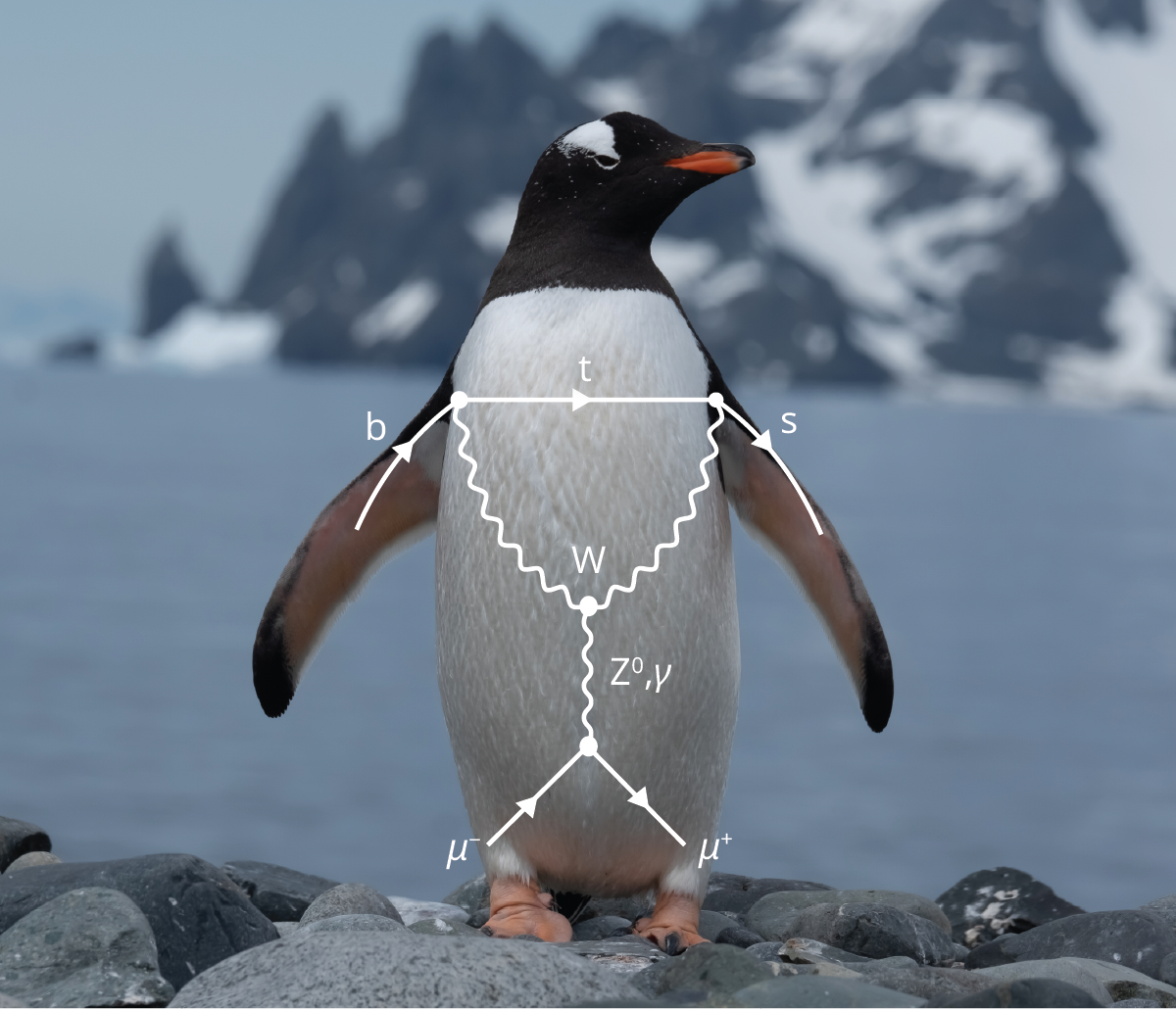
The new work focuses on the decay of a B meson into a kaon, pion, and two muons. Known as a penguin decay, it is playfully named for the rough resemblance its Feynman diagram has to the flightless bird, as shown in figure 2 . The penguin decay of B mesons is particularly useful for the study of new physics because it occurs only via quantum loops mediated by virtual particles, as opposed to via direct decays. As a result, the process is extremely rare: Only 1 in 1 million B mesons undergo this type of decay. The rarity means that when searching for new physics, researchers have less noise from the signals of SM processes to contend with than when they study more-frequent decays. Additionally, because of its quantum nature, the loop process is susceptible to being infiltrated by potential heavy non-SM particles that would influence the products of the decay in ways that SM particles cannot. Such heavy particles cannot be produced directly by the LHC, but the decay process offers an opportunity to indirectly observe their impact.
Figure 2.

This decay of a B meson is called a penguin decay, with its name the result of a bet that CERN theorist John Ellis lost in 1977. The decay of the B meson’s component bottom quark (b) yields a strange quark (s) and a muon and antimuon (μ− and μ+). The process is mediated by a quantum loop that includes a virtual W boson, top quark (t), photon (γ), and Z boson (Z0).
(Image by Freddie Pagani with photo by iStock.com/Leamus.)

Evidence that something unusual is happening in the penguin decay of B mesons has been mounting for over a decade. In 2013, the LHCb collaboration reported a 3.7σ discrepancy from SM predictions in the directions that the final particles fly off, known as the angular distribution, following the decay. CERN’s Compact Muon Solenoid collaboration reported similarly anomalous behavior last year but at a lower level of statistical significance.
In the new work, the collaboration analyzed 2011–18 proton–proton collision data, which encompassed about 650 billion B mesons, and reconstructed some 12 000 instances of B-meson penguin decay. The team then analyzed the angular distribution of the final particles and determined that there was a deviation of about 4σ from the predictions of the SM. “This result has a probability of about 1 in 16 000 that it is just a statistical fluctuation from the standard-model predictions,” says MIT’s Leon Carus, who contributed to the work.
If new physics is responsible for the anomalous angular distributions, there are particle candidates that researchers believe might fit what they see. Those include the Z′ boson, a proposed heavy cousin of the Z boson, and the leptoquark, a heavy particle that would have properties of both leptons and quarks. SM physics is not entirely ruled out, however. One explanation to remedy the B meson’s tension with the SM is the existence of an alternative decay path that includes a separate quantum loop that involves charm quarks. Although researchers estimate that the impact of such decays, known as charming penguins, should be too small to fully explain the anomaly, it is difficult to predict.
Ultimately, collecting more data is necessary to better understand the behavior of B mesons. The LHCb collaboration will soon be analyzing data collected during the experiment’s third run, which concludes at the end of June and will provide five times as much data as collected in the two previous rounds combined.
Reference
1. R. Aaij et al. (LHCb collaboration), “Comprehensive analysis of the B0 → K*0μ+μ− decay ,”
Phys. Rev. Lett. (in press).