The elusive signatures of quantum gravity


Gravity is unique among the known fundamental forces of the universe: Currently, there is no experimental result whose explanation requires a quantum theory of gravity. But physicists, including Albert Einstein, 1 have still argued on empirical grounds that quantum theory must modify theories of gravitation. As early as the 1920s, dimensional-analysis arguments suggested that observing any phenomena that meaningfully involved quantum dynamics of the gravitational field is beyond the scope of what’s experimentally possible. Thus, the hope of directly testing ideas about quantum gravity with experiments languished for nearly a century.
Today, the simplest expectation for a quantum theory of gravity is that, at a minimum, states of weak gravitational fields can be in quantum superpositions and be described in terms of gravitons. The hypothesized particles quantize the gravitational field akin to how photons quantize the electromagnetic field. Beyond that simple picture, physicists have quantum gravity models, such as string theory, that support the existence of gravitons at low energy but also work at vastly higher energy scales, where the graviton picture breaks down. How can researchers know if that quantum description accurately models how gravity operates in the real world?
To answer that, experiments are needed. That may be possible now that scientists have made significant advances in quantum-state control and measurement, which provide not only unprecedented spatial and temporal sensitivity but also new ways to prepare quantum states of macroscopic objects. A prime example is using the kilogram-scale mirrors of the Laser Interferometer Gravitational-Wave Observatory (LIGO) to measure gravitational waves, a measurement that is at the limit of sensitivity set by the Heisenberg uncertainty relation.
A vast array of architectures at other length and frequency scales are also rapidly changing what is possible. The developments open the door to realistic tests of the quantum nature of the gravitational field over the next two decades. Equipped with those new tools, many researchers have converged on a set of experimental approaches to definitively address the simple, fundamental question: Is the gravitational field quantized?
Quantum signatures of gravity
To determine whether gravity actually requires a quantum interpretation, researchers first need to ask what constitutes a truly quantum signature of gravity. The question turns out to be exceedingly subtle. Many phenomena can be described by both quantum and classical models. Consider, for example, a dilute gas of helium. It behaves classically at room temperature, fully condenses into a quantum superfluid at 0 K, and behaves with a mix of classical and quantum behaviors at low temperatures near absolute zero. Any given experiment can probe only some set of those behaviors. Ultimately, a barrage of tests of different phenomena is needed for probing quantum behavior. What signs would demonstrate whether they had found quantum gravity?
Inspiration for how to develop tests of quantum gravity can be found in quantum optics questions that ask what kinds of observations can be explained with only a quantized electromagnetic field. Initially, introducing the idea of photons allowed researchers to quantum mechanically describe all relevant aspects of light–matter interactions, including the photoelectric effect, absorption, spontaneous and stimulated emission of radiation, and the Lamb shift. Yet most experimental results associated with those phenomena can also be described with simple classical models of the radiation field.
In the photoelectric effect, shining light on a metal or semiconductor produces discrete electron currents. Einstein himself argued that observations of the effect are evidence of the quantization of light into photons, but others later showed that the same effect can be explained classically by a plane electromagnetic wave of classical light interacting with quantized electrons in a metal. 2 (For more on the quantum theory of the photon , see the 1972 PT article by Marlan Scully and Murray Sargent.)
However, more sophisticated photodetection experiments can be explained only with a quantum model of light. One particularly clear set of examples is based on the notion that classical light will be energetically split in half by a beamsplitter, but an individual photon cannot be similarly divided. Thus, in quantum theory, unlike in the classical theory of light, a single-photon state will be observed by only one of two detectors behind a beamsplitter. John Clauser, Alain Aspect, and others made such observations of correlated photon detections requiring a quantized explanation in now historic experiments during the 1970s and 1980s. 3 Similar nonclassical counting statistics were found for other inherently quantum states of light, such as squeezed states, in which the light’s quantum mechanical uncertainty is unevenly distributed between amplitude and phase, and entangled states, in which the quantum state must be described by joint properties of multiple particles. Such experiments rule out the possibility that the electromagnetic radiation field can be described with classical states or probabilistic mixtures of classical states.
Fundamentally, the tension between classical and quantum descriptions is based on a quintessential dividing line between quantum and classical behaviors: superposition. The interference fringes seen in the distribution of particles after they pass through a double slit, or the detection statistics of a photon that passes through a beamsplitter, are in direct conflict with a model of the particles, or waves, as classical objects. Instead, the state of a particle needs to be described in terms of a quantum superposition of multiple classical states. A particle that passes through the double slit, for example, is in a superposition of two locations, and the photon that has passed the beamsplitter is in a superposition of two paths.
Similarly, in regard to the gravitational field, the question is whether a demonstration can show that the field itself can be quantum mechanically superposed and thus able to produce a detectable signature of quantum gravity. A gravitational superposition would go beyond classical general relativity and imply that the gravitational field, and thus the geometry of spacetime itself, is not in a single, definite configuration but in some quantum superposition of configurations.
In principle, the familiar double-slit experiment should produce such states because a particle, such as an atom, sent through a double slit is a source of gravity. When an atom has traversed the double slit and is in a quantum superposition of two distinct locations, the simple expectation from a quantized model of gravity would be that the gravitational field produced by the atom would also be in a quantum superposition.
One way researchers can measure a superposed gravitational field is by observing what happens to a passing test mass. Researchers suggested in 2005 that the superposition of millions of atoms in a Bose–Einstein condensate could act as a source of gravity and a passing micrometer-scale object could serve as a test particle. 4 Although that specific proposal appears to be experimentally impossible, various related proposals have been recently suggested that appear to be feasible in the next decade or more.
Searching for signatures
Many experiments already involve gravitational fields that act on quantum systems, such as light and atoms. But those experiments do not necessarily test whether the gravitational field itself is quantized.
In the 1975 COW (Colella-Overhauser-Werner) experiment, for example, a neutron interferometer was used to prepare neutrons in a quantum superposition of two vertically distinct locations. That produces an interference pattern because of the difference in the gravitational potential at the two locations. In other words, gravity acts differently on each neutron wavepacket. 5 The neutrons are clearly quantum mechanical particles, as evidenced by their interference fringes, but the gravitational field of Earth that acts on those particles can be described entirely as a single, distinct classical configuration. Similarly, the LIGO-Virgo-KAGRA Collaboration’s observations of gravitational waves can be successfully modeled as arising from classical gravitational waves acting on the quantized light and mirrors of the detectors. 6
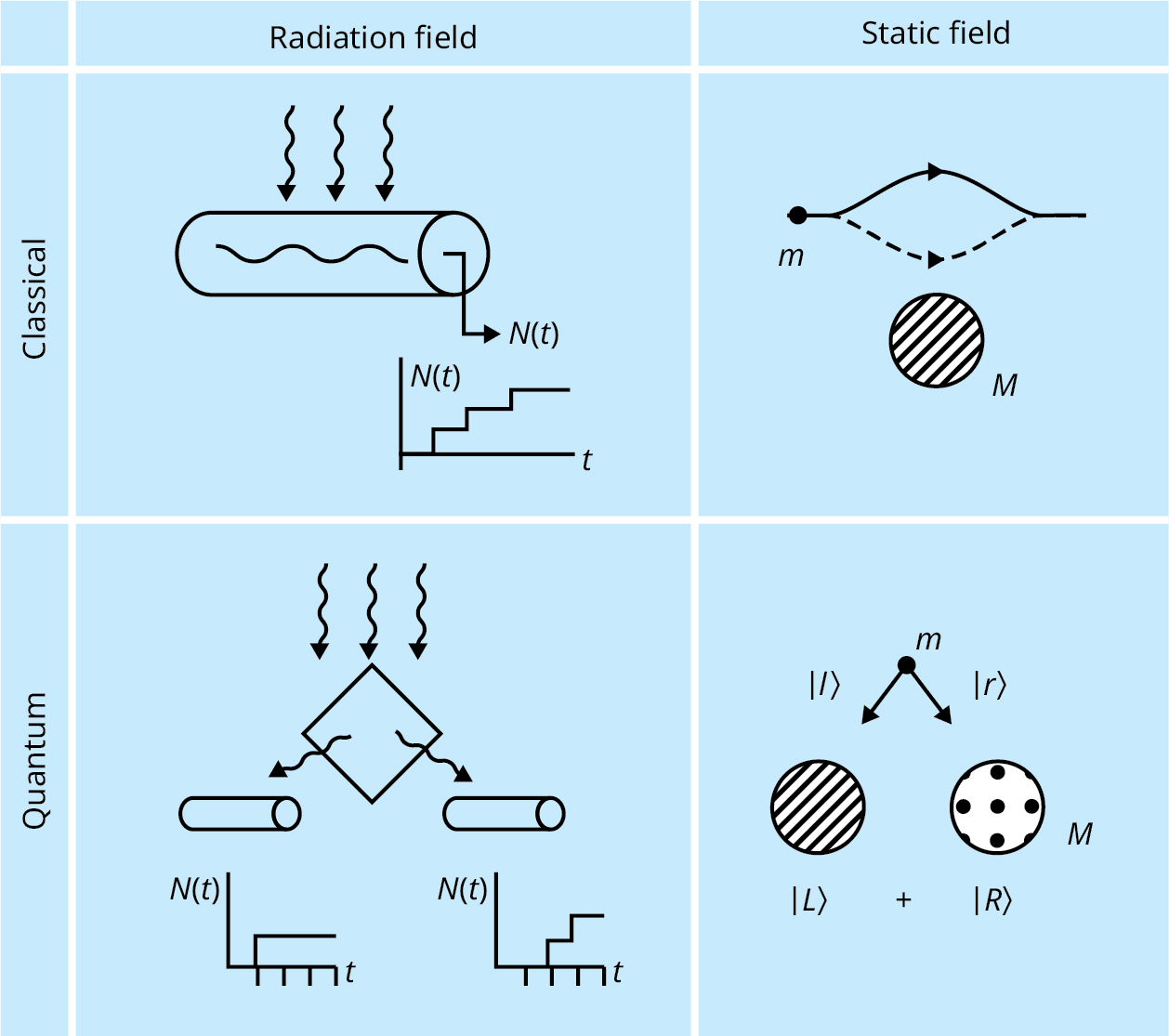
What is truly required is a nonclassical state of the gravitational field itself. A nonclassical state could be sought in two regimes of the gravitational field, as illustrated in figure 1 : radiation fields, like the gravitational waves emitted by merging black holes, and static fields, similar to the one sourced by Earth. In the case of radiation fields, the waves can be viewed as having a particle-like nature that can be described using gravitons.
Figure 1.

Experimental approaches that can or cannot observe quantum behavior of a gravitational field. On the left, large cylindrical masses known as Weber bars are used to detect radiation fields—that is, gravitational waves. An experiment with a single gravitational-wave detector (top left) can be explained with classical gravity; the plots show the total event number of excited Weber bar phonons N as a function of time. A hypothetical experiment (bottom left) involving a gravitational beamsplitting system and a pair of detectors cannot be explained with classical gravity. The right column depicts an analogous distinction with static gravitational fields. An experiment (top right) to detect a changing quantum phase in a detector system placed in the static field of a mass like Earth can be explained with a classical gravitational field. An experiment (bottom right) that uses gravity on a test mass m to detect a superposition of the location of source mass M cannot be explained with a classical gravitational field.

Given the success of photon measurements in electromagnetism, a natural starting point is looking for quantum effects in gravitational radiation, but that is exceedingly difficult in practice. Certain astrophysical events could be a source of nonclassical gravitational radiation. 7 But even if such an exotic gravitational state was available, researchers would need to probe the nonclassical statistics of the state, analogous to the photodetection statistics in quantum optical measurements.
The efficiency of photodetectors makes such measurements easy for electromagnetism, but for gravity, the challenge is immense. In a gravitational-wave detector like LIGO, only around 1 in 1030 gravitons is effectively absorbed. Consequently, detecting subtle quantum statistics comparable to those available in optical experiments is currently impossible. Researchers would be able to detect only random events, which have statistics that are indistinguishable from those produced by a classical gravitational wave acting on the same same detectors. 8
Unless new ideas for substantially increasing the coupling of gravity to Earth-based detectors are developed, the limited detection efficiency of gravitational radiation experiments means that any result can be explained with classical gravitational waves. Therefore, even if nonclassical sources of gravitational radiation are available, they could not be identified with foreseeable technology.
Creating a nonclassical state
Static fields, like those created by slow-moving masses, are an alternative to gravitational waves for detecting quantum signatures of gravity. If a superposition of a mass in two distinct locations is created and if gravity is quantized, then the Newtonian gravitational field becomes quantum mechanically superposed. One way to probe the gravitational field of a superposed quantum source mass is to use a test mass. Since each branch of the superposed gravitational field acts differently on the test mass, the source and test masses will become entangled, and that entanglement can then be measured. 4 9
Although less prohibitive than detecting nonclassical gravitational radiation, detecting gravitational entanglement is difficult. Quantum entanglement can occur only when the gravitational field sourced by each branch of the superposition acts differently on the test mass, so large masses and large spatial superpositions are more likely to produce observable effects. Large superpositions, however, easily decohere because of rapid environmental interactions with gas molecules, thermal radiation, and other noise sources.
Figure 2.

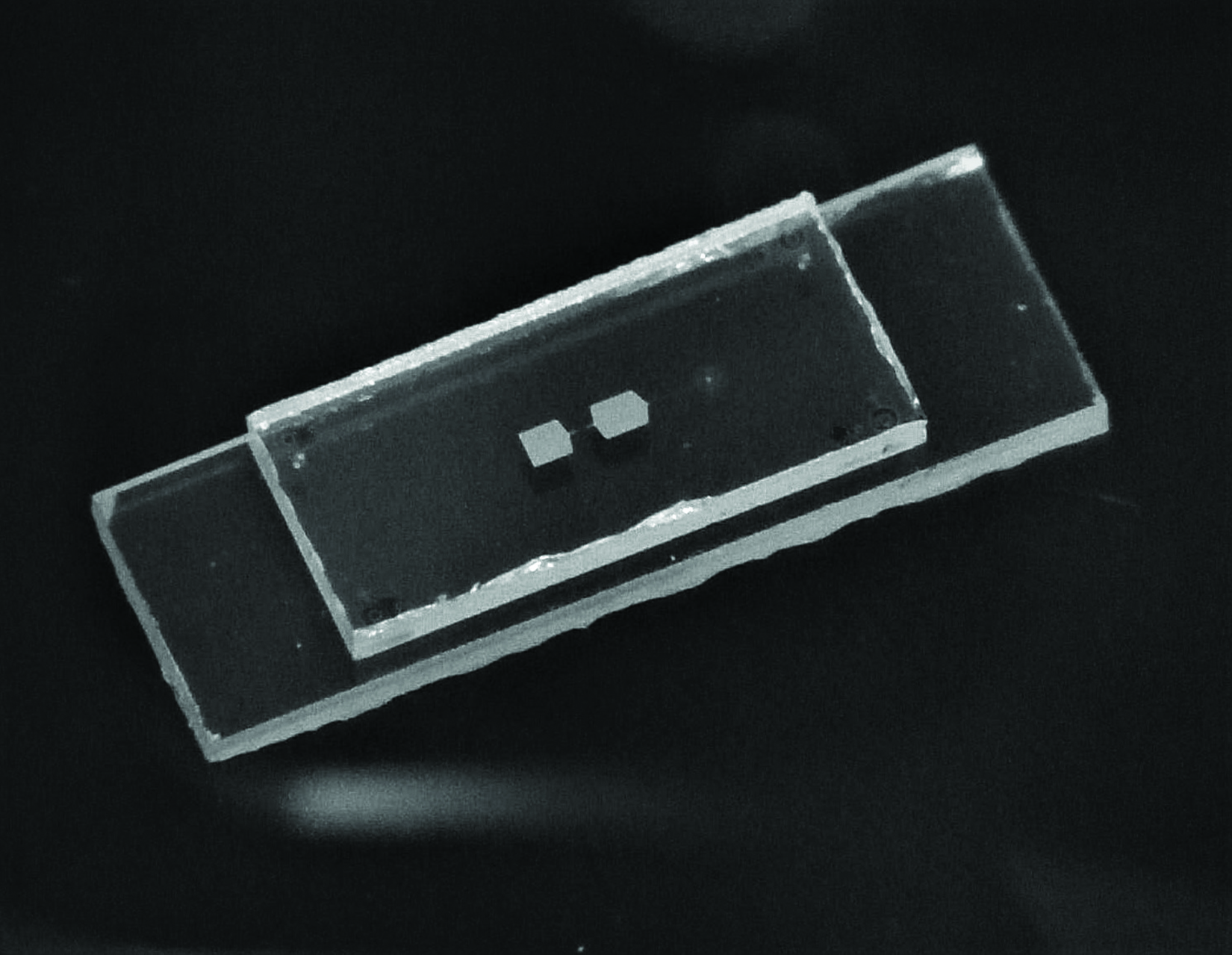
This mechanical resonator made out of sapphire is one of the largest objects that has been quantum mechanically controlled. Its 1017 atoms were put into a quantum superposition to wiggle in opposite directions simultaneously. Although the attometer separation between the superposed states is too small for researchers to resolve the states’ gravitational differences, future work on such objects could help identify whether gravity has a quantum description.
(Image courtesy of Uwe von Lüpke/ETH Zürich.)

Such decoherence effectively collapses the superposition’s wavefunction before the gravitational state can be measured. (For more on how the environment can decohere a quantum system , see the 1991 PT article by Wojciech Zurek.) Two atoms, separated by 100 μm and in a superposition with center-of-mass positions separated by 100 nm, can be kept in a quantum-coherent state for several minutes. But the difference in the states’ gravitational energies is so small that the time it takes for the states to gravitationally entangle is longer than the current age of the universe. In contrast, two 50 µm lead spheres, each containing 1018 atoms, put in the same superposition and at the same distance would generate observable entanglement in just 10 ms. But no one has ever observed such a state because it would quickly decohere.
Researchers are still far from developing a working experimental system to detect signatures of quantum gravity. The largest mass thus far prepared in a quantum superposition contained 1017 atoms in a bulk acoustic resonator. 10 (A version of the resonator is shown in figure 2 .) But its superposition size of a few attometers is far too small to resolve any gravitational difference between the superposition states in its vicinity.
Figure 3.

The rightmost, fixed gold sphere has a mass of 90 mg and a radius of 1 mm. It’s one of the smallest objects for which gravitational effects, probed here by a similarly sized sphere mounted on a torsion pendulum, have been measured. Obtaining quantum signatures of gravity for such a small object is exceptionally difficult because of decoherence issues. But if such measurements could be made, some of the most fundamental physics concepts would need revision.
(Image courtesy of the Aspelmeyer Group/University of Vienna.)

On the other hand, the smallest measured gravitational field to date is from a millimeter-sized source mass containing 1022 atoms. 11 It’s a small gold sphere, shown in figure 3 , and would decohere far too quickly in any realistic laboratory environment. Nevertheless, the hurdles to prepare actual quantum source masses seem more technical than fundamental. One promising approach is to control the quantum state of isolated solids trapped in a vacuum. 12 Those objects can be scaled to large masses and large spatial separation of the wavefunction. Another approach is to use miniaturized torsional pendulums for accessing small gravitational fields. 13
With concerted efforts, a direct test of the quantum superposition of static gravitational fields may be plausible in the next two decades. There are somewhat clear experimental pathways to such measurements, although they are undoubtedly filled with unknown difficulties. Perhaps a new solution to the problem is in the mind of an ambitious student. The way to find out is for researchers to push the limits of precision quantum control and measurement deep into the domain of massive quantum systems.
Beyond the quantization of gravity
This article has focused on the simple question of whether the gravitational field is quantized at all. Even for that question, only limited information can be gained in a given experiment. The gravitational entanglement experiments we have discussed, for example, will answer the question of whether the gravitational field can be put into quantum superposition. If so, then a purely classical model of gravity is ruled out. But that would still leave a wealth of possible quantum models. Quantization in the form of gravitons would be consistent with this experiment, but so would more complex models in which gravity, like the low-temperature superfluid phase of helium, arises from emergent behavior of some underlying “atomic” system. 14
Many other experiments at widely varying scales can provide new information about the quantum nature of gravity, and such experiments will be necessary for researchers to obtain a complete picture. For example, given the rapid advances in precision and architecture of optical and nuclear clocks, 15 researchers may have a path to probe the temporal aspects of gravitational superpositions. Another complementary probe could be measurements of anomalous noise in the gravitational interaction and the spacetime metric; such noise is a generic prediction of nongraviton models.
Experimental signatures of quantum gravity at high energies and, hence, high spacetime curvature scales is an entirely different matter. Astrophysical and cosmological effects of quantum gravity may exist that have no classical counterparts. Although observations of a primordial gravitational-wave background could be explained by classical stochastic models, some cosmological observables may violate Bell’s inequalities, which would rule out a classical origin of early universe fluctuations. 16 Or perhaps new physics will be revealed in searches of specific high-energy models and their predictions, such as deviations from Newton’s 1/r2 force from small extra dimensions.
Obtaining signatures of quantum gravity presents exciting and formidable challenges. Determining whether the gravitational field is truly quantized is one of the most important pieces of information that quantum gravity researchers can obtain in experiments over the coming decades. If evidence is found that gravity is not quantized in the same basic manner as electromagnetism, all the most basic assumptions about the presumed quantum nature of gravity would need to be revisited. That makes it even more pressing to understand what exactly can or cannot be learned about quantum gravity from experiments.
Editor’s note, 20 August 2026: A previous version of the article included an incorrect citation in ref. 15.
References
1. A. Einstein, “Näherungsweise Integration der Feldgleichungen der Gravitation ” (Approximate integration of the field equations of gravitation), Sitz. K. Preuss. Akad. Wiss. (1916), p. 688.
2. J. F. Clauser, “Early History of Bell’s Theorem ,” in Quantum [Un]Speakables: From Bell to Quantum Information, R. A. Bertlmann, A. Zeilinger, eds., Springer (2002), p. 61.
3. J. F. Clauser, “Experimental distinction between the quantum and classical field-theoretic predictions for the photoelectric effect ,” Phys. Rev. D 9, 853 (1974); P. Grangier, G. Roger, A. Aspect, “Experimental evidence for a photon anticorrelation effect on a beam splitter: A new light on single-photon interferences ,” Europhys. Lett. 1, 173 (1986).
4. N. H. Lindner, A. Peres, “Testing quantum superpositions of the gravitational field with Bose–Einstein condensates ,” Phys. Rev. A 71, 024101 (2005).
5. R. Colella, A. W. Overhauser, S. A. Werner, “Observation of gravitationally induced quantum interference ,” Phys. Rev. Lett. 34, 1472 (1975).
6. R. Weiss, “Nobel lecture: LIGO and the discovery of gravitational waves I ,” Rev. Mod. Phys. 90, 040501 (2018); B. C. Barish, “Nobel lecture: LIGO and gravitational waves II ,” Rev. Mod. Phys. 90, 040502 (2018); K. S. Thorne, “Nobel lecture: LIGO and gravitational waves III ,” Rev. Mod. Phys. 90, 040503 (2018).
7. T. Guerreiro, “Entanglement and squeezing of gravitational waves ,” Phys. Rev. D 112, L101904 (2025).
8. M. Parikh, F. Wilczek, G. Zahariade, “Signatures of the quantization of gravity at gravitational wave detectors ,” Phys. Rev. D 104, 046021 (2021); D. Carney, V. Domcke, N. L. Rodd, “Graviton detection and the quantization of gravity ,” Phys. Rev. D 109, 044009 (2024).
9. D. Kafri, J. M. Taylor, G. J. Milburn, “A classical channel model for gravitational decoherence ,” New J. Phys. 16, 065020 (2014); S. Bose et al., “Spin entanglement witness for quantum gravity ,” Phys. Rev. Lett. 119, 240401 (2017).
10. M. Bild et al., “Schrödinger cat states of a 16-microgram mechanical oscillator ,” Science 380, 274 (2023).
11. T. Westphal et al., “Measurement of gravitational coupling between millimetre-sized masses ,” Nature 591, 225 (2021).
12 M. Kamba, N. Hara, K. Aikawa, “Quantum squeezing of a levitated nanomechanical oscillator ,” Science 389, 1225 (2025).
13. C. A. Condos et al., “Ultralow loss torsion micropendula for chipscale gravimetry ,” Phys. Rev. Lett. 134, 253602 (2025); S. Agafonova et al., “One-milligram torsional pendulum toward experiments at the quantum-gravity interface ,” Commun. Phys. 9, 80 (2026).
14. D. Carney et al., “On the quantum mechanics of entropic forces ,” Phys. Rev. X 15, 031038 (2025).
15. A. D. Ludlow et al., “Optical atomic clocks ,” Rev. Mod. Phys. 87, 637 (2015); S. M. Girvin, L. Radzihovsky, commentary, “Prospects for a solid-state nuclear clock ,” J. Club Condens. Matter Phys. (2025).
16. J. Maldacena, “A model with cosmological Bell inequalities ,” Fortschr. Phys. 64, 10 (2016); I. Pikovski, A. Loeb, “Quantum coherent oscillations in the early universe ,” Phys. Rev. D 93, 101302 (2016).
More about the authors
Markus Aspelmeyer is a professor of physics at the University of Vienna and director of the Institute for Quantum Optics and Quantum Information Vienna at the Austrian Academy of Sciences.
Daniel Carney is a staff scientist at Lawrence Berkeley National Laboratory in California. Trained as a string theorist, he now works across the theory–experiment intersection.