The pioneering life of Edward Alexander Bouchet

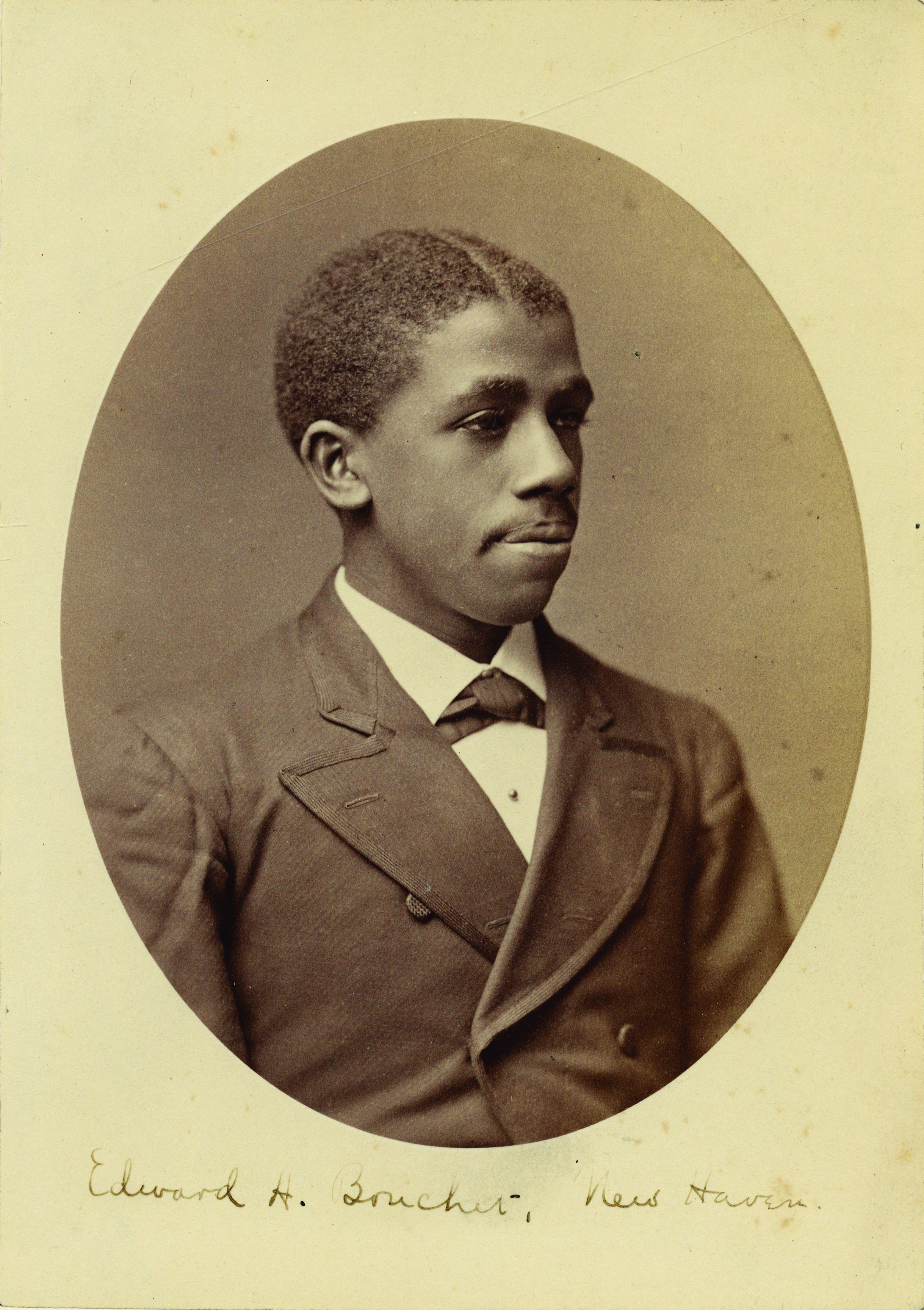
A portrait of Edward Bouchet taken sometime in 1873–74 during his studies at Yale College (now Yale University).
(Image from Yale College Class of 1874 Class Album, Yb71 874+ Oversize, Manuscripts and Archives, Yale University Library.)

Edward Alexander Bouchet, born on 15 September 1852 in New Haven, Connecticut, became the first African American to earn a PhD in the US when he completed his doctoral studies in physics at Yale College (now Yale University) in 1876. 1 2 He then spent the next 26 years teaching chemistry, physics, and mathematics at the Institute for Colored Youth (ICY), a Quaker-run private college in Philadelphia, 3 where he established a reputation as an excellent teacher and mentor.
Bouchet resigned from the ICY in 1902 after the institution became embroiled in a national controversy between W. E. B. Du Bois and Booker T. Washington over whether Blacks in the US should focus on collegiate or industrial education. 4 It was a major setback to Bouchet’s career: He spent the next 14 years teaching at several high schools and colleges in various parts of the country before retiring for health reasons in 1916 and returning to New Haven, where he died of arteriosclerosis on 28 October 1918 at age 66. 5
Although Bouchet never formally conducted scientific research after receiving his PhD, he nevertheless maintained a connection to the field through his involvement with scientific societies located in the cities where he worked. This year, 2026, marks the 150th anniversary of Bouchet earning his doctorate, and it is thus an appropriate occasion to look back on his career.
Early life and college
Bouchet’s father, William, was born in Charleston, South Carolina, in 1817 and appears to have come to New Haven at age seven as the enslaved servant of Yale student John B. Robertson. 6 William was emancipated in 1842 and died in New Haven in 1885. Bouchet’s mother, Susan, was born as a free Black woman in Connecticut in 1817; she died in 1920, outliving her son. Bouchet was the youngest and only son of their four children. He never married and had no children. 2
As a child in New Haven, Bouchet first attended the Artisan Street Colored School, which at the time was one of only three schools in the city that accepted Black children. The school’s sole teacher, Sarah Wilson, nurtured Bouchet’s academic abilities and aspirations. In 1866, he entered New Haven High School, where he spent two years before transferring to Hopkins Grammar School (today Hopkins School), where he graduated as valedictorian in 1870. Hopkins was a prestigious private boys’ school that prepared its students in the classics and sciences for entry to Yale.
Bouchet started at Yale that September. During his freshman year, his grade point average was 3.36, with his highest grade being a 3.52 in mathematics. The remainder of his college days were devoted to the study of English, French, German, Greek, Latin, logic, and rhetoric, along with courses in the sciences: astronomy, chemistry, mathematics, mechanics, and physics.
But he did not find Yale to be particularly welcoming. At social events and through to graduation, students sang racist songs and recited racist poems, and Bouchet was unable to join any of the college’s famed secret societies because of his skin color. 6 Despite those conditions, Bouchet succeeded academically and graduated summa cum laude in June 1874 as the sixth in a class of 124. Based on his outstanding undergraduate record, Bouchet was selected for membership in Phi Beta Kappa.
Graduate school
Bouchet enrolled in Yale’s graduate program in physics in September 1874, an effort that was made possible by Alfred Cope, 3 a philanthropist and a member of the ICY’s board of managers. Cope probably heard about Bouchet from the scholar’s many friends in New Haven, especially those at Hopkins Grammar School and Yale. Cope recruited Bouchet to teach at the ICY but convinced him to remain at Yale to first complete a doctoral degree. Bouchet agreed to do so only after Cope arranged to finance his graduate studies with a $1500 yearly stipend.

Physicist Arthur Williams Wright, Edward Bouchet’s PhD adviser at Yale.
(Image from W. L. Kingsley, ed., Yale College: A Sketch of Its History [. . .], 1879, p. 431.)

In graduate school, Bouchet’s research adviser was Arthur Williams Wright, 7 who was one of three Yale students who were awarded the first PhD degrees in the US in 1861. (Wright’s PhD was the first in a scientific field.) In addition to taking courses in experimental physics with Wright, Bouchet studied calculus with astronomer and mathematician Hubert Newton and chemistry and mineralogy with mineralogist George Brush. Interestingly, there is no direct evidence that Bouchet had any academic interaction with the contemporaneous Yale physicist who proved to have the biggest historical legacy: Josiah Willard Gibbs.
Bouchet’s graduate work focused on measuring indices of refraction, 1 2 which was in line with both Wright’s and Brush’s interests in gems and mineralogy. Brush had joined the Yale faculty in 1855, first as a professor of metallurgy and later of mineralogy, and immediately began acquiring an extensive research collection of minerals. Later, he was appointed as the first curator of the mineral collection of the Peabody Museum of Natural History, now the Yale Peabody Museum. By the time Bouchet began his PhD, Yale had a vast source of materials at his disposal for his research, in which he used geometrical optics to characterize the physical properties of minerals.
Institute for Colored Youth
After completing his PhD in 1876, Bouchet began teaching that September at the ICY, where he served as the head of its new science program. 2 In that role, he taught courses in chemistry, physics, astronomy, physical geography, physiology, and mathematics. In annual reports to the board of managers, he regularly requested additional laboratory space and equipment for students so that they could carry out experiments. To help both his students and colleagues gain a well-rounded education, he gave lectures on a variety of scientific topics outside his formal work in the classroom.
He also extended those efforts out into the wider community, presenting public lectures at numerous locations, including the church he attended, the African Episcopal Church of St. Thomas. Indeed, Bouchet was deeply religious: He was a member of the church’s vestry, or governing body; served as church secretary; and was later appointed as a lay reader by the local Episcopal bishop, which meant that he could conduct daily services. Bouchet’s involvement in the church was also important because many of Philadelphia’s educated, elite African Americans were members of the congregation.
Although Bouchet did not have formal access to any research laboratories, he remained interested in science and kept up with the latest discoveries by becoming a member of two distinguished Philadelphia-based learned societies: the Franklin Institute (now largely known for its science museum) and the American Academy of Political and Social Science. During his time in Philadelphia, Bouchet maintained his ties with Yale through the local chapter of the alumni association. 2 5 He attended many of the chapter’s meetings and annual dinners and was readily received and welcomed by the other members. 8

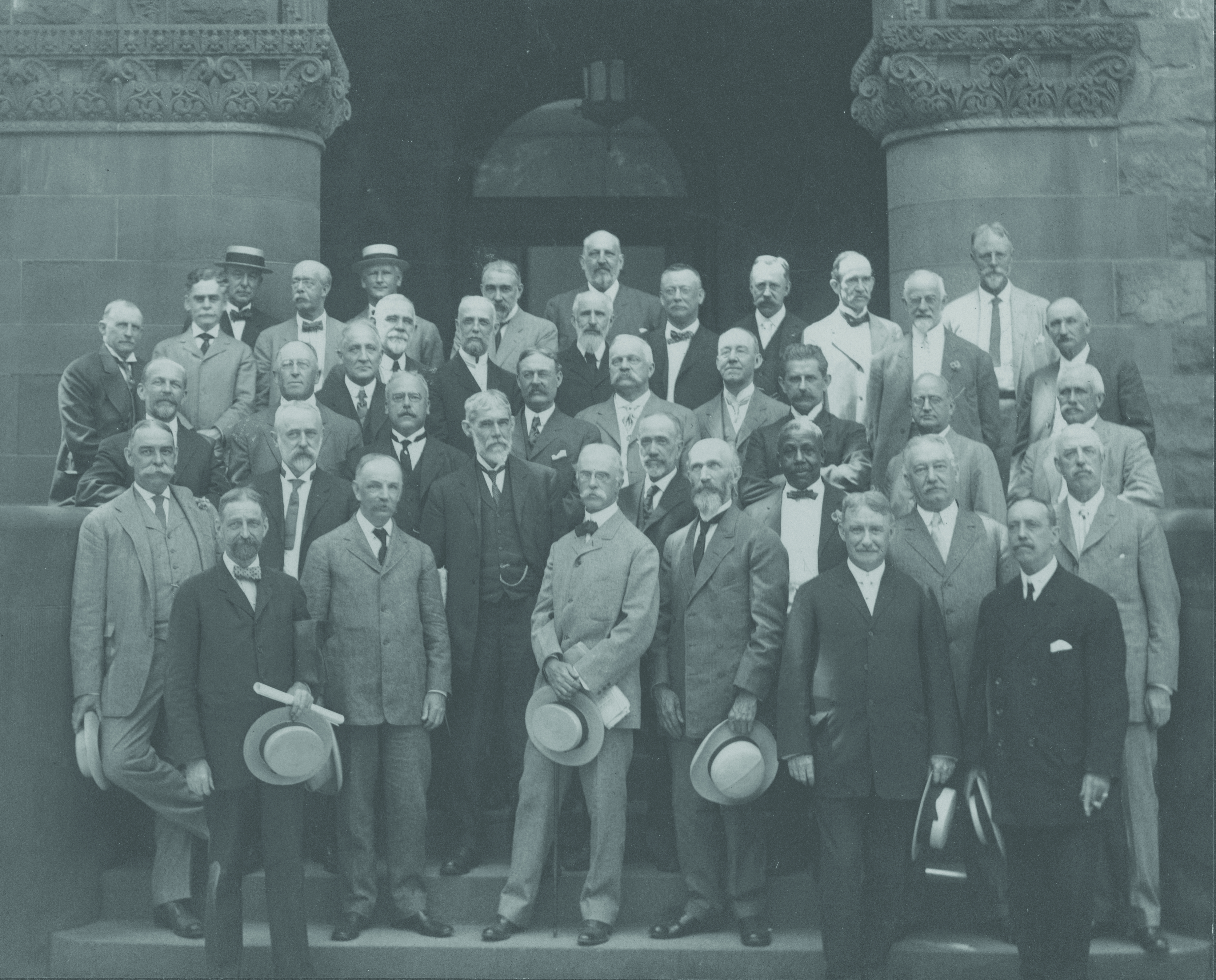
Attendees of the 35th reunion of Yale College’s class of 1874, pictured in 1909. Edward Alexander Bouchet is in the second row, third from right.
(Image from Yale Classes Photographs, RU 779, Manuscripts and Archives, Yale University Library.)

Around 1900, the ICY became embroiled in a major debate within the Black community. One wing of the Black elite, led by W. E. B. Du Bois, urged the community to prioritize college education for talented individuals at institutions like the ICY. Another, led by Booker T. Washington, argued that in the face of ever-present racism, the community should focus on practical, trade-based education. Ultimately, the board of managers, a group largely made up of white Quakers, were persuaded by Washington’s arguments and decided to change the ICY’s classical curriculum to one that emphasized more manual and industrial education.
The ICY closed its Philadelphia building in 1902 and moved to Cheyney, about 40 kilometers outside the city. 3 (Today it is known as Cheyney University of Pennsylvania, and it is the oldest of the US historically Black colleges and universities.) After Bouchet had several heated exchanges with the board of managers, he chose to resign. He was the only ICY teacher or administrator who did not receive severance pay when the institution moved to Cheyney. 1 2
No destination
Now unemployed, Bouchet began searching for a full-time position. He quickly reached out to two other historically Black institutions: the Hampton Normal and Agricultural Institute (now Hampton University) in Virginia and the Tuskegee Institute (now Tuskegee University) in Alabama. Both institutions replied stating that no teaching positions were available. Their responses were unsurprising: Washington was the president of Tuskegee, and Hampton’s leadership was aligned with him in the African American educational dispute. In fact, high-ranking leaders at both institutions had urged the ICY to end its liberal arts educational efforts in Philadelphia and move to Cheyney.
Bouchet was eventually able to find a teaching position—albeit one at the secondary school level—in fall 1902 at Sumner High School in Saint Louis, Missouri, a segregated institution that was the first (and, at the time, only) high school for Black students in the city. However, he left that job after the 1902–3 academic year. From November 1903 to May 1904, Bouchet was the business manager for Provident Hospital, a private medical facility that served the St Louis Black community. That was followed by a position as a US customs inspector at the city’s 1904 World’s Fair—also known as the Louisiana Purchase Exposition—from May 1904 to March 1905.

A portrait of Bouchet as an older man, taken circa 1912, which was included in the class book prepared after the 35th reunion of Yale College’s class of 1874.
(Image from H. W. Farnam, ed., Biographical Record of the Class of 1874 in Yale College, Part Fourth, 1874–1909, Tuttle, Morehouse & Taylor, 1912, p. 18; Ybb 874, Manuscripts and Archives, Yale University Library.)
Bouchet was again jobless. He returned to his family home in New Haven and decided to see if he could find a job in Yale’s physics department. He asked Wright, his doctoral adviser, to recommend him for a position. Wright quickly agreed and wrote to the Yale bureau of appointments, saying that Bouchet had “agreeable personal qualities, gentlemanly manners, and good address” and that he was “eminently well fitted for a Professorship in Physics and Chemistry.” Wright closed the letter by stating that he had “entire confidence in Mr. Bouchet’s ability and character” and that with his experience, Bouchet “would not fail to be efficient and successful in any position he was called to occupy.” 9 Sadly, Wright’s efforts were in vain: As far as I am aware, Bouchet never heard from Yale.
Instead, Bouchet eventually landed a job as the director of academics at the Saint Paul Normal and Industrial School, a historically Black college in Lawrenceville, Virginia, in October 1906. He remained there until June 1908. In September of that year, he moved to the town of Gallipolis in southern Ohio, where he became the principal of Lincoln High School, the segregated secondary school for Blacks in the community.
Bouchet remained in Gallipolis for five years, at which point arteriosclerosis forced him to resign his position and again return to New Haven, where his mother cared for him. In about 1914, he accepted a faculty position at Bishop College, a historically Black institution in Marshall, Texas, where he taught science and mathematics. But he was yet again forced to return to New Haven in 1916 for health reasons, and he remained there until his death in 1918. That same year, Elmer Samuel Imes became the second African American to obtain a PhD in physics, from the University of Michigan in Ann Arbor. (For more on Imes, see my October 2018 PT article .)
Legacy
Bouchet never had the opportunity to engage in research after graduating from Yale. He ended up devoting his life to teaching. As he wrote in the class book for his 15th Yale College reunion, “There is every prospect that teaching will be my life-work.” 10 Ten years later, in the book for his 25th reunion, Bouchet wrote that he had “endeavored to discharge my duty as a teacher to those coming under my care, and have aimed to be a good citizen, and to exemplify in my life the mottoes of our Alma Mater.” 11
It is nearly impossible to assess the influence that Bouchet had on the many people whose lives he touched, all of whom are now long dead. But in 1977, I was fortunate to correspond with Lillian Mitchell Allen, one of Bouchet’s former students during his time as principal of Lincoln High School in Gallipolis:
I recall hearing my parents . . . discuss some of the outstanding characteristics of Dr. Bouchet as follows—that he was a fine Christian gentleman, a consummate scholar, one who seemed very knowledgeable in all areas and yet was extremely modest and a person who set a wonderful example of politeness and graciousness for the community.
Allen wrote that when she was in the seventh and eighth grades, Bouchet selected her as the school’s student pianist, which meant that she played for both music classes and at commencement. She ended up pursuing a PhD of her own and became a professor and the head of music education at Howard University in Washington, DC. So it is perhaps unsurprising that more than 50 years later, she saw that as a pivotal moment in her life: “Dr. Bouchet’s selection of me to play for the high school music classes while I was still an elementary school pupil was perhaps one of the contributing factors which caused me to continue my education and achieve the Ph.D. in Higher Education.” 12
Bouchet’s obituary in his Yale class’s 45th reunion book attests to the impact he had on some of his undergraduate classmates:
Bouchet came among us at the beginning of freshman year with the prestige of having been valedictorian of his class at Hopkins Grammar School and from the beginning to end of the course was one of our high stand men. He was one of the few among us entitled to wear the Phi Beta Kappa key. . . . He reflected great credit on his people and demonstrated by his own career their capacity to accomplish worthy things in intellectual fields. In all his associations, both in college and in later life, he showed himself the thorough gentleman. The memory of his quiet scholarly life will long remain as an influence for good among the members of his race and many others who were privileged to know him. 8
To honor Bouchet’s legacy, several honors, prizes, and awards have been established that acknowledge his contributions to teaching, mentoring, and society. Those recognitions include the American Physical Society’s Edward A. Bouchet Award, which recognizes distinguished minority physicists who have made significant contributions to the field, and the Edward Alexander Bouchet Graduate Honor Society , cofounded by Howard University and Yale University to honor Bouchet’s pioneering work in doctoral education and to promote excellence in the academic professoriat. Additionally, as part of the American Physical Society’s Historic Sites and Events Initiative—and after a successful nomination from Yale’s physics department—a plaque honoring Bouchet was placed on Vanderbilt Hall, one of the two Yale buildings now located on the site of the laboratory where Bouchet did his graduate research. 13
“Undaunted by enormous odds”

Ronald E. Mickens at the gravesite of Edward Bouchet, in 2017. The grave was unmarked until 1998.
(Image from the AIP Emilio Segrè Visual Archives, Ronald E. Mickens Collection.)

Bouchet was a loner. No significant letters, class notes, or scrapbooks are known to exist; neither is his PhD dissertation. No extant Bouchets can trace their origins back directly to him, for he never married or had children. But his memory still haunts us with the possibilities of what can—and cannot—be accomplished in the face of adversity by individuals of principle who love and seek knowledge. His training, teaching experience, and intellectual interests prepared him to be a potentially outstanding researcher. But he was never given the opportunity to realize that dream. Instead, he led the life of the master teacher and the quiet scholar. His success must be measured by the inspiration that he provided to hundreds of his students.
In the preface to a 1979 report on the status of Black graduate and professional students at Yale, epidemiologist Curtis Patton—at the time, one the few Black faculty members at the university—reflected on Bouchet’s experience as the first Black recipient of a Yale PhD:
Preeminent, humane, undaunted by enormous odds, untouched by self pity, Yale and a young man named Bouchet found their resources and goals compatible more than a century ago. History was made. But no tradition was started.
We may never know the specifics of Bouchet’s suppression. We have no documents that give clues to his thoughts on his career. We only know that he lived during a period that can only be called terrible for Black people. His challenges must have been magnificent. 14
This article is adapted and expanded from my essay “Bouchet and Imes: First Black Physicists,” in The African American Presence in Physics, R. E. Mickens, ed., National Society of Black Physicists (1999), p. 20.
References
1. R. E. Mickens, ed., The African American Presence in Physics, National Society of Black Physicists (1999), p. 20.
2. R. E. Mickens, ed., Edward Bouchet: The First African-American Doctorate, World Scientific (2002).
3. J. Giesberg et al., “History of the Institute for Colored Youth ,” Falvey Library, Villanova University (ca. early 2015).
4. T. Aiello, The Battle for the Souls of Black Folk: W. E. B. Du Bois, Booker T. Washington, and the Debate that Shaped the Course of Civil Rights, Praeger (2016).
5. “Edward Alexander Bouchet, B.A. 1874,” Obituary Record of Yale Graduates, 1918–1919, Yale U. (1919), p. 919.
6. D. W. Blight, Yale and Slavery: A History, with the Yale and Slavery Research Project , Yale U. Press (2024).
7. C. S. Hastings, “Arthur Williams Wright ,” Science 43, 270 (1916).
8. J. C. Sellers, “Edward Alexander Bouchet,” in Biographical Record of the Class of 1874 in Yale College, Part Fifth, 1909–1919, Tuttle, Morehouse & Taylor (1919), pp. 81, 83.
9. A. W. Wright, recommendation letter for E. A. Bouchet (9 June 1905), E. A. Bouchet alumni file, box 1042, Alumni Records Office, Yale University, Records of Alumni from the Classes of 1701–1978 (RU 830), Manuscripts and Archives, Yale U. Library.
10. G. L. Dickerman, ed., Biographical Record with Report of Sexennial and Decennial Meetings of the Class of 1874 in Yale College, Part Second, A. C. Raymond (1889), p. 13.
11. G. L. Dickerman, ed., Biographical Record with Report of Quindecennial and Vicennial Meetings of the Class of 1874 in Yale College, Part Third, Price, Lee & Adkins (1899), p. 14.
12. L. M. Allen to R. E. Mickens (1 February 1977), reprinted in ref. 2, p. 93.
13. A. Cheng, “New plaque honors Edward Bouchet ,” Yale Daily News, 9 April 2017.
14. Ref. 1, p. 24.
More about the authors
Ronald E. Mickens is the Distinguished Fuller E. Callaway Professor Emeritus of Physics at Clark Atlanta University in Georgia. A mathematical physicist by trade, he has also published several articles and monographs on the history of Black scientists.