The history of eyeballs as particle detectors

Dean Cowie works with the 60-inch cyclotron at the Carnegie Institution of Washington’s department of terrestrial magnetism in 1944. A couple of years later, he developed cataracts.
(Photo from Carnegie Science.)

Measurements in particle physics usually involve sophisticated equipment, from the cloud chambers of the first half of the 20th century to the semiconductors and scintillators of today. Those devices have had a shared purpose: to amplify signals from events taking place at extremely small scales so that they are a size that physicists can observe.
Occasionally, though, scientists have made those measurements more … directly. Stories passed down about the early cyclotrons tell of researchers who used their own eyes to align particle beams.
This was not a particularly safe thing to do. Some researchers who had worked with cyclotrons lost much of or all their vision. A phenomenon that would come to be known as cyclotron cataracts would intrigue medical researchers in an era when the field was just starting to understand the health effects of radiation.
Experimentalists are much more careful today, but mysteries remain: What exactly caused the vision problems experienced by those early cyclotron researchers? How did they detect particle beams by eye? And do some of the stories bear similarities to ones told by astronauts and by patients undergoing radiotherapy? Over the years, medical researchers have investigated different mechanisms and found new ways that high-energy particles can interact with the eye. The research continues to this day.
Cyclotron lore
Ernest Lawrence conceived of cyclotrons in 1929 at the University of California, Berkeley. The early accelerators used rapidly varying electric fields to accelerate particles while a static magnetic field held them in a spiral trajectory. Cyclotrons quickly progressed from a 15 cm prototype to bulky machines that required teams of assistants, doctoral students, and research fellows. That community seeded the first cyclotron legends.
Robert Varney was at Berkeley through the 1930s, as a student and then as an instructor and research fellow. Physics Today published his reminiscences in 1982. “For a few years,” he wrote, “the crews working at the cyclotron took no precautions whatsoever against radiation injury.” He reported of one of the undergraduate research assistants: “Dean Cowie aligned the cyclotron beam by eye, looking directly at the target lighted by the impact of the beam ions while the neutrons came on through the window into his eyes.” In those experiments, the targets were small samples of materials like lithium and carbon. If the cyclotron was properly aimed, the deuteron beam, which glowed purple when exposed to air, would strike the target and throw off light, heat, and a variety of particles.
Cyclotrons were soon a common feature of university physics departments, and more stories emerged of researchers measuring particles in worryingly direct ways. Says Stewart Bushong, now a professor at Baylor College of Medicine:
I was in graduate school at the University of Pittsburgh from 1961 to 1967 and have a particular recall of walking between buildings with one of my physics professors whose name I do not recall. He was always guided by hand-holding with an assistant because he was near blind as a result of his earlier work with a cyclotron.
My recollection is that he described in detail what he did for years. His sample-irradiation room was adjacent to the cyclotron room. He would use a radiographic intensifying screen to determine where to place his sample, making sure it would intercept the proton beam.
A version of Bushong’s story is in the 2017 edition of his textbook Radiologic Science for Technologists: Physics, Biology, and Protection, in which he discusses the first evidence for radiation-induced cataracts. Cowie was a key case. By 1943, he had completed his undergraduate studies at Berkeley and was working at the Carnegie Institution of Washington. According to a 1949 article in Time, while he was setting up the institution’s cyclotron, Cowie was exposed to an unexpected dose of radiation. By 1947, he had developed cataracts, cloudy areas in the lenses of his eyes. When Time interviewed him, he was blind in one eye. He was one of five young physicists whose cyclotron-cataracts cases were reported to the public at the time. Cataracts are often treatable, and several of the physicists had them surgically removed successfully.
Later, in 1949, a team of medical researchers examined many of the affected cyclotron workers and interviewed them about their exposures, which typically had occurred several years earlier. Although gamma rays were known to cause cataracts, the researchers concluded that the cyclotrons did not produce enough gamma radiation. By process of elimination, they settled on neutrons , another common component of radiation from cyclotron beams, as the likely culprit. Experiments on mice confirmed that neutrons could cause cataracts at much lower doses than gamma rays.
The research motivated new safeguards and more attention to existing ones. In a 1949 editorial , The New England Journal of Medicine noted, “One of the continuing problems of all physicians and biophysicists having to do with safety monitoring is to counteract the natural enthusiasm of the scientist.”
Visual particle detection
Whereas some stories from the early cyclotrons mention aligning the beam by looking at a glowing target or a radiographic intensifying screen, others suggest something stranger. Andrew Jackson of the Niels Bohr Institute in Copenhagen remembers a story from his student days at Princeton University:
The beam of the cyclotron had to be tuned and adjusted by hand. To do this properly, it was necessary to do a lot of running back and forth between the quadrupole magnets and the control panel. It was far faster simply to look down the beamline while adjusting the magnet controls until flashes of light were seen in the eye. I have never seen this done but was assured by the senior Princeton technician that they used this method when adjustments were urgent.
What could have caused those flashes of light? Few people involved in those first experiments are alive, so stories like Jackson’s are difficult to confirm. But in the decades since the first cyclotron experiments, medical researchers have investigated other situations in which people exposed to radiation observe flashes of light.
When astronauts in the Apollo program reported observing flashes in the command module on their way to the Moon, researchers began to speculate as to what they were seeing. The lights appeared mostly when the astronauts’ eyes were closed, suggesting that a high-energy particle had passed through the eye. Research on volunteers on Earth led to a plausible explanation: The radiation was directly affecting the process of vision by activating either photoreceptors in the retina or neurons in the visual pathway.
Meanwhile, doctors had begun to hear from their patients about similar light flashes. Patients treated with cobalt-60, a radioactive isotope used in the 1970s to treat cancer that had metastasized to the lungs, frequently reported seeing mysterious flashes in their eyes. Later, those receiving other radiation treatments reported similar observations. “It’s kind of a known thing from clinicians that if you treat a patient behind the eye, just to warn them that they might see blue light,” says Lesley Jarvis, a physician-scientist in the department of radiation oncology and applied sciences at Dartmouth College’s Geisel School of Medicine. “We didn’t know the reason for it.”
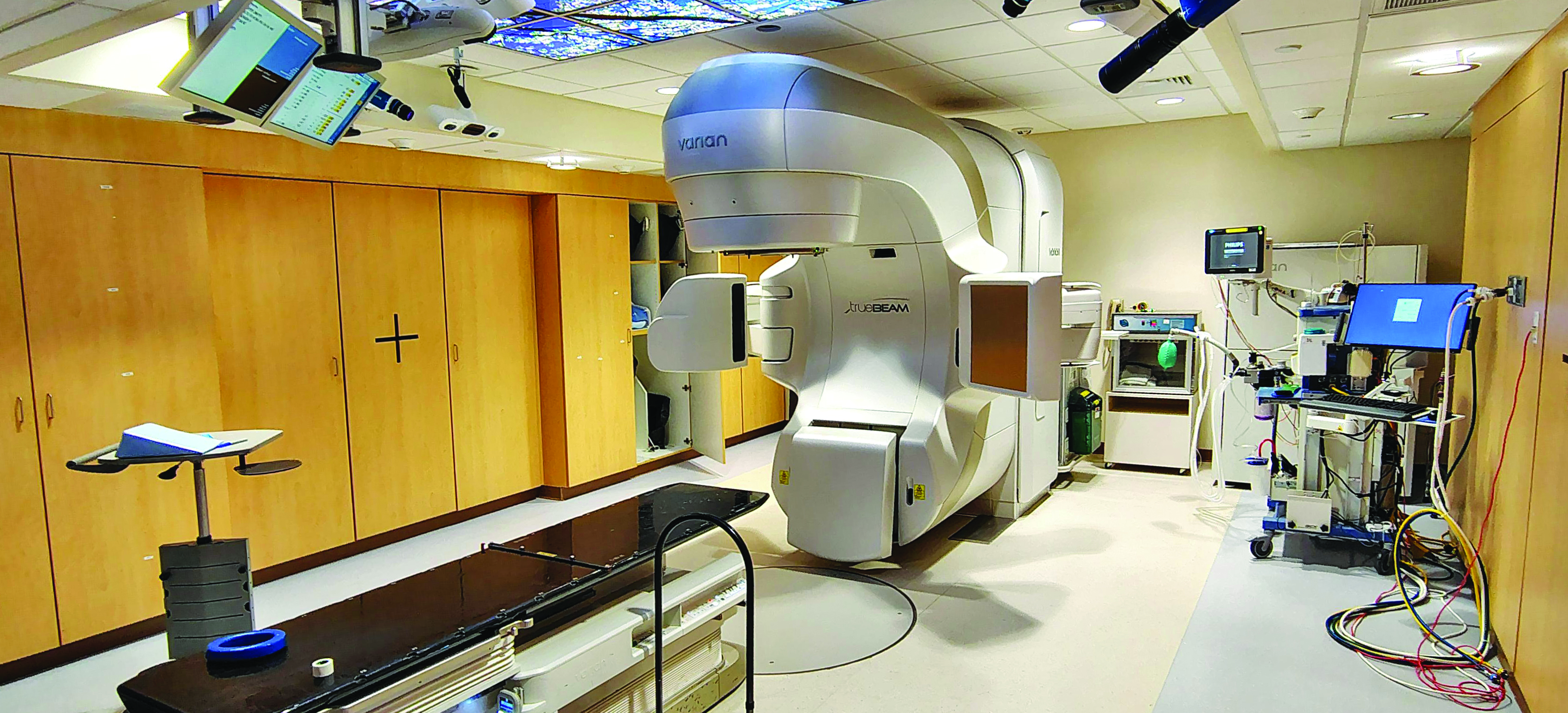
Jarvis worked with Brian Pogue from Dartmouth’s engineering school in 2019 on a camera to detect radiation, with the goal of better aiming photon beams during treatment. In one test, Jarvis noticed something startling. “This was a patient who was getting a high-dose radiosurgery procedure for a tumor right behind her eye,” she says. “And all of a sudden, right out of her pupil we saw blue light glowing out of her eye.”
Because the light was visible to Jarvis, it could not have been caused by the direct stimulation of the patient’s retina. Instead, the light must have been generated in the eye.

Dartmouth College’s Lesley Jarvis and colleagues installed ceiling-mounted cameras to track photon beams that are used in certain cancer radiation treatments. During one trial, the researchers observed blue light shining out of a patient’s eye.
(Photo from Lesley Jarvis.)

Jarvis and colleagues suspected that they had observed Cherenkov radiation, which is emitted by a charged particle that is passing through a medium faster than the speed at which the crests and troughs of a wave of light can travel in that medium. The cause of the characteristic blue glow in underwater nuclear reactors, Cherenkov radiation plays a useful role in physics experiments like IceCube and SNOLAB that use cameras in large volumes of frozen or liquid water to detect high-energy particles. Here, Jarvis hypothesized, the flash of blue light came from electrons in the eye that were kicked into motion by the photons used for the radiation treatment.
Jarvis, whose Stanford University education in cancer biology was filled with stories about the first linear accelerator at SLAC, realized that she had an opportunity to observe the phenomenon in unprecedented detail. Using pigs’ eyes secured from a butcher, Jarvis and colleagues confirmed that Cherenkov light could be triggered in the eye by high-energy particles. They reported their experimental results and patient observations in a 2020 paper .
Looking back
Early cyclotron researchers, Apollo astronauts, and radiotherapy patients have experienced high-energy particles in an incredibly direct way. Are the experiences related? Could some of the cyclotron researchers have seen particles via Cherenkov radiation? At this point, there is a limit to how much anyone can know.
The physicians who studied cyclotron cataracts in the 1940s had pinned the cause on neutrons, which don’t emit Cherenkov radiation, and the Princeton cyclotron accelerated protons, which would not have had enough energy to trigger Cherenkov in an eye. Either would have had to somehow accelerate other charged particles in a secondary or tertiary process, and the comparatively low energy of the machines makes that possibility unlikely.
But there is another way they could have experienced Cherenkov radiation. The experiments by Jarvis’s team used a medical accelerator to generate 6 MeV photons, which kicked off electrons when they ionized atoms in the pig eyes. Although the 1949 analysis disfavored gamma rays as a cause of cataracts, it mentioned that cyclotrons were known to throw off hard gamma rays. If any of the early cyclotrons threw off enough photons in the right energy range, there is a chance they would have caused Cherenkov radiation in the same way.
Today’s patients are dosed with radiation under controlled conditions. Doctors benefit from decades of research on radiation’s health risks and how to mitigate them. That means more safety for patients, doctors, and technicians. It also means fewer stories.
“We’re so careful these days about not getting near the radiation sources,” Jarvis says. “But I know it was a different world back then.”