Exposing life’s limits with dimensionless numbers
From the archives: November 1998
The impressive performance of evolution as a design mechanism needs no belaboring. Physics, though, constitutes a larger reality that evolution can no more transcend than a cow can jump upward at escape velocity. Enzymes cannot act as Maxwellian demons, nor can birds turn off gravity. Physics limits life’s designs no less rigidly than it constrains our own technology.
But how, in practice, can we locate the limits that the physical context sets on life? At least for understanding its macroscopic, mechanical aspects, a device long used by engineers in particular proves to be useful. Surprisingly often, boundaries get set by the interplay of two competing factors, and their ratio, expressed in dimensionless terms, provides us with at least heuristic guidance.
As a simple if fanciful example, consider the limits to stacking. The ratio of the stress on the pile’s base to the compressive strength of the blocks’ material cannot exceed one. Or,
where ρ is the density of the material, g is the strength of gravity, h is the height and σcm is the material’s ultimate compressive stress or crushing strength. Inserting values, we find that ordinary bricks run into trouble at a height of less than 400 meters, but granite can be piled to nearly 5000 meters; bone and wood do better, and a pile of either could exceed 8000 meters. So simple gravitational loading imposes no serious design limitation. Doing the same thing for tensile loading gives the length at which a cable breaks from self-loading alone. It exposes the impossibility of lowering a rope to Earth’s surface from a satellite in geosynchronous orbit, a notion both raised and shot down back in 1966 by a group at the Woods Hole Oceanographic Institute. 1
Dimensionless numbers are usually offshoots of their parent subject, dimensional analysis, and hundreds have been defined and named. 2 , 3 Most consist of the ratio of two forces, such as viscous and gravitational. But they can be contrived without formal analyses, with just an eye to practical utility. They typically permit simple but still quantitative views of complicated physical phenomena. Biology, cursed by complicated phenomena, needs even such relatively crude tools.
Dimensionlessness holds an additional appeal for biologists. It can keep size from confusing an analysis, which is no small matter for a field whose subjects encompass lengths spanning eight orders of magnitude. For instance, the ratio of surface area to volume is important when looking at the sizes of cells, at swimming speeds and at metabolic rates, but its values reflect both size and shape. If something (sinking rates of plankton, let’s say) varies with surface-to-volume ratio, either shape or size may be responsible. A dimensionless version, such as the ratio of surface cubed to volume squared, depends on shape alone. Something shape dependent will vary with this cubed/squared ratio, while a purely size-dependent phenomenon won’t.
Swimming, gas extraction, gait changes
William Froude (1810–79) first devised a useful way to extrapolate performance data from small model ships moving slowly to full-size ships at their intended speeds. We now use a scaling parameter that bears his name for a lot more than ensuring dynamic similarity between model and ship. One way to get the Froude number is by taking the ratio of the inertial force that keeps the water within a wave moving to the gravitational force that prefers the water’s surface to be flat. Thus,
where v is the speed at which the waves move across the water’s surface and l is the distance between adjacent crests. (Sometimes the square root of the relationship is used as the Froude number.) Waves move at a specific Froude number. So longer waves travel faster than shorter ones, at least in the range (lengths greater than a few centimeters) where inertial and gravitational forces are what matter.
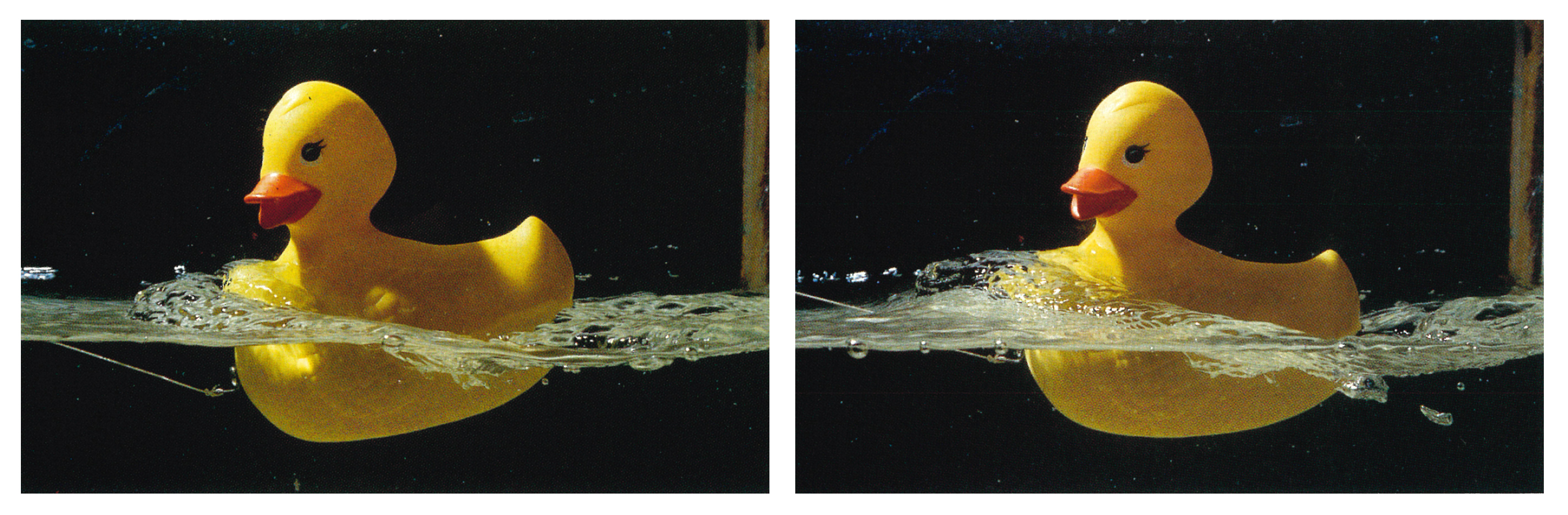
A surface ship with an ordinary water-displacing hull creates waves as it moves. In particular, it makes a bow wave in front and additional waves along its length and at its stern. At full (“hull”) speed, it’s left with a bow wave and a stern wave, the two separated by the length of the ship’s hull. All is well as long as the ship doesn’t exceed the speed that waves of that length will travel. Going faster than the critical Froude number of about 0.16 requires that the ship leave its beneficent stern wave astern and try to cut through or climb up its bow wave. That’s why getting ahead be-comes an uphill battle, as the small ship of figure 1 discovers. Crucial here is the longer-is-faster rule, which permits the longer ship to go faster before reaching the point at which its power requirement rises steeply.
Figure 1.

Rubber ducky being towed in a flow tank just under (left) and just over (right) its hull speed. Notice that at the higher speed this small surface ship tips upward and its stern wave disappears.

Surface ships are practical, in short, when they’re long. A 100 m long ship reaches hull speed at about 13 m/s, or 28 mph, whereas a 10 m long ship can do only 4 m/s, or 8 mph—or just a little more with a clever hull design. That’s why animals find that swimming with a displacement hull on the surface is such a bad deal relative to swimming fully submerged. A duck, with a hull length of about a third of a meter, hits hull speed at 0.7 m/s, or 1.6 mph. Fully submerged, it can swim several times as fast. 4 Terrie Williams of the University of California, Santa Cruz found that above hull speed, mink towed along the surface had up to ten times as much drag as they did when fully submerged. 5
The value of that critical Froude number shows why decent surface speeds are off-limits for the sizes of most of nature’s craft, why even its air breathers mostly swim submerged. An occasional animal porpoises up and down through the interface or planes on the surface, but only a large whale could consider migrating as a surface ship. Snorkeling is rare, perhaps because swimming deep enough to keep wave drag low requires breathing against too much hydro-static pressure—an argument originally raised by Knut Schmidt-Nielsen of Duke University for why long-necked dinosaurs couldn’t have walked around largely submerged. 6
Mention of hydrostatic pressure brings up another limit for which the Froude number provides insight. Consider an organism attached to a rock beneath flowing water while it manages to hold on to a bubble of air. The flow of water, by Bernoulli’s principle—that a fluid’s velocity and static pressure vary inversely—will reduce the pressure in the bubble. So while the very front of the bubble may be subjected to an inward dynamic pressure, the rest will be drawn outward. If sufficient air is dissolved in the water, oxygen and nitrogen will diffuse into the bubble, which could act as a permanent lung. And the water of rapid streams is usually equilibrated with the atmospheric air above. But the subambient pressure in the bubble isn’t necessarily subatmospheric, for ambient pressure increases hydrostatically with depth. Pressure reduction in the bubble follows Bernoulli’s principle, so it depends on the square of the flow speed. For the bubble to provide a permanent lung, the ratio of the flow-induced pressure decrease to the hydrostatic pressure increase (inertial and gravitational forces, again) must exceed one, or,
where h is the depth and Cp is an empirically determined pressure coefficient. 7
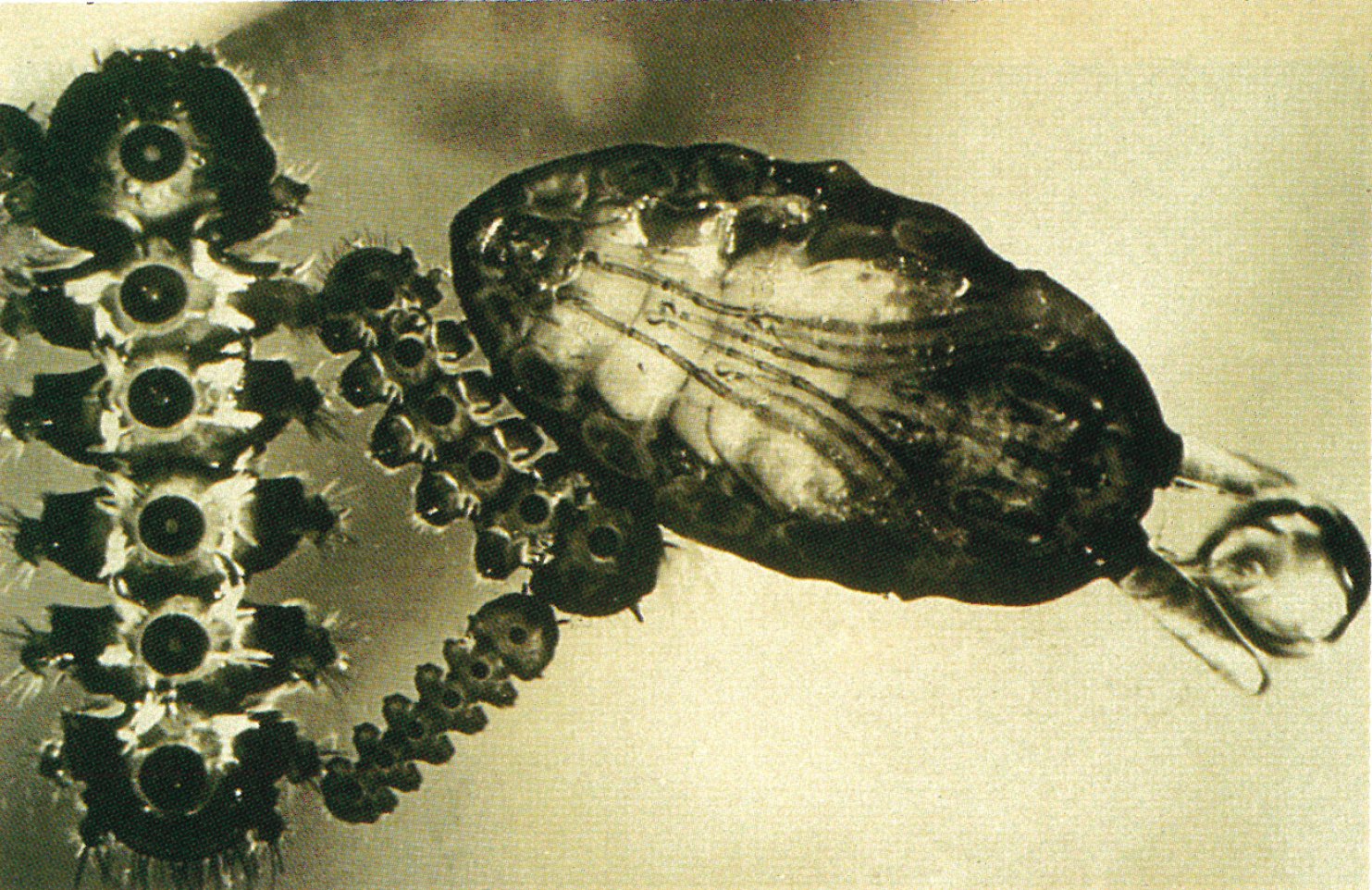
Figure 2.

Pupa of a midge with a bubble between its gills, together with several larvae of the same species—Neocurupira chiltoni (in the blepharocerid family). The bubble acts as a permanent lung, with air diffusing into it from the flowing water.
(Photo courtesy of Douglas Craig, University of Alberta.)

For small bubbles, Cp will be about 0.2, so the critical depth can be expressed as a Froude number v2/gh of about 10, with h now indicating depth. That’s a severe constraint: For a brisk water speed of a meter per second, the lung will persist only down to a depth of a centimeter. To go down a full meter would require a 10 m/s flow, a speed encountered only in waterfalls and large, breaking waves. At least a few organisms do use the device—a West African beetle that dives into shallow, rapid streams and grazes on the algae on their rocky floors, and the pupae of some midges (figure 2 ) attached to rocks in torrential streams. 8 , 9 But we’re no longer surprised by the rarity of the scheme.
An application of the Froude number both more general and closer to home was pointed out by R. McNeill Alexander of Leeds University. 10 He noted that in a walking gait, an animal uses gravitational energy storage in pendulum fashion to reduce the work of repeatedly accelerating inertial legs. Animals of all sizes should walk in a dynamically similar manner at a given Froude number, when length in the formula is redefined as the hip-to-ground distance. To keep storing energy as they walk faster, animals increase amplitude, or stride length, rather than frequency. Dynamic similarity implies that all will reach the practical amplitude maximum at about the same Froude number, which turns out to be between 0.5 and 0.6. At that point, animals ranging from small insects to large mammals shift to a trot or some other gait that uses elastic energy storage (mainly in tendons) instead of gravitational storage. The transition point, of course, is size dependent. You can walk comfortably while the youngster holding your hand prefers to jog. For a typical adult, the gait transition happens at about the expected 5 mph—try it. Recently, Rodger Kram and his coworkers at the University of California, Berkeley found that the transition happens at the same Froude number even when the value of gravitational acceleration is altered. 11
Alexander noted as well that the trot-to-gallop transition for quadrupeds occurs at Froude numbers between 2 and 4, still a fairly specific transition point considering the size range involved. This is puzzling, because neither gait involves gravitational energy storage. The explanation may turn not on the upper speed limit of trotting but on the lower limit of galloping—an animal is in free fall for a time within each stride, and it ought to tolerate a fall of a fixed fraction of leg length. So gravity can reasonably reenter the picture. If the period of falling is a fixed fraction of stride duration and if running speed at transition varies with leg length times stride frequency (which is supported by observations), 12 then the Froude number ought to set that transition point.
Walking on water, getting sap up the tree
For us, water’s high surface tension is a mild nuisance ordinarily mitigated by a dose of detergent. For other organisms, typically smaller than we, it can be a major player in their physical world. Quite a few creatures can walk on water, pressing legs into the interface and using the upward component of surface tension for support. But they are mainly insects and spiders that span a narrow size range of about a millimeter to a centimeter or two in length. A pair of dimensionless numbers sheds some light on the bounds of their window of opportunity.
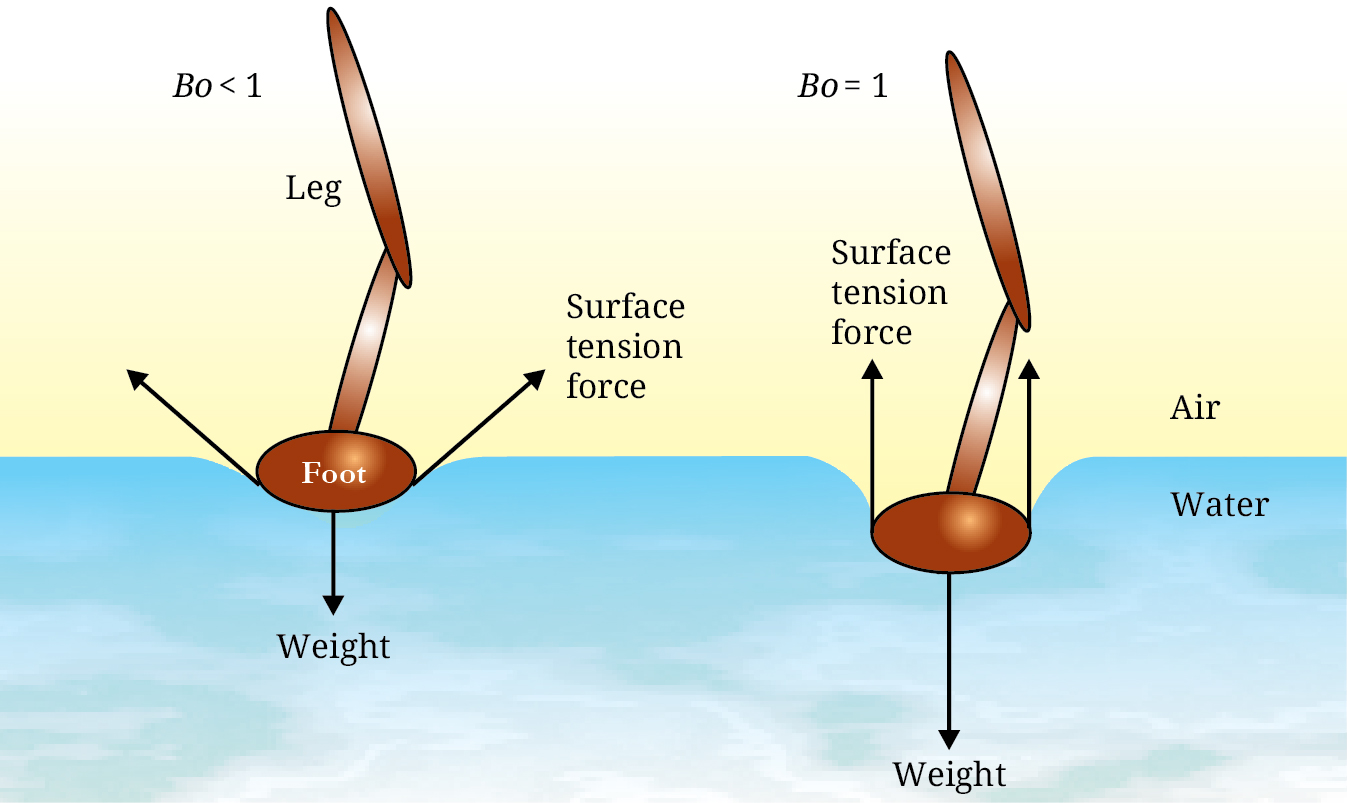
Figure 3.

Walking on water. The schematic diagram shows legs pressing on the air–water interface where surface tension is more than adequate for support (Bond number Bo < 1), and where the weight of the animal just reaches the force that can be sustained by surface tension (Bo = 1).

The upper size limit ought to involve, as competing factors, the upward force of surface tension and the downward force of gravity. If the animal isn’t to fall through, the ratio of gravitational force to surface tension force, the Bond number, should be less than one:
where γ is the surface tension and l is the wetted perimeter, which is the length of the air-water-leg interface (figure 3 ). Assuming unpolluted water, a human wearing my size 9C sandals could weigh no more than 10 grams to stand or 5 grams (one leg supporting) to walk. But an insect weighing a tenth of a gram needn’t be bizarrely shaped—1.3 mm will do for a perimeter, which a water strider, for instance, can divide among four contacting legs. A fringe of hydrophobic foot hairs gives it lots of leeway. For that matter, some creatures can jump vertically from the surface, which demands support by an upward force an order of magnitude greater. Ignoring shape and substituting density times length cubed for mass shows that the Bond number varies with length squared. So larger is very much worse. 13
What about the lower size limit? Here the problem isn’t support but locomotion. The water’s surface tension will pull against an animal whichever way it tries to move. Can it get enough inertial force to offset the force of surface tension? Put another way, it needs a sufficiently high value of the ratio of those forces, given by the Weber number,
not to find the surface a fatal trap. So the animal has to be sufficiently large and fast; because size and speed are ordinarily correlated, that makes real trouble for really tiny creatures. As D’Arcy Thompson, the greatest prose artist among biologists, put it, “A water beetle finds the surface of a pool a matter of life and death, a perilous entanglement or an indispensable support.” 14
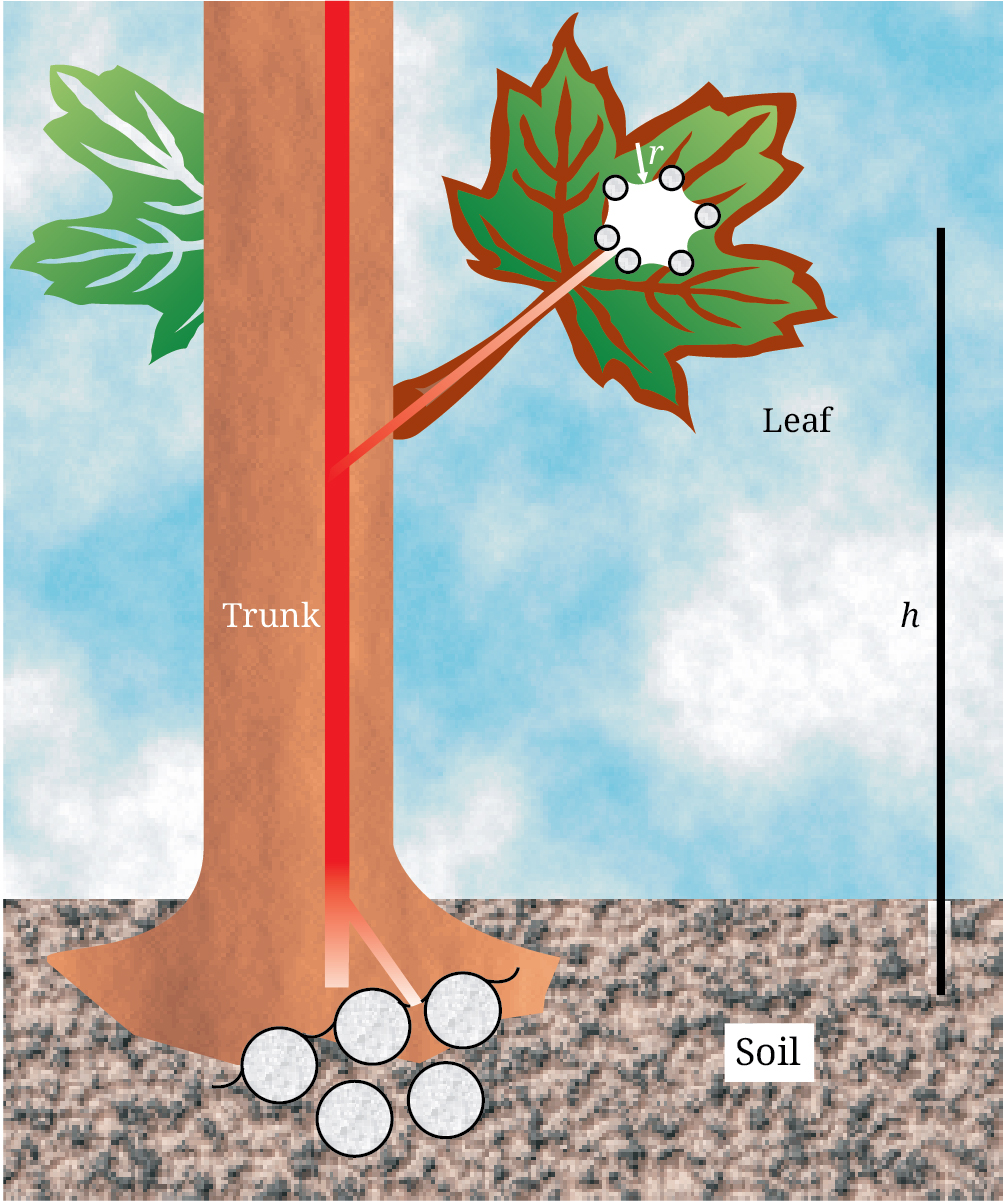
Figure 4.

Continuous columns of liquid sap, nearly pure water, run up a tree and connect the water between soil particles with the wet walls of the cells within the leaves that contact the air. Supporting the columns of height h, as well as offsetting the pressure losses due to flow and capillary forces within the soil, requires that the radius of curvature r of the final air–water interfaces be very small.

The interplay of gravity and surface tension may be still more important in quite a different biological context. The columns of liquid sap within even the tallest tree extend, uninterrupted by gas, from roots to leaves. Could capillary rise account for the ascent of sap? Assuming perfect wetting of the walls of the conduits, the upward pressure will be twice the surface tension divided by conduit radius, so we can write that Bond number as
For the Bond number not to exceed one with a typical conduit radius of a twentieth of a millimeter, the rise h must remain below about 3 m. That wouldn’t be much of a tree; capillary rise simply won’t do the job.
In the generally accepted picture, columns of sap are maintained by the considerable internal cohesion of water, in essence hanging from the tops of trees and drawn up by evaporative water loss from the leaves, as in figure 4 . 15 Putting aside the matter of cohesion, we can ask how the columns can remain open to the air at the top. Put another way, we can ask why, since water vapor quite clearly leaves the leaves, air doesn’t enter. Here the relevant interfacial radius is much smaller, about a ten-thousandth of a millimeter for the pores in the walls of cells within the leaves. With this radius, the Bond number won’t rise above one and air won’t be pulled in by gravity until a tree exceeds 1500 meters in height—over an order of magnitude higher than any tree ever known. So trees are not limited in height on this account, and they have lots of margin for pressure losses from flow in the conduits and from extracting water from soil.
Two matters of circulation
Perhaps nowhere does physics so strongly constrain the arrangements of organisms as in their systems for moving fluids through themselves. Surface tension may play a much smaller role in animals than we noted in plants, but gravity matters as much to a large, terrestrial animal as to a tree. And sucking with subambient pressures is a game played largely by plants, with their noncollapsible piping; siphoning has been persuasively excluded even for giraffes and thus most likely for dinosaurs. So, lacking much in the way of auxiliary pumps, we need hearts that can pump blood up to our heads with enough pressure left to drive blood through arterioles and capillaries. (See the article by George J. Hademenos on the physics of cerebral aneurysms, Physics Today, February 1995, page 24 .)
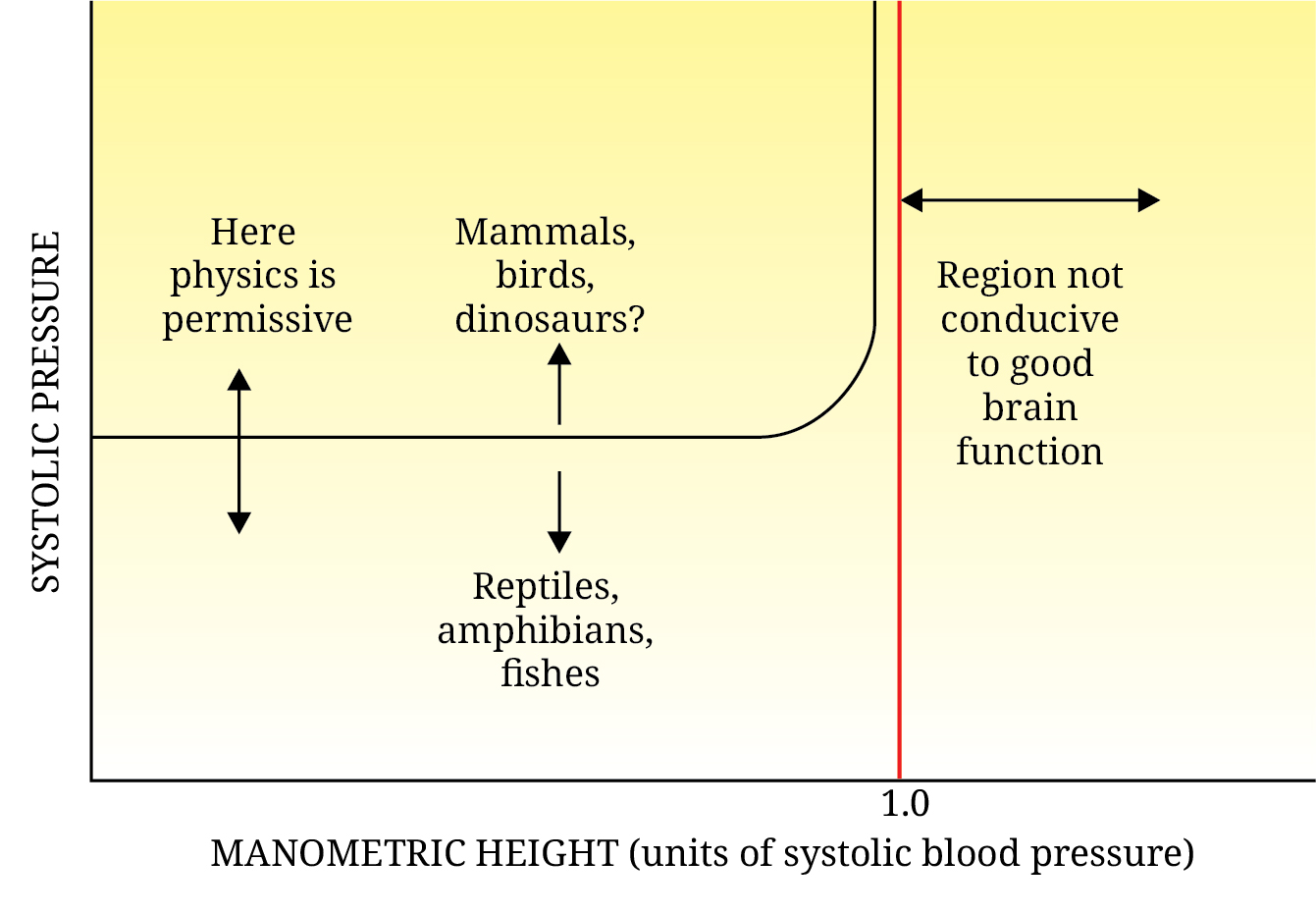
Trouble ensues if an animal has a height, expressed in units of blood pressure, that exceeds its systolic blood pressure, the peak output of the left ventricle. That’s a rough-and-ready criterion: On the one hand, one’s heart isn’t in one’s feet, and so body height over-states the hill to be climbed, while on the other hand, systolic pressure overstates the pressure drop avail-able to supply the brain. Still, we can define what we could call “circulatory hazard” as the ratio of manometric height (blood density times gravity times height) to systolic pressure, and assert that it ought to stay below one.
What happens in mammals proves intriguing. Most mammals have about the same resting systolic pressure as we humans—120 mm of mercury, corresponding to a manometric height of about 1.7 m or between 5 and 6 feet. That works for cat, dog or human, but species much taller than we increasingly depart from the typical mammalian pressure. Horses run about 180 mm Hg at rest, and giraffes get as high as 300. 16 So humans are near the inflection point where a plot of manometric height against blood pressure, as in figure 5 , begins to slope upward—as necessary to keep the circulatory hazard below one. If I stand up suddenly after sleeping horizontally, I get a bit dizzy, which I’m told indicates that I’m not hypertensive. Our cat should have no such problem.
Figure 5.

Systolic blood pressure as a function of animal height. The pressure shows little regular variation among small- and medium-sized mammals. But it must (and does) rise in large mammals so that it remains at least as great as manometric height (the product of blood density, gravitational field strength and the animal’s height).

For aquatic animals, living in a medium near blood density, height and posture are of little concern, so whales have normal mammalian pressure and sea snakes have the normal reptilian pressure of around 40 mm Hg. A terrestrial snake is okay on the ground, but how can it climb a tree without passing out?
Tree-climbing snakes keep their circulatory hazard under control by a heroic adjustment—their hearts are located considerably nearer their front ends. One wonders about long-necked dinosaurs; they must have had the fully separate systemic and pulmonary circulations of present birds (and humans), together with the high pressures of giraffes. 17 Physics, again, doesn’t bend for evolution.
Physiology textbooks often begin their section on circulatory systems by talking about Bernoulli’s principle. Only a few ever mention Bernoulli again—probably a good thing, as we’ll see. Consider what should happen if a fluid pulses through a pipe with a flexible wall. Bernoulli’s principle implies lower pressures with faster flow, so the pipe ought to constrict as the flow speeds up. Another rule, the Hagen–Poiseuille equation, predicts the opposite. It describes the pressure necessary to force a laminar flow through a pipe whose walls exert some resistance, and it makes clear that faster flow requires higher pressure. Is a given flow Bernoulli dominated or Hagen–Poiseuille dominated? We need do no more than look at their ratio (using dynamic pressure ρv2/2 for the former),
where μ and ρ are the dynamic viscosity and density of blood, respectively.
For a pipe 100 mm long and 1 mm in diameter carrying blood at 100 mm/s, the ratio has a value of about 0.01, indicating that Hagen–Poiseuille is in charge and Bernoulli has little to say. 7 Because circulatory systems have their pipes serially arrayed, the effective lengths are in practice even longer. In circulatory systems, Bernoulli’s principle finds use only around heart valves, at pathological stenoses and in a few other places. That one’s pulse is felt as an arterial expansion rather than constriction ought to make the point. Bernoulli does better in turbulent flow or where (as in carburetors) the ratio of pipe radius to length is high. Maybe the terminal ends of the urethras of large animals are braced, like vacuum-cleaner hoses, against collapse.
Incidentally, the relationship in the equation above turns out to be a version of the Reynolds number, the ratio of inertial to viscous forces and the most famous of all dimensionless numbers in fluid mechanics.
Jets, propellers and wings
Efficiencies are dimensionless indices that establish limits, usually by setting an ideal of 100%. Perhaps of more biological interest are places where low values preclude the use of certain devices. Thus the maximum thermal efficiency of an engine with a heat source at 40 °C and a sink at 0 °C—a range that a wet, proteinaceous organism may achieve—is less than 13%. That nature lacks heat engines should thus be no surprise.
Consider a device, such as a propeller, that provides thrust by speeding up a fluid flowing through it from v1, the craft’s speed, to v2, some output speed. The device’s thrust is the product of the mass it processes per unit time and the increase in speed (v2 – v1) it imparts. Its power output is that thrust times the craft’s speed. Its power input is kinetic energy per unit time, or half that mass per unit time multiplied by the difference in the squares of the speed of its output and the craft’s speed v22 – v12. So efficiency, usually called the Froude propulsion efficiency, is simply 7
Now v2 has to be at least a bit above v1 if any thrust is to be generated, and so 100% efficiency can’t be reached. But making v2 approach v1 means processing the largest possible volume of fluid and giving it the least increase in speed. That’s a bad indictment of jets relative to paddles or propellers—a jet ordinarily gives a smaller mass flux a higher incremental speed. In this light, it’s understandable that neither Hero’s jet engine of the first century nor James Rumsey’s pulse-jet steamboat of 1787 led anywhere. 17
But nature makes quite a few jet engines—in jellyfish, salps, frogfish, dragonfly nymphs, squid, scallops and others. They’re probably easy to achieve given that organisms often push water through themselves to filter food or gain oxygen, often make one-way valves, and often wrap muscle around soft tubes. Aside from squid, though, nature’s large, fast swimmers—fish, penguins, seals, whales and such—all use some form of propeller, like our propellers except for being oscillatory rather than rotational. Jets lose when competition between fins or flukes and jets turns on Froude propulsion efficiency. Squid can go fast—8 m/s is impressive for foot-long swimmers. But they do so only briefly, to escape predators or lunge at prey, when efficiency must matter little, and they use their fins for steady traveling. 7
We have a similarly equivocal attitude toward jets. No commercially produced cars or motorcycles and only a few boats use jet engines. We usually reserve them for high-speed applications since, when push comes to shove, the jet’s output speed has to be high enough to exceed the craft’s speed. An exception, the Harrier jet, a small military aircraft that can take off vertically and hover, consumes fuel at a notoriously high rate. One can imagine a birdlike creature that uses its chest muscles and a pair of one-way valves to run a pulse-jet engine that provides thrust and respiratory gas exchange at the same time. Birds, in fact, do pump air through their lungs unidirectionally. But even the fastest known avian flyer, a falcon diving at a little over 60 m/s, or 130 mph, is surely too slow to make good use of the scheme. 18
Froude propulsion efficiency exposes yet another limit, although this one matters mostly for human technology. Our earliest successful aircraft (ignoring lighter-than-air fliers) and most of our present ones get lift from fixed wings and forward propulsion from propellers or jets. That combination is almost unknown among birds, bats and insects, which get both lift and propulsion from pointing a single thruster in the appropriate direction. The helicopter, our analog of nature’s fliers, wins no prizes for either fuel economy or range. Are nature’s fliers as bad?
The utility of fixed wings turns out to depend on size. The lift of a wing varies with its area, while the weight of craft to be lifted varies with its volume. Larger thus means relatively lift-deprived unless wings are disproportionately large—or unless the flying machine goes faster. A faster v1 demands a greater v2 to generate forward thrust. Lift, of course, comes from downward thrust, and that’s the crux of the problem. The vertical speed of an airplane is trivial, so the downward component of v1 is negligible. If the propeller or jet is simply reaimed to get some downward momentum flux, then v2down – v1down will be great and the efficiency low. A fixed wing acts as a transformer, converting some of the high-speed, low-volume rearward flow from propeller or jet into a low-speed, high-volume downward flow behind the wing, and thereby creating lift efficiently.
Nature’s fliers go much more slowly—a bird that flies horizontally at 30 m/s is remarkable, while an airplane that flies that slowly is equally special. So flying animals can achieve adequately high propulsion efficiencies without resorting to separate fixed wings and propellers. Or mostly so, since the inner portions of the wings of large birds operate nearly as fixed, horizontal airfoils. The relatively large wings of nature’s small fliers permit low speeds. Thus, very small birds can hover steadily, medium-sized ones can hover only momentarily and large birds can’t hover at all. The advent of hovering aircraft awaited engines of very high power-to-weight ratios, and the very slow human-powered aircraft have gigantic wings.
Dimensionless numbers find use in many other biological or at least biomechanical situations. Some are well-established in the physical sciences, where they get used in much the same fashion; others have their variables redefined for biological purposes; still others have been especially contrived. Some set specific boundaries for the possible; others provide scaling rules that show how the desirable slopes off toward the impractical. Some answer specific questions; others just head us in some useful direction. Most, though, involve more complicated stories than those just related, which merely give the flavor of the game.
References
1. J. D. Isaacs, A. C. Vine, H. Bradner, G. E. Bachus, Science 151, 682 (1966) .
2. R. C. Pankhurst, Dimensional Analysis and Scale Factors, Chapman and Hall, London (1964).
3. N. S. Land, A Compilation of Dimensionless Numbers, NASA, Washington, DC (1972).
4. H. D. Prange, K. Schmidt-Nielsen, J. Exp. Biol. 53, 763 (1970) .
5. T. M. Williams, J. Exp. Biol. 103, 155 (1983) .
6. K. Schmidt-Nielsen, in Scale Effects in Animal Locomotion, T. J. Pedley, ed., London, Academic Press (1977), p. 3.
7. S. Vogel, Life in Moving Fluids, 2d ed., Princeton U. P., Princeton, N.J. (1994).
8. G. O. Stride, Ann. Entomol. Soc. Am. 48, 344 (1955).
9. G. D. W. Pommen, D. A. Craig, Can. J. Zool. 73, 373 (1995) .
10. R. M. Alexander, Am. Sci. 72, 348 (1984).
11. R. Kram, A. Domingo, D. P. Ferris, J. Exp. Biol. 200, 821 (1997) .
12. N. C. Heglund, C. R. Taylor, J. Exp. Biol. 138, 301 (1988) .
13. S. Vogel, Life’s Devices: The Physical World of Animals and Plants, Princeton U. P., Princeton, N.J. (1988).
14. D. A. Thompson, On Growth and Form, 2d ed., Cambridge U. P., Cambridge, England (1942), p. 77.
15. M. H. Zimmermann, Xylem Structure and the Ascent of Sap, Springer-Verlag, Berlin (1983).
16. S. Vogel, Vital Circuits: On Pumps, Pipes, and the Workings of Circulatory Systems, Oxford U. P., New York (1992).
17. S. Vogel, Cats’ Paws and Catapults: Mechanical Worlds of Nature and People, W. W. Norton, New York (1998).
18. V. A. Tucker, T. J. Cade, A. E. Tucker, J. Exp. Biol. 201, 2061 (1998) .
More about the authors
Steven Vogel (1940–2015) was a James B. Duke Professor in the zoology department at Duke University in Durham, North Carolina.