Making magnetized plasmas in the lab

A hot, dense plasma illuminates a laboratory in this long-exposure photograph.
(Photo courtesy of Thomas Varnish.)

If matter is continually heated, its constituent neutral atoms will eventually break apart into a soup of charged particles known as plasma. Plasmas exist over a vast range of densities, from less than a single particle per cubic centimeter in the void between stars to a million times as dense as liquid water in the core of a white dwarf star.
An extremely dense plasma also has an extreme high energy density (HED), which causes the plasma to expand. The expansion is opposed by gravity in astrophysical objects such as stars. But in the lab, an HED plasma can exist only briefly and must be confined by strong magnetic fields or inertia.
Pressure is used to measure the energy density of a plasma. Earth’s atmosphere exerts a pressure of 1 bar (105 N/m2), and the pressure at Earth’s center is 3 million times as large. HED plasmas are usually defined as having a pressure of at least 1 million bars, although in reality, HED-relevant effects can occur under less extreme conditions.
Even at such high pressures, the charged particles in a plasma are significantly influenced by magnetic fields. Studying the rich interplay between magnetic fields and the dynamics of HED plasmas in the lab offers a window into some of the most energetic astrophysical processes in the universe. Such studies are also relevant for carbon-free power from self-sustaining nuclear fusion reactors. Using the approach of inertial confinement fusion at Lawrence Livermore’s National Ignition Facility (NIF), researchers demonstrated in 2022 for the first time that a laser-driven controlled fusion reaction could produce more energy than the energy put into it. Some plasma physicists aim to improve on that result with the help of magnetized HED plasmas.
Magnetic fields and plasmas
The charged particles of a plasma respond to electric and magnetic fields through the Lorentz force. In response to electric fields, the particles rapidly rearrange until their charges cancel out the electric fields. That phenomenon, known as Debye shielding, is similar to how the nuclear charge in an atom is reduced by the electrons that are closest to the nucleus.
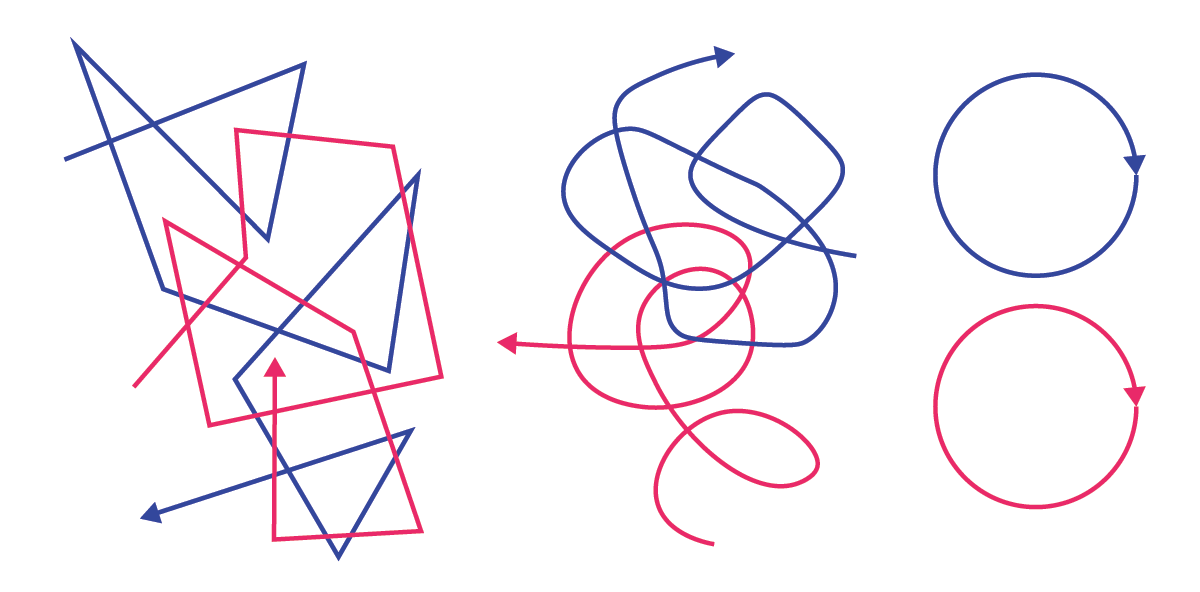
In contrast, magnetic fields in plasmas are not shielded. Instead, particles follow tight orbits along magnetic field lines, as seen in the rightmost image in figure 1 . The orbital motion has significant consequences: It ties the magnetic field to the plasma through the frozen-in flux, affects the plasma’s magnetic pressure, and suppresses thermal conduction perpendicular to the magnetic field.
Figure 1.

The orbits and collisions of particles in plasma. On the left, the magnetic field is minimal, so two particles follow a random-walk pattern, represented by the blue and pink lines. In the middle, the magnetic field is strong enough to deflect the particle trajectories between collisions. On the right, the particles tightly orbit the magnetic field lines and rarely collide, and the magnetic field is so strong that it suppresses the transport of heat and particles.

The frozen-in flux law states that the magnetic flux through part of a plasma is conserved, and the magnetic field lines are effectively pinned to the plasma. In other words, any time a force moves the plasma, the magnetic field moves too. The magnetic field exerts an opposing force because of gradients in the magnetic pressure , where is the magnetic field strength and is the permeability of free space.
In addition to magnetic pressure, plasmas also have thermal pressure. It’s the same pressure in the context of regular liquids and gases, although in HED plasmas the thermal pressure often has a more complex functional form. The dimensionless plasma beta is the ratio of the thermal pressure to the magnetic pressure.
The magnetic field, in addition to the magnetic pressure, restricts heat transport in a plasma. That’s critically important for nuclear fusion in stars and in a reactor because the fuel must stay hot to undergo fusion. In the absence of a magnetic field, the plasma’s charged particles are free to move in any direction. When they collide, they transfer kinetic energy and therefore heat.
But in the presence of a strong magnetic field, the particles tightly orbit the field lines and cannot move far in the direction perpendicular to the magnetic field. The limitation in movement leads to anisotropic thermal conduction—heat can still be transported rapidly along the magnetic field lines, but conduction is significantly suppressed in the perpendicular direction. Magnetic fields, therefore, can insulate hot plasmas and maintain them at the conditions necessary for nuclear fusion.
For an HED plasma, the magnetic field has a significant effect only when it is strong. Creating magnetized HED plasmas in the laboratory, therefore, requires not only a method to provide them with high-energy densities but also a method to generate strong magnetic fields. Although that’s difficult, researchers are taking on the challenge using intense pulses of either laser light or electric current. Both approaches to producing magnetized HED plasmas in the lab are being used to better understand how to harness nuclear fusion for power and to create scaled replicas of extreme astrophysical objects.
Magneto-inertial fusion
Research on controlled nuclear fusion aims to bring the energy source of the stars to Earth for carbon-free electricity, and magnetized HED plasmas are critical to that effort. Many controlled thermonuclear fusion schemes use magnetic fields to confine plasmas and to suppress the transport of heat through them. In magnetic confinement devices—including the ITER tokamak in development in France, the Experimental Advanced Superconducting Tokamak in China, and the Wendelstein 7-X stellarator in Germany—the plasma’s magnetic pressure is much larger than its thermal pressure. The low-beta regime keeps the plasma stable, but the magnetic pressure has to be generated by running current through strong magnets. Such a large up-front energy cost can be justified only if the plasma produces fusion power in a steady state.
An alternative to a steady-state approach is a pulsed approach, in which the plasma is rapidly brought to fusion conditions and then explosively disassembles as the fusion reaction ignites the fuel. To generate steady power, the pulsed process must repeat on a cycle, analogous to an internal combustion engine, in which one pulse after another translates to a steady power output. The advantage of the pulsed approach is that many plasma instabilities do not have time to fully develop. But the disadvantage is that the plasma generates fusion power for only a short time, often no longer than a nanosecond.
To avoid the need to recoup the initial magnetic energy cost, designers of pulsed approaches often minimize the plasma’s magnetic energy by having the systems operate at a high beta; that is, with a relatively low magnetic pressure. Although a low magnetic pressure alone cannot confine the fuel, research demonstrations have shown that it is strong enough to suppress heat transport, keep the plasma fuel hot, and significantly boost the fusion energy produced.
One of the most well-known pulsed approaches is the laser-driven scheme of inertial confinement fusion at NIF. In those experiments, lasers heat the surface of a spherical capsule, which causes material to ablate outward, and the remaining part of the capsule is launched inward like a spherical rocket. The center of the capsule is filled with low-density gas, which reaches fusion conditions at peak compression and then initiates a thermonuclear burn wave that travels out through the solid, dense fuel surrounding it. (For more on the NIF results, see the 2024 PT feature article “Harnessing energy from laser fusion ,” by Stefano Atzeni and Debra Callahan.)
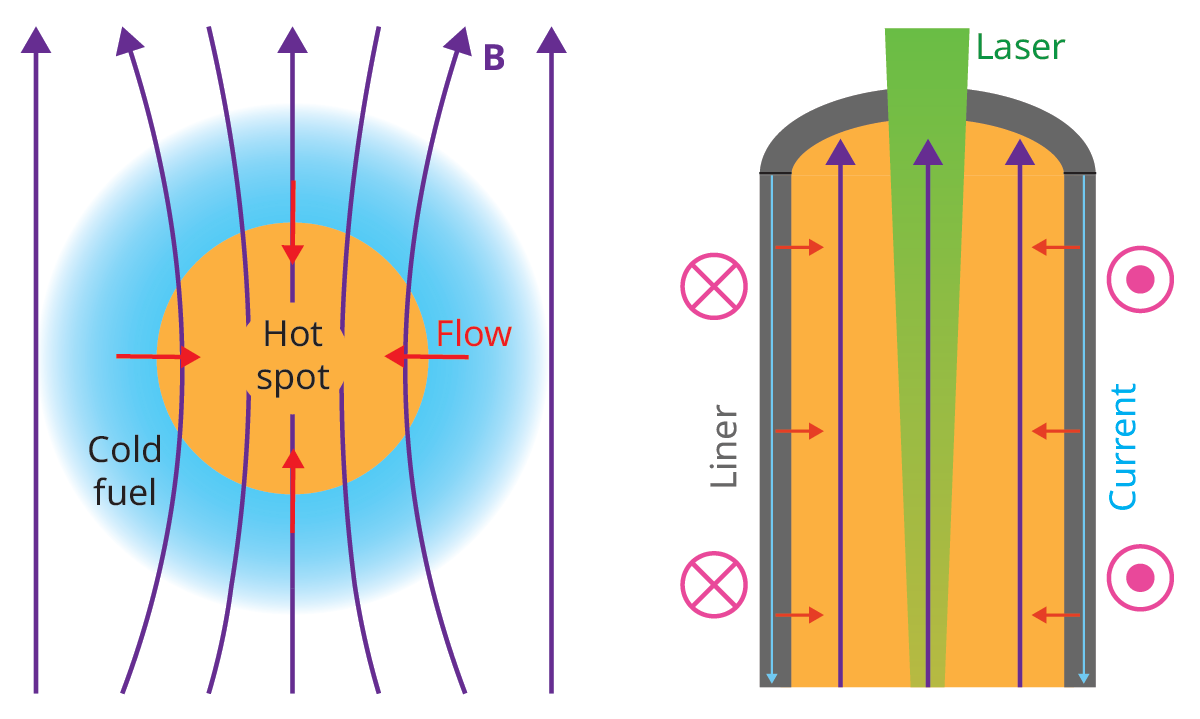
Because of the steep temperature gradient between the hot spot and the cold fuel, the fusion yield is reduced by the significant amount of heat that’s transported away from the hot spot. Recent lab experiments have added an externally driven magnetic field, as shown on the left in figure 2 . The field suppresses heat transport perpendicular to the field lines, although some heat still escapes at the poles of the cylindrical hohlraum that holds the fuel capsule. 1 Simulations predict increased yields from magnetized inertial confinement fusion.
Figure 2.

Two fusion energy schemes use magnetized high-energy-density plasmas. On the left, in magnetized laser-driven inertial confinement fusion, an externally applied magnetic field (purple) is compressed and amplified during the implosion of a laser-heated, spherical fuel capsule. The field suppresses thermal conduction from the central hot spot to the surrounding cold fuel, which improves the fusion gain. On the right, in magnetized liner inertial fusion, a hollow metal cylinder, or liner (gray), is initially filled with highly pressurized gaseous fuel (orange) and preheated with a laser (green). An externally applied magnetic field (purple) parallel to the cylinder’s axis insulates the hot fuel from the cold metal liner. At the same time, a large electric current (light blue) is driven through the outside of the liner. The strong magnetic field (magenta) that’s generated in response causes the liner to implode and compress the fuel inside to fusion conditions.

The increased yields are a consequence of the frozen-in flux law, which conserves the magnetic flux. As the capsule implodes, the area through which the magnetic flux moves decreases, and the magnetic field strength amplifies. The thermal insulation of the plasma, therefore, increases as it compresses, and the associated magnetic fields may reach many thousands of teslas. (For comparison, the magnet in a typical MRI machine has a field strength of 1.5–3 T.)
Instead of using lasers to compress the fusion fuel, researchers can use large electric currents in a technique called magnetized liner inertial fusion (MagLIF), shown on the right in figure 2 . First proposed by researchers at Sandia National Laboratories, it uses a hollow metal cylinder, or liner, initially filled with gaseous fuel at high pressure. 2 An external magnetic field is applied parallel to the cylinder’s axis, and a laser preheats the fuel to the plasma state. The external field suppresses thermal conduction between the plasma fuel and the cold liner, and a large electric current is driven through the outside of the metal liner, which causes it to implode and compress the fuel inside to fusion conditions. The implosion amplifies the externally applied field because of the frozen-in flux condition and increases the thermal insulation.
Because the current flows on the outside of the metal liner rather than through the plasma inside, many current-driven plasma instabilities are avoided, and the external magnetic field is necessary to insulate the hot fuel from the cold metal liner. MagLIF experiments at Sandia have produced encouraging fusion yields. 3
Scaled laboratory analogues
The propagation of a thermonuclear burn wave in a magnetized plasma is relevant for not just fusion power but also for plasma jets, supernovae, and other astrophysical phenomena. Many jets are launched from young, compact stars and accretion disks around black holes. The jets of plasma are stunning structures but are challenging to observe, in part because of how far away they are, and their exact mechanism remains unclear.
One approach to studying them and other HED plasmas is to create analogues in the laboratory. 4 The dimensionless scaling approach enables experiments to mimic astrophysical objects on much shorter length and time scales. 5 In practice, matching all the dimensionless parameters and the initial boundary conditions is impossible. But researchers have used laser- and pulser-driven approaches to generate scaled HED plasmas in the lab to better understand the mechanisms by which jets are launched and stabilized.
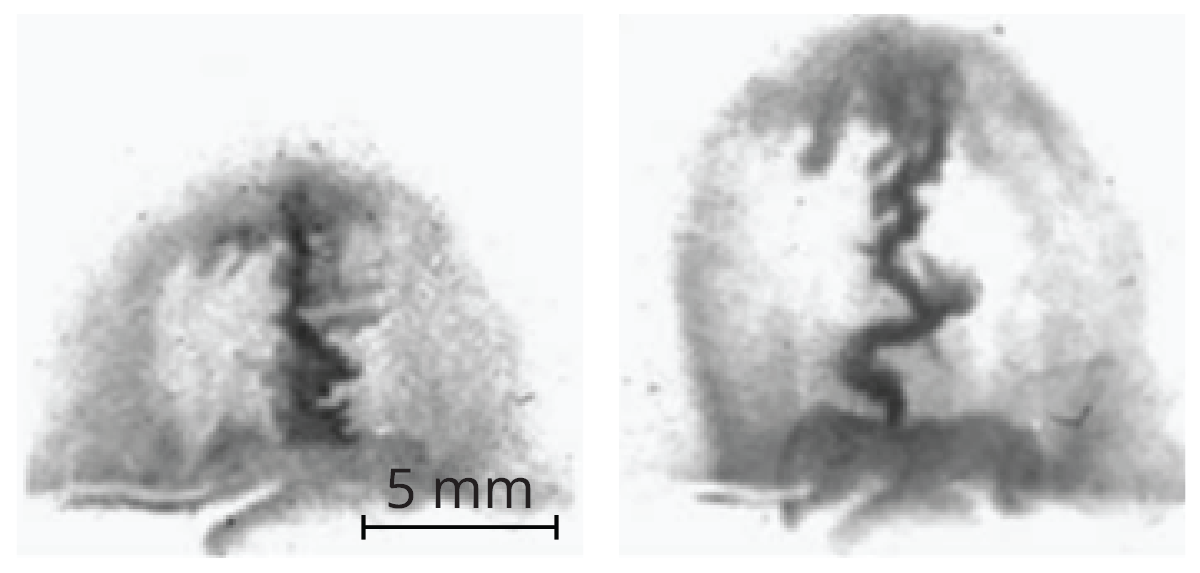
Figure 3 shows the results of one experiment. 6 The researchers drove an intense pulse of electric current, which peaked at 1 million A and lasted for around 500 ns, through an array of thin wires. The current rapidly heated the wires and created a plasma that surrounded each one. The current flowing through the plasma generated a large magnetic field on the order of tens to hundreds of teslas. The magnetic pressure accelerated the plasma and swept it up to form a dense jet of plasma. The two images in figure 3 reproduce critical features of one prevailing model that explains the launching mechanism of astrophysical jets.
Figure 3.

The x-ray emission shown in both images is from an astrophysical jet of plasma that was created in the lab. The jet is surrounded by a magnetic bubble, whose magnetic pressure causes the jet to form on the axis and propagate vertically. The intense pulse of electric current that forms the plasma also creates instabilities, which a mere 10 ns later cause the jet to kink and deform as it propagates.
(Images adapted from ref. 6 .)

That experiment also offers insight into astrophysical observations of jets and plasmas. A jet made in the lab carries a significant fraction of the driving current, which in turn produces a strong magnetic field that confines the jet. The current, however, leads to fast-growing instabilities that twist and deform the jet. The deformation leads to a clumpy structure with substantial density variations, which has been observed in astrophysical jets, such as Herbig–Haro 46/47 by the Hubble Space Telescope.
The Biermann battery
Although most of the visible universe is made from magnetized plasma, the origin of the magnetic fields is an open question. Most plasma processes only amplify existing fields, and so an initial seed field is still required. One possible explanation occurs in plasmas with nonparallel density and temperature gradients, which create an effective electric current that can grow a magnetic field from nothing. The Biermann battery effect occurs in many astrophysical phenomena, including supernova explosions, and may be the seed for the naturally occurring magnetic fields in the universe.
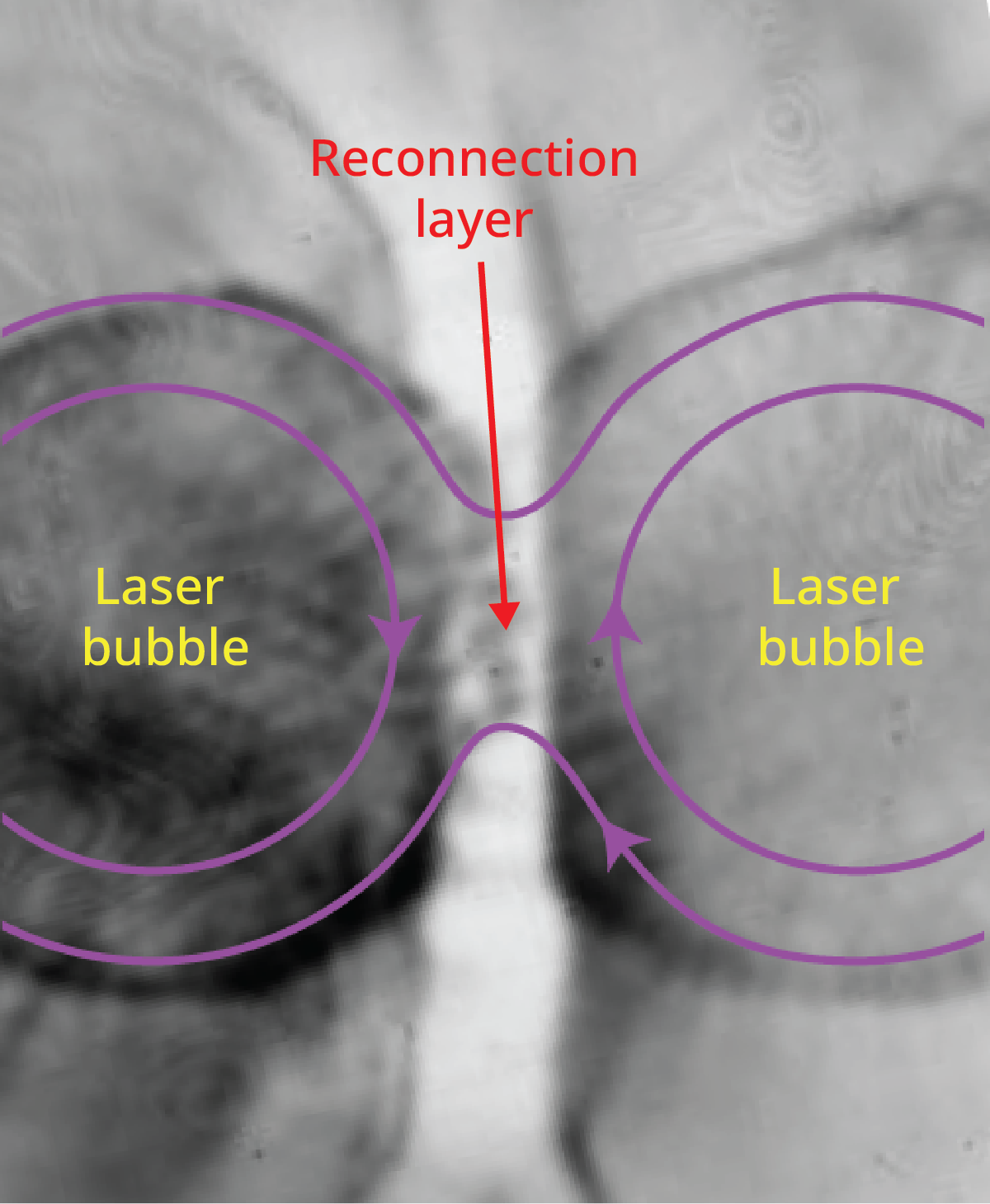
Laser-driven experiments in the lab can be used to study how efficiently, how rapidly, and over what length scales the Biermann battery creates magnetic fields and how strong the fields can grow. A focused laser rapidly heats a target to create a hot, dense, and expanding bubble of plasma. Inside the hemispherical bubble, the strong, nonparallel temperature and density gradients make an intense magnetic field that encircles the bubble. The magnetic field can then be measured using proton imaging, in which a high-energy beam of protons that passes through the plasma is deflected by the magnetic field.
Figure 4.

Hot, dense, and expanding bubbles of plasma (dark regions) can be made in the lab by a focused laser that rapidly heats a target. Because the plasma has nonparallel density and temperature gradients, the thermoelectric effect called the Biermann battery generates a magnetic field. Shown schematically in purple, the field is capable of deflecting a beam of high-energy protons, which researchers used to image a laser-driven magnetic reconnection event. The reconnection layer is a sheet of intense electric current, which rapidly heats and accelerates the plasma and changes the topology of the magnetic field.
(Image adapted from ref. 10 .)

Modeling a Biermann battery is difficult because the fine spatial and temporal resolutions that are necessary to simulate the steep gradients and complex physics are computationally prohibitive. Recent experiments have challenged results from simulations and show that magnetic fields can be generated much farther away from the plasma bubble than previously predicted. 7 The results are important not only because they help researchers understand self-generated magnetic fields in laser-driven experiments but also because of their implications for the generation of magnetic fields in the wider universe.
Magnetic reconnection in the lab
The use of lasers and pulsed electric currents to study new HED regimes has also been critical for the study of magnetic reconnection. That explosive process changes a magnetic field’s topology and rapidly converts magnetic energy to both accelerate and heat the plasma. Magnetic reconnection occurs when oppositely directed magnetic fields are brought together inside a plasma. The magnetic fields result in the creation of an intense sheet of electric current called a reconnection layer, which breaks and reforms the field lines. Magnetic reconnection is found in the dramatic eruptions of solar flares, around Earth’s magnetosphere (where it causes the aurora), and in some of the brightest, most extreme astrophysical objects, including the swirling plasma that surrounds black holes. (To learn more, see the June 2010 PT article “Magnetic field reconnection: A first-principles perspective ,” by Forrest Mozer and Philip Pritchett.)
Figure 5.

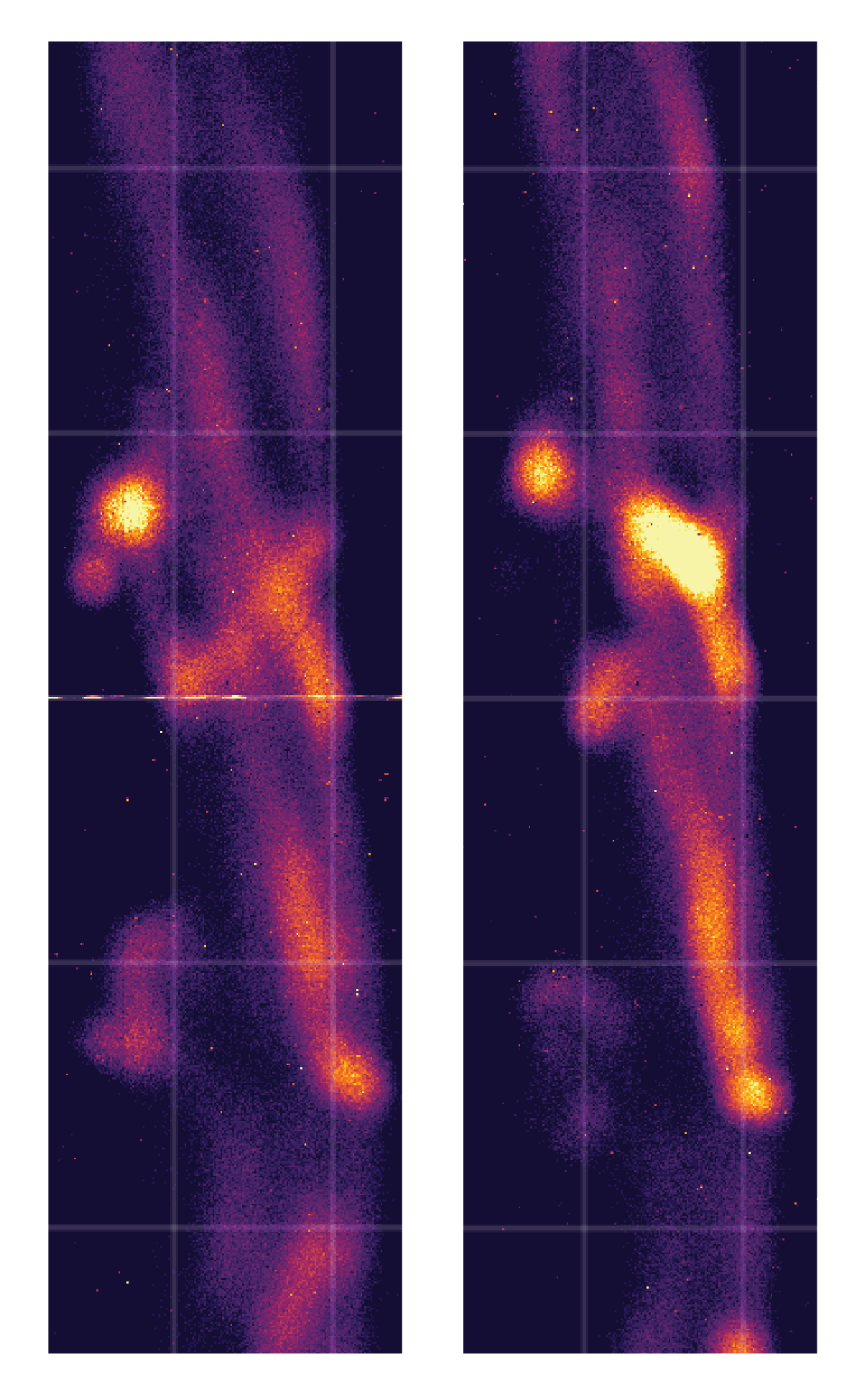
The localized, fast-moving hot spots of x-ray emission are shown as bright regions in the two images, each of which is 5 mm wide, and correspond to plasmoids. They’re instabilities that are created in a magnetic reconnection layer—an intense sheet of electric current. Magnetic reconnection layers develop in Earth’s magnetosphere, solar flares, and other astrophysical objects when oppositely directed magnetic fields are brought together inside a plasma. Then, the field lines break and reconnect.
(Images adapted from ref. 11 .)

Researchers have conducted numerous experiments over the years to understand which features of reconnection are ubiquitous and which ones depend on certain plasma parameters. Laser-driven experiments often use magnetic fields generated by the Biermann battery effect, and reconnection takes place between two adjacent expanding plasma bubbles. The magnetic energy density is typically smaller than the thermal energy density, so reconnection does not significantly heat the plasma.
Proton images, such as the one in figure 4 , clearly show the change in magnetic field geometry. Some work has shown evidence of small-scale magnetic perturbations that are caused by plasmoid instabilities, which tear the current sheet into many smaller ones and dramatically increase the rate at which reconnection occurs.
Magnetic reconnection has also been studied in plasma generated from heating thin wires with pulsed electric currents. The currents also produce magnetic fields embedded in the plasma. When two plasma flows from two exploding arrays of wires collide, the oppositely directed magnetic fields that the plasmas carry drive the formation of a reconnection layer. Inside, researchers have observed significant heating and the development of plasmoid instabilities, which are features of reconnection on fast time scales.
In some experiments with very dense plasmas, the plasmoids are characterized by localized hot spots of x-ray emission, and the hot spots—indicated by the bright spots in figure 5 —move rapidly in the reconnection layer while quickly cooling and dimming. Astrophysical objects in which reconnection occurs have similarly strong, variable emissions in space and time. Such laboratory experiments, therefore, suggest that the cause of reconnection may be the plasmoid instabilities coupled with strong cooling of the plasma by x-ray emission.
Magnetic fields profoundly affect HED plasmas in many ways, including suppressing heat transport and providing huge pressures. By studying the plasmas in the lab, researchers can enhance existing nuclear fusion concepts or drive entirely new ones. Laboratory plasma research has reproduced some of the fundamental processes of astrophysical plasmas, including the launch of jets from young stars and the generation and reconfiguration of magnetic fields. 8 9 The difficulty of producing HED plasmas, combined with the richness of the physics involved, means that magnetized HED physics remains an exciting frontier for research.
References
1. P. Y. Chang et al., “Fusion yield enhancement in magnetized laser-driven implosions ,” Phys. Rev. Lett. 107, 035006 (2011).
2. S. A. Slutz et al., “Pulsed-power-driven cylindrical liner implosions of laser preheated fuel magnetized with an axial field ,” Phys. Plasmas 17, 056303 (2010).
3. M. R. Gomez et al., “Magnetized liner inertial fusion platform development to assess performance scaling with drive parameters ,” Phys. Plasmas 32, 032702 (2025).
4. E. G. Blackman, S. V. Lebedev, “Persistent mysteries of jet engines, formation, propagation, and particle acceleration: Have they been addressed experimentally? ,” New Astron. Rev. 95, 101661 (2022).
5. D. D. Ryutov et al., “Magnetohydrodynamic scaling: From astrophysics to the laboratory ,” Phys. Plasmas 8, 1804 (2001).
6. A. Ciardi et al., “The evolution of magnetic tower jets in the laboratory ,” Phys. Plasmas 14, 056501 (2007).
7. J. Griff-McMahon et al., “Measurements of extended magnetic fields in laser–solid interaction ,” Phys. Rev. Res. 6, 033312 (2024).
8. D. B. Schaeffer et al., “Proton imaging of high-energy-density laboratory plasmas ,” Rev. Mod. Phys. 95, 045007 (2023).
9. S. V. Lebedev, A. Frank, D. D. Ryutov, “Exploring astrophysics-relevant magnetohydrodynamics with pulsed-power laboratory facilities ,” Rev. Mod. Phys. 91, 025002 (2019).
10. M. J. Rosenberg et al., “Slowing of magnetic reconnection concurrent with weakening plasma inflows and increasing collisionality in strongly driven laser–plasma experiments ,” Phys. Rev. Lett. 114, 205004 (2015).
11. R. Datta et al., “Plasmoid formation and strong radiative cooling in a driven magnetic reconnection experiment ,” Phys. Rev. Lett. 132, 155102 (2024).
More about the authors
Jack Hare is an assistant professor in the School of Electrical and Computer Engineering at Cornell University in Ithaca, New York.