
Hubble‘s 30-year legacy

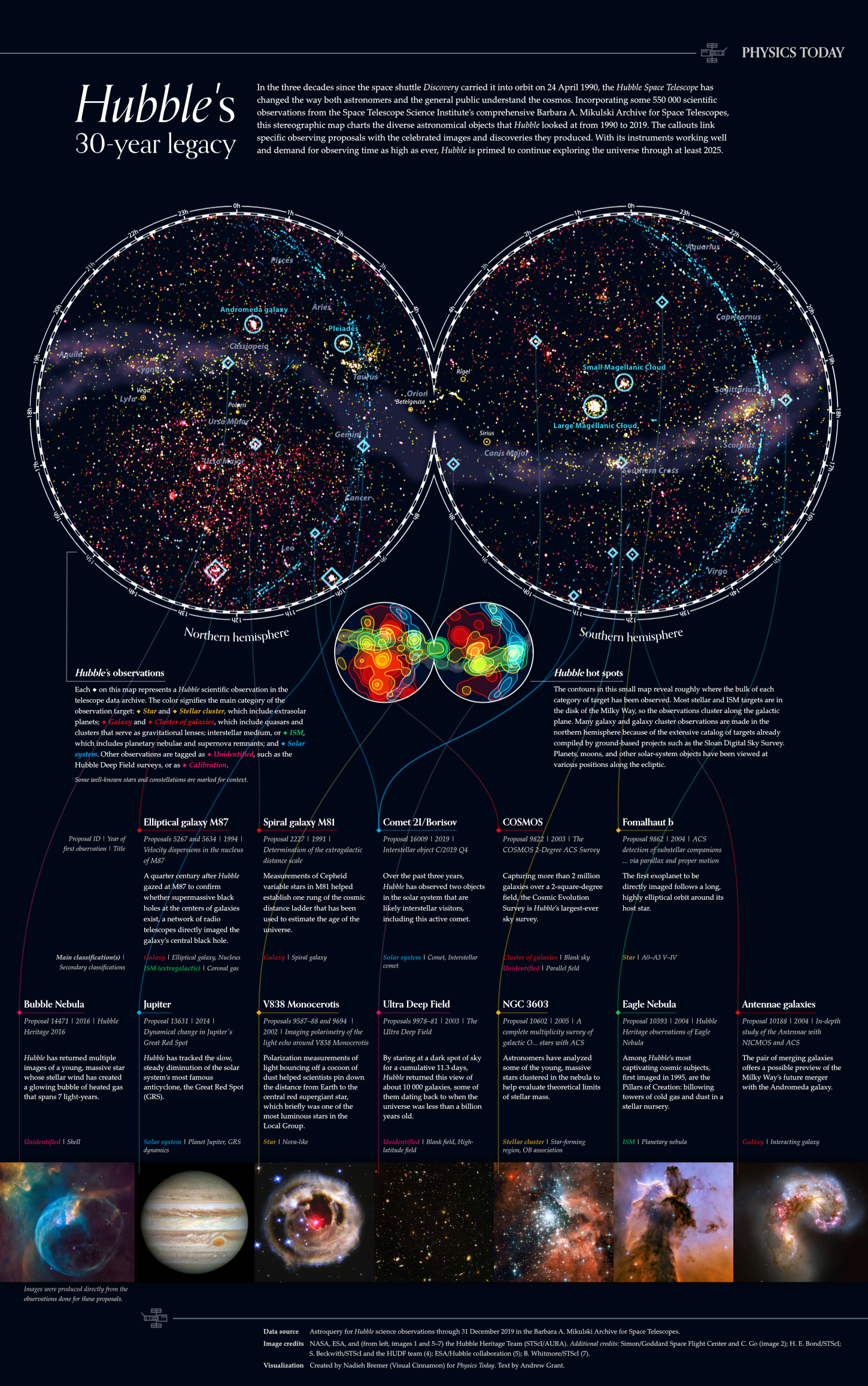
A visualization of the scientific observations made by the Hubble Space Telescope. Click to see a full-size version.
Nadieh Bremer (Visual Cinnamon )
Editor’s note: The visualization above is the online version of the four-page poster, also titled “Hubble’s 30-year legacy,” that appears in the April 2020 issue of Physics Today. “Hatching Hubble ,” by Charles Day, also appears in print. See below for more Hubble content that is not in the magazine.
In the April 1990 issue of Physics Today, C. R. O’Dell previewed the soon-to-be-launched Hubble Space Telescope. “No other astronomy project has taken so long to develop, proven so technologically challenging or cost so much,” wrote the telescope’s longtime project scientist.
Three decades later, Hubble has changed the way both astronomers and the general public understand the cosmos. The visualization above is our attempt to encapsulate the achievements of the long-lived space observatory. Click on the image for a larger version.
Incorporating some 550 000 scientific observations from the Space Telescope Science Institute’s comprehensive Barbara A. Mikulski Archive for Space Telescopes, the stereographic map charts the diverse astronomical objects that Hubble looked at from 1990 to 2019. Each point on the map is a separate scientific observation; the color depicts whether the objects of interest were stars, galaxies, objects in the solar system, or other targets. The callouts link specific observing proposals with the celebrated images and discoveries they produced. The contours in the smaller map show where the bulk of observations for each target category were taken. High-density areas include the Andromeda galaxy, elliptical galaxy M87, the Large and Small Magellanic Clouds, and the galactic center.
For more detail on how Hubble observing time has been divided among all kinds of intriguing targets, see our second visualization .

A close-up of the Andromeda galaxy from the sky map above. Each diamond is a separate Hubble observation.
Nadieh Bremer
The 30-year milestone also provides a good excuse for diving into some Hubble history. Our coverage explores the work of the late Nancy Grace Roman , NASA’s longtime head of space astronomy, in shaping the 94-inch telescope, and chronicles the findings of Hubble during its turbulent first few years in orbit , when its vision suffered due to a mirror defect.
This set of stories and visualizations focuses mainly on Hubble’s legacy in terms of research output, but that’s not the only important contribution of the mission. To allot the limited amount of in-demand telescope time, the Space Telescope Science Institute recently adopted a system of dual-anonymous evaluation. As Lou Strolger and Priyamvada Natarajan described in Physics Today last year, the double-blind process shows promise in leveling the playing field for women and other marginalized groups in astronomy. Already it has become a model that is being adopted for other scientific projects.
With its instruments working well and demand for observing time as high as ever, Hubble is primed to continue exploring the universe through 2025 or later. The hope is that the telescope will get a chance to combine forces with the James Webb Space Telescope, which is slated to launch next spring at the earliest.

This section of the Andromeda galaxy captured by Hubble hosts more than 100 million stars.
NASA, ESA, J. Dalcanton, B. F. Williams, and L. C. Johnson (University of Washington), the PHAT team, and R. Gendler
Nadieh Bremer , a freelance data visualization designer/artist and astronomer based in the Netherlands, produced the visualization. Andrew Grant, senior editor for online at Physics Today, wrote the text in the visualization and the article.
The data presented in this article were obtained from the Space Telescope Science Institute’s Barbara A. Mikulski Archive for Space Telescopes (MAST). STScI is operated by the Association of Universities for Research in Astronomy, Inc, under NASA contract NAS5-26555.
More about the authors
Andrew Grant, agrant@aip.org


