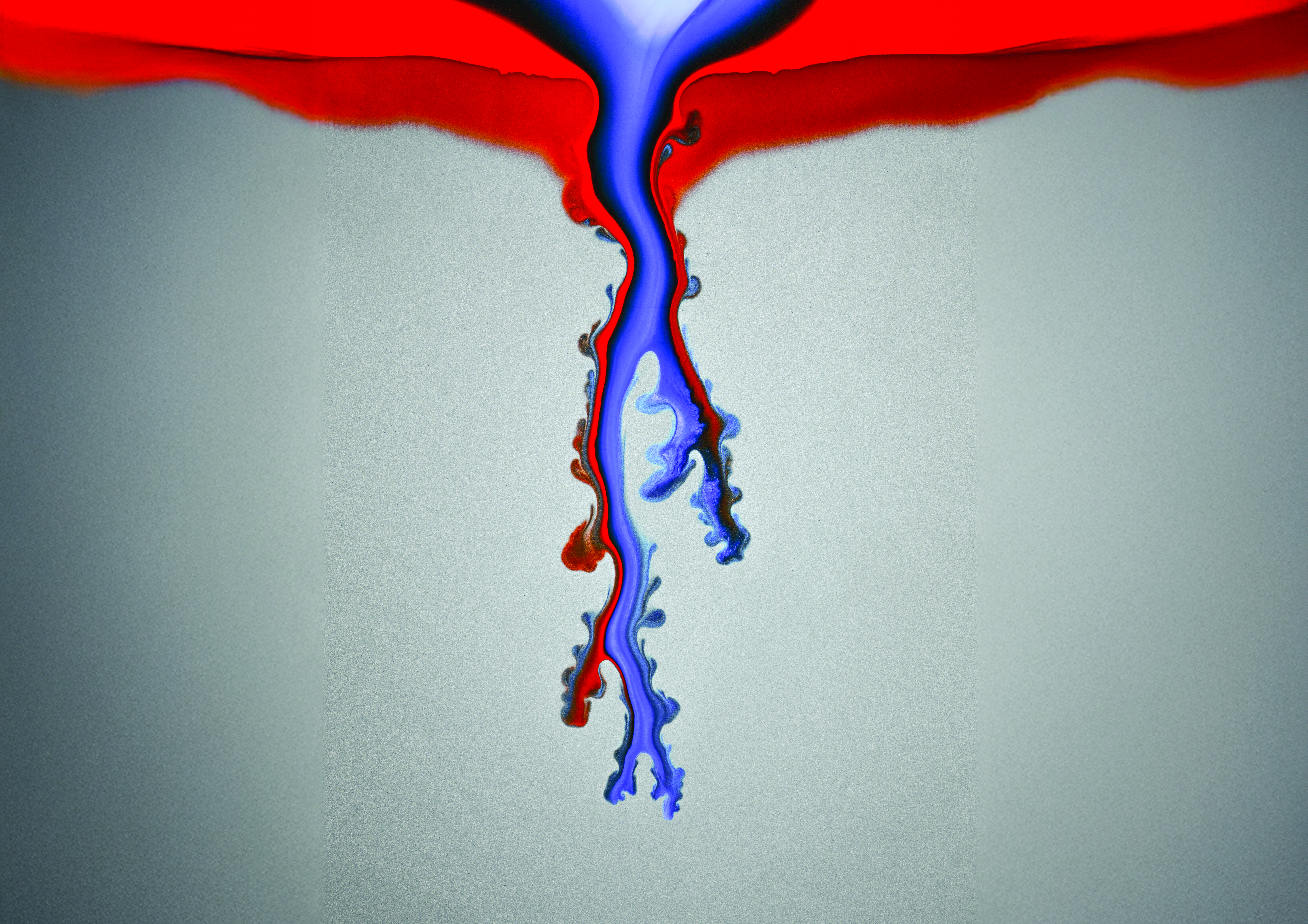
Fluid fingers through the sand


(Image courtesy of Miles Morgan and Bjørnar Sandnes.)

When fluids interact with granular materials such as sand, the resulting behavior is often complex. Erosion and deposition generate intricate patterns in rivers and oceans, for example, and fluid flow can weaken faults or trigger the formation of sinkholes. This image, submitted by Miles Morgan and Bjørnar Sandnes of Swansea University in the UK, shows water flowing downward through a dense granular bed that’s confined between two plates. The fingerlike patterns created by the invading fluid are caused by the interplay between hydrodynamic, gravitational, and frictional forces as it flows through the chamber.
After submerging grains in a cell filled with water and allowing them to settle, Morgan, Sandnes, and their colleagues induced a rate-controlled flow using pumps at the top and bottom of the chamber: Water was injected at the top, and water—or some combination of water and grains—exited at the bottom. To help visualize how the invading fluid mixed with the water already present in the chamber, the former was dyed blue and the top layer of the latter was dyed red. The behavior depended on the flow rate. At low flow rates, the fluid easily passed between the grains without causing them to move. At moderate flow rates, the grains moved in a predictable manner that was dominated by gravity. But at high flow rates, instabilities such as the viscous fingers seen here began to emerge.
1
The researchers express hope that their work will lead to more-accurate rheological models of fluid flow in natural hazards, industrial processing, and geophysical flows.
Reference
1. M. L. Morgan et al., “Wormhole formation in fluid-driven granular flow ,” Commun. Phys. 8, 468 (2025).