Cosmic extremes of luminosity
DOI: 10.1063/pt.nczi.mueu


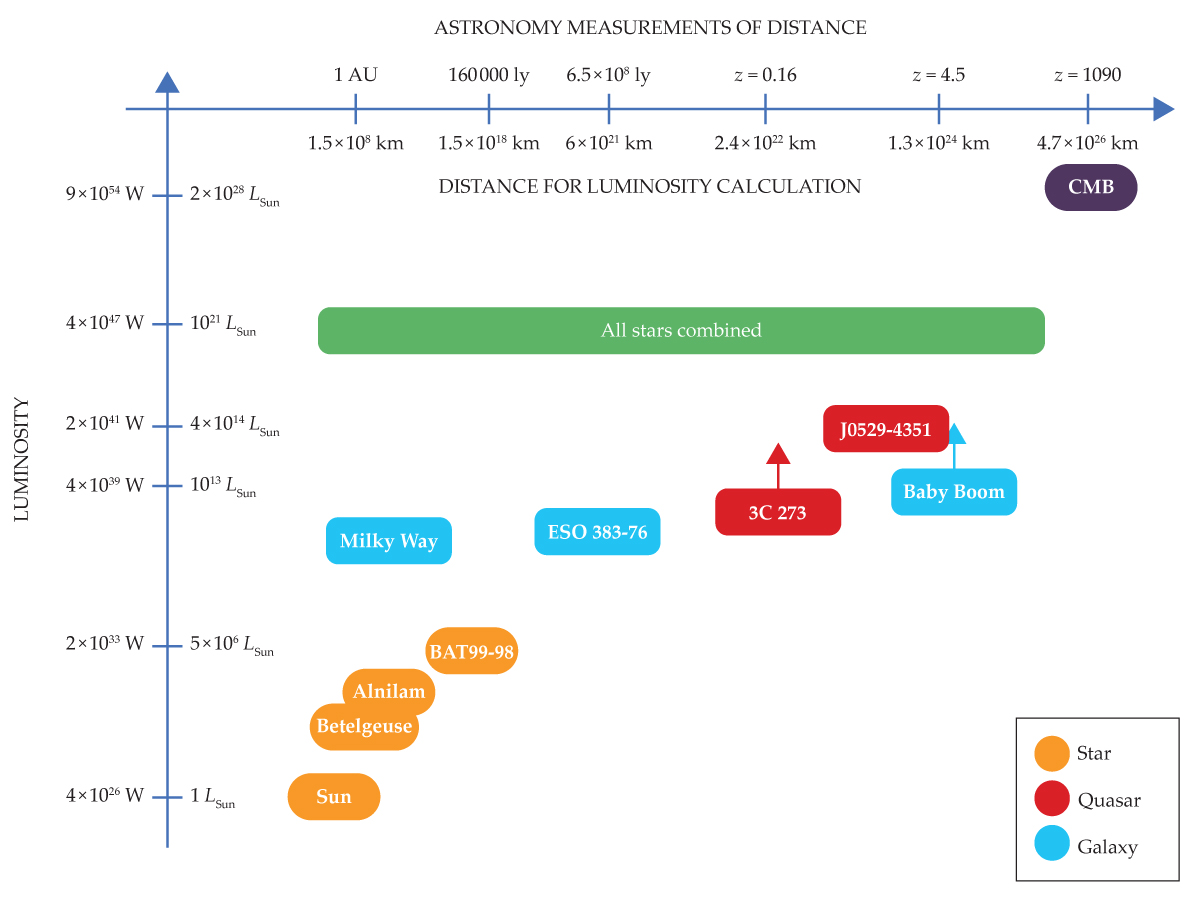
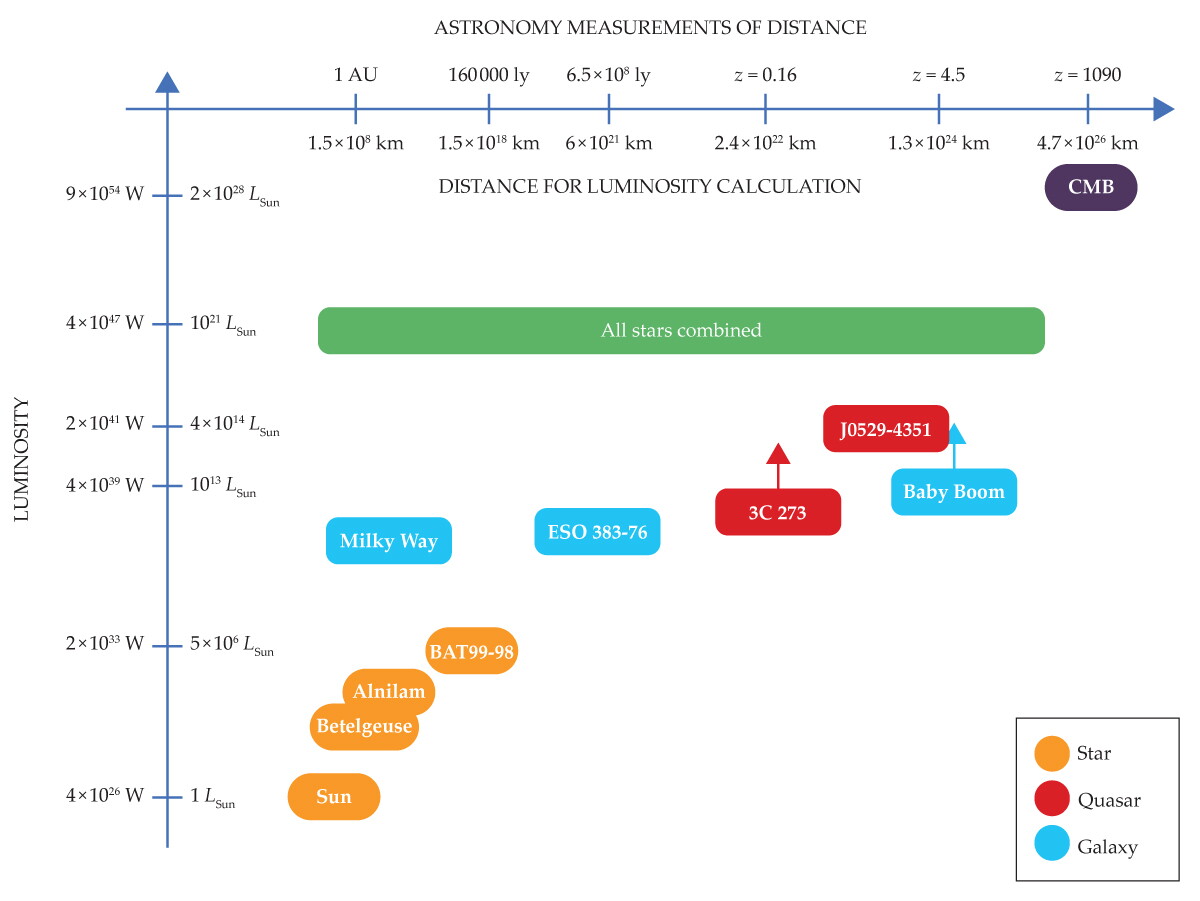
The distances of celestial objects from Earth in astronomical units (AU), light-years (ly), and redshift (z), plotted against luminosity in watts and solar luminosity (LSun). The cosmic microwave background (CMB) is both the most distant and the most luminous object in the sky.
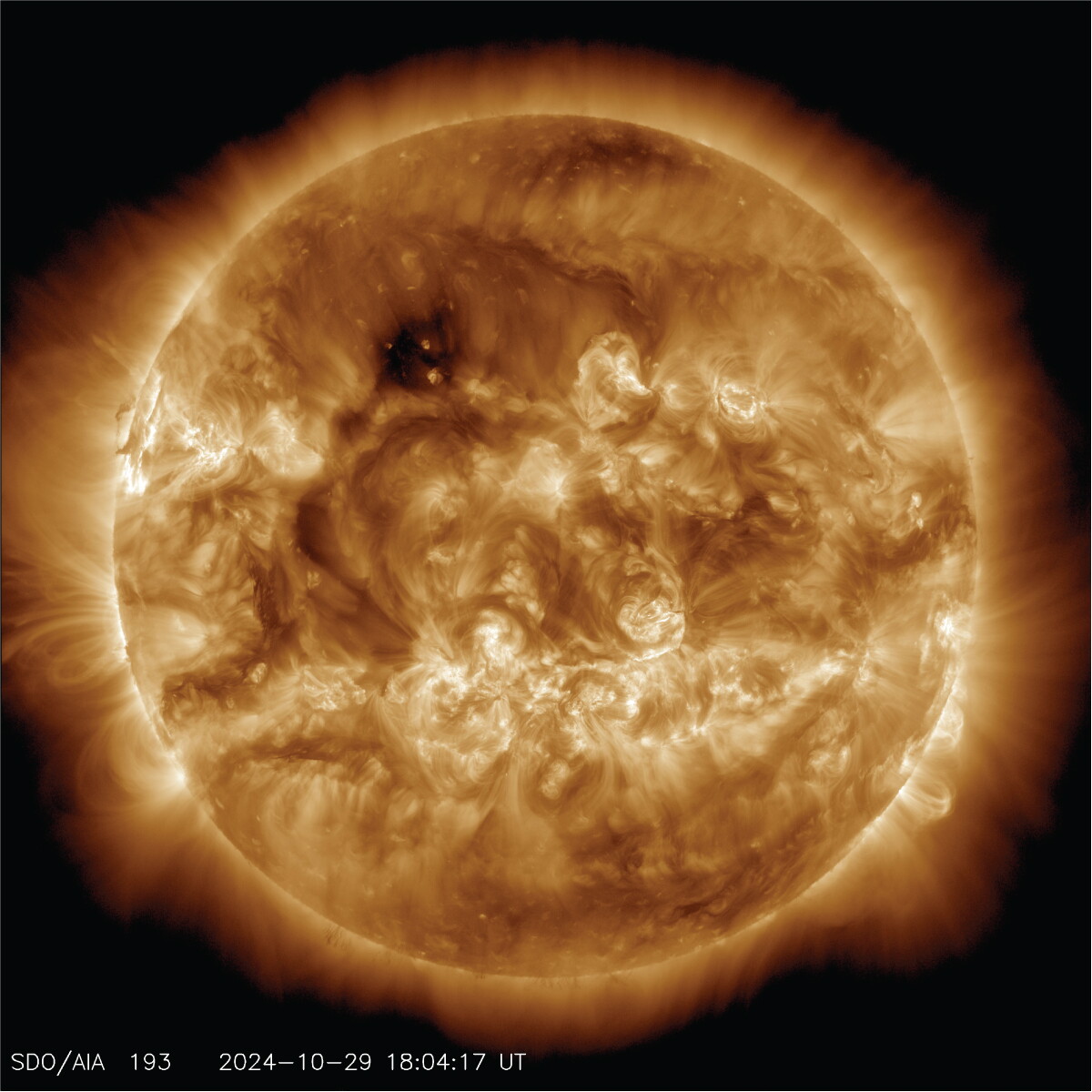
Even the smallest amount of the Sun’s disk is bright enough to hurt your eyes if you stare at it. But the Sun is bright because it’s so close to us. If you stand farther away from a light, it looks dimmer. Astronomers know the phenomenon as the difference between absolute magnitude and apparent magnitude. The former is a measure of intrinsic brightness, and the latter is how bright we perceive something to be from Earth.

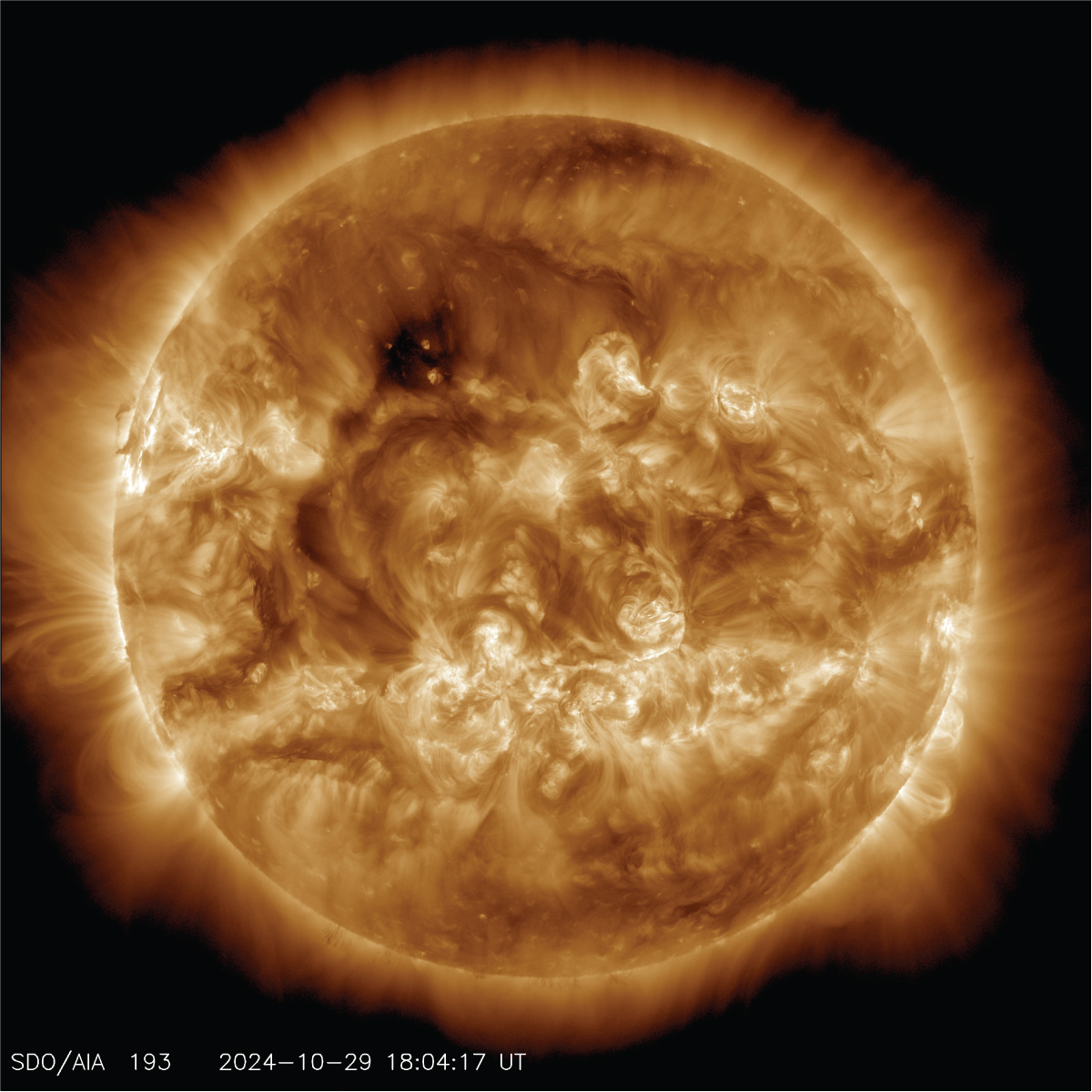
The Sun is the brightest star in our sky. (Image by NASA/SDO and the AIA, EVE, and HMI science teams.)
Mathematically, it’s the distinction between luminosity, which is how much energy an object produces per unit time, and flux, which is how much of that reaches us per unit area. If you have two objects with the same luminosity L, the one with a smaller distance D will have a higher observed brightness F. Alternately, if two objects have the same brightness, the one at greater distance is more luminous:
So, we could end the article right here. The Sun is the brightest thing we can see, 13 billion times as bright as Sirius, the second-brightest star in the sky. But let’s rephrase the question: What is the most luminous object in the sky? If everything in the universe were placed at the same distance from Earth, what would shine the brightest? We’ll focus on objects that shine steadily and leave transient sources like supernovae for some other time.
Stars

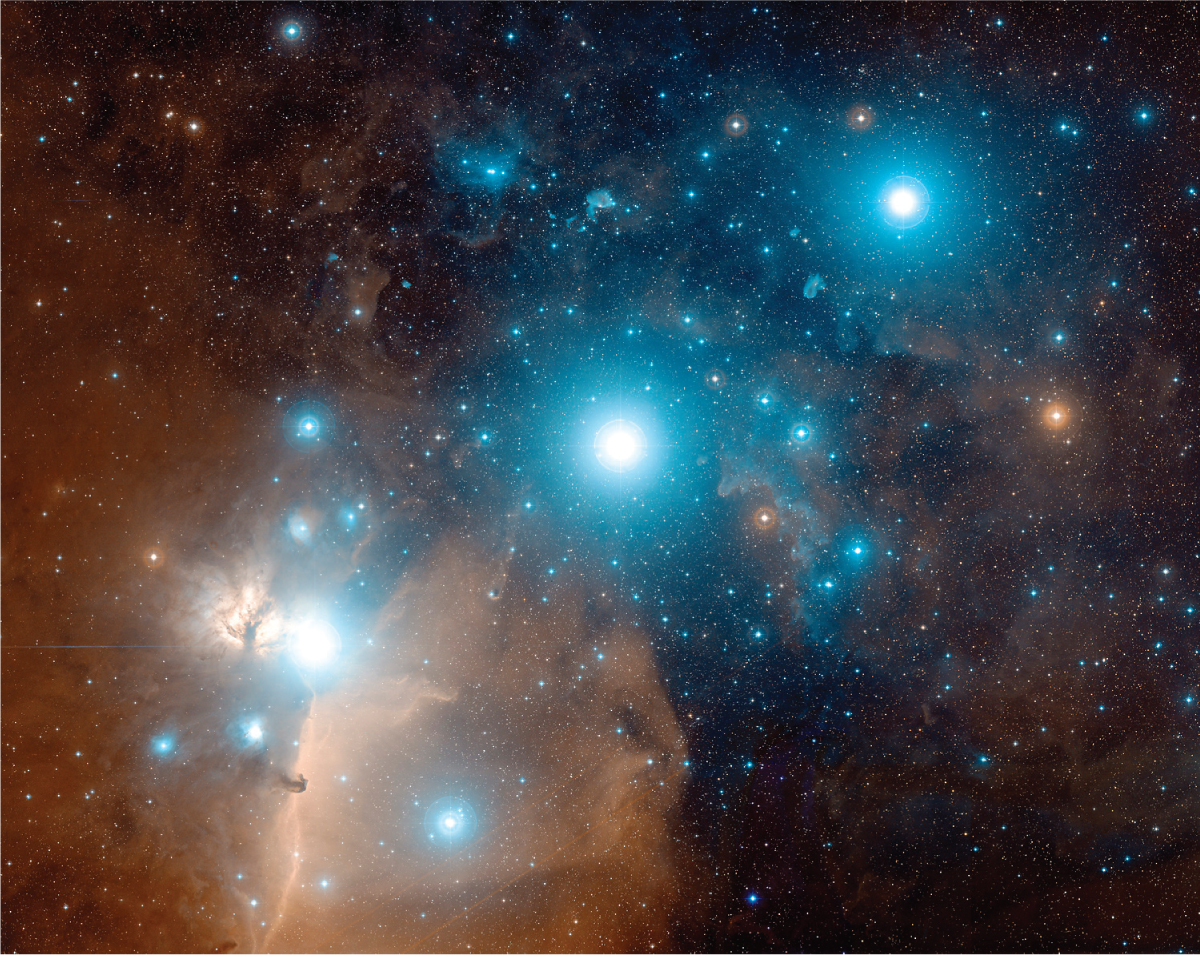
Alnilam (center), the brightest star in Orion’s belt, is 800 000 times as luminous as the Sun. (Image by the Digitized Sky Survey, ESA/ESO/NASA FITS Liberator.)
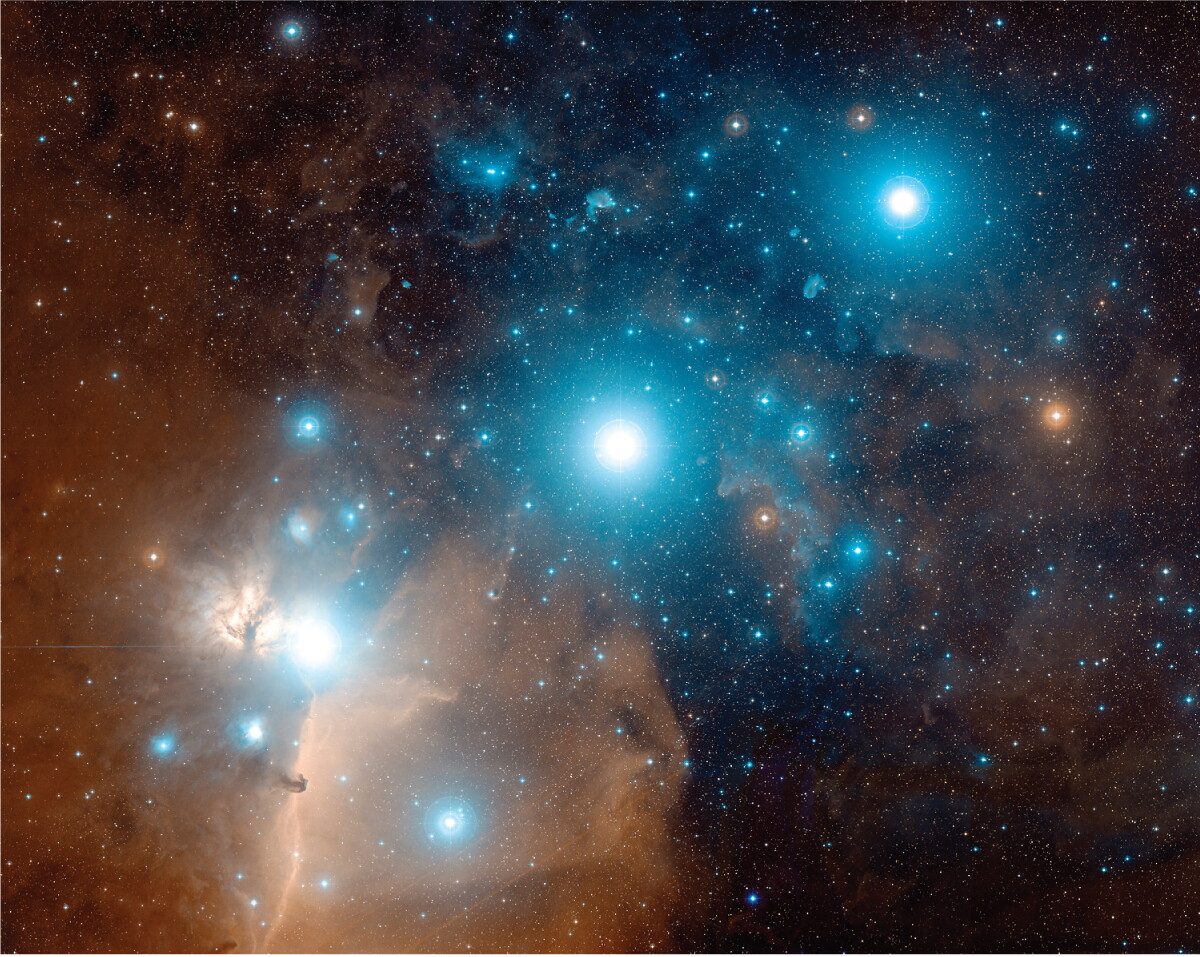
The Sun fuses more than half a billion tons of hydrogen every second to generate 4 × 1026 W of power (enough energy in one second to power modern civilization for 600 000 years at current energy consumption rates). As stars go, though, the Sun is nothing special. Betelgeuse, the red supergiant star in Orion’s left shoulder (as seen from Earth), is 90 000 times as luminous as the Sun. But Betelgeuse isn’t even the most intrinsically bright star in its own constellation: Alnilam, in the middle of Orion’s belt, is more luminous still.

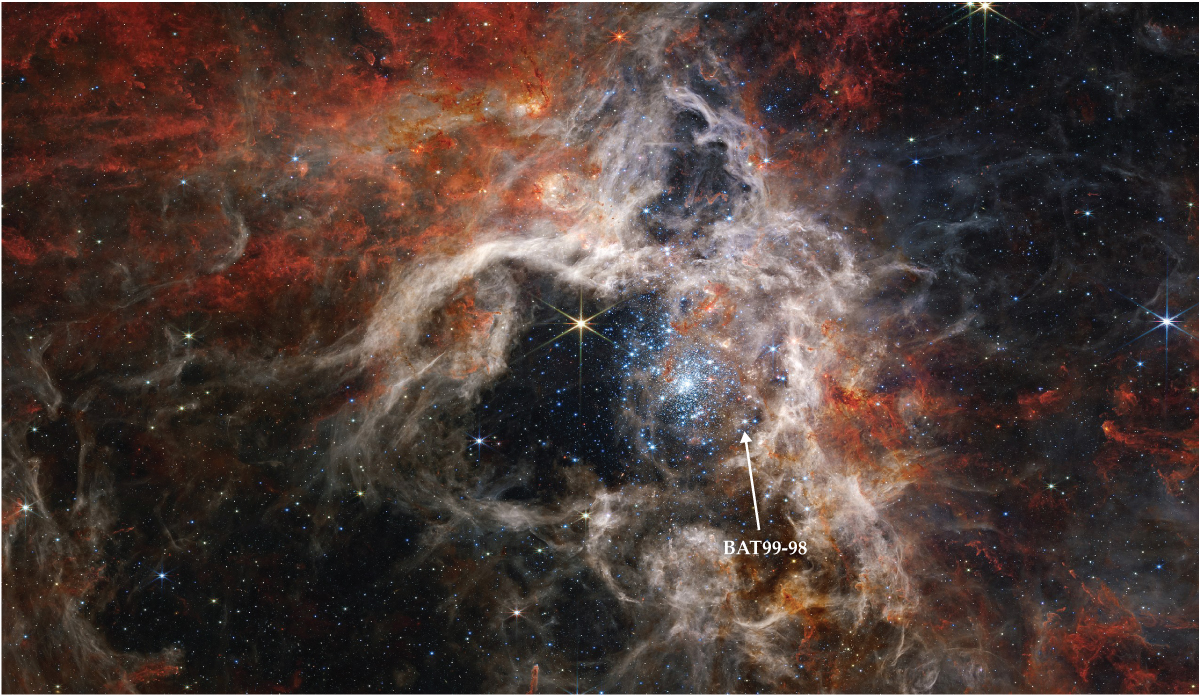
Shown in this IR image, BAT99-98, in the Large Magellanic Cloud’s Tarantula Nebula, is the most luminous star found to date. (Image by NASA, ESA, CSA, STScI, and the Webb ERO production team.)

Deep in the largest stellar nurseries, colossal stars are born that dwarf the Sun, Betelgeuse, and even Alnilam. In our galactic neighbor the Large Magellanic Cloud, the star BAT99-98 clocks in at roughly 225 solar masses. Such large stars are never totally stable, but at present, BAT99-98’s luminosity is fairly steady at 5 million times that of the Sun. If BAT99-98 replaced the Sun in the solar system, moonlit nights would be as bright as a cloudy day at high noon under the Sun. (Days would be rather less pleasant.) We know of no single star that is more luminous for extended periods of time.
Galaxies

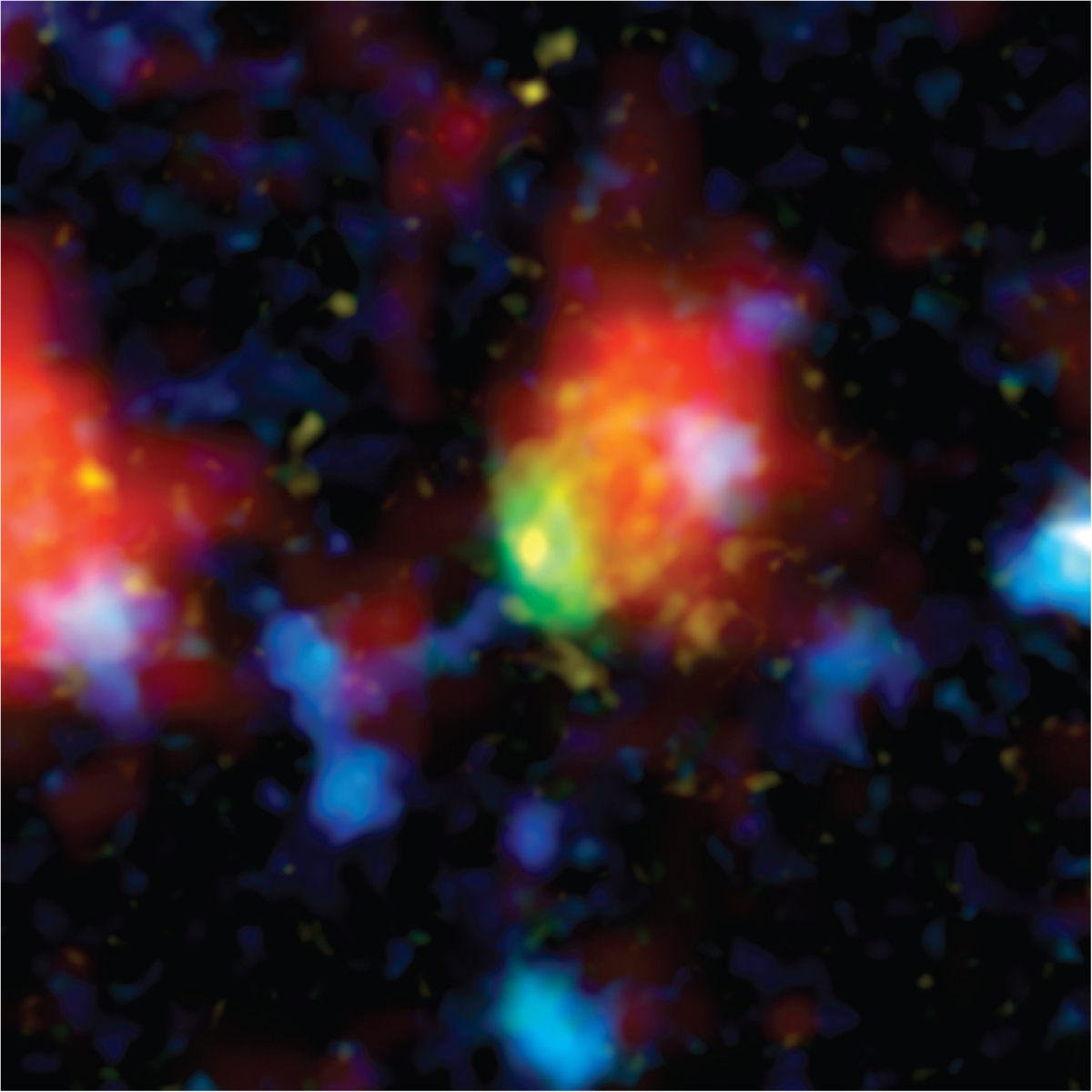
The distant Baby Boom galaxy is named for its incredible star-formation rate. (Image by NASA/JPL-Caltech/Subaru/STScI/P. Capak, SSC-Caltech.)

Some 650 million light-years away from Earth, in the Centaurus constellation, lies the large elliptical galaxy ESO 383-76. It’s 20 times as luminous as the Milky Way, or 4 × 10¹¹ times as luminous as the Sun.
The current record holder among galaxies, though, is much farther away. The Baby Boom galaxy is so distant that we measure redshift (z = 4.547) and rely on models of the universe to convert that into distance. Telescope images of the galaxy are not impressive: just a small blob of IR light. But when you take the distance and use equation 1 to compute the luminosity, the galaxy is 1013 times as luminous in IR alone as the Sun’s output at all wavelengths. The source of all that light, and the namesake of the galaxy, is a stupendous burst of star formation. Despite being just a fraction of our galaxy’s size, the Baby Boom galaxy is churning out stars 400 times as fast as the Milky Way.
Quasars

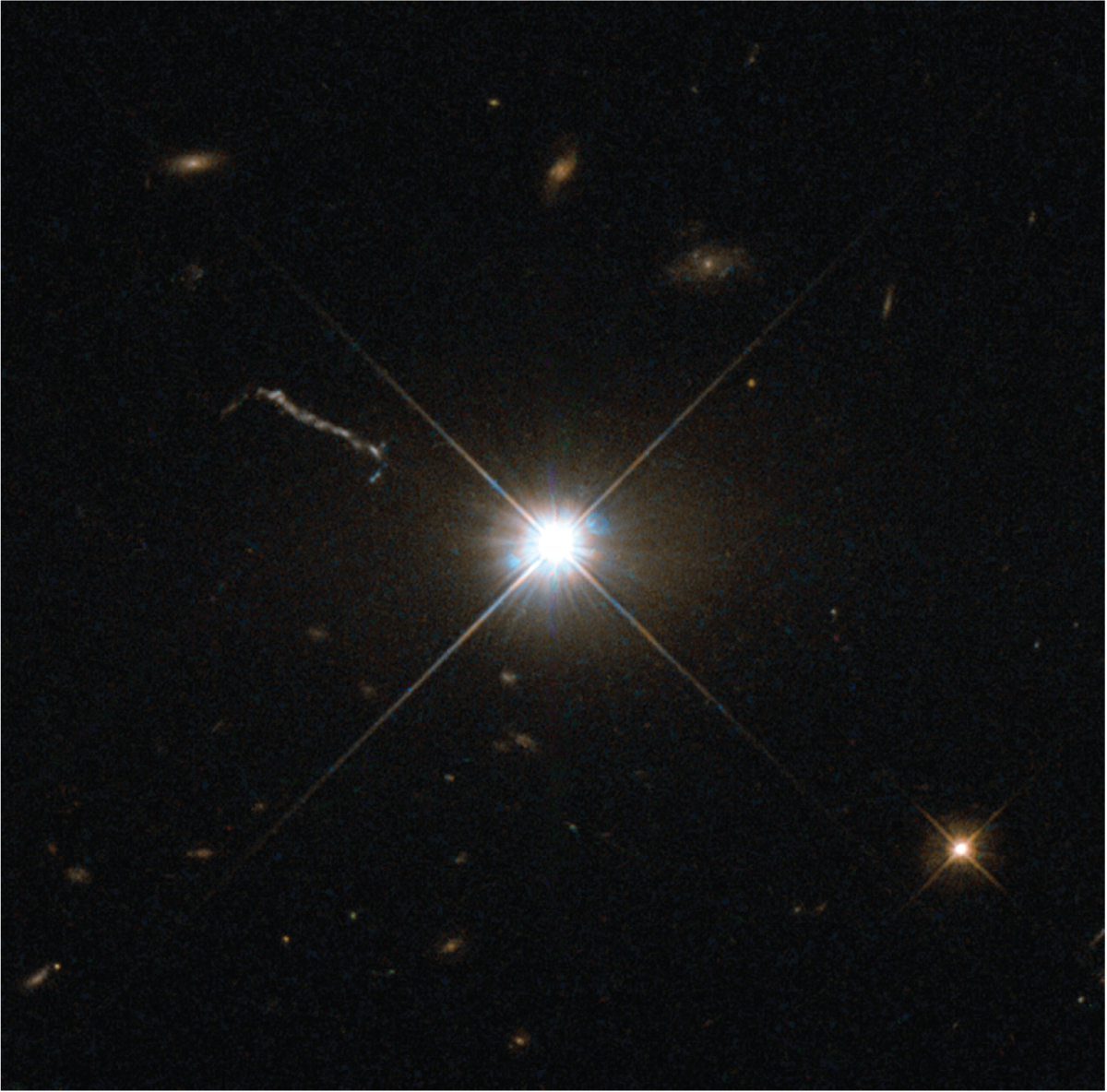
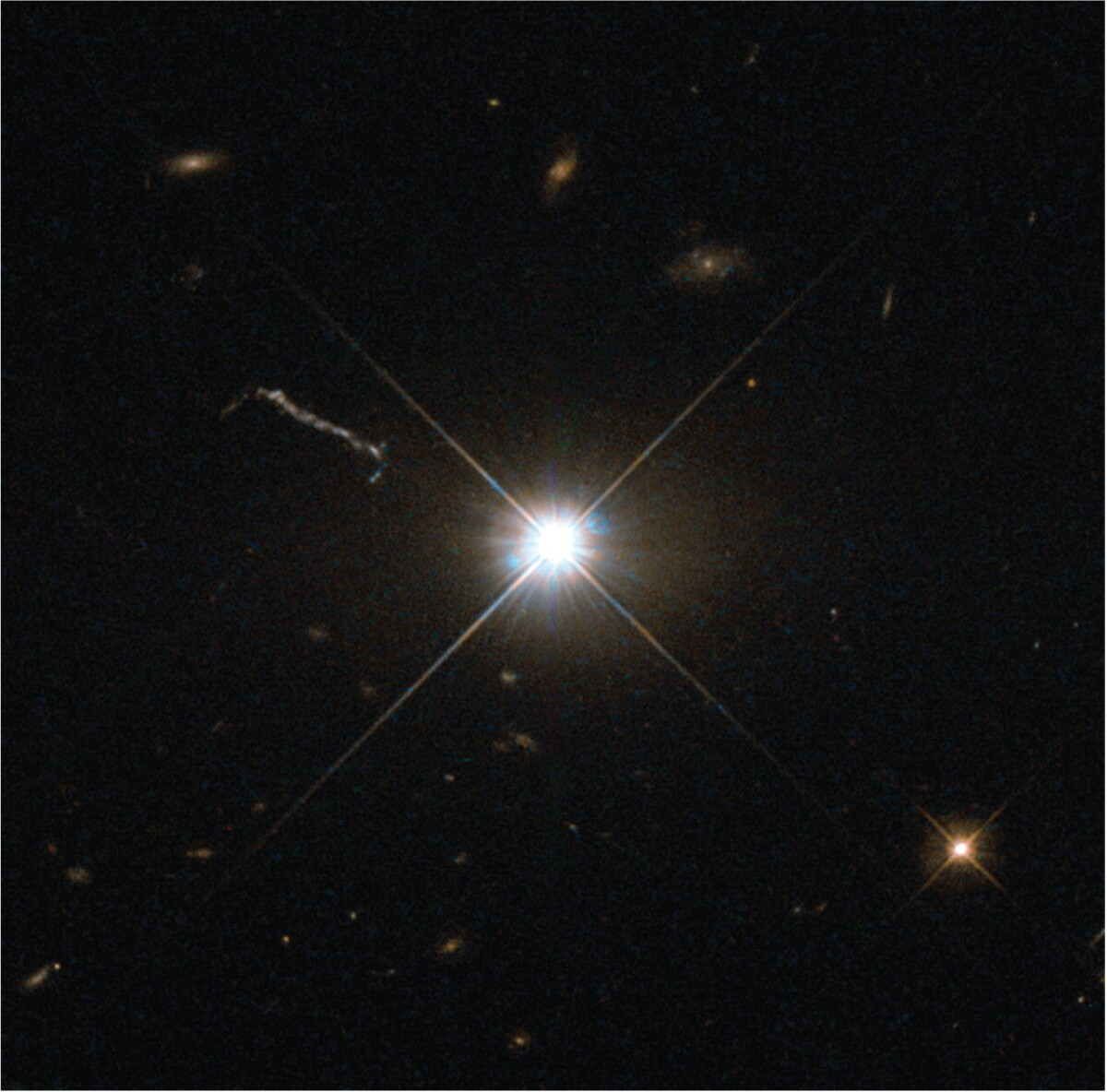
Despite being the center of an entire galaxy, quasar 3C 273 shines so brightly that it appears as just a point in the sky. (Image by ESA/Hubble and NASA/CC BY 2.0 .)
In the 1950s, radio astronomers were looking for optical counterparts to newly identified radio sources in the sky. Deep searches with large telescopes turned up faint starlike objects on top of some sources. But those “stars” exhibited spectral lines that didn’t correspond to any known element on Earth. They were called quasi-stellar radio sources, shortened to “quasars” (a term coined by Hong-Yee Chiu in Physics Today, May 1964, page 21 ).
In 1963, Maarten Schmidt showed that the mysterious spectral lines in the quasar 3C 273 could be explained as hydrogen, oxygen, and other familiar elements—but only if the object were moving away from Earth at a significant fraction of the speed of light. Because the universe is expanding, that meant 3C 273 had to be a distant object and thus far more luminous than an ordinary star: It releases 4 trillion times as much energy in visible light as the Sun does, and visible light is just a fraction of the total energy it radiates.
We know now that 3C 273 and other quasars are the cores of distant galaxies. In each of those cores, a supermassive black hole is accreting gas, dust, and stars at an extraordinary rate. The nucleus of 3C 273 releases so much energy that the core outshines the rest of the galaxy, and the galaxy appears as just a point in the sky.
Astronomers have now located more than a million quasars. The vast majority are less luminous than 3C 273. But the recently discovered J0529-4351 is devouring more than a Sun’s worth of matter every day. Its black hole is 17 billion times as massive as the Sun, and it is radiating 2 × 1041 W, 500 trillion times the total power output of the Sun. If placed in the Large Magellanic Cloud next to BAT99-98, 160 000 light-years from Earth, you could read by its light at night.
The CMB
There’s one more equation of relevance, the Stefan–Boltzmann law:
A perfect blackbody with a radius R at an absolute temperature T radiates in proportion to its surface area and to the fourth power of its temperature, with the Stefan–Boltzmann constant σ controlling the proportionality. (Stars are not perfect blackbodies, but they’re close enough.)
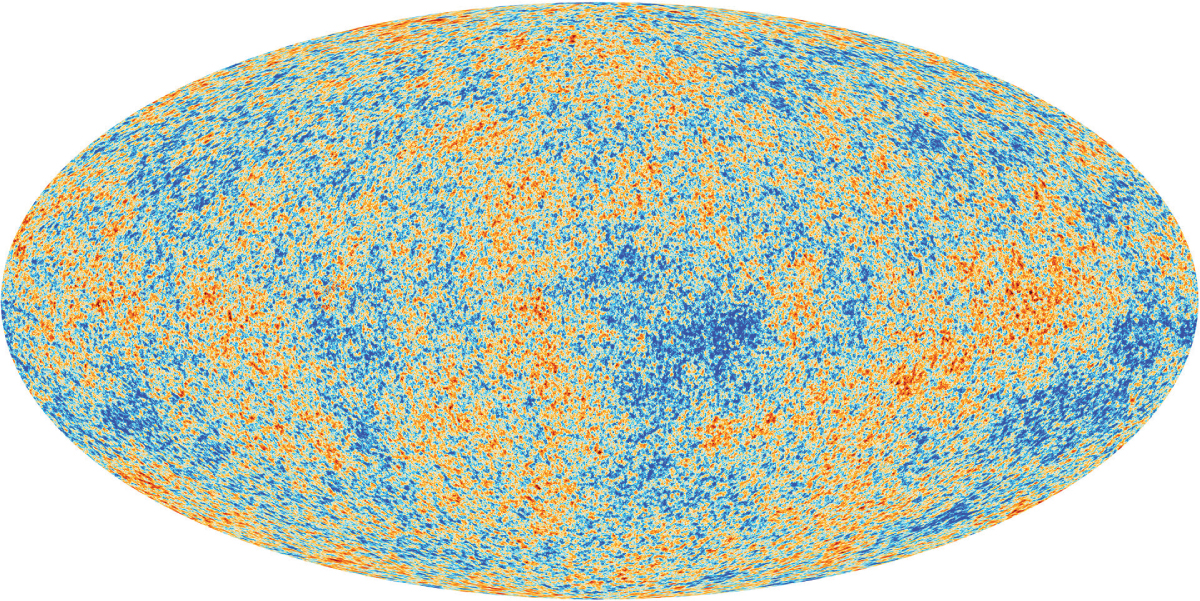
There is no more perfect blackbody than the universe itself, as evidenced by the cosmic microwave background (CMB). Predicted in 1948 as the cooling afterglow of the Big Bang, the CMB was discovered accidentally in 1964 by astronomers Arno Penzias and Robert Wilson after their radio antenna detected noise at certain frequencies no matter the direction or time of day. Those relic photons have been traveling almost uninterrupted since the universe was 380 000 years old. The very small departures from the CMB’s near-perfect 2.726 K blackbody spectrum have revealed an astonishing amount about the history of the universe (see, for example, Physics Today, January 2023, page 14 ).

The cosmic microwave background isn’t particularly luminous per unit area, but its enormous scale makes it the largest single source of energy in the sky. (Image by ESA and the Planck Collaboration.)
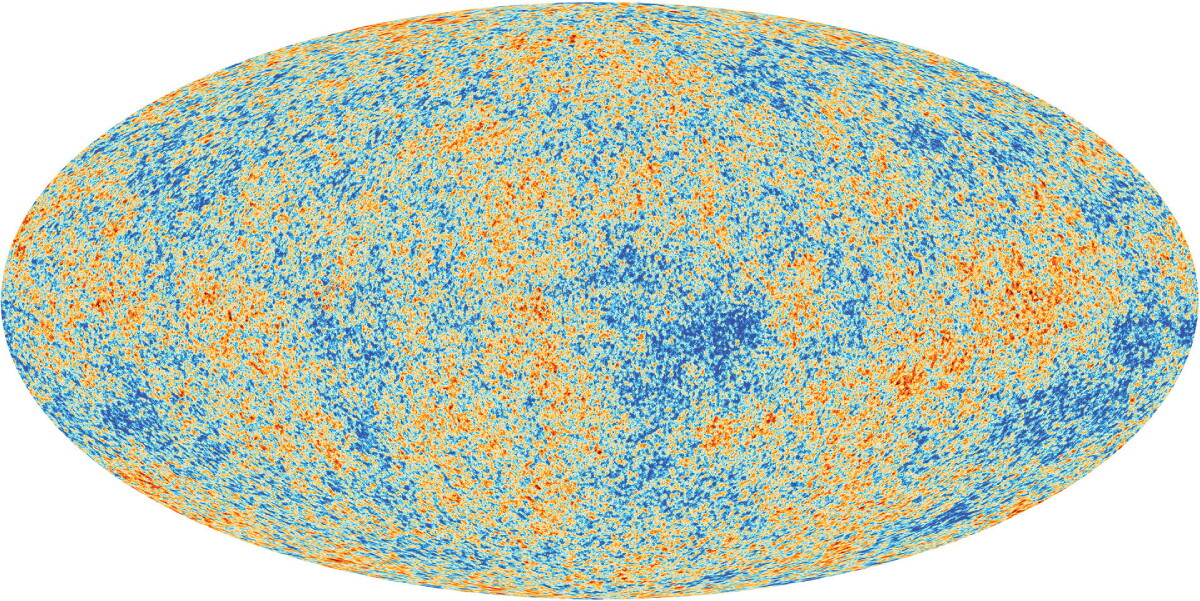
The emitting region of the CMB is a sphere of radius 4.7 × 1026 km that we’re on the inside of. (Conveniently, equation 2 doesn’t care whether we’re on the inside or the outside of the blackbody, as long as the object is radiating equally in every direction.) The CMB is not very luminous per unit area. What it lacks in intensity, it makes up in size. Plugging in the temperature and the radius leads to a total luminosity of 9 × 1054 W, some 20 million times the total combined output of every star in the night sky.
It turns out that the most luminous steady source in the sky is the sky itself, which bathes us in a gentle sea of microwave radiation left over from the universe’s fiery birth. You can’t see it, but it’s been there all along, just waiting for us to build the telescopes and learn about where we come from. If you’re feeling warm and fuzzy right now, maybe that’s the optimism for the future that astronomy tends to induce—or maybe it’s the microwaves of the CMB.
This article was originally published online on 23 December 2024.
References
► M. Schmidt, “3C 273: A star-like object with large red-shift,” Nature 197, 1040 (1963). https://doi.org/10.1038/1971040a0
► C. Wolf et al., “The accretion of a solar mass per day by a 17-billion solar mass black hole,” Nat. Astron. 8, 520 (2024). https://doi.org/10.1038/s41550-024-02195-x
► R. H. Dicke et al., “Cosmic black-body radiation,” Astrophys. J. 142, 414 (1965). https://doi.org/10.1086/148306
► A. Penzias, R. W. Wilson, “A measurement of excess antenna temperature at 4080 Mc/s,” Astrophys. J. 142, 419 (1965). https://doi.org/10.1086/148307
More about the authors
Donald Warren is an assistant professor in the department of aerospace, physics, and space sciences at Florida Tech in Melbourne. He is also a visiting scientist in the Interdisciplinary Theoretical and Mathematical Sciences Program at RIKEN in Japan.