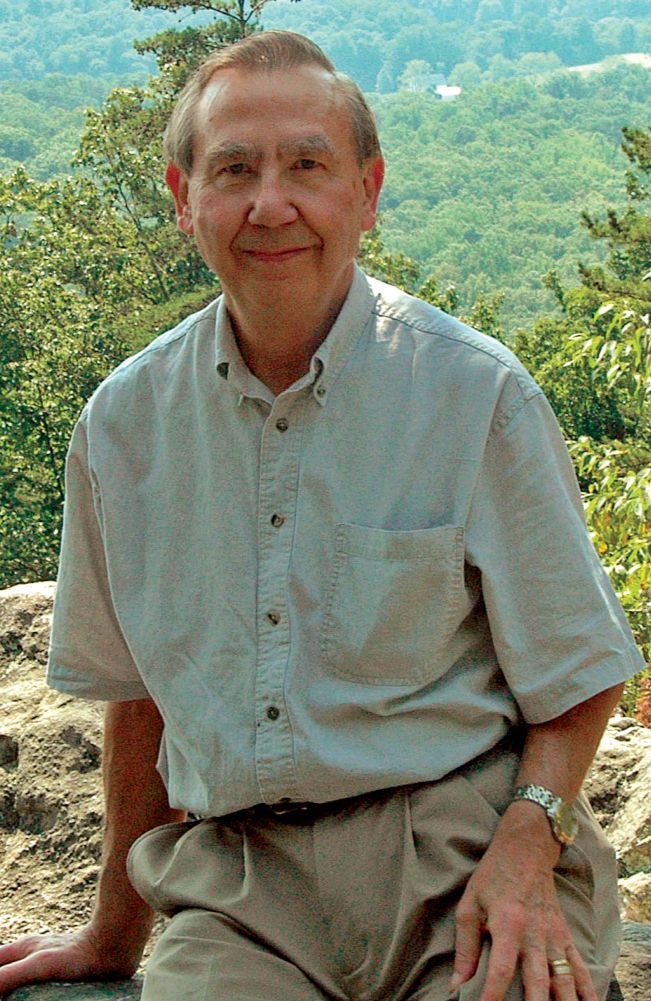
Thomas James McIlrath
DOI: 10.1063/PT.3.4821
Thomas James McIlrath, former treasurer and publisher of the American Physical Society (APS), passed away on 20 December 2020 of complications from Parkinson’s disease. In addition to being a skilled fiscal manager who maintained APS’s financial health in a period of rapid economic change, Tom was an outstanding atomic, molecular, and optical (AMO) physicist. He spent countless hours volunteering with the Optical Society. He also was a faithful colleague and friend and a steadfast steward to his family and neighbors.

Thomas James McIlrath
MCILRATH FAMILY COLLECTION

Tom was born in Dowagiac, Michigan, on 10 May 1938 and received his BS degree in physics at Michigan State University in 1960. His graduate work at Princeton University, done under the guidance of Thomas Carver, was on optical pumping of atomic hydrogen. After earning his PhD in 1966, he spent a year at Oxford University on a NATO postdoctoral fellowship. For the next six years, he pursued atomic spectroscopy research at the Harvard College Observatory while lecturing in the university’s astronomy department.
Tom joined the faculty of the Institute for Fluid Dynamics and Applied Mathematics (an antecedent to today’s Institute for Physical Science and Technology) at the University of Maryland (UMD) in 1973. During his time there, he was also a part-time staff researcher at the National Bureau of Standards (now NIST), where he collaborated extensively with Thomas Lucatorto and others. As part of Tom’s fruitful UMD–NIST association, he, Lucatorto, and James Roberts developed a vacuum-ultraviolet (VUV) window that could sustain a pressure differential of seven orders of magnitude while transmitting 50% of the light. That work earned the three an Industrial Research & Development I-R 100 award (the precursor to the R&D 100 Awards presented by R&D World) in 1980.
With Lucatorto, McIlrath discovered superelastic collision-assisted resonant ionization of atomic vapors that enabled VUV absorption measurements of long columns of atomic ions (cold plasmas). McIlrath and Lucatorto received a Department of Commerce Silver Medal Award for their research in plasma studies and spectroscopy. One of us (Hill) worked closely with McIlrath, first as a postdoc at NIST with some of the ion columns and later as a colleague at UMD. McIlrath also provided valuable input in the 1980s and 1990s that helped lay the groundwork for UMD, NIST, and the Laboratory for Physical Sciences to create the Joint Quantum Institute.
In 1986 Tom spent a sabbatical at Bell Labs, where he worked closely with another of us (Freeman), Philip Bucksbaum, and Howard Milchberg, then a postdoc. That was shortly after the discovery of above-threshold ionization by intense laser pulses, which at the time was not well understood. In the late 1980s, McIlrath, Freeman, and Bucksbaum wrote a series of papers describing the ionization of atoms and molecules in intense laser fields, an important step in the development of high-harmonic and attosecond generation in the 1990s and into the new millennium.
Between 1993 and 1995, Tom served at NSF as a rotator—a program director on temporary leave from one’s home institution—in which he oversaw the AMO experimental program. In addition, he and Lawrence Goldberg (in the Engineering Directorate) cochaired a major 1994 NSF workshop, “Optical Science and Engineering: New Directions and Opportunities in Research and Education.” It led to an NSF-wide initiative on multidisciplinary research in optical science and engineering that ultimately expanded research and education opportunities in those fields. Upon returning to UMD, Tom served as associate dean for research and graduate studies before retiring and becoming the treasurer and publisher at APS in 1996.
His achievements at APS included helping to steer the society into electronic publishing and to finance APS journals in a fairer and more equitable manner. For example, Tom started the tiered structure in which larger, research-intensive institutions began bearing more of the cost burden than non-PhD-granting, smaller institutions. Another legacy of his 10-year leadership—he stepped down in 2006—was his implementation of cost-saving measures, including online submissions, that led to dropping journal prices in the mid 2000s even as the size of the journals grew. Through it all, Tom was able to maintain the fiscal health of APS in a volatile economic period.
Tom faced a profound personal challenge when his wife, Valerie U. Hoy, was diagnosed with an incurable medical condition while he was in graduate school. His lifelong dedication to her and their two daughters, Christine and Laura, was exemplary, as was his service as deacon and elder of Riverdale Presbyterian Church. After his diagnosis with Parkinson’s, he and Valerie moved to Asbury Methodist Village (AMV), a continuing-care retirement community in Gaithersburg, Maryland. In his typical altruistic fashion, he became very active, contributing to the AMV newsletter and interacting with AMV’s department of pastoral care until his death.
We gratefully acknowledge important contributions from Christine McIlrath Lehnigk, Tom Lucatorto, Denise Caldwell, Larry Goldberg, Barry Schneider, Kate Kirby, Mike Stephens, David Voss, Phil Bucksbaum, and Howard Milchberg.
More about the authors
Wendell T. Hill, University of Maryland, College Park.
Jan V. Sengers, University of Maryland, College Park.
Richard R. Freeman, University of Washington, Seattle.