How Soviet and US scientists helped end the Cold War nuclear arms race


Significant changes in global policy are generally achieved only after long-fought struggles by coalitions of key players and advocates. In the case of nuclear arms control, scientists—especially physicists—have made important contributions both to the public debate and as government advisers. The three of us had the good fortune to participate in such an opening 40 years ago. We are sharing our story here in the hope of encouraging our fellow scientists to be alert to opportunities to network and brainstorm internationally about global problems.
The freeze movement
Our engagement in international dialogue about nuclear arms control began in the early 1980s. At that time, Cold War tensions were at the highest they had been since the Cuban Missile Crisis in 1962. The Reagan administration came into office in 1981 convinced that the Soviet Union was seeking the capability to fight and win a nuclear war, and it backed the development of a new generation of ballistic and cruise missiles accurate enough to destroy a large fraction of the Soviet strategic nuclear forces.

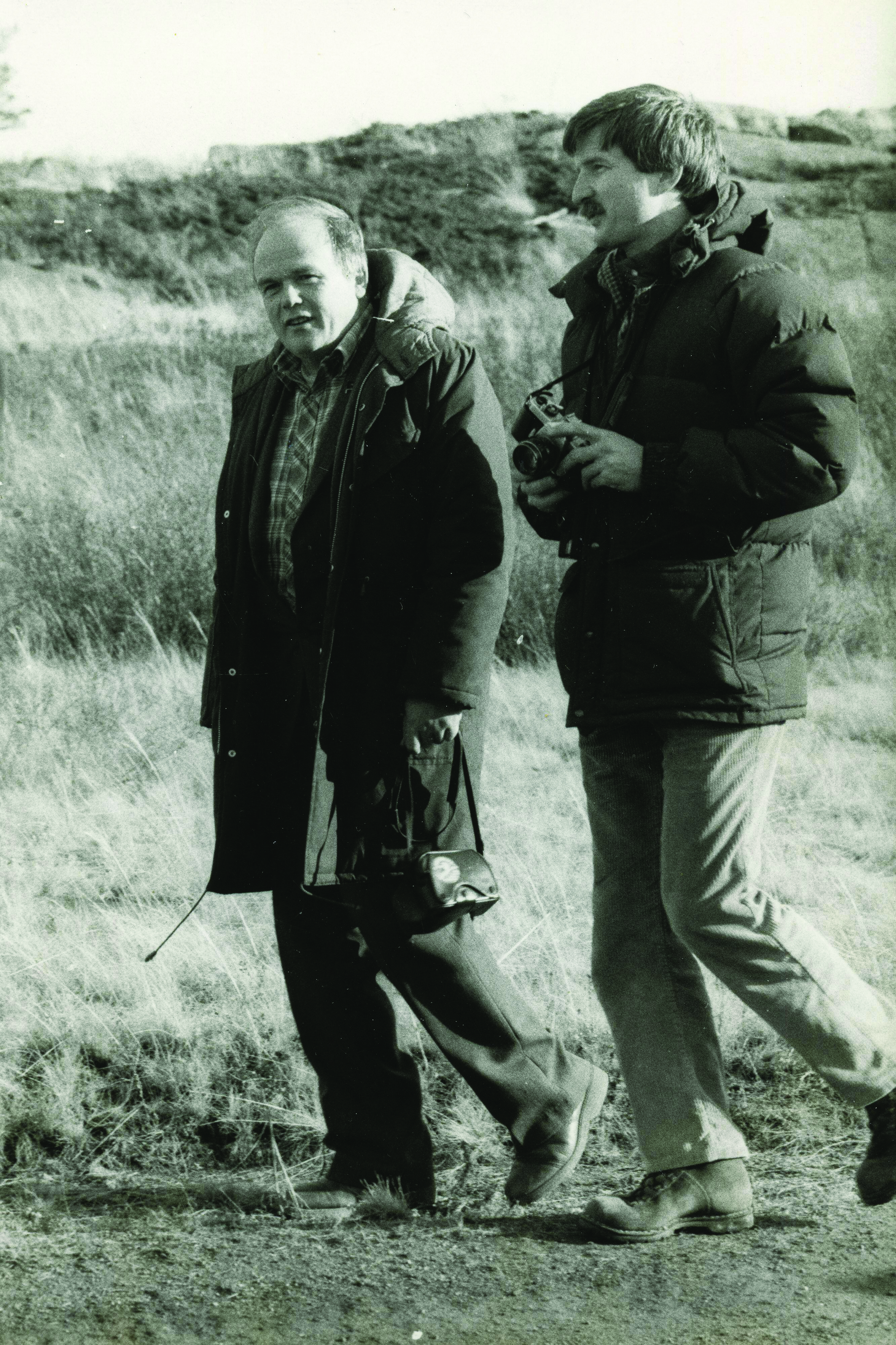
Soviet physicist Evgeny Velikhov (left) with US physicist Thomas Cochran in Kazakhstan in 1986.
(Photo from Colaimages/Alamy.)

The administration’s rhetoric about nuclear warfighting provoked the rise of a mass movement in the US calling for a freeze in the nuclear arms race. (See the January 1983 PT article “The freeze and the counterforce race ,” by Harold Feiveson and Frank von Hippel.) That movement arguably peaked on 12 June 1982, when a huge, exuberant crowd of protesters with banners marched in New York City from the United Nations headquarters to Central Park, where approximately 1 million activists gathered to hear speeches.
Nine months later, Reagan shifted his focus and announced the Strategic Defense Initiative (SDI), a proposed space-based missile defense system that he claimed would make Soviet missiles “impotent and obsolete.” He offered to share the technology with the Soviet Union. Critics ridiculed the initiative as a fantasy and labeled it Star Wars.
The Soviet government had already had internal debates over space-based ballistic-missile defense systems. In the late 1960s, one institute suggested shooting down incoming warheads with lasers or particle beams. And in the early 1980s, one of the bosses of the Soviet missile complex proposed placing interceptors in orbit like those proposed shortly thereafter by the Reagan administration (and now by the Trump administration).
Evgeny Velikhov, a fusion physicist who was one of the vice presidents of the Academy of Sciences of the Soviet Union and later president of the Kurchatov Institute of Atomic Energy, had developed high-powered lasers and was invited by the Soviet leadership to participate in its reviews of the ballistic-missile defense proposals. Those reviews highlighted the systems’ limitations and vulnerabilities. (For more on Velikhov’s role, see his November 1989 PT article, “Science and scientists for a nuclear‐weapon‐free world .”)
Velikhov and one of us (Sagdeev), at the time the director of the Space Research Institute of the Soviet Academy of Sciences, had benefited from dialogues on nuclear arms control with senior US physicists who had advised their government on nuclear weapons issues. The US National Academy of Sciences had recently created the Committee on International Security and Arms Control to engage with foreign counterparts. 1 Members included Richard Garwin, Marvin Goldberger, Wolfgang Panofsky, and Charles Townes.
In the wake of Reagan’s SDI announcement, Velikhov organized the Committee of Soviet Scientists for Peace and Against the Nuclear Threat (CSS), a new body within the Soviet Academy that would engage with the US scientific community more broadly. Sagdeev, who initially served as Velikhov’s deputy and succeeded him as chairman of the CSS, led several studies that recommended that the Soviet Union not attempt to emulate the SDI program. Instead, the studies proposed that the Soviet Union adopt a much less costly asymmetric strategy of countermeasures to neutralize any US space-based defense system.
The CSS also reached out to its counterparts in the US. Back in 1972, during the era of Cold War détente, the US and Soviet Union had ratified the Anti-Ballistic Missile (ABM) Treaty, which placed strict limits on the two countries’ ballistic-missile defenses. The committee wrote an open letter to US scientists asking whether they had changed their opposition to ballistic-missile defense. Mathematician Jeremy Stone, director of the Federation of American Scientists, and one of us (von Hippel), the FAS chairman, wrote back,
We want the ABM Treaty strengthened rather than weakened. And we consider this Treaty to be the fulcrum on which new limitations on offensive weapons can, and must be, based. Without this Treaty, the arms race would soon speed up, and become still more dangerous than it is even today. 2
That exchange launched a series of reciprocal visits that allowed the CSS and FAS to brainstorm about strategies for nuclear arms control.
Gorbachev’s nuclear-testing moratorium
Velikhov was invited in December 1984 by the Central Committee of the Soviet Communist Party to accompany a young member, Mikhail Gorbachev, on a trip to the UK. After returning, Velikhov became a close adviser to Gorbachev, who became the leader of the Soviet Union in March 1985.
The first nuclear arms control initiative that Gorbachev announced was a unilateral moratorium on Soviet underground nuclear weapons tests starting on 6 August 1985, the 40th anniversary of the atomic bombing of Hiroshima. Although originally intended to last until the end of that year, it ended up being extended through 1986. It was an echo of Nikita Khrushchev’s unilateral nuclear test moratorium of 1958, which Dwight D. Eisenhower joined five months later and which ultimately helped lead to the 1963 Partial Test Ban Treaty that banned nuclear tests everywhere except underground.
Underground testing was not prohibited in that treaty because of concerns from both sides. In the US, test-ban opponents made exaggerated claims that the Soviets could reduce the seismic signals of underground nuclear explosions by a factor of 300 by conducting them in huge, deep caverns. The Soviets, on the other hand, were paranoid about the US’s demand for a large quota of annual on-site inspections at the locations of suspect seismic events in the Soviet Union. 3

Two seismograms taken by a Norwegian seismic array on 14 September 1979 illustrate the advantage of taking measurements above the normal frequency range used for studying earthquakes. The upper seismogram shows the signal from a distant earthquake in the 1.2- to 3.2-hertz frequency band. The lower seismogram, taken in the 3.2- to 5.2-hertz band, shows an event in Kazakhstan that was determined to be a small, 0.5-kiloton nuclear test.
(Figure adapted from L. B. Loughran, ed., Semiannual Technical Summary, 1 April–30 September 1984 , sci. rep. no. 1-84/85, NORSAR, November 1984, p. 62.)

Even though Reagan was not interested in joining Gorbachev’s underground-test moratorium, an international organization called the Parliamentarians for Global Action commissioned Charles Archambeau, a US expert on the seismic detection of underground nuclear tests, to design a system that could verify a bilateral moratorium if one were instituted. He proposed constructing clusters of seismic stations around the test sites.
Velikhov was thinking along similar lines. Two months after the Soviet testing moratorium began, while he was at a conference on nuclear arms control in Copenhagen on the occasion of the 100th anniversary of Niels Bohr’s birth, Velikhov proposed to “organize a [nongovernmental] laboratory to detect nuclear explosions. We do not need anyone’s permission to make it. . . . Let us turn for money to the individuals and organizations who are worried about the nuclear threat.” 4
Von Hippel, who attended the conference, told Velikhov that he would try to find Western groups that might be interested in supporting the effort.
Another of us (Cochran) independently began developing a similar monitoring proposal. At a workshop in Moscow organized by Velikhov and von Hippel in May 1986, Cochran proposed that the Soviet Academy of Sciences and the Natural Resources Defense Council (NRDC), the US environmental group where he worked, establish jointly operated seismic stations around the two nations’ nuclear test sites: the Semipalatinsk Test Site in northeastern Kazakhstan and the Nevada Test Site. After deliberating with his colleagues and seeking government approval over the weekend, Velikhov signed an agreement for collaboration with Adrian DeWind, the NRDC chair, who had accompanied Cochran to the workshop.

US seismologists with seismometers on a granite outcrop about 200 kilometers from the Semipalatinsk Test Site in northeastern Kazakhstan to measure surface background noise. Permanent seismometers were placed in 100-meter-deep boreholes to isolate them from the surface noise.

Archambeau, who also participated in the Moscow workshop, reached out to Jonathan Berger, a leading seismologist at the Scripps Institution of Oceanography at the University of California, San Diego, and he agreed to recruit a group of US seismologists for the collaboration. Mikhail Gokhberg, deputy director of the Soviet Academy’s Institute of Physics of the Earth, recruited seismologists from his institute.
Berger and his team chose seismometers capable of recording higher-frequency signals so that they could distinguish earthquakes from chemical and nuclear explosions. DeWind’s connections in the Reagan administration helped speed US government permissions to ship the seismometers to the Soviet Union and to set up seismic stations on federal land around the Nevada Test Site. 5
The US and Soviet seismologists arrived with their equipment in Kazakhstan on 9 July 1986 and began the process of setting up three seismic stations around the Semipalatinsk Test Site. 6 Two years later, the NRDC was able to invite the Soviet seismologists to Nevada. The collaboration calibrated the seismic transmissivity of the rock under the test sites with nearby chemical explosions.
The Soviet display of openness had a dramatic impact in the US House of Representatives. Christopher Paine, a congressional staffer who attended the May 1985 workshop in Moscow, worked with then–Representative (and now Senator) Edward Markey (D-MA) on a measure that would have required the US to place a moratorium on nuclear tests with yields above 1 kiloton as long as the Soviet Union reciprocated. The measure passed the House in August 1986, but it took six years before enough support could be found in the Senate to force a stop to US nuclear testing. The moratorium legislation, which was signed into law by George H. W. Bush in October 1992, also required the executive branch to initiate negotiations on a treaty banning all nuclear tests.
Negotiations in Geneva produced the Comprehensive Nuclear-Test-Ban Treaty in 1996. Although the treaty still has not entered into force—it has not yet been ratified by nine required states, including the US—it has been complied with since 1998 by all nuclear-armed countries other than North Korea. (Both Trump administrations have accused Russia and China of carrying out small nuclear tests, but they have not provided any evidence for Russian tests, and their seismic evidence for possible Chinese tests is ambiguous.)
Nuclear glasnost
Glasnost, or openness, was Gorbachev’s policy to facilitate internal Soviet political reform. Starting with the 1986 Soviet test-site monitoring initiative, Velikhov used glasnost to promote international nuclear arms control. 7 The next year, he partnered with Cochran and his group at the NRDC to bring a US delegation—including three members of the House, members of their staff, and two US journalists—to visit one of the newly established joint seismic monitoring stations in Kazakhstan.
After they returned to Moscow, Velikhov arranged a second site visit to a large Soviet phased-array radar under construction near Krasnoyarsk in Siberia. 8 The US government had pointed out that the radar violated the ABM Treaty, which required that all early-warning radars be located on the periphery of the country and face outward. But the visitors saw that the radar was not hardened against nearby nuclear explosions and that the spacing of its receiver components meant that its wavelength was too long for battle management and that it indeed was an early-warning radar. Two years later, Soviet Minister of Foreign Affairs Eduard Shevardnadze—one of Gorbachev’s reformist allies—acknowledged that the radar violated the ABM Treaty, and the government began tearing it down.
Immediately following the 1989 Black Sea Experiment discussed below, Velikhov took a similar US delegation, including Cochran, Paine, and von Hippel, to visit Ozersk, a closed plutonium production city in the Ural Mountains, to show that the Soviet Union was beginning to shut down its production reactors. (US plutonium production reactors had already been shut down by then because of safety concerns after the 1986 Chernobyl accident in Ukraine.) The visit started the two countries down a path to a 1994 bilateral Russian–US agreement to end plutonium production for weapons. 9
Velikhov then took the same group to visit a laser director at the Soviet ballistic-missile defense test site at Sary Shagan in Kazakhstan. A Pentagon publication claimed that the facility was part of a clandestine Soviet counterpart to SDI. 10 The visitors found, however, that it contained only low-powered lasers. As Velikhov related in his 1989 PT article , the operators stated that they had been unable to even detect a reflection from a satellite equipped with a retroreflector. Velikhov gave his own account of those adventures in his 2012 memoir, Strawberries from Chernobyl: My Seventy-Five Years in the Heart of Turbulent Russia.
Warhead detection and dismantlement
Sagdeev, who took over from Velikhov as chairman of the CSS, and von Hippel at the FAS established in 1987 a joint study group on the detection and verified dismantlement of nuclear warheads. Von Hippel’s interest was reinforced by testimony given at the 1988 ratification hearings for the Intermediate-Range Nuclear Forces Treaty, which eliminated all Soviet and US land-based missiles with ranges between 500 and 5500 kilometers. A Reagan administration official explained that the treaty did not provide for the destruction of the missile warheads because verifying that they had been destroyed would be too intrusive.

During a detection test on 5 July 1989, a nuclear-armed cruise missile was loaded into one of the launchers of the Soviet missile cruiser Slava (top, pictured in 1983), and a neutron detector developed by Soviet physicists was carried by a helicopter (bottom left). The detector was able to pick up neutrons from spontaneous fission of plutonium-240, a minor isotope present in warheads, up to 70 meters away. Soviet physicists later shared that the system had been flown over US nuclear-armed ships. On board the Slava (bottom right), a Soviet experimental physicist (right) uses a liquid-nitrogen-cooled germanium-crystal scintillation counter to measure the gamma-ray spectrum from the cruise missile warhead. Steve Fetter and Thomas Cochran took similar measurements with a US-made counter. 17
(Slava photo from Wikimedia Commons/National Archives at College Park, MD, photo no. 6380582.)

Sagdeev, on the other hand, was motivated by Soviet arms control concerns: US sea-launched cruise missiles could easily reach Moscow from the waters around Europe, so the Soviets wanted to include them in future arms control agreements limiting nuclear missiles and warheads. But US negotiators had rejected that proposal on the basis that it would be impossible to nonintrusively distinguish nuclear-armed cruise missiles from conventional ones. Sagdeev thus wanted to determine the ranges at which radiation detectors could identify the presence of warheads on ships.
Cochran and Velikhov agreed in 1988 to demonstrate the use of various types of radiation detectors for identifying the presence or absence of nuclear warheads on ships. With Gorbachev’s backing, Velikhov was able to acquire for one day (5 July 1989) the use of the Soviet Black Sea Fleet’s flagship, the nuclear-armed missile cruiser Slava. In what came to be known as the Black Sea Experiment, a helicopter with a neutron detector developed at the Kurchatov Institute strapped to its side successfully picked up neutrons from spontaneous fission of plutonium-240, a minor isotope present in the cruiser’s warheads, from 70 meters away.
The joint FAS–CSS study group ultimately produced a 1990 book, Reversing the Arms Race: How to Achieve and Verify Deep Reductions in the Nuclear Arsenals, edited by von Hippel and Sagdeev, that proposed a nonintrusive approach to nuclear warhead dismantlement. Congress ordered the Department of Energy to do its own study of verified warhead dismantlement. The DOE report did not rebut the FAS–CSS approach but questioned the value of verifying warhead dismantlement given the uncertainty of the size of the Soviet stockpile. 11
That underlined the potential importance of nuclear archaeology—checking the veracity of declarations by the Soviet Union and the US of the quantities of plutonium and highly enriched uranium that they had produced. All the Soviet and most US plutonium had originated in graphite reactors. As part of the FAS–CSS study, Steve Fetter of the University of Maryland showed that neutron transmutation of trace elements in the graphite could be used to estimate the neutron fluence to which the graphite had been exposed and thereby the cumulative amount of plutonium the reactors had produced. That technique was tested and verified as accurate by Pacific Northwest National Laboratory, but it has not yet been incorporated into an arms control agreement. 12
Many of the study group papers were also published in Science and Global Security, a joint US–Soviet journal originally proposed by Sagdeev in the 1980s and founded in 1989 by Harold Feiveson, who edited the journal for 20 years, von Hippel, and Sagdeev. It continues to publish articles on the technical basis for nuclear arms control.
Workshops on eliminating nuclear warheads
Cochran and Paine at the NRDC, von Hippel at FAS, and Sergei Kortunov, a young, new-thinking official in the Soviet (and later Russian) foreign ministry, co-organized a series of international workshops from 1990 to 1993 with scientists from the weapons laboratories. The objective was to brainstorm about how to dispose of the nuclear material inside the excess warheads from the Cold War and downsize the nuclear weapons complexes.
At the October 1991 workshop in Washington, DC, Thomas Neff, an MIT physicist who had written a book about uranium markets, approached Viktor Mikhailov, a weapons physicist who was serving as the Soviet Union’s deputy minister of atomic energy and would soon become Russia’s minister of atomic energy. Neff proposed that the Soviet Union, which was entering a deep economic depression, could dispose of the highly enriched uranium from its excess warheads by blending it down to low-enriched uranium that would be sold as fuel for nuclear power plants. In that way, the possibility of weapons-grade uranium being sold on the black market by desperate nuclear workers would be forestalled. The idea made sense to Mikhailov, and Neff soon publicized it with an op-ed in The New York Times. 13 Neff’s idea drew support from key officials in the Clinton administration, including physicists Ernest Moniz and James Timbie, and in Congress, where it was championed especially by Pete Domenici, a Republican senator from New Mexico. 14
The resulting “megatons-to-megawatts” deal blended down 500 tons of Soviet weapons-grade uranium from approximately 20 000 warheads to provide about half the fuel used by US nuclear power reactors over two decades, from 1993 to 2013. A related agreement, facilitated in large part by Paine—who arranged for Mikhailov to meet with key US senators—saw the US fund the construction of a secure storage facility for the plutonium recovered from the Soviet warheads. 15 Both the proceeds from the nuclear fuel sales, which totaled roughly $17 billion, and the secure storage facility may have forestalled the nightmare of loose nukes available on the black market.

The world’s estimated stock of nuclear warheads from 1945 to 2023. In the past three years, the global stockpile has probably increased by a few hundred warheads because of China’s expansion of its nuclear arsenal.
(Figure adapted from ref. 18 )

The legacy
Gorbachev’s pursuit of nuclear disarmament and his freeing of the captive nations of Eastern Europe ended the Cold War and made possible huge cuts in the global stockpile of nuclear weapons, which we—along with many others—helped facilitate. We offer this account because we hope similar opportunities will come to a younger generation of physicists, and we wanted to share what worked for us. We learned the importance of international workshops and seminars in exploring the possibilities of progress. We also learned that international demonstrations and visits to key facilities can attract much more public and government attention than writing papers.
Finally, we pass along the sage advice of Neff. “I think there are always opportunities,” he observed in an interview.
There are always people who see something that can be fixed. The average college graduate will probably have an opportunity in his or her life to do something that actually improves things.
But the trick is recognizing it. 16
References
1. M. Evangelista, Unarmed Forces: The Transnational Movement to End the Cold War, Cornell U. Press (1999), pp. 148, 156.
2. J. J. Stone, F. von Hippel to A. D. Alexandrov (18 April 1983), reproduced as “FAS answer to Soviet scientists ,” in F.A.S. Public Interest Report, May 1983, p. 12.
3. W. Burr, H. L. Montford, eds., “The making of the Limited Test Ban Treaty, 1958–1963 ,” National Security Archive (8 August 2003).
4. E. Velikhov, “Niels Bohr and the Crisis in the Development of Mankind,” in The Challenge of Nuclear Armaments: Essays Dedicated to Niels Bohr and His Appeal for an Open World, A. Boserup, L. Christensen, O. Nathan, eds., U. Copenhagen (1986), p. 136.
5. P. G. Schrag, Listening for the Bomb: A Study in Nuclear Arms Control Verification Policy, Westview (1989).
6. J. Berger et al., “A new U.S.–U.S.S.R. seismological program ,” Eos 68, 105 (1987).
7. D. E. Hoffman, “The Glasnost tours: Breaking down Soviet military secrecy ,” National Security Archive (29 April 2010).
8. W. J. Broad, “Inside a key Russian radar site: Tour raises questions on treaty ,” New York Times, 7 September 1987, p. 1.
9. International Panel on Fissile Materials, “U.S.–Russian Agreement on the Shutdown of Plutonium Production Reactors ” (23 June 1994).
10. Defense Intelligence Agency, Soviet Military Power 1985, US Department of Defense, p. 58.
11. J. L. Fuller, Verification of Nuclear Warhead Dismantlement and Special Nuclear Material Controls , US Department of Energy (July 1992).
12. S. Fetter, “Nuclear archaeology: Verifying declarations of fissile‐material production ,” Sci. Glob. Secur. 3, 237 (1993); T. W. Wood et al., Feasibility of Isotopic Measurements: Graphite Isotopic Ratio Method , PNNL-13488, Pacific Northwest National Laboratory (April 2001).
13. T. L. Neff, “A grand uranium bargain ,” New York Times, 24 October 1991, p. A25.
14. J. L. Hughes, Megatons into Megawatts: The Deal Eliminating 20,000 Atomic Bombs (2025).
15. US General Accounting Office, Weapons of Mass Destruction: Effort to Reduce Russian Arsenals May Cost More, Achieve Less Than Planned , GAO/NSIAD-99-76 (April 1999).
16. J. Lott, “The power of a transformative idea ,” Lewis & Clark Magazine, Fall 2014.
17. S. Fetter et al., “Gamma-ray measurements of a Soviet cruise-missile warhead ,” Science 248, 828 (1990).
18. H. M. Kristensen et al., “Nuclear Notebook: Nuclear Arsenals of the World ,” Bulletin of the Atomic Scientists (2026).
More about the authors
Frank von Hippel is a senior research physicist and emeritus professor of public and international affairs in the Program on Science and Global Security at Princeton University in New Jersey. He is the author of the 2024 memoir Ending the Nuclear Arms Race: A Physicist’s Quest.
Roald Sagdeev is a Distinguished University Professor Emeritus in the department of physics at the University of Maryland, College Park. He is the author of the 1994 memoir The Making of a Soviet Scientist: My Adventures in Nuclear Fusion and Space from Stalin to Star Wars.
Thomas Cochran is a former senior scientist at the Natural Resources Defense Council’s nuclear program and a former member of the Department of Energy’s Nuclear Energy Advisory Committee.