Two teams take different routes to resolve atomic collisions

The air around us is never still. Molecules are constantly moving, ping-ponging off each other and every surface. Each molecule’s billions of collisions per second quickly add up to create the measurable air pressure we perceive as a steady, enveloping presence.
Corralling that atomic-scale chaos for quantitative study is no easy task. Now two independent research teams have harnessed laser-suspended nanoparticles to measure with high precision the minuscule momentum transferred during a singular molecular impact. 1 2

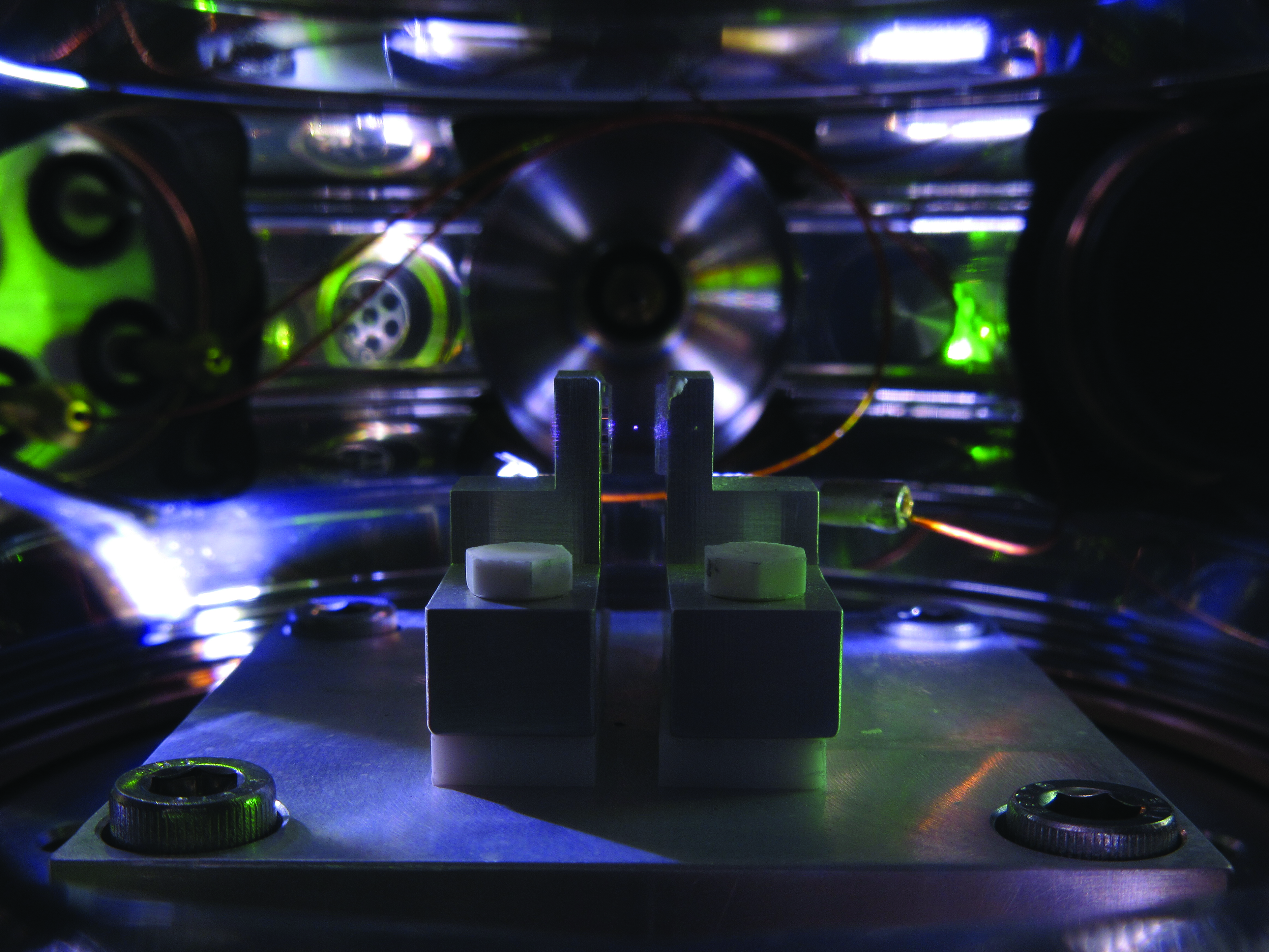
In a lab at ETH Zürich, a 100-nm-diameter levitating glass bead was used to record the kicks delivered by impacts from individual atoms in a pulsed beam of supersonic xenon.
(Photo courtesy of Maxime Perdriat, ETH Zürich.)
Their methods could be leveraged to measure ultralow-vacuum pressure below what’s reachable by conventional gauges and to aid in the study of neutrinos, including a dark-matter candidate.
A team at ETH Zürich led by Lukas Novotny cooled a glass ball down to its motional quantum ground state (an achievement first reported in 2020, as described in the PT article “An optical trap nudges a nanoparticle into its motional ground state ”) and aimed a supersonic pulsed beam of xenon atoms at it. By controlling the timing, direction, and velocity of the xenon atoms, the team was able to clearly distinguish xenon collisions from background noise and precisely record the recoil of the nanosphere.
Because nanospheres have such low mass, “they are extremely sensitive to any fluctuation or perturbation,” says Maxime Perdriat, lead author of the ETH Zürich paper. “So they are very good force sensors.”
Researchers led by David Moore at Yale University took a different approach to measuring single collisions: They released tiny amounts of various gases into the chamber and measured collisions between the nanosphere and atoms that come from all directions. The greater amount of noise in that environment meant that the recoil measurements were less precise, but they could be checked against theory and used to estimate pressure and properties of the nanosphere, including its temperature.

Researchers in the Yale Wright Laboratory examine the equipment used for optically levitated nanoparticle experiments. From left to right are former postdoc Thomas Penny and current graduate students Yu-Han Tseng and Cecily Lowe.
(Photo courtesy of Yale Wright Lab.)

“We saw this beautiful [momentum] spectrum that follows the kinetic theory of gases over many orders of magnitude,” Moore says.
Both teams plan to use the ultrasensitive momentum measurements to investigate particles that are otherwise challenging to probe. Novotny’s lab intends to target particles at the low end of the momentum range, which include cosmic particles and dark-matter candidates.
Moore’s team has started to embed the radioisotope fluorine-18 in the nanosphere—a small percentage of the radioactive decay events from that isotope occur through electron capture and neutrino emission. Neutrinos are notoriously hard to measure because of their low propensity for interaction with other particles, but they’d leave detectable footprints in the recoil caused by their emission. Previously, Moore’s group had made recoil measurements of radioactive alpha-decay events (see the 2024 PT article “Levitating beads reveal radioactivity ”), which he says have about 200 times the momentum of a neutrino. The team’s latest measurements are far more sensitive than what is needed to measure neutrino recoil.
Neutrinos interact with other particles in the standard model of particle physics only via the weak interaction and gravity. But one hypothetical type of neutrino, yet to be observed, interacts only via gravity; called the sterile neutrino, it’s a candidate for dark matter. Researchers hope that, if it does exist, it might one day be observed in the tiny wobble of a glass bead.

Inside a vacuum chamber, a 150-nm-diameter glass sphere is suspended by a laser. Researchers at the Yale Wright Laboratory used a similar setup with a 100 nm sphere to measure the momentum transferred by individual gas molecules that collide with it.
(Photo courtesy of Thomas Penny, Yale Wright Lab.)

References
1. M. Perdriat et al., “Single-atom detection with a quantum-controlled mechanical oscillator ,” Phys. Rev. A 114, 023515 (2026).
2. Y.-H. Tseng et al., “Optomechanical detection of individual gas collisions ,” Phys. Rev. Lett. 137, 173601 (2026).