World lays groundwork for future linear collider
DOI: 10.1063/1.3463620

With the Large Hadron Collider at CERN finally working, the particle-physics community can now afford to divide its attention between achieving LHC results and preparing for the next machine on its wish list, an electron–positron linear collider. The preparations involve developing and deciding on the technology for such a machine, the mode of its governance, and how to balance regional and global particle- and accelerator-physics programs.
The consensus among particle physicists is that a lepton machine will be needed to make the most of the LHC results. Because protons have components, smashing them together yields a complicated web of particle interactions. From those interactions, scientists will determine only general characteristics of the most interesting physics, and they’ll want to get at the details from the cleaner collisions between more-elementary leptons. The University of Tokyo’s Sachio Komamiya, a member of the International Linear Collider (ILC) steering committee and of the International Committee for Future Accelerators, points to the bottom quark, the charm quark, the W and Z bosons, and gluons as examples of particles for which hadron and lepton collisions played complementary roles. “From the long history of high-energy physics,” he says, “we need both hadron and lepton machines. And we need the next electron–positron machine in a timely fashion for it to have some interplay with the LHC.”
Competing technologies
At electron-positron collision energies approaching a TeV (1015 eV), there is no doubt you have to go to a linear machine, says Barry Barish, director of the global design effort for the ILC, the more advanced of two rival projects for a future linear collider. “What limits a circular machine is [energy loss via] radiation. You are forced to make the ring so huge that it becomes too expensive and takes too much property.” The downside in a linear collider is that particles pass through each accelerating element only once, “so you have to be very efficient going from the wall plug to the particles,” notes Barish. And the particles cross paths only once, so to raise the probability of collisions, the beams have to be focused down to a tiny diameter.
In the ILC, the particles would be accelerated with superconducting microwave cavities powered by klystrons. Spearheaded by scientists in the US, Europe, and Japan, the ILC, with its maximum collision energy of 1 TeV, would be 48 km long; the plan is to start with a 0.5-TeV, 30-km-long collider.
For several years the ILC was considered to be the only option for a future linear collider, recalls CERN council chair Michel Spiro. But the delays to the LHC meant a decision could be pushed back, “and CLIC started to become a more realistic approach.” CLIC, the Compact Linear Collider, got started more than 20 years ago at CERN. Funding for its R&D has picked up recently, and 38 institutions in 19 countries are now involved in the project. It’s generally considered to trail the ILC by at least five years.
In a novel scheme, CLIC’s muzzle-to-muzzle electron and positron linear accelerators—the so-called main beam—are each powered by a parallel drive beam. In the drive beams, GeV electrons are decelerated and the resulting RF energy accelerates the main beam. “This is the most efficient way to produce [and transfer] high-peak RF power in short pulses to generate large accelerating fields,” says CERN’s Jean-Pierre Delahaye, CLIC study leader and a member of the ILC executive committee. “It’s like a transformer,” he explains, in that it exchanges high current for high voltage. Energy is extracted from the drive beam and transferred to the main beam at roughly one-meter intervals; fresh GeV electrons are injected into the drive beam every 880 meters. The high-energy electron and positron beams would each require a chain of two dozen such drive segments to get to 1.5 TeV.
“CLIC’s whole trick is to eliminate klystrons as the RF power source, which limits the ILC energy to about 1 TeV,” says Barish. For the same collider length, CLIC would reach three times the center-of-mass collision energy. “We have identified 10 feasibility issues, which we are solving one after the other,” says CERN’s Philippe Lebrun. Among them are maintaining a small beam diameter to maximize the collision rate, compensating for ground vibrations with active stabilization systems, and producing short pulses of RF. “We have a schedule and will have them all tested by next year. Not all simultaneously or full scale, but on a scale to give us confidence,” says Lebrun. “We have seen no showstoppers.”
A single objective
Over the past couple of years, the ILC and CLIC teams have built up a collaboration, formalized with a memorandum of understanding at the start of this year. Their cooperation spans research on the accelerator and detectors, civil engineering, and cost and scheduling. “The basic technology is different,” says Lebrun, “but we share a lot of things that represent a significant part of the total cost–things like part of the injector complex [and] creating small intense collimated beams. The machine–detector interface is similar for both.” Lebrun is cochair, with Brookhaven National Laboratory’s Michael Harrison, of the newest joint working group, which covers general issues, costs being perhaps the most important. The costs of the two projects are being worked up using the same algorithms so they can be compared. Previously, Barish says, “the two groups were distant and ignored each other. But barriers and bad blood have been largely broken down by cooperating. There is huge overlap. People are realizing that only be one in the world, and we should show our funding agencies that we work for the same objective.”
CERN director general Rolf-Dieter Heuer agrees: “The cooperation is extremely important. You save some resources by not reinventing the wheel on either side. You have a deeper insight into both projects. It’s sort of a collaboration and a competition, and by working together, it will be easier to agree on a single project.” Both by expanding the CLIC collaboration and cooperating with the ILC, CERN is positioning itself to participate in a future linear collider–wherever it is, and whichever technology is chosen.
Reach, cost, and risk
The choice of technology will be based on LHC results. Says Lebrun, “If the LHC tells us there is plenty of physics around 500 GeV, both machines could do it. If it says you have to go above 1 TeV to see supersymmetry or the Higgs zoo, then we could clearly go to CLIC technology.” The decision will come down to a balance of physics reach, cost, and risk, he says. “If you don’t need the higher energies, then it’s the right thing for both projects.”
One impetus for the cooperation was the hit to ILC funding in the US in fiscal year 2008. “It became apparent that it would be beneficial to pool resources in areas where there are evident synergies,” says Harrison. “There was a political need for collaboration,” Lebrun adds. “It is clear that if [any collider] is ever to be built, it will be very expensive. We need to capitalize on the efforts of the whole community. There will every advantage is with the ILC,” says Barish. “The technical risks and uncertainties are much larger with CLIC.”
A decision might be made as soon as 2012. “If nature is kind to us and has states of supersymmetry that are low mass, that could be a possibility for discovery in the next one or two years,” says Heuer. “If we are unlucky and the states have higher mass, it could take until 2015. This is crystal balling.” Following its delayed start (see Physics Today, October 2009, page 25 ), the LHC has been running at 7 TeV since the end of March. In 2012 it will be shut down for a year to bring it up to 14 TeV.
In the meantime, the ILC team plans to prepare a technical design report by 2012. “There is nothing fatally flawed in the earlier designs, so this is all optimization,” says Barish. The CLIC team will complete its feasibility studies and ready a conceptual design report next year. “So starting in 2012, you will be in a good position to know whether to make a push. There is convergence on that time scale,” Barish says. The earliest a linear collider could start taking data, he adds, is the mid-2020s.
“Avoid the mistakes”
As the first truly global particle-physics project, the next linear collider comes with a host of organizational problems: management structure, representation and voting in the governing body, inkind contribution evaluation, and legal status, to name a few.
One scheme would be to have a geographically and politically extended CERN manage the new project, taking advantage of the organization’s experience and its treaty-based legal status. CERN would have to open its membership to non-European countries. The LHC has contributions from around the globe, but about 90% of the accelerator cost was covered by Europe. A sore point is that the US has the largest LHC user group and is seen by some as free-loading. But there is no way that the US would contribute to CERN according to the organization’s fee formula, which is based on gross domestic product (GDP); that would make the US the biggest contributor and put a huge part of its budget for particle physics toward the future linear collider.
Not only are the US and China unwilling to pay so much for CERN, notes the University of Tokyo’s Komamiya, but it would be impossible for Japan. “And there are some worries about being swallowed up by CERN,” he adds. CERN is exploring different options for membership that may not be as closely linked to GDP or may allow membership in a project as opposed to the full lab. Says Heuer, “I hope we can come to a resolution which would open the door for opening CERN beyond the boundaries of Europe. That does not mean I expect many countries to join, but at least it would be an option.”
The opening of CERN membership, says Spiro, “is in the spirit that CERN would like to be ready, at least institutionally speaking, to host the next machine at the high-energy frontier.” Other possible sites include Dubna, Russia; Fermilab in the US; and Japan. As to whether the US would like to host the future linear collider, Dennis Kovar, the US Department of Energy (DOE) associate director of science for high-energy physics, says, “Out of context, yes, of course. In context, it’s more complicated.” A lab such as CERN could still manage the new machine if it’s built somewhere else. Or on site, CERN, Fermilab, or the KEK research institute in Japan could act as landlord—being responsible for safety and other issues but not the actual collider.
Another option for the legal status would be to create a treaty organization from scratch. That has its own difficulties, as demonstrated by the more than two decades it took to form ITER (the international fusion energy test reactor). Or a limited liability corporation could be created with the member countries as stakeholders. In a report presented in early June to the US High Energy Physics Advisory Panel, the linear collider steering group of the Americas writes that as far as legal status, the “most desirable will be an instrument that … maximizes the incentive of the parties to complete the project on an agreed upon schedule; provides ready access for the international staff … and users; [and] provides tax free access to equipment and materials for construction and operation of the facility.”
Who pays for operations is a likely sticking point. Until now, the host country has always paid the power bill—a significant cost—for the main accelerator, while users typically cover the cost of running their detectors. That model works in a world with big facilities on each continent, as envisioned by the current guidelines of the International Committee for Future Accelerators. But, says the University of Oxford’s Brian Foster, the European director for the ILC, “As you get to fewer installations, that averaging out fails to work. We need to address that.” Alternatives range from the host country’s paying the operating costs in full to countries paying in proportion to their numbers of users. “It’s premature to decide,” says Foster.
More generally, Foster says, “We are trying to avoid the mistakes which we can identify in current projects and [which] have been made by past ones. We are looking at big international projects—above $1 billion.”
One lesson is to ensure that countries’ cash contributions are enough to give the project flexibility. Pointing to the high level of in-kind contributions as a major cause of ITER’s troubles, Foster says that a minimum of 20% of the total budget should be cash. Another lesson is to avoid delays that would result from needing approval of a governing council—which meets infrequently—by giving the project director the authority to make most decisions. But, notes Foster, “until you have a host site, all of these governance issues are rather abstract.”
A balancing act
A problem that goes along with having fewer, bigger machines is how to keep national or regional accelerator- and particle-physics programs vibrant enough to attract new talent. There is talk about each region becoming preeminent in a particular field; for example, Europe could be host to the high-energy frontier, and the US and Asia could focus on the intensity frontier, such as intense proton beams to create neutrinos and muons, or on astroparticle physics—the “cosmic frontier.” Another model is for regions to sequentially host big machines. None of those models holds wide appeal, however.
“In a nutshell,” says Nobu Toge, a KEK accelerator physicist and member of the ILC global design effort, “each one of us prefers to have [the future machine] in his neighborhood for physical or economic or political motivations. Of particular importance are the issues associated with domestic education and training of younger generations, which have wide-ranging implications for our societies.”
Everyone, says Kovar, is struggling with the questions, “How do we go forward in a way that countries can contribute in an equitable way to facilities and research that is going to advance the field? How do we keep facilities open for all scientists from any country? How do we make investments so that everyone feels they are bearing a fair share? And how do we do it in a way that we also preserve national programs, and the benefits can be demonstrated to taxpayers?”

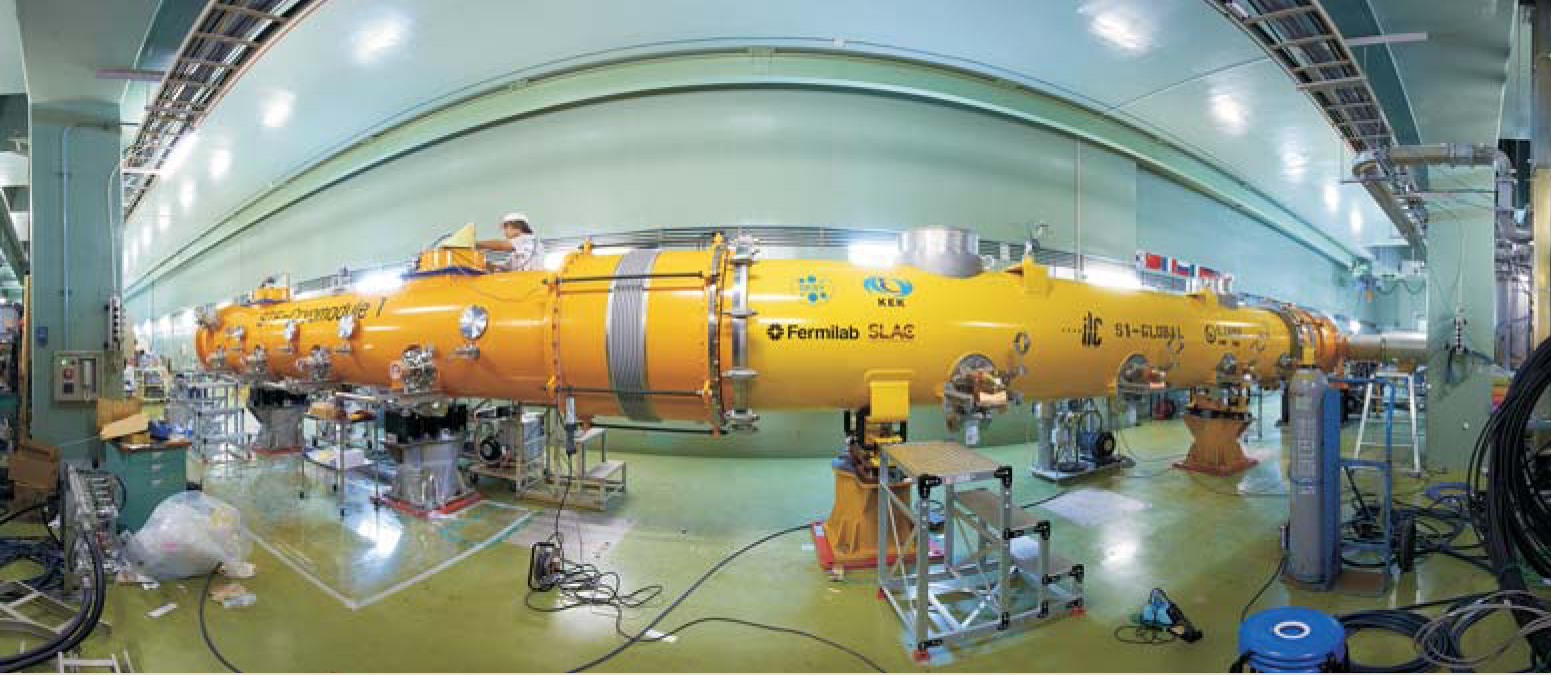
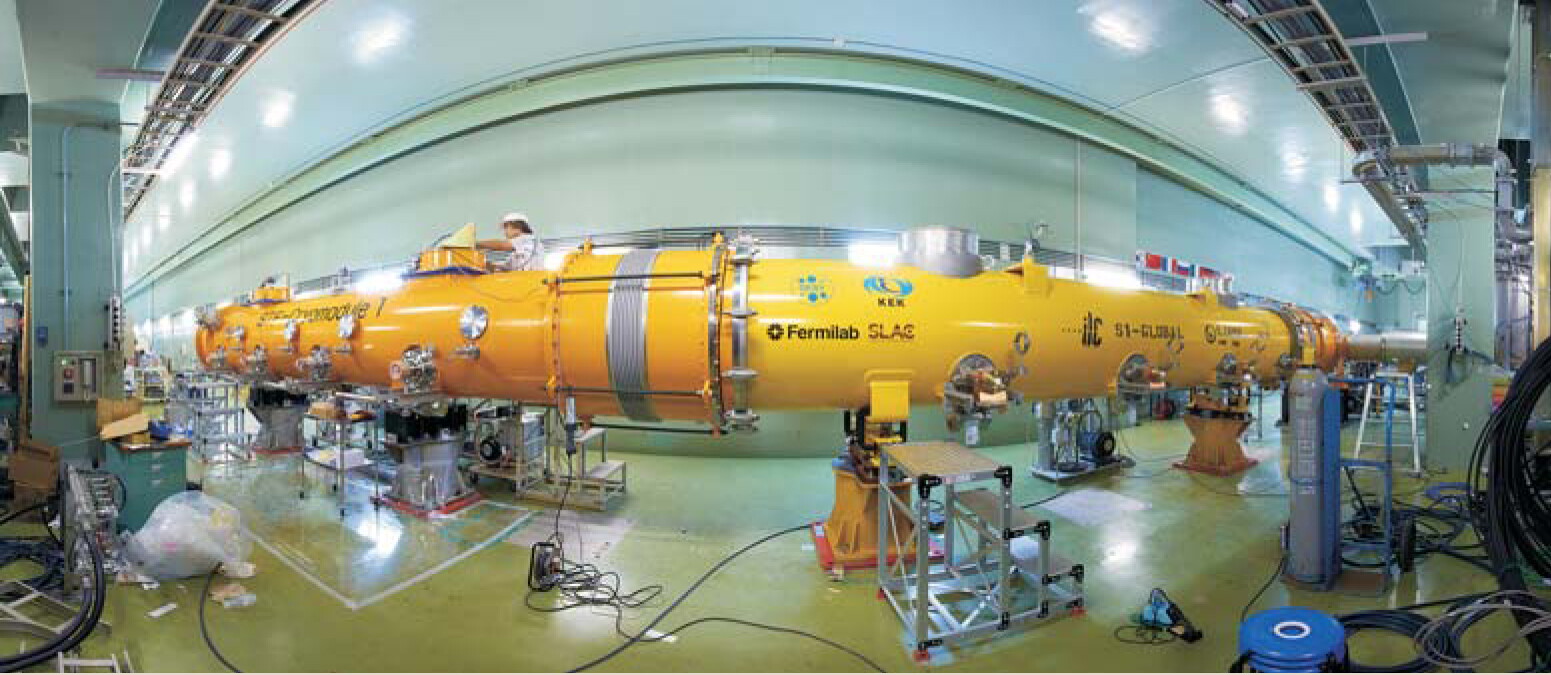
Tests on a cryomodule containing eight superconducting cavities are getting under way. The tests are intended to show that the International Linear Collider’s acceleration technology works, and that it works with parts fit together from around the world. The ILC would have more than 1000 such cryomodules.
NOBU TOGEKEK

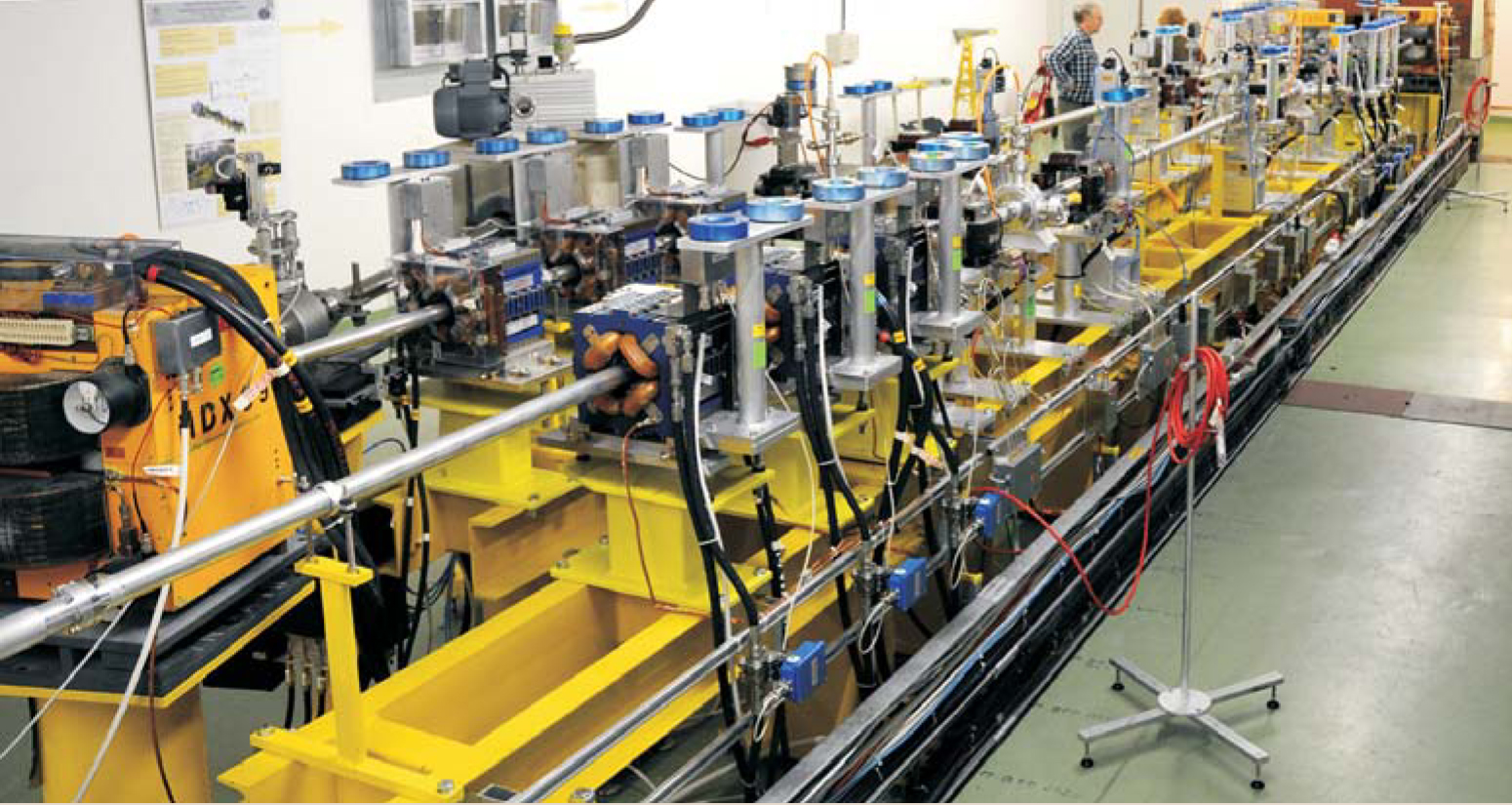
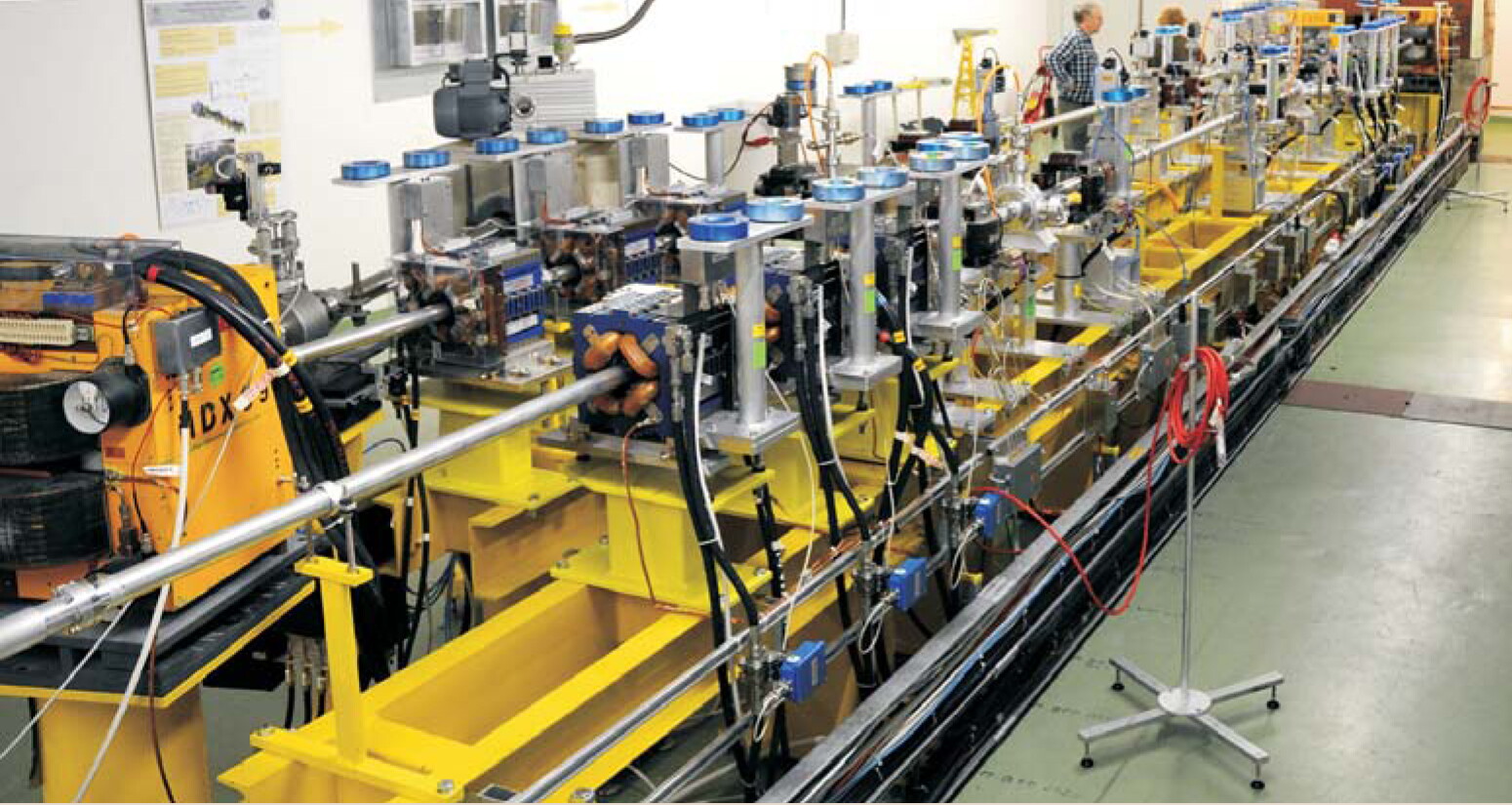
Feasibility tests for the Compact Linear Collider are in progress at CERN’s 17-meter-long two-beam test stand. A high-intensity, short-pulsed drive beam (closer beam) feeds the main beam through RF power extraction.
CERN
More about the authors
Toni Feder, American Center for Physics, One Physics Ellipse, College Park, Maryland 20740-3842, US . tfeder@aip.org