Why do active galactic nuclei differ?
DOI: 10.1063/PT.3.2440
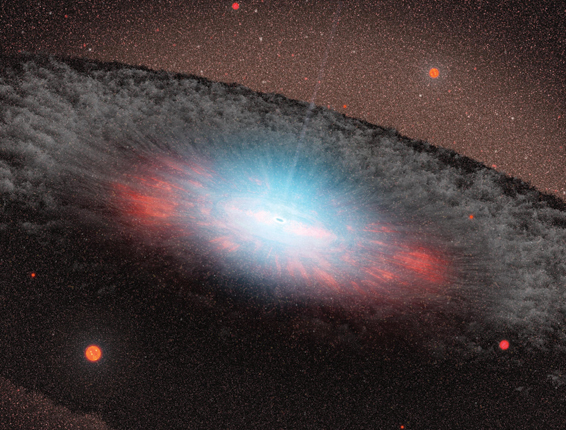
In some galaxies, including our own, the black hole sits inconspicuously in the middle. But in others, the black hole is orbited by a thick toroidal disk of hot gas. As material in the disk spirals toward the black hole’s event horizon, the disk’s inner region becomes so agitated and hot that it radiates copiously (see the accompanying artist’s impression). Such systems are known as active galactic nuclei, of which there are two broad classes. Type 1 AGNs have broad emission lines characteristic of hot, fast-moving matter. Type 2 AGNs have narrow lines characteristic of cool, slow-moving matter. Given that a thick torus shrouds the AGN engine, the two AGN types could conceivably differ only by viewing angle: Type 1s afford a face-on view of the hot, swirling inner disk; type 2s, an obscured view. Known as AGN unification, that appealing explanation can account for some of the differences between the two AGN types, but not all of them. Now Beatriz Villarroel and her thesis adviser Andreas Korn of Uppsala University in Sweden have shown that another factor is at play. Using data from the Sloan Digital Sky Survey, Villarroel and Korn looked at the neighboring galaxies of a sample of 11 334 type 1 and 53 416 type 2 AGNs. If viewing angle were the sole discriminant, the properties of galaxies in an AGN’s vicinity would have no bearing on its type. But that’s not the case. Compared with the neighbors of type 1s, the neighbors of type 2s are significantly bluer and seem to be making more stars. Although viewing angle does influence an AGN’s outward appearance, Villarroel and Korn’s findings indicate that type 1s and type 2s are intrinsically different, perhaps because of their collision histories. (B. Villarroel, A. J. Korn, Nat. Phys. 10, 417, 2014, doi:10.1038/nphys2951 .)

NASA/JPL