Westinghouse, Intel, and then? Research competition seeks new sponsor
DOI: 10.1063/PT.3.2978

Participating in what is now known as the Intel Science Talent Search (STS) was “a life-enhancing, maybe even life-changing, experience for me,” says MIT theoretical physicist Frank Wilczek, a 1967 finalist and later Nobel Prize winner. “There is a big gap between the processes of learning and researching and the final process of deciding the project is done and sharing the results with the world. The STS gives people that experience early and paves the way for later success.”
The annual US competition is open to original, individual research projects across all areas of science, engineering, and math by students in their last year of high school. Each year, 40 finalists spend a week in Washington, DC. “Having this trip down to Washington and meeting very famous scientists and having the experience of success and bringing my dreams within sight was profound,” says Wilczek. “It gave me a lot of confidence. Whenever I was struggling, I could always look back and say, I can’t be that bad.”
This fall, Intel gave notice that it would stop sponsoring the STS in 2017 after 20 years; before Intel, Westinghouse Electric Corp had sponsored it since the competition’s start in 1942. Intel’s move surprised the science community, the more so since the competition’s $6 million cost represents just a tiny fraction of the semiconductor company’s revenues. Intel did not respond to Physics Today’s phone calls or emails. “I believe that their corporate priorities have changed,” says Maya Ajmera, an STS alum and now president of the Society for Science and the Public (SSP), which runs the competition. The SSP has received a lot of interest from potential sponsors and aims to announce a new sponsor early next year, she says.
Each year, about 1800 students enter the STS, from which 300 semifinalists are chosen. That group is whittled down to 40 finalists, and prizes are awarded in basic research, global good, and innovation. In each category, the first-prize purse is $150 000, second is $75 000, and third is $35 000. The other finalists each take home $7500, and semifinalists and their high schools each get $1000.

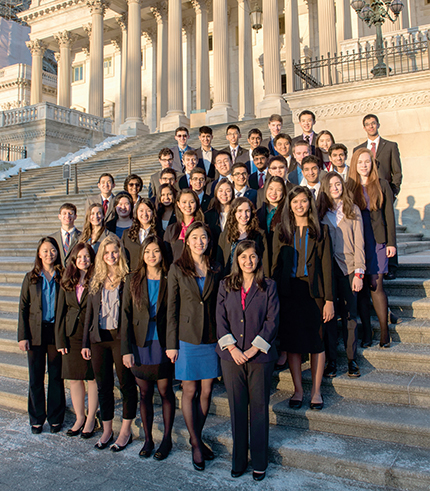
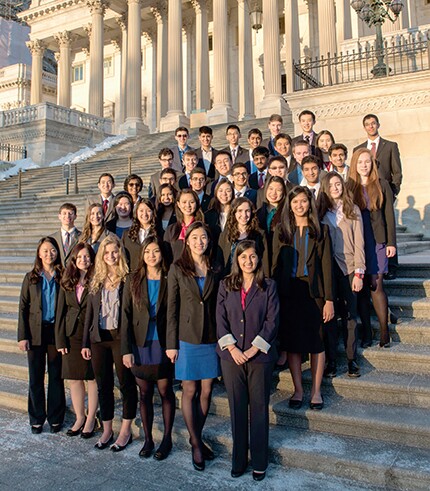
Finalists in the 2015 Science Talent Search visit the US Capitol.
CHRIS AYERS/SOCIETY FOR SCIENCE AND THE PUBLIC
Michael Winer won first prize in innovation this year for his calculations on electron–phonon interactions. Now a freshman at MIT, Winer—who earned a silver medal in the 2014 International Physics Olympiad—says, “it was kind of standard for high schoolers to enter a contest” in the science and math magnet program he attended at Montgomery Blair High School in Silver Spring, Maryland. In the STS judging process, he notes, he was quizzed about more than his project. “They asked hard questions,” he says. “What would happen if you tried to boil a pot of water in space? Tell me everything you know about cosmology. If you had to design a form of life that didn’t have DNA, how would you do it?”
Like Winer, most STS competitors come from high schools that have a culture of encouraging students to do science projects and enter such competitions and that provide support—from help with finding mentors at nearby universities to prompts about deadlines. “I love stories of how kids do experiments in their backyards and then enter and win,” says Angelique Bosse, the research coordinator for Montgomery Blair’s magnet program. “But it’s a long shot. You really need support.”
Broadening the accessibility of contests like the STS for underrepresented minorities and economically disadvantaged students is the aim of the new SSP Advocate Grant program, says Ajmera. Launched this year, the program awards stipends of $3000 to mentors who help several students enter projects in competitions. The program started with 9 grants this year, and Ajmera hopes to grow that to 100 annually.
Over the years, eight STS finalists have gone on to win a Nobel Prize in physics or chemistry, and other STS alumni have won MacArthur Fellowships, Fields Medals, and National Medals of Science. A sampling of finalists includes computer scientist and futurist Ray Kurzweil (finalist, 1965); Eric Lander (first place, 1974), now cochair of President Obama’s Council of Advisors on Science and Technology; theoretical physicist Lisa Randall (first place, 1980); and theoretical physicist Brian Greene (finalist, 1980), author of The Elegant Universe (W. W. Norton, 2010) and cofounder of the World Science Festival.
“They may have been successful without the Science Talent Search,” says Ajmera. “But alumni have told me that participating was a major inflection point in their lives and influenced them to pursue a career in science. The national recognition, networking, and friendships that were formed at STS played an important role.”
More about the authors
Toni Feder, tfeder@aip.org