Vast amounts of hydrogen are likely hidden under our feet
DOI: 10.1063/pt.qque.nmug
Trillions of tons of hydrogen gas are likely trapped in Earth’s subsurface, according to a new study. That’s potentially more than enough to meet the projected hydrogen needed to achieve net-zero carbon emissions for about 200 years.
Geoff Ellis, a petroleum geochemist at the US Geological Survey (USGS) who coauthored the 13 December paper in Science Advances, cautions that many of the hydrogen deposits may be too small or are located too deep or too far offshore to be economically practical for extraction. Nonetheless, he says, “it’s a big enough number that if we could find a fraction of that hydrogen, it could still be a significant resource.”
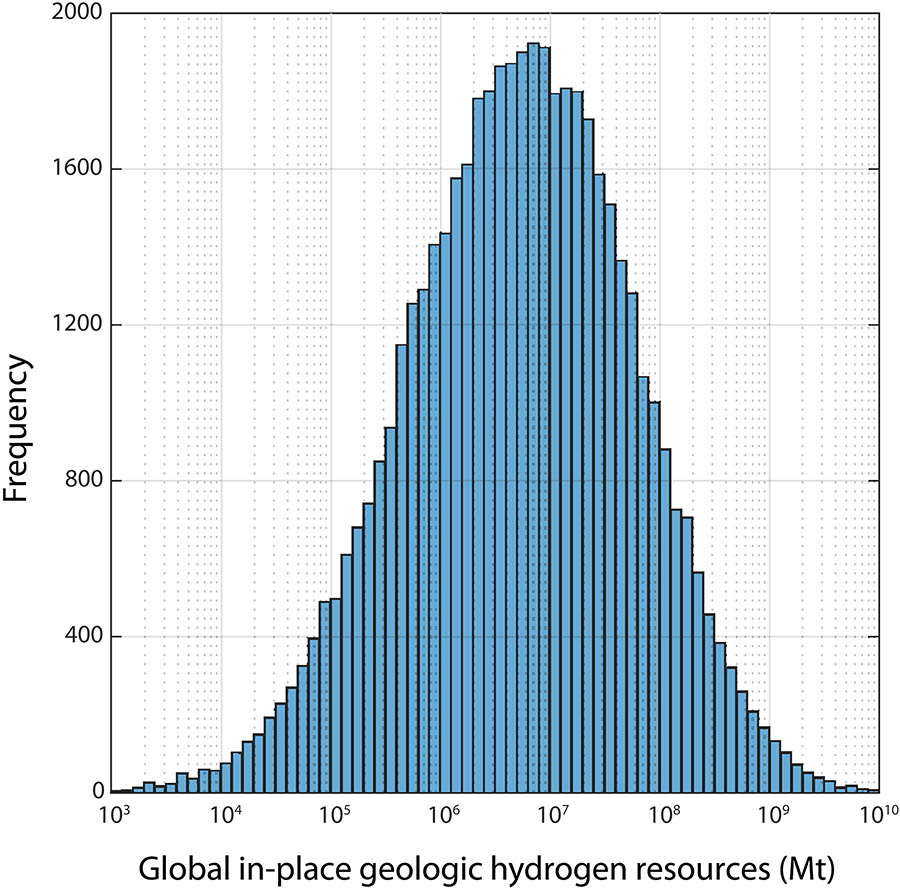
Ellis and his USGS colleague Sarah Gelman developed a model to predict global in-place hydrogen resources. It has significant uncertainty, with the estimated quantities ranging from thousands to billions of megatons, but the most likely value is about 5.6 million Mt. Global demand for molecular hydrogen, or H2, reached 97 Mt in 2023 and is expected to increase to about 530 Mt by 2050.
Frieder Klein, a geochemist at the Woods Hole Oceanographic Institution in Massachusetts, says that the latest paper is “probably the most detailed statistical analysis of geologic hydrogen resources I have seen.” He says that this study and others demonstrate “that there is a pressing need for basic research to better constrain the H2 formation conditions and rates, as well as the potential to trap and exploit geologic H2.”

Iron-rich rocks containing minerals such as the forsterite shown here can react with water at high temperatures to form hydrogen. (Photo from the Smithsonian National Museum of Natural History.)

Today, H2 is mainly used in industrial processes, such as refining petroleum and producing fertilizer and other chemicals. But hydrogen is a key energy source in plans to transition away from carbon-based sources. It has numerous potential clean-energy applications, such as using it as a replacement for carbon-rich natural gas, burning it to generate electricity, and using it in fuel cells, which run on hydrogen and produce water as a byproduct. The International Energy Agency estimates that hydrogen and hydrogen-based fuels could account for up to 30% of energy consumption in transportation by 2050.
Most commercially produced H2 is a byproduct of fossil-fuel processing, which emits large quantities of carbon into the atmosphere. It is also possible to manufacture the gas by using renewable energy to split water molecules, producing what’s referred to as green hydrogen; that method, however, is energy intensive and thus pricey (see Physics Today, August 2022, page 22 ). Last year, the US government committed $7 billion to green hydrogen projects to spur innovation in the sector.
Naturally occurring hydrogen, known as white hydrogen or geologic hydrogen, circumvents many of the difficulties associated with the manufacture of the gas—mainly because it springs from the ground for free. Rocks generate hydrogen in several ways, such as serpentinization, in which iron-rich rocks interact with water, and radiolysis, in which radioactive decay splits water molecules. There are numerous sites in places such as Turkey, Oman, and the Alps where hydrogen gas seeps from the ground naturally.
Ellis, who has researched natural gas geochemistry for 30 years, says that conventional wisdom used to be that it was not worth trying to tap into whatever hydrogen gas was stored in Earth’s subsurface. The gas, it was thought, would react with minerals in the soil, get consumed by microorganisms, or leak out and escape into the atmosphere before it could be extracted in large quantities.
A surprise 1987 discovery of a hydrogen deposit in Mali, however, ignited the possibility of large underground deposits of the gas and fired Ellis’s curiosity about the potential of exploitable hydrogen gas resources underground. Recently, more discoveries have been made. In 2023, researchers uncovered a massive deposit in the Lorraine region of France, and earlier this year, scientists described a giant geyser of hydrogen in Albania in a deep chromium mine (see “Geologic hydrogen is discovered in a chromite mine ,” Physics Today online, 8 February 2024).

The researchers’ model outputs a wide range of potential amounts of hydrogen that is trapped beneath Earth’s surface. (Image from G. S. Ellis, S. E. Gelman, Sci. Adv. 10, eado0955, 2024 .)

In their paper, Ellis and Gelman provide estimates of annual geologic hydrogen generation and the extent to which the gas is absorbed by minerals and microorganisms, among other variables. Their models used data on how natural gas gets trapped underground to calculate the fraction of hydrogen that could accumulate and, with helium as an analogue, to investigate how long the hydrogen molecules would remain trapped. “We were able to calculate how much might be trapped in these accumulations,” Ellis says, “and then how much might be leaking out to the surface every year.”
Ellis underscores that the large quantities of subsurface hydrogen suggested in the model do not necessarily translate to a bountiful energy source. The International Energy Agency’s 2023 Global Hydrogen Review warns that the resource may be “too scattered to be captured in a way that is economically viable.”
Stuart Haszeldine, codirector of the Edinburgh Climate Change Institute, says none of the currently known deposits have reached the size to be produced profitably. To exploit a hydrogen reservoir, companies would have to drill multiple exploratory boreholes, build pipelines, and meet many safety criteria for the volatile gas. “There is a large overhead in producing that,” he says.
Similar to natural gas, hydrogen would have to be transported. “You can do that by road tanker or railway, but hydrogen is much, much less dense than methane gas or oil,” Haszeldine says. “You will need to compress it and cool it, which is really quite expensive in terms of the cost of energy.”
The next step, according to Ellis, is to determine specific locations where hydrogen could potentially collect underground. “That’s the big uncertainty,” he says. “Is it down there in places we could get it out efficiently, and how do we do that?”
This article was originally published online on 18 December 2024.