US government agencies work to minimize damage due to helium-3 shortfall
DOI: 10.1063/1.3248465

Helium-3 is becoming scarcer and pricier because of a huge jump in demand paired with a dwindling supply. A US government multiagency panel is prioritizing allocation of 3He and seeking alternative technologies to reduce demand for the gas.
A product of tritium decay 3 He is collected from nuclear weapons, in which tritium produces neutrons that boost the explosiveness of plutonium. In the US, that is done as weapons are refurbished and dismantled at the Savannah River site of the Department of Energy’s (DOE’s) National Nuclear Security Administration (NNSA). But the number of weapons in US—and Russian—nuclear stockpiles has gone down since the cold war, so less 3He is available. As a result, says Bill Hagan, acting deputy director of the Domestic Nuclear Detection Office (DNDO) in the Department of Homeland Security (DHS), “US production alone cannot meet anticipated worldwide demand.”
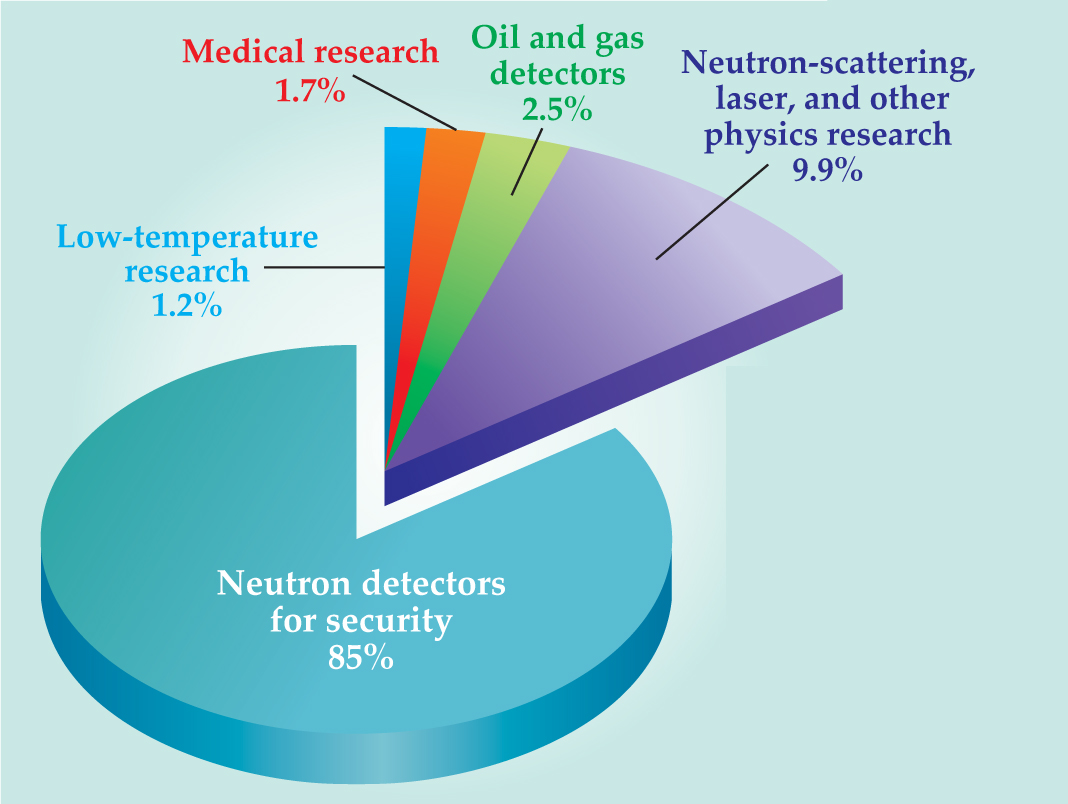
That demand had been fairly steady for decades, says Keith Darabos, product manager for the isotope group at Spectra Gases, a major international supplier of 3He. He puts the annual use at around 25 000 liters, but other estimates are more than twice that. (See pie chart chart for breakdown of 3He use.) Since the 2001 terrorist attacks, DHS has become the big gorilla: It says it needs 20 000-25 000 liters/year for the proportional neutron counters it places at borders and around the country to detect smuggling of plutonium and other weapons materials; the US also wants other countries to deploy such detectors at their ports. (See PHYSICS TODAY, April 2008, page 32 ).

Rough breakdown of helium-3 use over the past five years. By far the largest use is for neutron detectors for security screening by the Departments of Homeland Security, Defense, and Energy; traditionally, they have accounted for 80% of 3He use.
(Figure based on data from DOE.)

By comparison, the total global estimated demand for the gas in cryogenics is about 4000 liters/year. Michael Cuthbert, business manager for the Oxford Instruments ultra-low- temperature group, says cryogenic instrument companies needed a total of 1700 liters of the gas in 2007. “My estimate is that in 2010, it will be 1965 liters; in 2011, 2224 liters. The low-temperature market is growing steadily, mainly driven by quantum computing and nanotechnology in general.” Neutron scattering facilities are much bigger users of 3He, and medical research, defense manufacturing, and well-logging are among the other uses for the gas.
According to Kimberly Koeppel of the DNDO, the “releasable numbers … are that the anticipated supply-to-demand ratio of 3He is expected to be 1 to 10.” Another estimate, published in a white paper by scientists from Pacific Northwest and Oak Ridge national laboratories this past July, puts worldwide supply at 10 000–20 000 liters/year and demand at 65 000 liters/year.
“The government would never tell you how much 3He they have,” says Darabos, “because you could back-calculate and know how much tritium they had produced. Therefore you could probably figure out how many bombs they had laying around.” At this point, 3He availability is unpredictable: “We don’t have gas right now,” Darabos says. DOE, he adds, “is piecemealing it out.”
“Uncertainty and anxiety”
Perhaps the first to recognize an imminent 3He shortage was Amersham Health, a UK-based drug company (now owned by GE). Around the turn of the millennium, says John Mugler, vice chair of radiology research at the University of Virginia, Amersham “realized there were supply limitations, and if you pushed on the supply, the price would go up. They got cold feet about the profitability of 3He for widespread medical use. That is, for techniques potentially available in every hospital worldwide.”
But the current crisis came as a surprise to most. Typically, scientists find out about the shortage when they try to order 3He or instruments that use it. Early this year, says Bill Halperin, a low-temperature physicist at Northwestern University, “we needed some 3He in the lab. One of my students started to check what the pricing might be. He found out that the ultra-pure 3He was not available. The standard purity of 99.95% was available, but only at elevated prices.”
Oxford Instruments, the largest manufacturer of 3He cryostats and dilution refrigerators, first identified the shortage by “some small price rises over the past 12 months,” says Cuthbert. “Then the amounts we were requesting were being refused. Subsequent orders have been either refused or reduced.” Over just a few weeks this summer, he adds, the price went up by a factor of six. A couple of years ago, 3He sold for around $100/liter. For those lucky enough to get it, the cost is now upwards of $2000/liter.
Tritium has a half-life of 12.3 years, so “it doesn’t make sense that this happened suddenly,” says Cuthbert. “The immediate implication is a lot of uncertainty and anxiety. Low-temperature physicists are driven by results. If they are not able to get to low temperatures, there won’t be a next grant.” His company, he adds, has asked customers about obsolete instruments. “We tell them to make sure they have the gas secured and we offer to buy it back. But as soon as we’ve told customers there is a shortage, they don’t want to let it go.”
“I am in the fortunate situation that I have no leak in my fridge and I have some spare 3He,” says Pennsylvania State University physicist Moses Chan. But, he adds, “if you are a new assistant professor waiting for a dilution refrigerator, without 3He you cannot do any experiments. It will also impact cryogenic companies.” Zuyu Zhao, vice president and principal scientist at the US-based cryogenic equipment company Janis Research, agrees: “If we get zero next year, our revenues will drop immediately. In the long-term, it’s a disaster because it cuts off a cutting-edge technology.”
Spectra Gases, says Darabos, “is talking with the government all the time. We tell them that private businesses will go out of business and technologies will be lost. We are trying to put product in the hands of the people who need it to get a project complete.” Many non-DHS users of 3He believe the agency wants to hoard the gas. Darabos says his boss “points out [to DHS] that the government funds researchers at universities in lung imaging, cryogenics, and the like. They need 3He to do their research. There are clinical trials under way. It’s important to look beyond Homeland Security.”
The American Association for the Advancement of Science is planning to hold a workshop on 11 February 2010 to raise awareness among scientists about the 3He shortage.
Seeking solutions
An interagency panel was formed this past June to seek solutions to the 3He shortage. Says the DNDO’s Hagan, “The first thing we are attacking is, can we reduce demand? Is there a way to use something else for some of the applications, like radiation detectors?” Although DOE has long overseen the 3He supply, the panel now holds the reins and “will try to allocate it amongst the various uses so as to balance all priorities,” Hagan says. Unlike in the past, he adds, “any significant release in the future will be subject to scrutiny and review and discussion.” In addition to DOE and DHS, the panel includes representatives from the White House Office of Science and Technology Policy (OSTP), NNSA, NIST, and the Departments of State, Commerce, and Defense.
It’s rare, Hagan says, “for agencies to try to work out a solution together that is optimal across all needs. I think the government is doing the right thing with a national asset. If we are successful, we can lessen the severity” of damage due to the 3He shortage.
For cryogenic research, says Cornell University’s Bob Richardson, whose work in low-temperature physics earned him a Nobel Prize, 3He “is irreplaceable. If you want to create temperatures on the order of magnitude of 10 mK, there is no substitute.”
Medical research using hyperpolarized 3He to image the lungs—because there is little water there—is more advanced than with xenon-129, the only other option. Still, says Mugler, if the imaging method becomes available clinically, “it’s long been understood that 129Xe would be used for most applications” because it is more abundant. Now, adds Mugler, whose lab goes through around 200 liters of 3He annually, the price has gone up so much that “I’ll be surprised if medical applications of hyperpolarized 3He are sustainable. We’re not a big user, but the field has shown some nice things, and it would be a shame to kill us, especially since some important applications, such as imaging the infant lung, may not be viable with 129Xe due to its anesthetic properties.”
Neutron facilities, such as the Spallation Neutron Source at ORNL and J-PARC (Japan Proton Accelerator Research Complex), which is nearing completion, are jointly discussing ways to minimize their use of the gas. Helium-3 is used in experiments for which efficiency and the ability to discriminate neutrons from gamma rays are necessary. “The total future need for US DOE neutron scattering facilities is estimated at 87 000 liters,” says SNS director Thom Mason, adding that the facility’s “current inventory is not sufficient to meet the projected demand.” At the moment, Mason says, “there is no option that would not result in a significant loss of performance.”
Solution in sight?
The biggest dent in 3He demand could come from DHS employing alternate technologies for neutron detection. In the near-term, says Hagan, the focus is on boron trifluoride, which was used for years before 3He became the detector of choice because it’s more efficient and nontoxic.
In addition to BF3, possible near-term alternatives for neutron detection include technologies based on boron-lined tubes, lithium-loaded glass fibers and other solid-state detectors, and a plastic coated with scintillator.
On the several-year timescale, says Hagan, “we are looking for other materials and techniques that rely on how neutrons interact with boron or lithium.” And for the longer term, the hope is that nanotechnology will provide solutions. The government has been funding research to that end for several years, he adds. “It’s been known for a long time that new ways to detect neutrons would be desirable.”
The interagency panel is also looking at ways to up tritium production. “We can try to increase the efficiency with which 3He is extracted—that could lead to a 50% increase,” says Steven Fetter, OSTP assistant director at large. Similar to the US situation, the Russian supply of 3He seems to have been stanched, and so far nothing has come of the ideas of getting small amounts from tritium stored at the now-defunct reactors in Chalk River, Ontario, and from French and Chinese sources. Increasing the number of US reactors that produce tritium, an action being considered by the Obama administration, is too far off to be of near-term help.
“The government has been flat-footed here,” says an expert who requested anonymity. Helium-3 fell through the cracks, he adds, “because NNSA produces 3He as a byproduct. The [DOE] isotope program acts as a broker. Nobody had the responsibility, and now nobody wants it.” But, he adds, “I am optimistic that within six months we’ll be able to identify [a technology] that would be acceptable. If we don’t run into obstacles—we might have a technical solution that may not be politically acceptable—we could have a solution ready to implement within a year.”

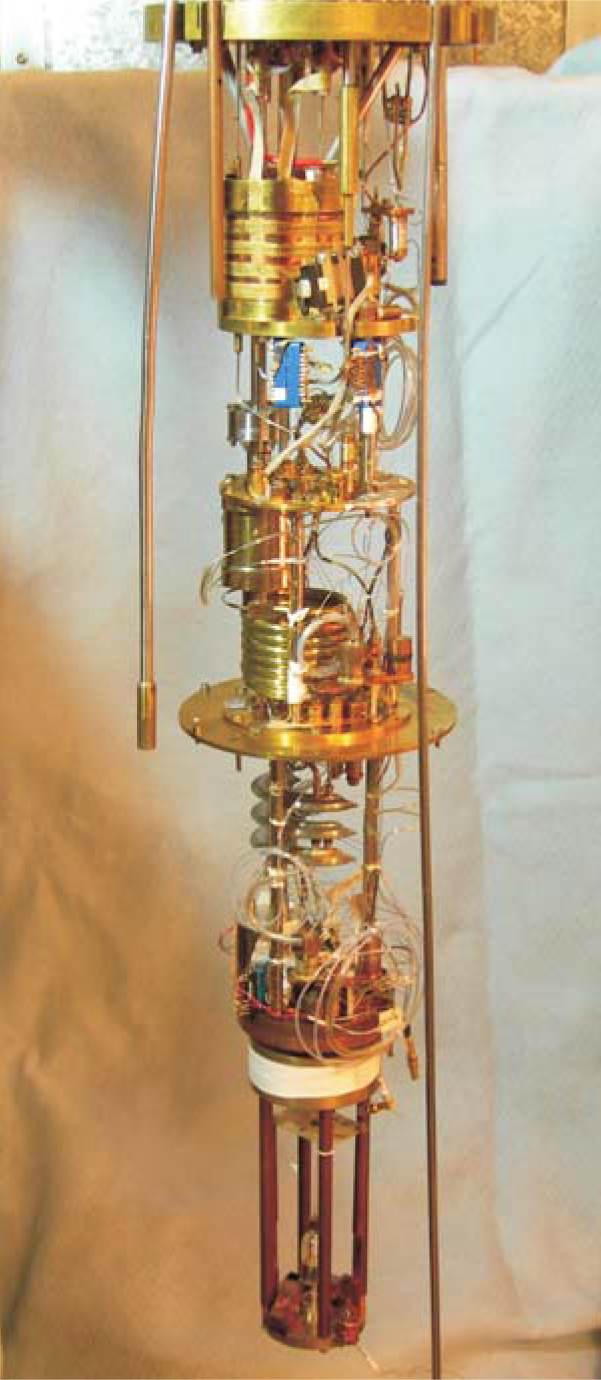
Scientists wanting to acquire a new dilution refrigerator, or to refill an existing one, are in trouble during the current shortage of helium-3.
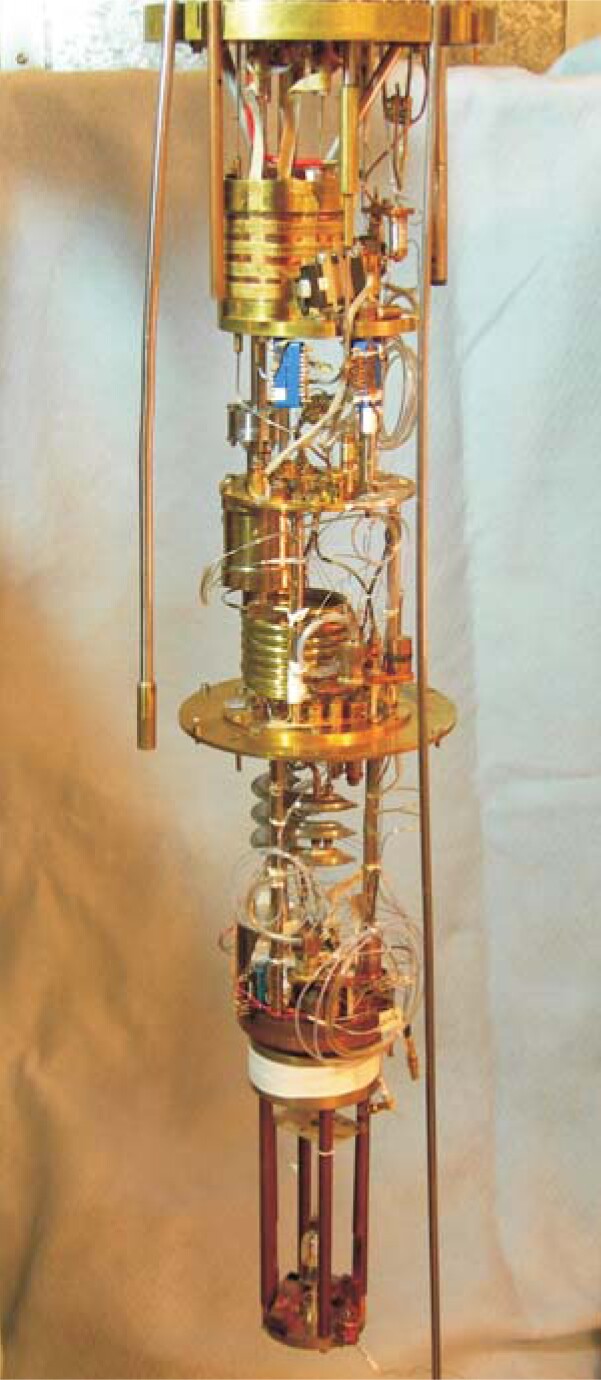

Demand for helium-3 skyrocketed when the Department of Homeland Security started placing proportional neutron counters around the US to detect illegal transport of plutonium.

More about the authors
Toni Feder, tfeder@aip.org