US academic fusion researchers sound alarm
DOI: 10.1063/PT.3.3552

Magnetic confinement fusion research on US university campuses is in crisis, according to a recent white paper by the University Fusion Association (UFA). The report focuses on two worrisome trends: Funding is down, and faculty members are getting older and shrinking in number. The white paper “gets beyond the anecdotal level to become a statement of the challenges facing the community collectively,” says UFA vice president John Sarff of the University of Wisconsin—Madison.
The UFA surveyed the 14 institutions that between them get roughly 80% of all funding for university-based fusion and plasma physics provided by the Department of Energy’s Office of Fusion Energy Sciences (FES), the field’s main funder. At those institutions, the average age of faculty in fusion and plasma research is 56, up from 53 a dozen years ago. Some 30% of current faculty were reported likely to retire in the next five years. Overall, the survey respondents estimated as poor the likelihood of their hiring researchers in the field.
The institutions reported receiving combined experimental fusion funding of $36.8 million in fiscal year 2015, a 17% decrease from FY 2006. Nearly two-thirds of the money went to the two largest campus-based facilities—the

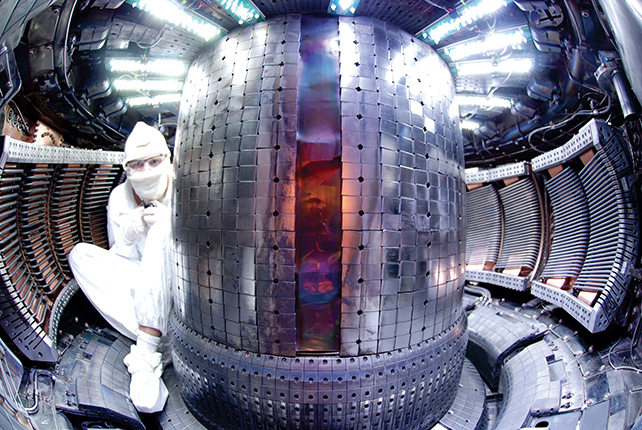
A graduate student works on the Alcator C-Mod tokamak at MIT. The facility lost its funding at the end of last fiscal year. But on its final day of operation, 30 September 2016, it reached an operating pressure of more than 2 atmospheres, setting a new world record for magnetically confined plasma.
CHRIS BOLIN

Funding for the Alcator C-Mod was zeroed last year, and as of next year the status of the Madison Symmetric Torus within FES will be revised to take a nonfusion focus, and its funding is expected to go down. For researchers, that leaves the smattering of much smaller on-campus fusion experiments at Auburn University, Columbia University, the Los Angeles and San Diego campuses of the University of California, and the University of Wisconsin—Madison, plus the large national facilities DIII-D at General Atomics and the National Spherical Torus Experiment, which is currently undergoing repairs at the Princeton Plasma Physics Laboratory. (See Politics and Policy on Physics Today’s website , 29 September 2016.)
The UFA report notes that funding for university researchers to use off-campus facilities has gone up, but not by enough to offset the decrease in funding for on-campus research. Says Dennis Whyte, director of MIT’s Plasma Science and Fusion Center, “You need to be able to attract students, have them work on equipment, prepare equipment. Then they sometimes go to an off-campus facility. The white paper shows how the balance has changed. It’s clear that on-campus capabilities have deteriorated.” Or, as the white paper puts it, “Without a strong academic foundation our U.S. fusion program will wither in fundamental respects… . We are well into such a trend now.”
The white paper’s main recommendations to FES and the fusion community are as follows:
Develop new modes of participation for university researchers in off-campus facilities that lead to enhanced leadership roles.
Develop and sustain predictable funding opportunities.
Develop a long-term vision and strategy for fusion science.
Promote the long-term strategy ideas and innovations that are best implemented using on-campus experimental facilities.
DOE is “very sensitive” to the concerns expressed in the white paper, says Edmund Synakowski, the department’s associate director of science for FES. “Maintaining a strong fusion research program at US universities is vital. The question is not whether to have such a strong program, but how best to maintain the program’s strength.” But, he says, “we differ with the UFA on the best strategy to address the two key challenges.”
According to Synakowski, the paradigm for fusion research is shifting toward larger collaborations using larger national and international facilities. “A key challenge remaining for the university community,” he says, “is how to make this off-site leadership activity visible to university departments and administrations, so that fusion can compete effectively for resources and positions within the university.”
Whyte points to US participation in ITER, the international test fusion reactor under construction in France, as evidence of US commitment to support fusion and plasma physics. “ITER obligates us to make sure we have a strong research effort,” he says. The white paper, he continues, “signals deep concern, but we feel it should spark a healthy dialog.”
More about the authors
Toni Feder, tfeder@aip.org