Ultracold Neutrons Exhibit Quantum States in the Earth’s Gravitational Field
DOI: 10.1063/1.1472382
Quantum mechanics is thought to be universal. It ought to apply to particles trapped in the Earth’s gravitational field just as it does to electrons trapped in the electric field of an atom. Like atomic electrons, very cold neutrons sitting in a gravitational potential well ought to have quantized energy levels. The experimenter’s problem, of course, is that the gravitational force on a neutron at sea level is 19 orders of magnitude weaker than the Coulomb force on an electron in the ground state of the hydrogen atom. Whereas the low-lying hydrogen energy eigenstates are separated by electron volts, the analogous neutron states in a gravitational well would be separated by only picoelectron volts (1 peV = 10−12 eV).
More than 20 years ago, Vladislav Luschikov and Alexander Frank at the Joint Institute for Nuclear Research in Dubna, near Moscow, suggested that one might exploit the then-new technology of ultracold neutrons to exhibit these gravitationally bound quantum states. Now, at last, a group at the Laue-Langevin Institute (ILL) in Grenoble seems finally to have pulled off this difficult trick. Valery Nesvizhevsky and coworkers report, in a recent paper, that they have clearly demonstrated the 1.4-peV neutron ground state in a gravitational well and have also found hints of the first few excited quantum levels. 1
It’s not just a matter of verifying quantum mechanics in a new observational realm. The techniques developed in this very challenging experiment may eventually be applied to searches for a nonvanishing neutron charge or violation of the equivalence of inertial and gravitational mass. The present experimental upper limit on the neutron’s charge is about 10−21 e.
At the Laue-Langevin
Nestled in the French Alps, the ILL, with its high-flux research reactor, is a particularly prolific source of ultracold neutrons. The reactor neutrons are cooled by being made to traverse a liquid-deuterium moderator and then work their way uphill against gravity through piping whose reflecting walls preferentially absorb out the more energetic neutrons. The resulting ultracold neutrons, collimated and concentrated in momentum space by turbines, reach Nesvizhevsky’s gravitational well as a horizontal beam with a sprinter’s speed of about 10 m/s. But in the vertical direction, transverse to the beam, the effective temperature of the neutron aggregation is only 20 nK, corresponding to an energy of a peV or so.
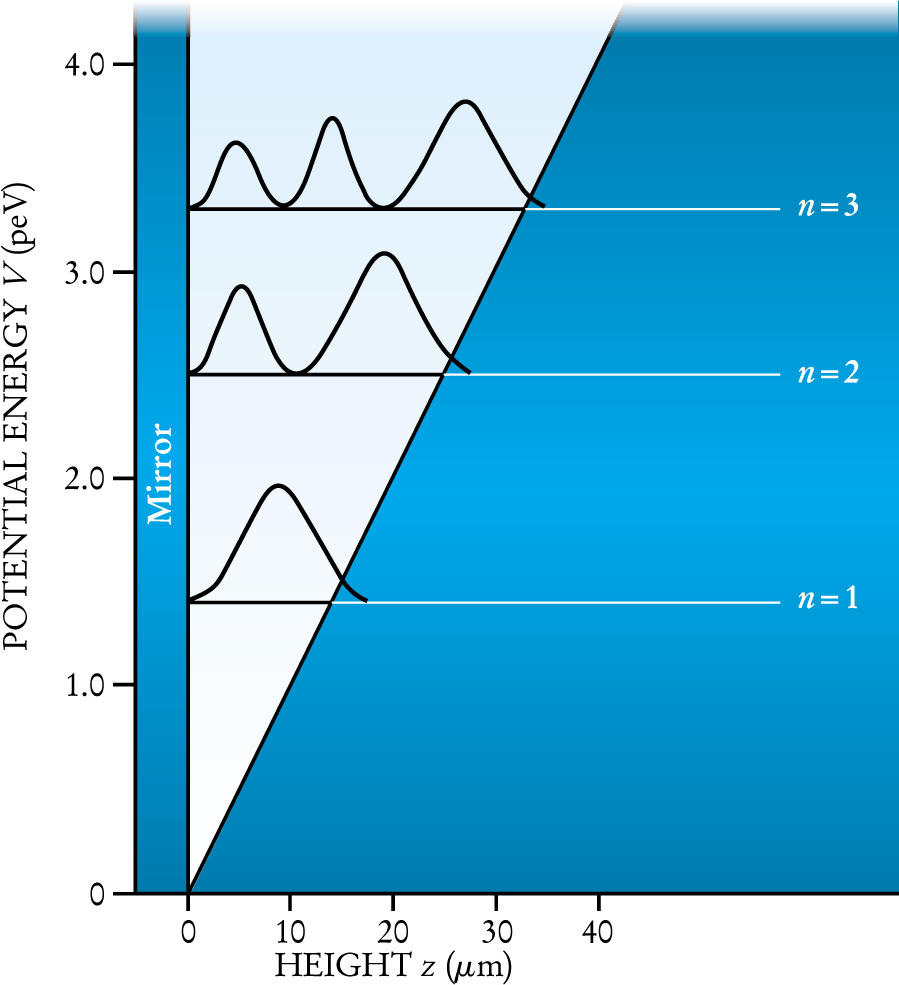
The experiment’s one-dimensional gravitational potential well is shown in figure 1, together with the calculated wavefunctions (squared) of its three lowest-lying neutron energy eigenstates. The one dimension is the height z above the horizontal slab of material that serves as a perfect reflecting mirror for the ultracold neutrons and thus as an impenetrable wall of the potential well. At sufficiently low temperatures, many metal surfaces are perfect neutron reflectors at all angles of incidence.

Figure 1. Gravitational potential well with walls formed by a mirror for ultracold neutrons and by the Earth’s gravity field. The calculated energy levels and wavefunctions (squared) are shown for the three lowest energy eigenstates for a neutron trapped in such a well.
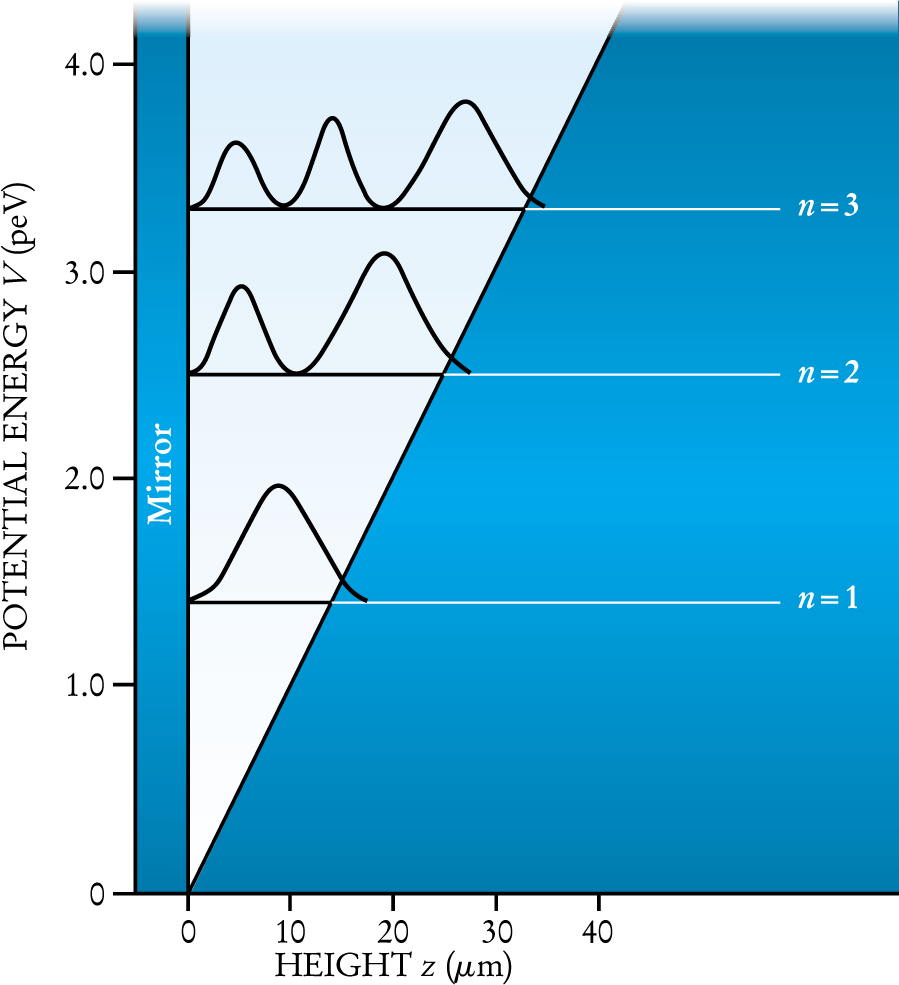
The second, sloped wall is the potential energy
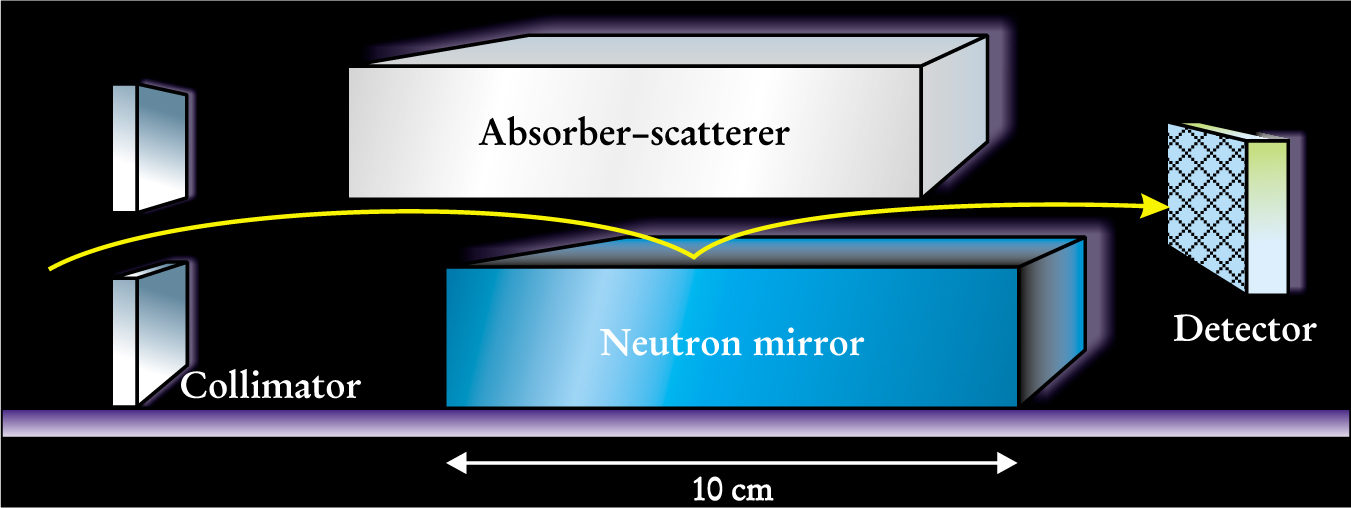
The ground-state energy, E 1 = 1.4 peV, is the kinetic energy a neutron would gain by falling classically onto the mirror from a height of about 14 µm, having reached a final vertical speed of 1.6 cm/s. But the experimenters cannot simply drop neutrons from various micron heights. Instead, they direct the horizontal beam of cold neutrons at the mouth of a 10-cm-long gap between the mirror and an upper surface that either absorbs or scatters out of play any neutron that touches it. 2 (See figure 2.) The vertical spacing between the mirror and the absorber–scatterer can be varied from 0 to 100 µm. A neutron detector at the far end of the gap measures the neutron flux that gets through as a function of the gap height.

Figure 2. Schematic setup of the experiment that detected quantum states of neutrons in a gravitational potential well. A horizontal beam of ultracold neutrons with, on average, a slight upward tilt enters a long, narrow gap of adjustable height between a neutron mirror floor and an absorbing–scattering ceiling. The gap height, much exaggerated in this drawing, limits the vertical velocity component of the entering neutrons. The detector records the fraction of transmitted neutrons as a function of the gap height.
(Adapted from ref. 1.)
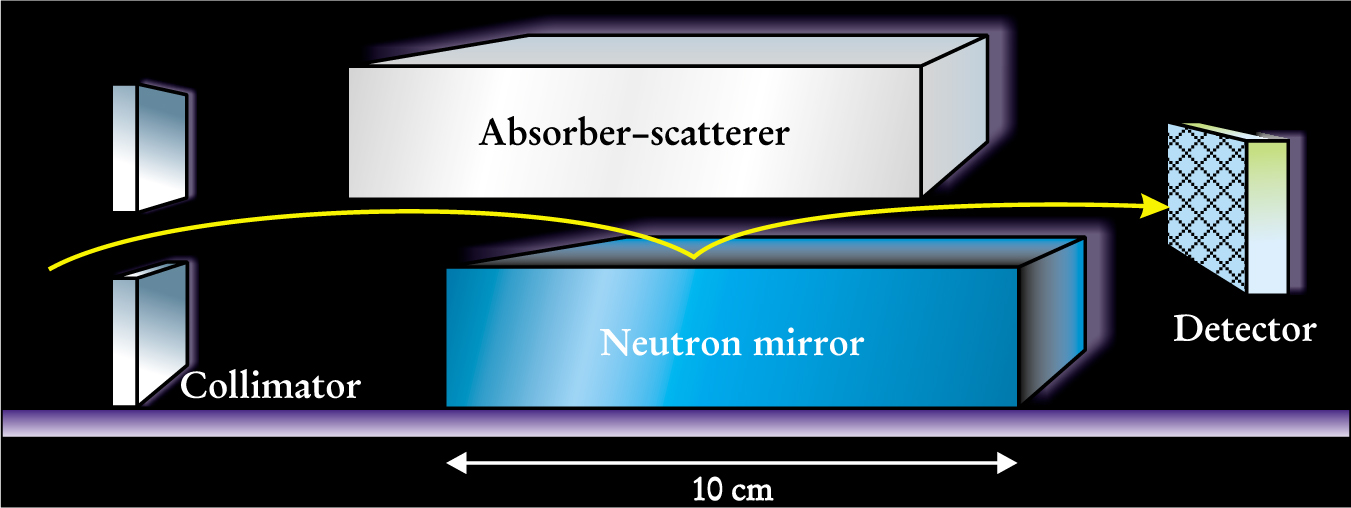
The beam is directed at the gap with a slight upward tilt. The range of neutron energies emerging from the ultra-cold source leaves a significant spread in the vertical-velocity distribution of the entering beam. The gap height then serves as a filter that sets an upper limit on the vertical velocity components of the individual neutrons. Classically, if the absorber–scatterer ceiling does its job perfectly, the largest initial vertical velocity component that can make it through a gap of height z is the velocity a particle would acquire by falling through that height.
But the quantum-mechanical ground state imposes a lower limit on the gap height and, in a sense, on the vertical velocity. Semiclassically, a bound neutron of energy E, unencumbered by a ceiling or a horizontal velocity, would continually bounce off the mirror to a height z = E/mg. The quantum well cannot, however, accommodate any neutron for which that characteristic bounce height is less than the 14 µm, corresponding to E 1. To put it more quantum mechanically, if the gap is not high enough for the ground-state wavefunction to fit inside, the neutron beam will be scattered away at the gap’s entrance.
Quantum threshold
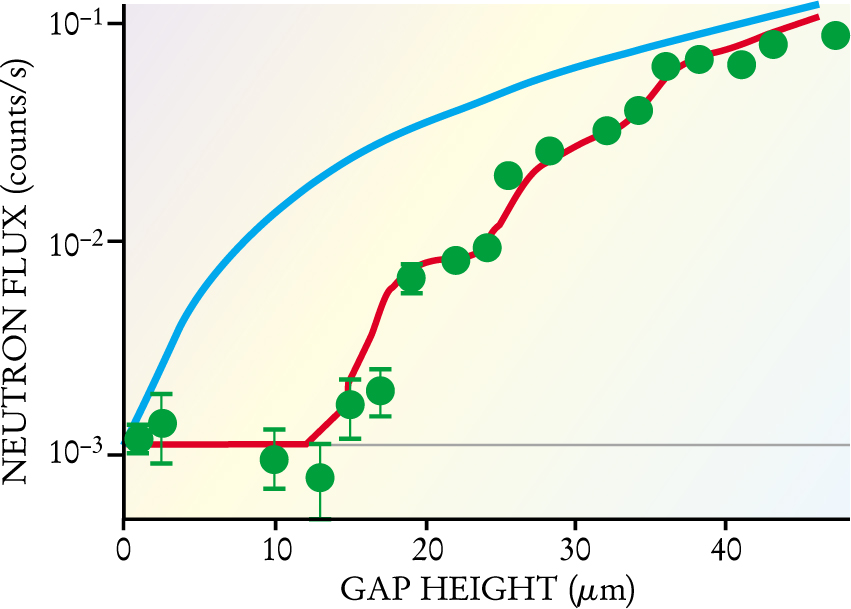
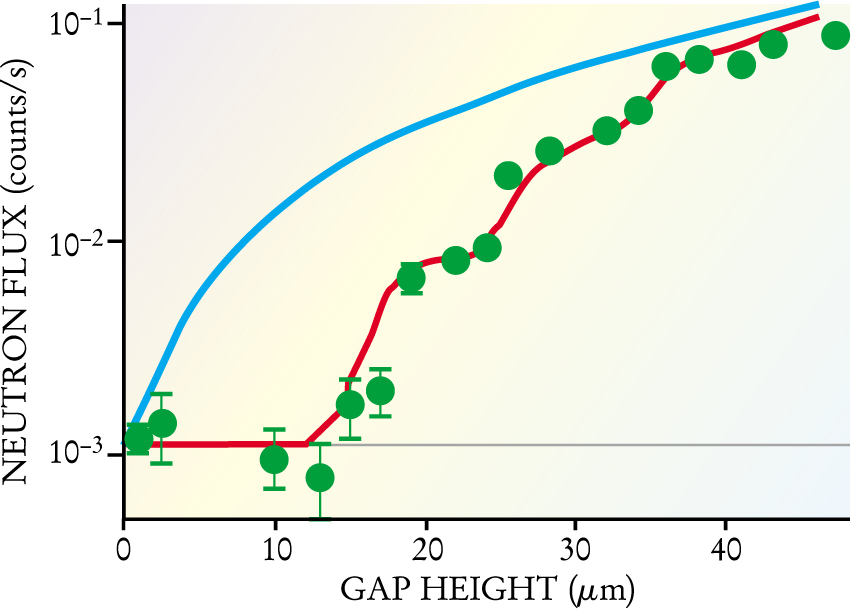
All this assumes that the vertical component of the neutron velocity can be treated independently of the horizontal beam velocity. So, if the experimenters have taken adequate care to eliminate any mechanical or magnetic effects that might couple the velocity components, one expects that the transmission of neutrons through the gap as a function of its height will exhibit a threshold at about the width of the ground-state wavefunction, followed by a sequence of steps at heights corresponding to the widths of the excited-state wavefunctions.
The red curve in figure 3 is the detailed prediction of the neutron flux reaching the detector. The blue curve, with no threshold, is what one would expect simply from geometric and phase-space considerations, without any quantum effects. The data clearly favor the quantum-mechanical prediction, though the extremely limited statistics can only hint at quantum steps beyond the first. “Our experiment had to select only one in a billion incoming reactor neutrons,” Nesvizhevsky told us.

Figure 3. Transmitted neutron flux as a function of gap height in the Laue–Langevin experiment shows a clear threshold near 15 µm and indications of steps at larger gap heights, consistent with the quantum-mechanical prediction (red curve). The blue curve is what one expects simply from the increasing phase-space acceptance of the gap. The horizontal line indicates the detector’s background level.
(Adapted from ref. 1.)
The experiment’s energy resolution is not limited only by statistics. The quantum-mechanical uncertainty relation
If the horizontal and vertical neutron motions are sufficiently decoupled, the transmission curve in figure 3 should be independent of the neutron beam velocity. And that is indeed what the experimenters find. Furthermore, the fact that the gap, even when it’s less than 10 µm high, has no difficulty transmitting visible light is evidence that its opacity to neutrons at that height is really due to the neutron ground-state energy in the gravitational well. The width of the ground-state wavefunction is, roughly speaking, the de Broglie wavelength corresponding to the vertical momentum component of that state. The much smaller de Broglie wavelength corresponding to the horizontal beam momentum, on the other hand, plays no role at the threshold in figure 3.
“For precision experiments in search of new, unpredicted effects,” says Nesvizhevsky, “we will have to find ways of making the neutrons spend more time in the gravitationally bound states. And, of course, we’ll need a significant increase in the available density of ultracold neutrons.”
References
1. V. Nesvizhevsky et al., Nature 415, 297 (2002).https://doi.org/10.1038/415297a
2. V. Nesvizhevsky et al., Nucl. Instrum. Methods Phys. Res. 440, 754 (2000).https://doi.org/10.1016/S0168-9002(99)01077-3